What is the workplace investigation interview form template?
When a complaint or grievance needs investigating, the interview notes become the backbone of the file. They are what the decision-maker reads, what an appeal panel reviews and, sometimes, what an outside adviser asks to see months later. Notes scribbled in a notebook, or typed differently by each investigator, make that harder than it needs to be. This template gives every interview the same shape: who was there, what the interviewee was told at the start, what was asked, what was said and what evidence changed hands.
One question does a lot of the work. “Interviewee's role in this investigation” offers Witness, Respondent (the person the concern is about) and Complainant (the person who raised the concern). Each choice shows its own opening statement, written to be read aloud, so a witness hears that they aren't the subject of the investigation and a respondent hears that no decision has been made and they'll get a full chance to respond. The investigator then confirms “Was the opening statement read out and understood?”
The form is filled in by the investigator or note-taker, not the interviewee, and each completed record is filed as a PDF in your FileIt vault, alongside any evidence uploaded during the interview.
- Best for
- HR teams, managers and external investigators handling grievances, complaints and conduct concerns
- Filled in by
- The investigator or note-taker, during or straight after each interview
- Time to complete
- As long as the interview — about 10 minutes to tidy up afterwards
- Includes
- Three role-specific opening statements, numbered questions and answers, evidence uploads, two signatures
Who uses a workplace investigation interview form?
- An HR adviser interviewing three witnesses to a reported argument on the shop floor
- A manager meeting the respondent to a bullying complaint for a fact-finding interview
- An external investigator keeping the same record format across a dozen interviews in one case
- A small business owner investigating a customer's complaint about a staff member's conduct
- A school or charity documenting a safeguarding-adjacent staff concern before it goes to a panel
Questions on this workplace investigation interview form
34 questions over 2 pages · includes signature, file upload, conditional questions, multiple pages, consent checkbox.
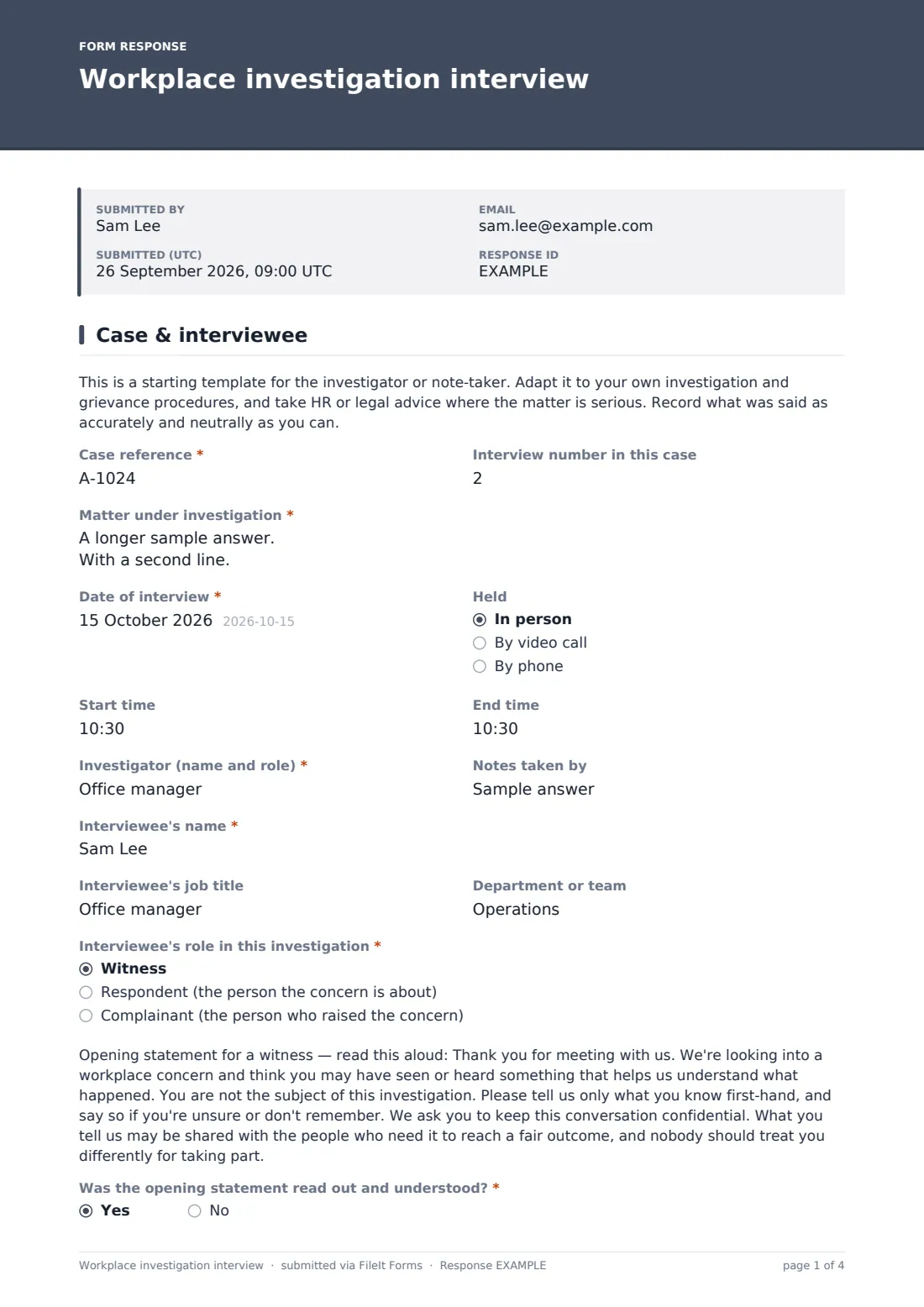
1 Case & interviewee
- Case reference*
- Interview number in this case
- Matter under investigation*
- Date of interview*
- Held In person · By video call · By phone
- Start time
- End time
- Investigator (name and role)*
- Notes taken by
- Interviewee's name*
- Interviewee's job title
- Department or team
- Interviewee's role in this investigation* Witness · Respondent (the person the concern is about) · Complainant (the person who raised the concern)
- Was the opening statement read out and understood?*
- Was the interviewee accompanied?*
- Companion's name and role asked only when it applies
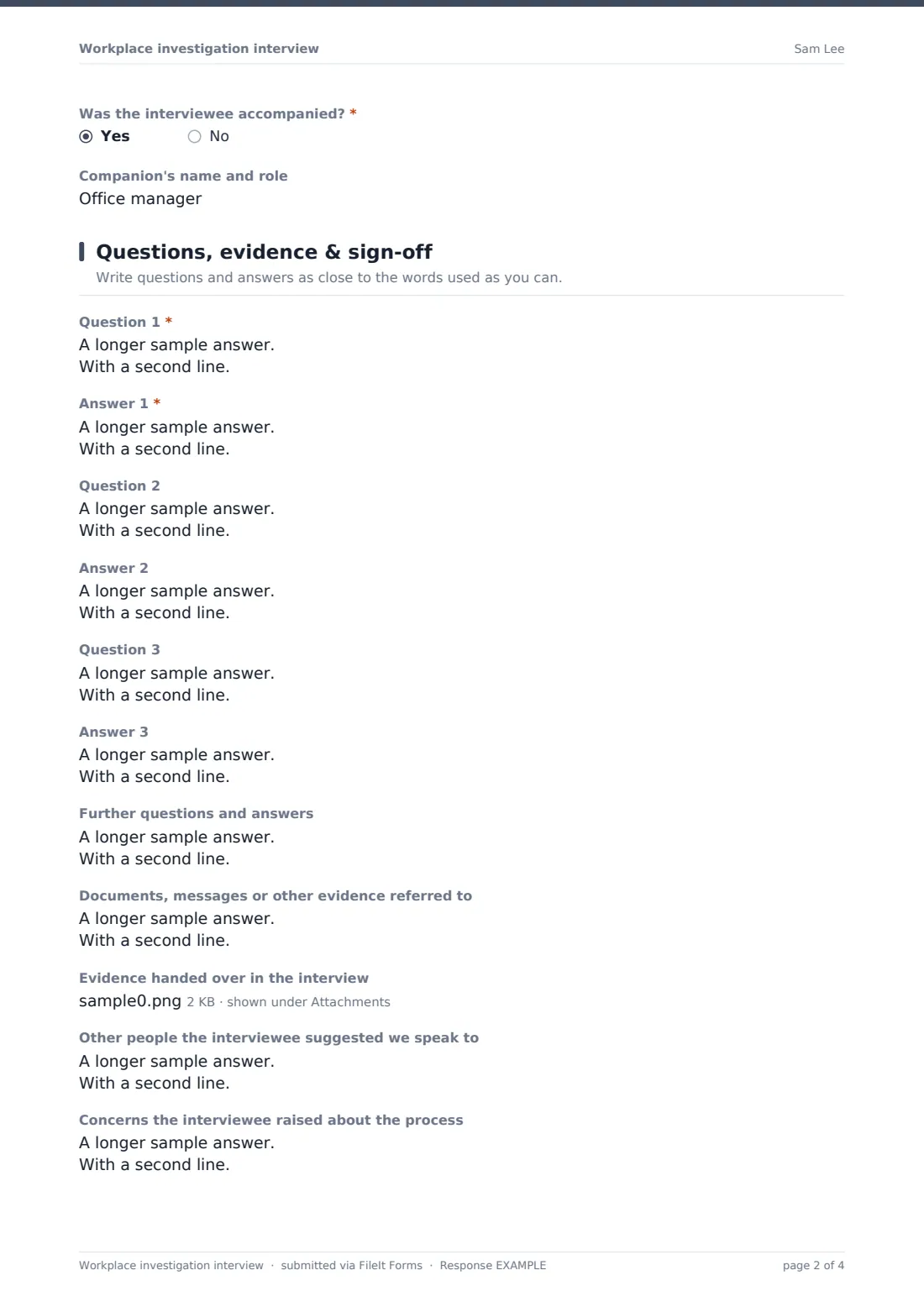
2 Questions, evidence & sign-off
- Question 1*
- Answer 1*
- Question 2
- Answer 2 asked only when it applies
- Question 3
- Answer 3 asked only when it applies
- Further questions and answers
- Points the respondent accepted or disputed asked only when it applies
- Documents, messages or other evidence referred to
- Evidence handed over in the interview
- Other people the interviewee suggested we speak to
- Concerns the interviewee raised about the process
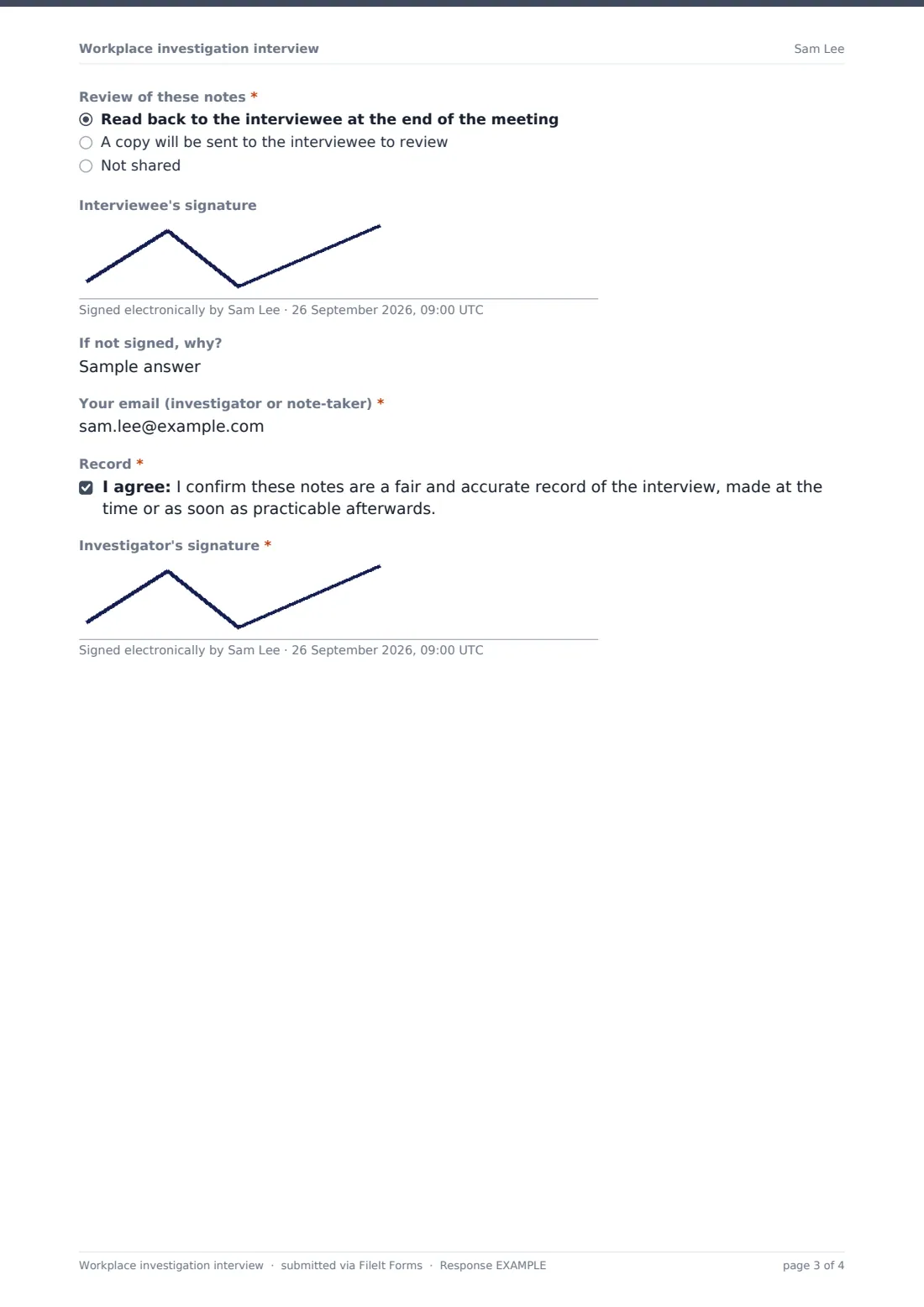
- Review of these notes* Read back to the interviewee at the end of the meeting · A copy will be sent to the interviewee to review · Not shared
- Interviewee's signature
- If not signed, why?
- Your email (investigator or note-taker)*
- Record*
- Investigator's signature*
The workplace investigation interview form, page by page
1 Case & interviewee
A short note reminds the investigator to follow their own procedures and take advice where the matter is serious. They enter the “Case reference” and the “Interview number in this case”, then a neutral summary under “Matter under investigation”. The date, how the interview was “Held” (in person, by video call or by phone), start and end times, the investigator and the note-taker follow.
The interviewee's name, job title and team come next, then their role. Picking Witness, Respondent or Complainant shows the matching opening statement. The page finishes with “Was the interviewee accompanied?”, which asks for the companion's name and role when the answer is yes.
2 Questions, evidence & sign-off
Questions 1 to 3 each have their own answer box, and an answer only appears once its question has been written. “Further questions and answers” takes everything after that, numbered on from 4. If the interviewee is the respondent, “Points the respondent accepted or disputed” appears so the key positions are easy to find later.
The investigator lists “Documents, messages or other evidence referred to” and can attach up to five files under “Evidence handed over in the interview”. They note “Other people the interviewee suggested we speak to” and any “Concerns the interviewee raised about the process”. “Review of these notes” records whether they were read back, will be sent, or weren't shared. The interviewee can sign, or the investigator explains why not. The investigator confirms the record is fair and accurate and signs it.
Make the template yours
- Rewrite the three opening statements in your own organisation's voice, or to match your grievance policy
- Add more numbered question and answer pairs if your interviews usually run long
- Set the vault folder to a restricted HR folder so records are filed away from general documents
- Change the document title to include the case reference, making a case's interviews easy to group
- Remove the complainant option if you use a separate intake form for the person raising the concern
Tips for a better workplace investigation interview form
- Prepare your first three questions before the interview and paste them in, so the record starts tidy
- Write answers in the interviewee's own words where you can, and avoid summarising them into conclusions
- Use one record per interview, even when the same person is interviewed twice
- Ask for evidence there and then, and upload photos of paper documents before the meeting ends
- Send the interviewee their copy of the notes promptly if you said you would, and keep their comments with the file
Every response becomes a PDF in your vault
Each completed interview becomes a PDF in your FileIt vault, with uploaded evidence attached to the same document. You get an email notice, and anyone else you add in the settings, such as an HR lead, can be notified too. No copy is emailed automatically, so you decide when the interviewee sees the notes.
The Responses table lists every interview with its date and case reference. Search by the case reference to pull up all the interviews in one investigation, or export them to CSV to build a timeline.
- Start from this template. It opens in the FileIt Forms designer — change any question, add pages, set the rules for when questions appear.
- Share it. Turn on a public link, or send it to people by email, each with their own link. They don’t need a FileIt account.
- Get the answers as PDFs. Each response is saved as a PDF in the vault folder you choose, with uploaded files attached — and listed in a Responses table you can export to CSV.
Workplace investigation interview form: frequently asked questions
Is this investigation interview template free?
Yes. It's one of the starter templates in FileIt's Forms app, which is available on every account, including the free plan.
Who fills in the form — the investigator or the interviewee?
The investigator or note-taker. The interviewee only adds a signature at the end, if they're willing to sign.
Why are there three opening statements?
Witnesses, respondents and complainants need to hear different things at the start. The statement shown changes with the role you choose, so the right words are in front of you.
Is this form a substitute for HR or legal advice?
No. It's a structured way to record an interview. Follow your own procedures, and take professional advice where an investigation could lead to serious outcomes.
Can I attach documents the interviewee brings along?
Yes. Up to five files — PDFs, photos, Word documents — can be uploaded, and each is filed with the interview's PDF in your vault.
What if the interviewee refuses to sign?
Their signature isn't required. Leave it blank and use “If not signed, why?” to record what happened.
Can I keep these records private?
Choose a vault folder in the form's settings so every record is filed there, and turn off the copy to the respondent, which this template already has off.