
What is the first aid treatment log form template?
Every first aid treatment should be written down, even a plaster. A first aid log shows patterns — the same machine, the same corner of the playground — keeps the kit stocked, and gives an accurate account if an injury turns out to be more serious later. This template lets a first aider record a treatment on a phone in a few minutes.
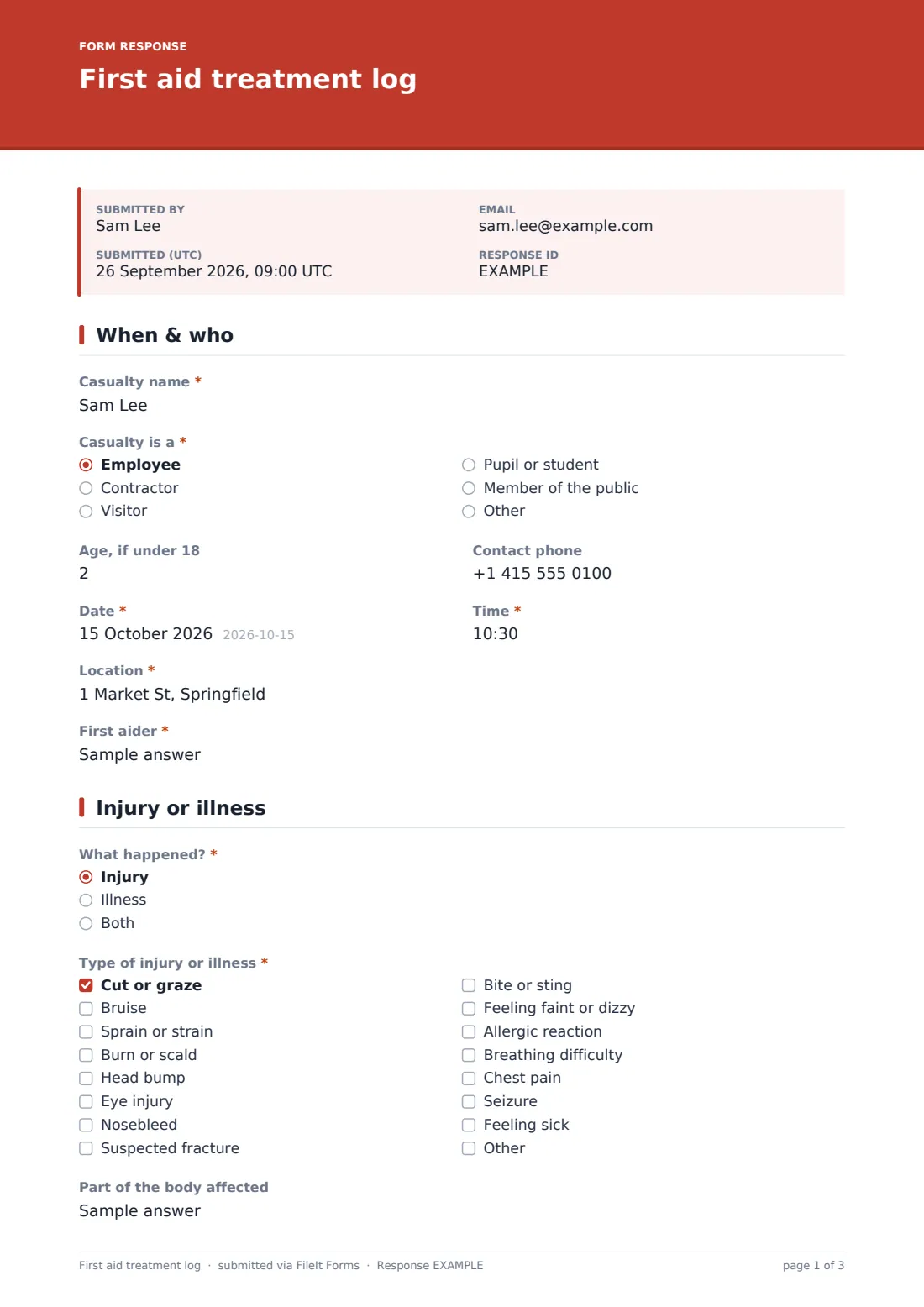
It records the casualty and their relationship to the organisation, when and where it happened, the type of injury or illness, the part of the body and how it happened. Treatment is a checklist from cleaning and dressing to CPR and defibrillator use, with supplies used for restocking. The outcome records whether the person went back to work, went home, was advised to see a doctor, went to hospital or needed an ambulance. A head bump brings up a question about head injury advice.
Each entry is saved as a signed PDF in your FileIt vault, and a final question flags anything that needs a full incident report.
- Best for
- Workplaces, schools, sports clubs, events and venues with first aiders
- Filled in by
- The first aider who gave treatment
- Time to complete
- About 3 minutes
- Includes
- Injury and treatment checklists, outcome, ambulance time, head injury advice, incident report flag
Who uses a first aid treatment log form?
- Workplace first aid records
- School and nursery first aid books
- Sports clubs and matchday first aid
- Events and festivals with first aid teams
- Venues, gyms and leisure centres
- Tracking kit use to keep first aid boxes stocked
Questions on this first aid treatment log form
23 questions over 3 pages · includes signature, conditional questions, multiple pages.
1 When & who
- Casualty name*
- Casualty is a* Employee · Contractor · Visitor · Pupil or student · Member of the public
- Age, if under 18
- Contact phone
- Date*
- Time*
- Location*
- First aider*
2 Injury or illness
- What happened?* Injury · Illness · Both
- Type of injury or illness* Cut or graze · Bruise · Sprain or strain · Burn or scald · Head bump · Eye injury · Nosebleed · Suspected fracture · Bite or sting · Feeling faint or dizzy · Allergic reaction · Breathing difficulty
- Part of the body affected
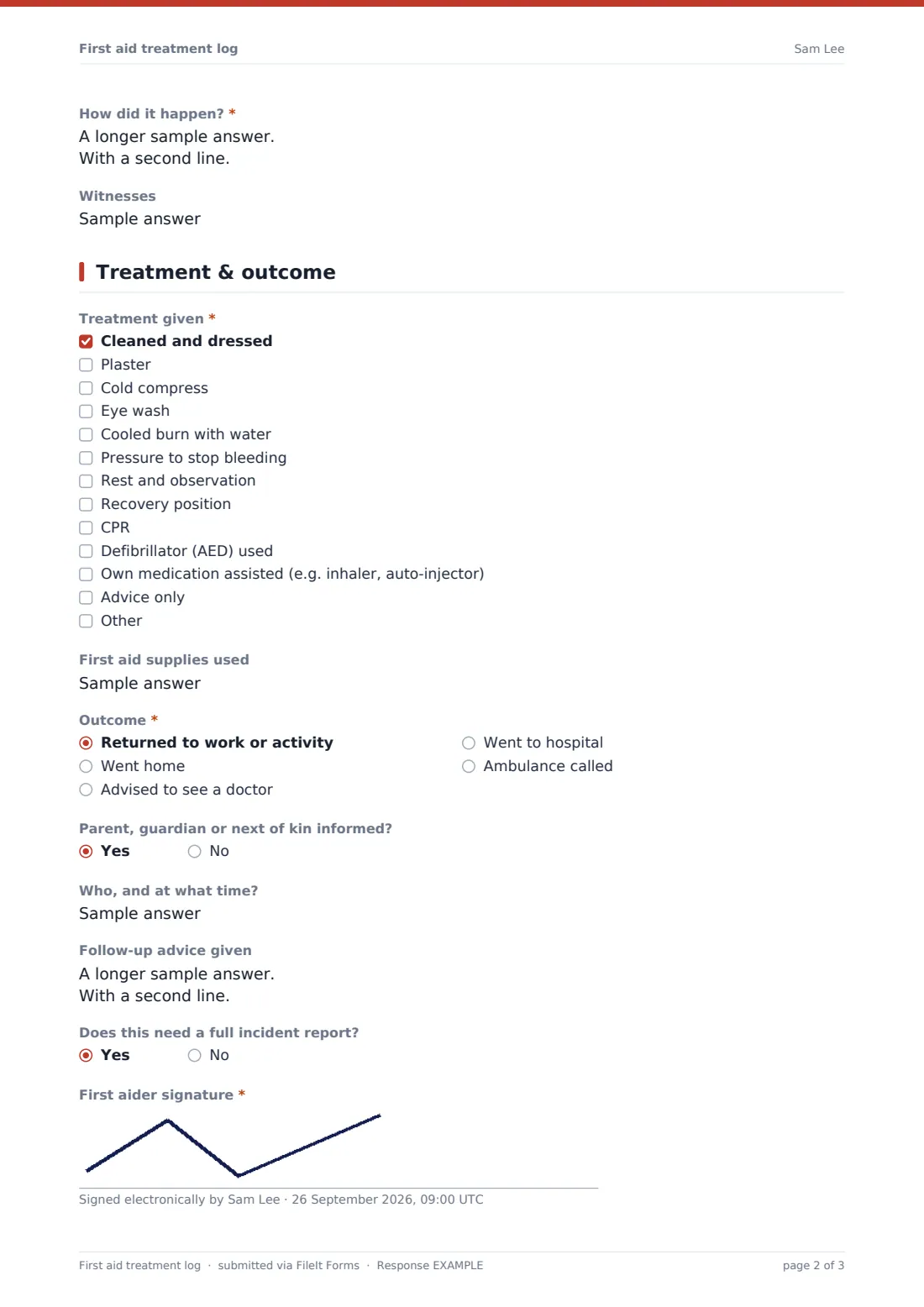
- How did it happen?*
- Witnesses
3 Treatment & outcome
- Treatment given* Cleaned and dressed · Plaster · Cold compress · Eye wash · Cooled burn with water · Pressure to stop bleeding · Rest and observation · Recovery position · CPR · Defibrillator (AED) used · Own medication assisted (e.g. inhaler, auto-injector) · Advice only
- First aid supplies used
- Outcome* Returned to work or activity · Went home · Advised to see a doctor · Went to hospital · Ambulance called
- Time ambulance called asked only when it applies
- Head injury advice given? asked only when it applies
- Parent, guardian or next of kin informed?
- Who, and at what time? asked only when it applies
- Follow-up advice given
- Does this need a full incident report?
- First aider signature*
The first aid treatment log form, page by page
1 When & who
Casualty name, whether they're an employee, contractor, visitor, pupil or member of the public, age if under 18, contact phone, date, time, location and the first aider's name.
2 Injury or illness
Injury, illness or both; the type from a checklist including cuts, burns, head bumps, suspected fractures, allergic reactions, breathing difficulty, chest pain and seizures; the part of the body; how it happened; and witnesses.
3 Treatment & outcome
Treatment given, supplies used and the outcome. An ambulance outcome asks when it was called, and a head bump asks whether head injury advice was given. Whether a parent, guardian or next of kin was informed, and who; follow-up advice; whether a full incident report is needed; and the first aider's signature.
Make the template yours
- Change the casualty types to fit your setting, such as members or players
- Add your sites or areas as a dropdown for the location
- Send notifications to your health and safety lead
- Link to your incident report form in the confirmation message
- Add a parent notification statement for schools
- File entries by month in your vault
Tips for a better first aid treatment log form
- Record every treatment, however minor
- Write how it happened in plain facts, not blame
- Restock the kit from the supplies used answer
- Review the log regularly for repeat locations or causes
- Complete a full incident report as well when the last question is yes
Every response becomes a PDF in your vault
Each entry is saved as a signed PDF in your FileIt vault and the people you choose are emailed.
Use the Responses table as your first aid book, and export to CSV to look for patterns by location or injury type.
- Start from this template. It opens in the FileIt Forms designer — change any question, add pages, set the rules for when questions appear.
- Share it. Turn on a public link, or send it to people by email, each with their own link. They don’t need a FileIt account.
- Get the answers as PDFs. Each response is saved as a PDF in the vault folder you choose, with uploaded files attached — and listed in a Responses table you can export to CSV.
First aid treatment log form: frequently asked questions
Is this first aid log free?
Yes. It's part of FileIt's Forms app on every account, including the free plan.
Is it an incident report?
No. It records first aid given. The last question flags when a full incident report is needed; use your incident report form for that.
Can first aiders use it on a phone?
Yes. It works in any phone browser and they sign on screen.
Does it record head injury advice?
Yes. Ticking a head bump asks whether head injury advice was given.
Does it tell me what's legally reportable?
No. Reporting rules depend on where you are; check your local requirements.
Where are entries stored?
Each one is saved as a PDF in your FileIt vault and listed in the form's responses.