What is the first aid kit inspection form template?
A first aid kit is only useful if it's complete when someone needs it. Plasters run out, dressings pass their expiry date, eyewash bottles get opened and never replaced, and defibrillator pads quietly expire in their cabinet. Regular, recorded checks are how most workplaces, schools, clubs and fleets make sure that doesn't happen.
This template takes one kit or station at a time. The inspector records where it is, what type of kit it is, whether it's signed and easy to reach, whether the seal is intact and what condition the container is in. A contents grid covers common items — plasters, dressings, bandages, eye pads, gloves, shears, a face shield, foil blanket, burns dressings and more — marking each as present and in date, low or missing, expired, or not in this kit.
A separate page checks eyewash, bottled or plumbed, and any defibrillator: its status indicator, pad and battery dates and accessories. The last page records what was restocked, what's on order, the overall result, photos, the next inspection date and the inspector's signature. Every inspection is filed as a PDF in FileIt.
- Best for
- Workplaces, schools, sports clubs, construction sites and vehicle fleets
- Filled in by
- A first aider, health and safety lead or site manager
- Time to complete
- About 5 minutes per kit
- Includes
- Contents grid, expiry dates, eyewash and AED checks, overall result, photos, next inspection date and signature
Who uses a first aid kit inspection form?
- Monthly checks of first aid stations around an office or warehouse
- Inspecting vehicle kits across a van or bus fleet
- Sports clubs checking pitch-side kits before a season
- Schools checking classroom, PE and trip kits
- Construction sites checking kits at each welfare cabin
- Restocking a kit after it's been used
Questions on this first aid kit inspection form
28 questions over 4 pages · includes signature, file upload, conditional questions, multiple pages, ratings.
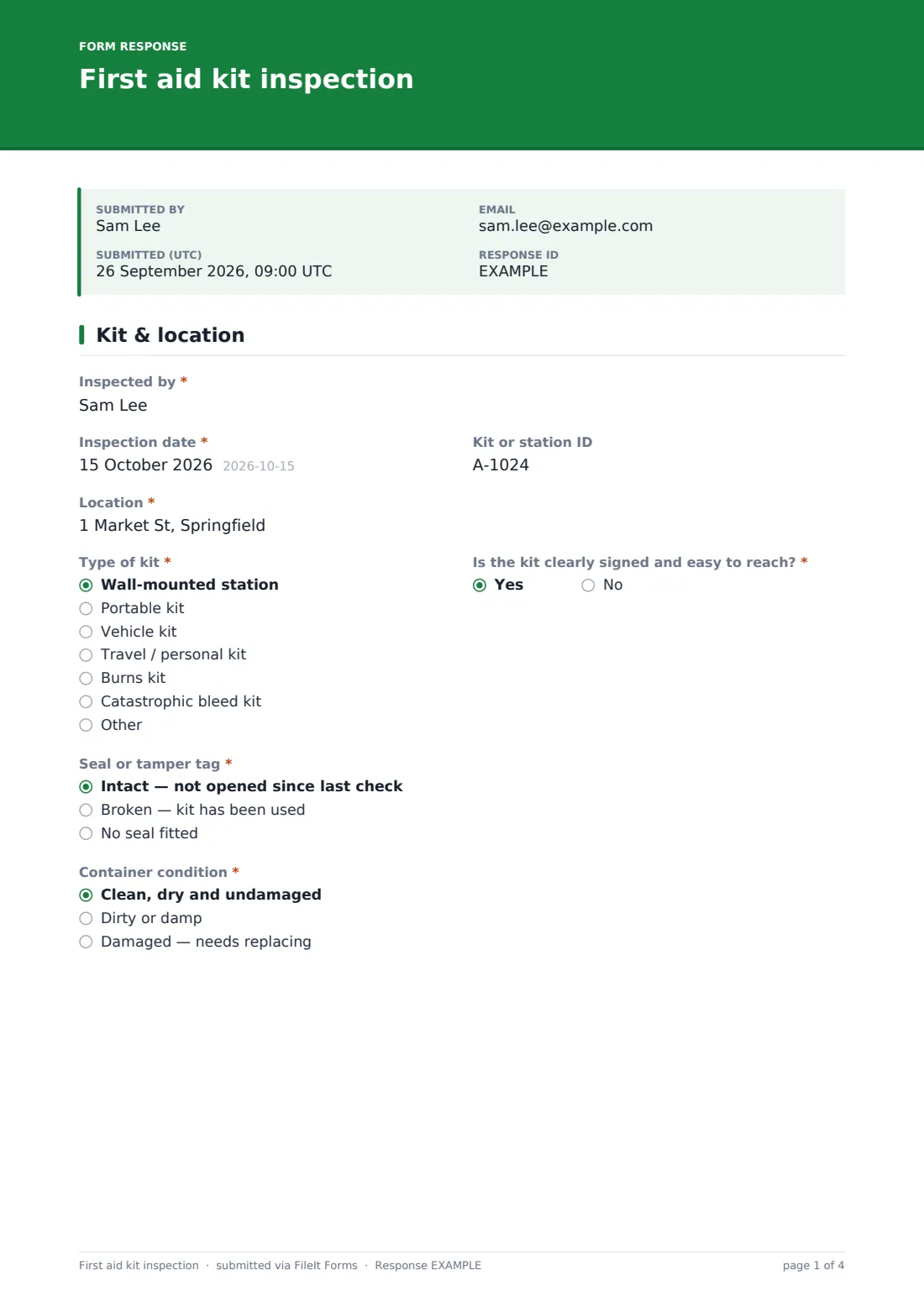
1 Kit & location
- Inspected by*
- Inspection date*
- Kit or station ID
- Location*
- Type of kit* Wall-mounted station · Portable kit · Vehicle kit · Travel / personal kit · Burns kit · Catastrophic bleed kit · Other
- Is the kit clearly signed and easy to reach?*
- Seal or tamper tag* Intact — not opened since last check · Broken — kit has been used · No seal fitted
- Container condition* Clean, dry and undamaged · Dirty or damp · Damaged — needs replacing
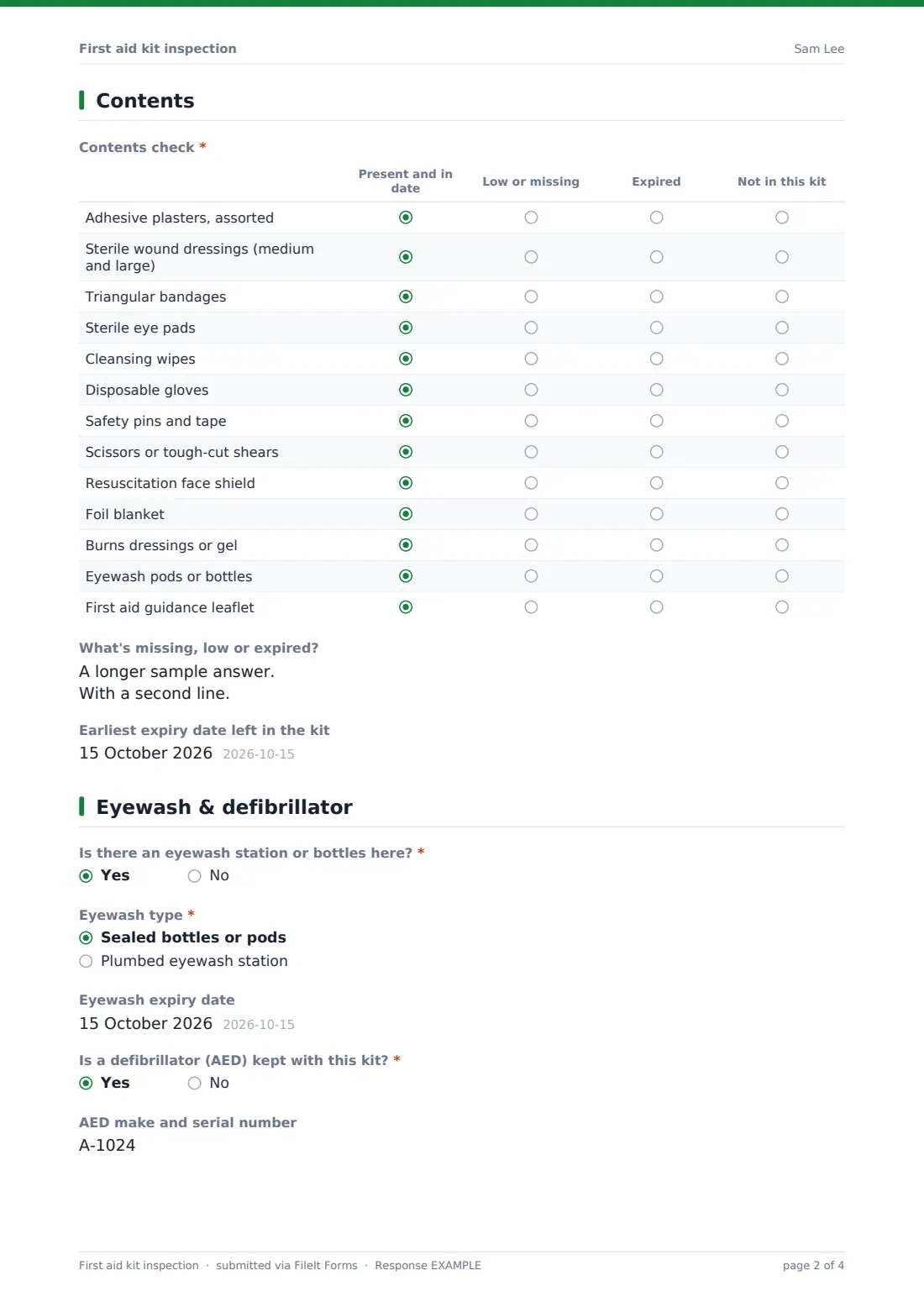
2 Contents
- Contents check* Present and in date · Low or missing · Expired · Not in this kit
- What's missing, low or expired?
- Earliest expiry date left in the kit
3 Eyewash & defibrillator
- Is there an eyewash station or bottles here?*
- Eyewash type* asked only when it applies Sealed bottles or pods · Plumbed eyewash station
- Eyewash expiry date asked only when it applies
- Flushed and running clear?* asked only when it applies
- Is a defibrillator (AED) kept with this kit?*
- AED make and serial number asked only when it applies
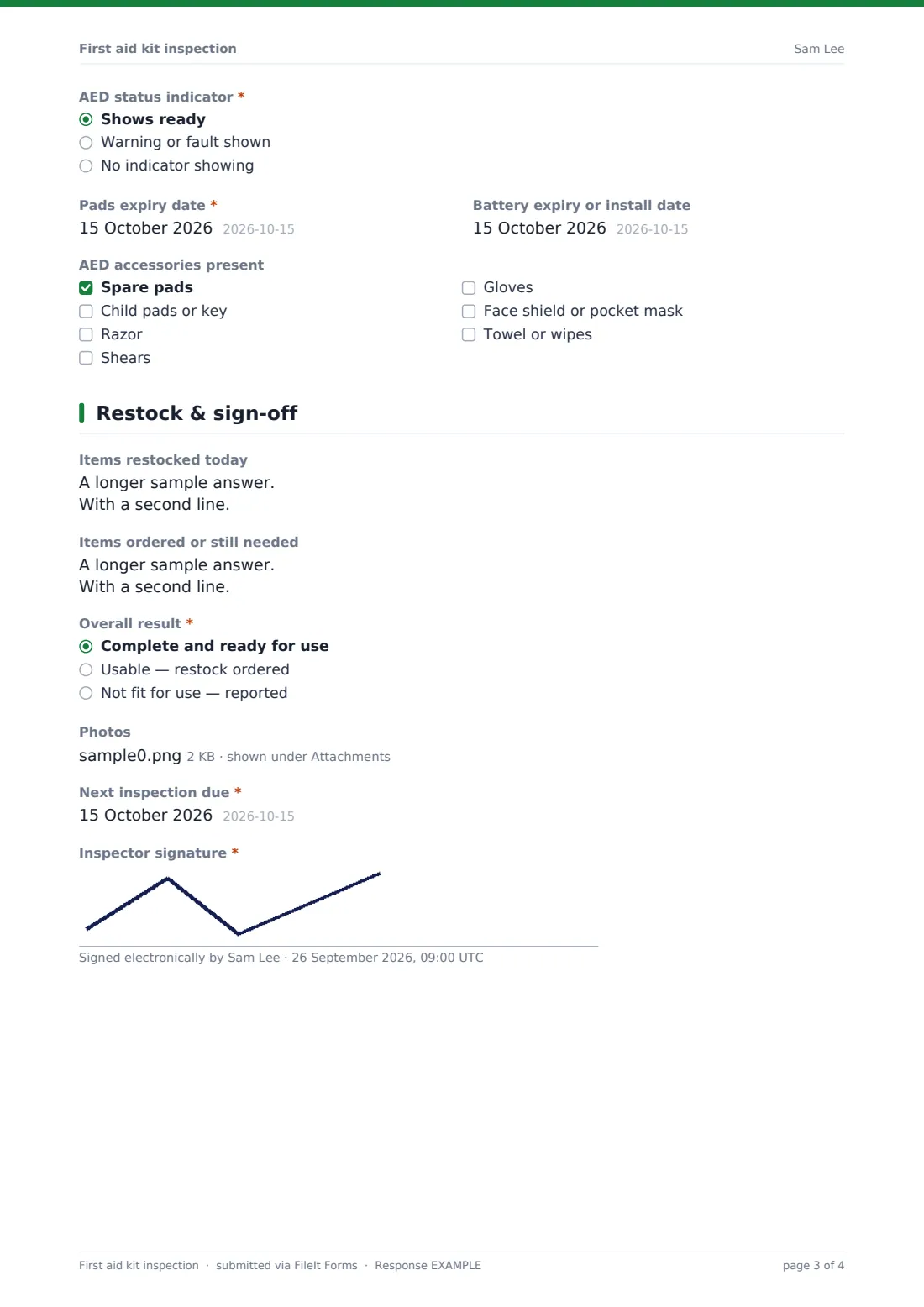
- AED status indicator* asked only when it applies Shows ready · Warning or fault shown · No indicator showing
- Pads expiry date* asked only when it applies
- Battery expiry or install date asked only when it applies
- AED accessories present asked only when it applies Spare pads · Child pads or key · Razor · Shears · Gloves · Face shield or pocket mask · Towel or wipes
4 Restock & sign-off
- Items restocked today
- Items ordered or still needed
- Overall result* Complete and ready for use · Usable — restock ordered · Not fit for use — reported
- Reported to* asked only when it applies
- Photos
- Next inspection due*
- Inspector signature*
The first aid kit inspection form, page by page
1 Kit & location
Record who inspected the kit and when, its ID, where it's kept and its type — a wall-mounted station, portable, vehicle, travel, burns or catastrophic bleed kit. Then answer whether it's clearly signed and easy to reach, whether the seal or tamper tag is intact, broken or not fitted, and whether the container is clean and dry, dirty or damaged.
2 Contents
A grid lists thirteen common items, from assorted plasters and sterile dressings to a resuscitation face shield, foil blanket, burns dressings, eyewash pods and a guidance leaflet. Each row is marked present and in date, low or missing, expired, or not in this kit. A box records exactly what's missing, low or expired, and a date field captures the earliest expiry left in the kit.
3 Eyewash & defibrillator
If there's eyewash, the inspector says whether it's sealed bottles — with an expiry date — or a plumbed station that's been flushed and runs clear. If a defibrillator is kept with the kit, they record its make and serial number, what the status indicator shows, the pads expiry date, the battery date and which accessories are present, such as spare or child pads, razor, shears and a face shield.
4 Restock & sign-off
The inspector lists items restocked today and items still on order, then gives an overall result: complete and ready, usable with a restock ordered, or not fit for use. Not fit for use asks who it was reported to. Up to three photos can be added, and the next inspection date and signature complete the record.
Make the template yours
- Replace the contents rows with the list your kit supplier or policy specifies
- Remove the defibrillator questions for kits that never have one
- Add a dropdown of your kit IDs and locations so inspectors pick rather than type
- Send results marked not fit for use to your health and safety lead
- File each site's inspections in its own vault folder
- Set the cover text to your inspection frequency
Tips for a better first aid kit inspection form
- Follow the contents list and check frequency in your own first aid needs assessment
- Check expiry dates on sterile items, eyewash and AED pads, not just whether they're there
- Fit a numbered tamper tag after each check so use is easy to spot
- Record the earliest expiry date so the next inspector knows what to replace first
- Restock straight after a kit is used, not just at the next scheduled check
- Follow the AED manufacturer's instructions for routine checks
Every response becomes a PDF in your vault
Each inspection is saved as a PDF in the vault folder you choose, with the contents grid, eyewash and AED checks, photos and signature together. The account owner can be emailed whenever a check is submitted.
In Responses, filter by kit ID or location to see a kit's history, or export to CSV to track restocking and spot kits that are repeatedly short.
- Start from this template. It opens in the FileIt Forms designer — change any question, add pages, set the rules for when questions appear.
- Share it. Turn on a public link, or send it to people by email, each with their own link. They don’t need a FileIt account.
- Get the answers as PDFs. Each response is saved as a PDF in the vault folder you choose, with uploaded files attached — and listed in a Responses table you can export to CSV.
First aid kit inspection form: frequently asked questions
Is this first aid kit inspection template free?
Yes. It's part of the Forms app, included with every FileIt account, the free plan too.
Does the contents list meet a particular standard?
No. It lists common first aid items as a starting point. Edit the rows to match the contents your supplier, policy or local guidance sets for your kit.
Can I use one form for several kits?
Each response covers one kit. Submit the form once per kit or station, using the Kit ID field to tell them apart.
Does FileIt remind me when the next inspection is due?
The form records the next inspection date, but it doesn't send reminders about it on its own. Add your own calendar or reminder for the date.
Can I skip the defibrillator questions?
Yes. Answer no to the AED question and its follow-ups stay hidden, or remove them in the designer.
Can inspectors add photos?
Yes. Up to three photos per inspection, taken straight from a phone or tablet.