What is the dental intake form template?
A new patient's first visit runs more smoothly when the practice already knows why they're coming in, what's bothered them lately, and anything about their health that could affect treatment. This template walks a new patient through exactly that — from their last dental visit and any pain they're in today, to medications, allergies, and how anxious they feel about being at the dentist.
Sending this as an online form instead of a clipboard in the waiting room means the patient can fill it in from home, at their own pace, with time to think about dates and medication names rather than guessing under pressure at check-in. Conditional questions mean someone coming in for a routine check-up isn't asked to describe pain they don't have, while someone in discomfort gets asked exactly where it hurts and how badly.
Once submitted, FileIt saves the completed form as a PDF in the vault folder you choose — ready for the dentist or hygienist to review before the appointment, with an insurance card attached if one was uploaded.
- Best for
- Dental practices, orthodontists and hygienists preparing for a first visit
- Filled in by
- The patient, or a parent completing it for a child
- Time to complete
- About 6 minutes
- Includes
- Pain and anxiety scales, conditional questions, insurance upload, signature
Who uses a dental intake form?
- General dental practices setting up a record for every new patient before their first appointment
- Orthodontists and specialists who need a patient's dental and treatment history before a referral visit
- Hygienist-led clinics screening for health conditions that affect cleaning or treatment
- Practices that want to flag dental anxiety in advance so they can adjust how an appointment is run
- Multi-location practices standardizing intake so every new patient answers the same questions
- Practices wanting insurance details captured before the visit rather than at the front desk
Questions on this dental intake form
27 questions over 5 pages · includes signature, file upload, conditional questions, multiple pages, consent checkbox, ratings.
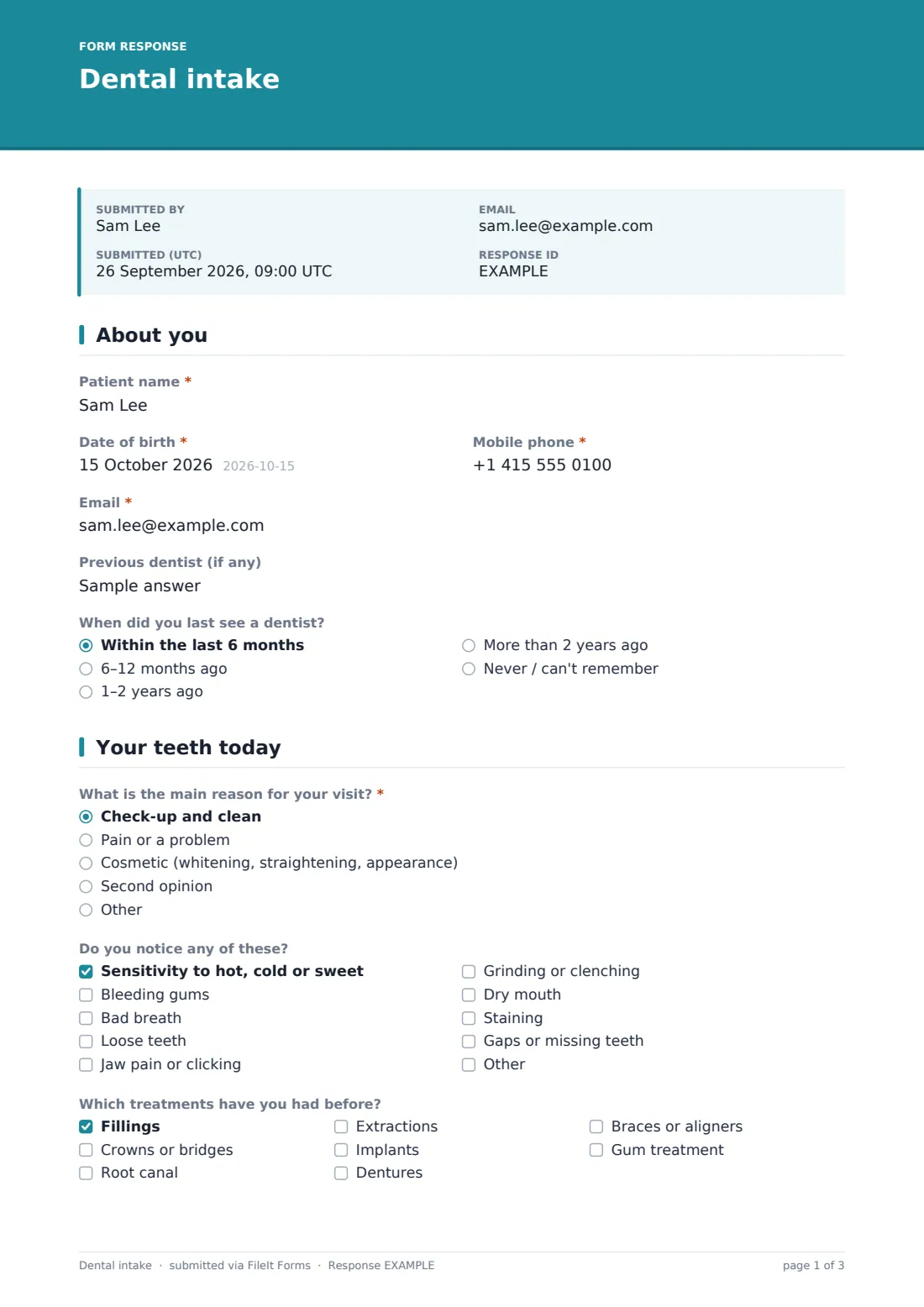
1 About you
- Patient name*
- Date of birth*
- Mobile phone*
- Email*
- Previous dentist (if any)
- When did you last see a dentist? Within the last 6 months · 6–12 months ago · 1–2 years ago · More than 2 years ago · Never / can't remember
2 Your teeth today
- What is the main reason for your visit?* Check-up and clean · Pain or a problem · Cosmetic (whitening, straightening, appearance) · Second opinion
- Where is the problem and how long have you had it?* asked only when it applies
- How much does it hurt right now? asked only when it applies
- Do you notice any of these? Sensitivity to hot, cold or sweet · Bleeding gums · Bad breath · Loose teeth · Jaw pain or clicking · Grinding or clenching · Dry mouth · Staining · Gaps or missing teeth
- Which treatments have you had before? Fillings · Crowns or bridges · Root canal · Extractions · Implants · Dentures · Braces or aligners · Gum treatment
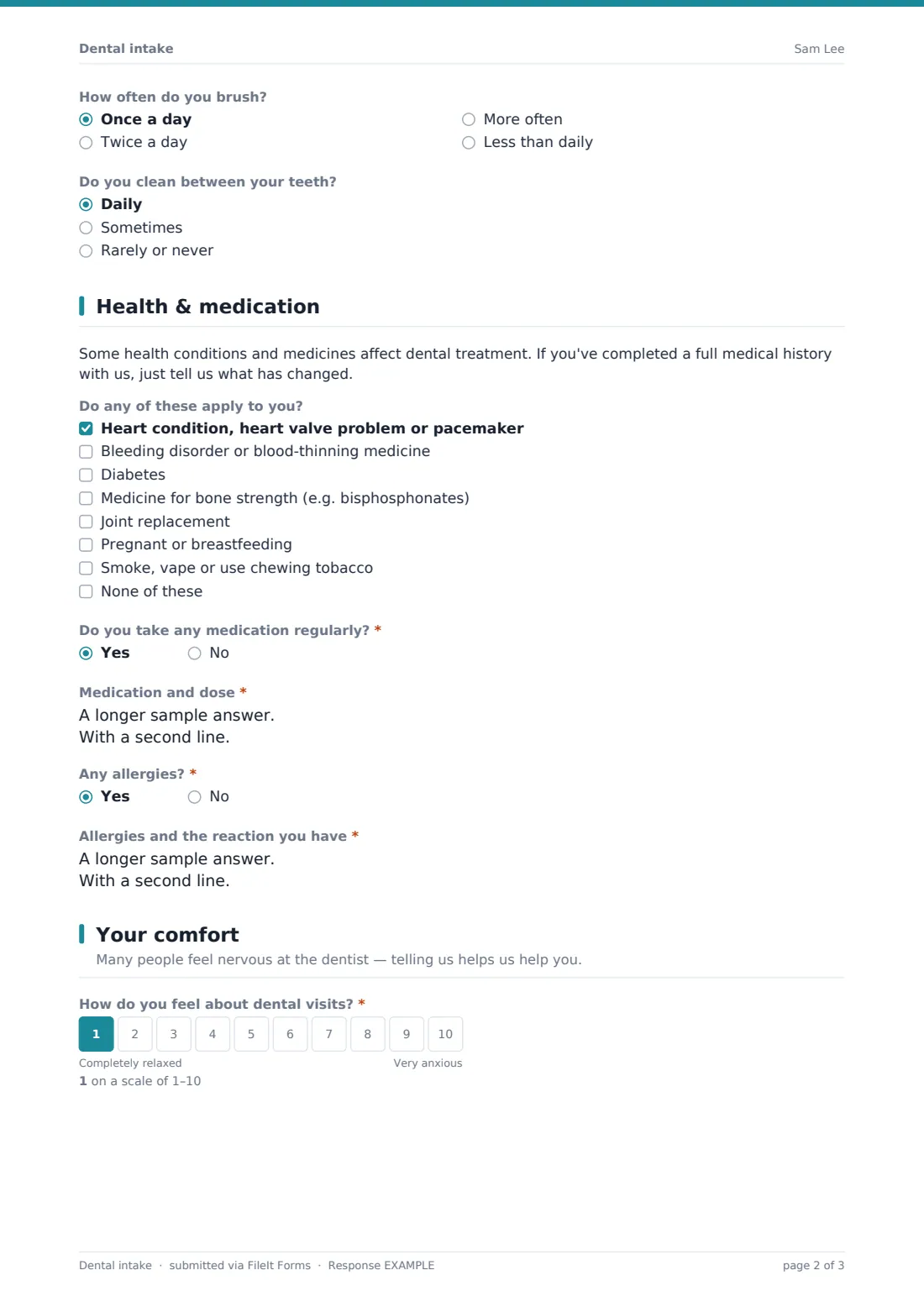
- How often do you brush? Once a day · Twice a day · More often · Less than daily
- Do you clean between your teeth? Daily · Sometimes · Rarely or never
3 Health & medication
- Do any of these apply to you? Heart condition, heart valve problem or pacemaker · Bleeding disorder or blood-thinning medicine · Diabetes · Medicine for bone strength (e.g. bisphosphonates) · Joint replacement · Pregnant or breastfeeding · Smoke, vape or use chewing tobacco · None of these
- Do you take any medication regularly?*
- Medication and dose* asked only when it applies
- Any allergies?*
- Allergies and the reaction you have* asked only when it applies
4 Your comfort
- How do you feel about dental visits?*
- What would help you feel more comfortable? asked only when it applies Explain each step before starting · Agree a stop signal · Shorter appointments · Headphones or music · Talk about sedation options
- Is there anything that has made visits difficult before? asked only when it applies
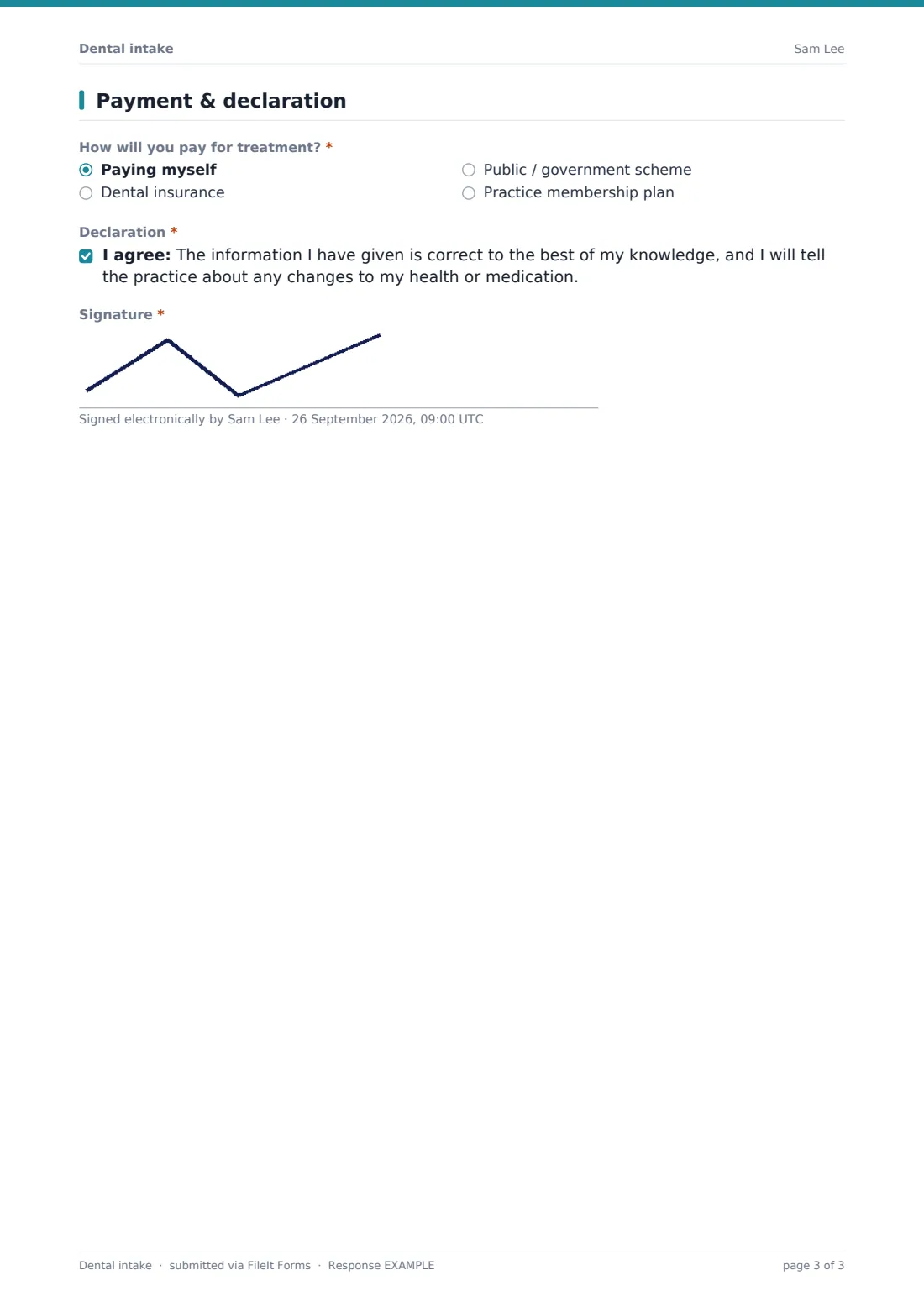
5 Payment & declaration
- How will you pay for treatment?* Paying myself · Dental insurance · Public / government scheme · Practice membership plan
- Insurance provider* asked only when it applies
- Member / policy number* asked only when it applies
- Insurance card (front and back) asked only when it applies
- Declaration*
- Signature*
The dental intake form, page by page
1 About you
The form opens with the patient's name, date of birth, mobile phone and email, then asks about their dental history so far: their previous dentist, if any, and a dropdown for When did you last see a dentist? ranging from within the last six months to never. This gives the practice a quick sense of how established the patient's dental care has been before they've even sat down.
2 Your teeth today
This is the longest page, and it adapts to what the patient is coming in for. What is the main reason for your visit? offers a check-up and clean, pain or a problem, cosmetic work, or a second opinion. Choosing pain or a problem opens two extra questions: Where is the problem and how long have you had it?, and a 0–10 pain scale for how much it hurts right now — details a routine check-up doesn't need.
Every patient is then asked which symptoms they notice, from sensitivity and bleeding gums to jaw pain or grinding, which past treatments they've had (fillings, crowns, root canal, implants, braces and more), and simple questions about how often they brush and whether they clean between their teeth — background that helps the dentist plan the visit before an exam even starts.
3 Health & medication
Because some health conditions and medicines change how dental treatment is planned, this page asks whether any of a list of conditions apply — a heart condition or pacemaker, a bleeding disorder or blood thinners, diabetes, bone-strengthening medication, a joint replacement, pregnancy, or tobacco use. Do you take any medication regularly? and Any allergies? each open a required text field only when the patient answers yes, so someone with nothing to report isn't asked to type "none" into empty boxes.
4 Your comfort
A short note acknowledges that many people feel nervous at the dentist, then asks patients to rate How do you feel about dental visits? on a 1–10 scale. Anyone who rates their anxiety above 5 sees two extra questions: What would help you feel more comfortable? — with options like explaining each step, agreeing a stop signal, shorter appointments, music, or talking about sedation — and an optional space to describe anything that's made past visits difficult. Patients who aren't anxious skip straight past both.
5 Payment & declaration
The last page asks How will you pay for treatment? — themselves, dental insurance, a public scheme, or a practice membership plan. Choosing insurance opens fields for the provider and policy number, plus an optional upload for a photo of the insurance card, front and back. The form closes with a declaration that the information given is correct and that the patient will report any changes, followed by a signature.
Make the template yours
- Add or remove health-flag options to match the conditions your practice screens for
- Adjust the anxiety threshold, or the comfort options offered, to fit how your team handles nervous patients
- Add a question about a preferred hygienist or appointment time if your practice offers a choice
- Change the accent color and cover message to match your practice's branding
- File completed intakes straight into each patient's own vault folder if you organize records by patient
- Turn off the insurance card upload if your front desk always scans it in person instead
Tips for a better dental intake form
- Ask about pain and symptoms before the visit so chairside time can go toward treatment rather than history-taking
- Keep medication and allergy questions quick to answer 'no' to, but always required to explain if the answer is yes
- Flag anxious patients to the treating dentist ahead of time rather than leaving it for them to mention on the day
- Ask only for the health information that actually affects dental treatment — use a separate, fuller medical history form if you need one
- Remember this form collects information for planning purposes only — it isn't medical advice and doesn't replace a dentist's own clinical assessment; a patient in urgent pain should be told to contact the practice directly rather than wait for a scheduled appointment
Every response becomes a PDF in your vault
As soon as a patient submits the form, FileIt turns their answers into a PDF and saves it in the vault folder you've set up for patient intakes, with any insurance card image attached. If notifications are switched on, the practice is emailed the moment a new form comes in, and the patient can receive their own PDF copy if you choose to send one.
From there, most practices open the Responses table before the appointment, review the notes for anything the treating dentist should know — pain location, anxiety level, health flags — and file the PDF into the patient's own record. Filters make it easy to check who has an appointment coming up but hasn't yet completed their intake.
- Start from this template. It opens in the FileIt Forms designer — change any question, add pages, set the rules for when questions appear.
- Share it. Turn on a public link, or send it to people by email, each with their own link. They don’t need a FileIt account.
- Get the answers as PDFs. Each response is saved as a PDF in the vault folder you choose, with uploaded files attached — and listed in a Responses table you can export to CSV.
Dental intake form: frequently asked questions
Is this dental intake form template free?
Yes. It's included in FileIt's template library, which is available on every account including the free plan, with no extra charge for the template or the Forms designer.
Do new patients need a FileIt account to fill it in?
No. Patients complete and submit the form from a link or emailed invitation without creating any account. Only the practice needs a FileIt account to set up the form.
How do I get each patient's answers as a PDF?
Every submission is automatically saved as a PDF in the vault folder you chose when setting up the form. You can open any patient's answers from the Responses table, or export the full list to CSV.
Can patients upload a photo of their insurance card?
Yes. If they choose to pay with dental insurance, the form offers an optional upload for a clear photo of the card, front and back, which is attached to their PDF response.
Does this form replace a full medical history form?
Not necessarily — it covers the health conditions and medications most relevant to dental treatment. If your practice wants a fuller health history, you can use a separate medical history form alongside this one.
Can I add questions specific to my specialty, like orthodontics?
Yes. Every page and question can be edited, reordered or removed in the designer, and you can add new questions for whatever your specialty needs to know.
Is the pain or anxiety scale a clinical assessment?
No. It's a self-reported answer meant to help the practice plan the appointment and prepare the patient, not a diagnosis or clinical evaluation.
Can a parent fill this in for a child patient?
Yes. The form doesn't restrict who completes it, so a parent or guardian can fill in the child's details themselves as the patient.