What is the debt recovery instruction form template?
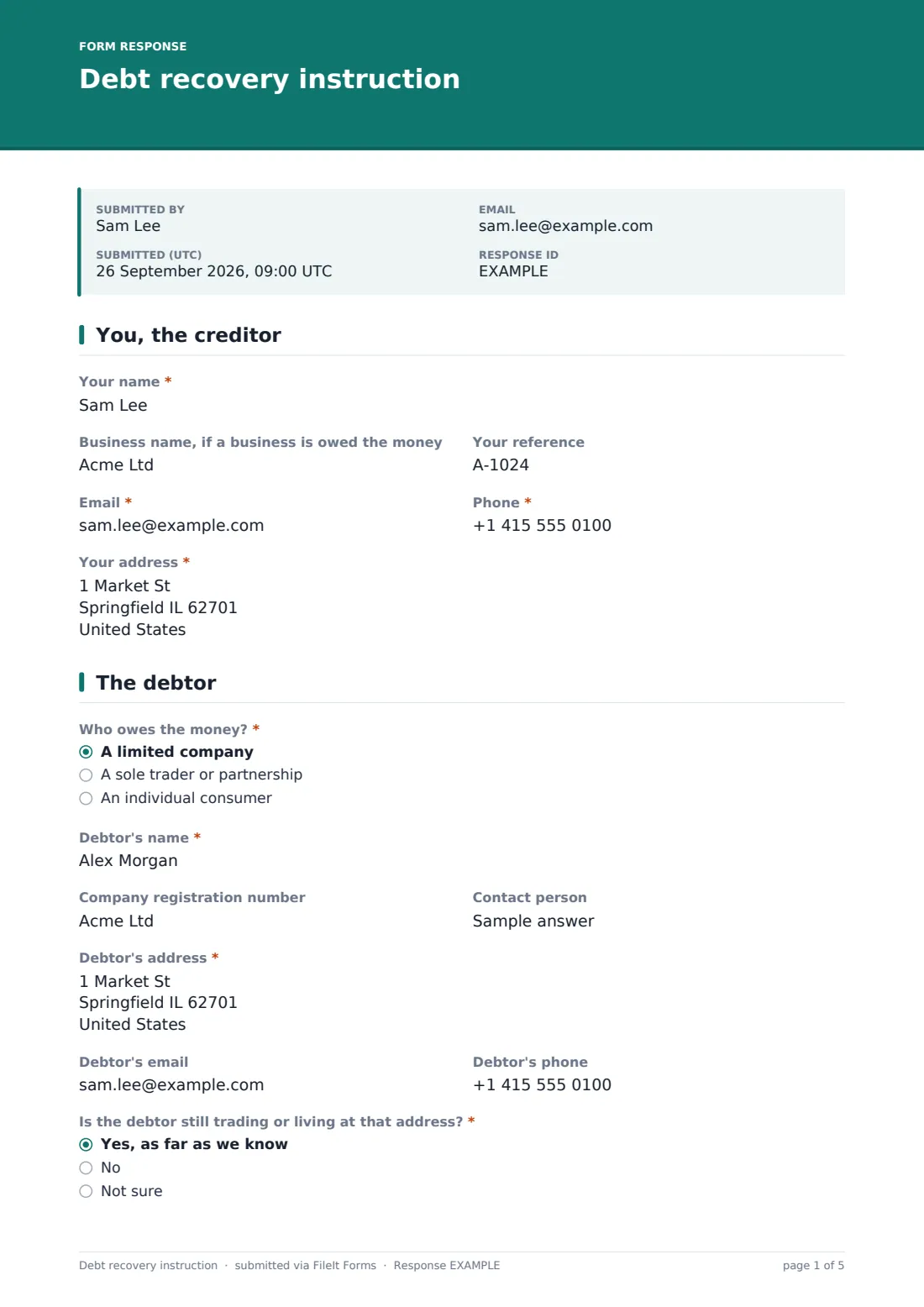
Before a law firm or collection agency can send a letter, it needs the debtor's correct legal name and address, the amount and its basis, what's been tried and whether the debt is disputed. Missing any of these slows the first letter or puts it at risk. This instruction form asks for them in order and asks for the invoices up front.
Logic follows the case. A company debtor is asked for its registration number. Mentioning insolvency asks what the creditor has heard. Part payments ask how much and when. A disputed debt asks what's disputed and the creditor's answer, and agreeing to instalments asks for the lowest monthly payment.
Each instruction is saved as a PDF in FileIt with the invoices, contract and chasing letters attached.
- Best for
- Law firms, collection agencies and in-house credit control teams
- Filled in by
- Business creditors, and individuals owed money
- Time to complete
- About 10 minutes with invoices to hand
- Includes
- Creditor, debtor type and details, insolvency, debt basis, amount, oldest due date, terms, part payments, interest, chase history, disputes, instalments, action, documents, authority
Who uses a debt recovery instruction form?
- A trade customer hasn't paid several overdue invoices
- A former client owes fees after the work finished
- A landlord is chasing unpaid rent after a commercial tenant left
- A sole trader supplier has gone quiet after a part payment
- An agency taking on accounts from a new client
Questions on this debt recovery instruction form
40 questions over 5 pages · includes file upload, conditional questions, multiple pages, consent checkbox.
1 You, the creditor
- Your name*
- Business name, if a business is owed the money
- Your reference
- Email*
- Phone*
- Your address*
2 The debtor
- Who owes the money?* A limited company · A sole trader or partnership · An individual consumer
- Debtor's name*
- Company registration number asked only when it applies
- Contact person
- Debtor's address*
- Debtor's email
- Debtor's phone
- Is the debtor still trading or living at that address?* Yes, as far as we know · No · Not sure
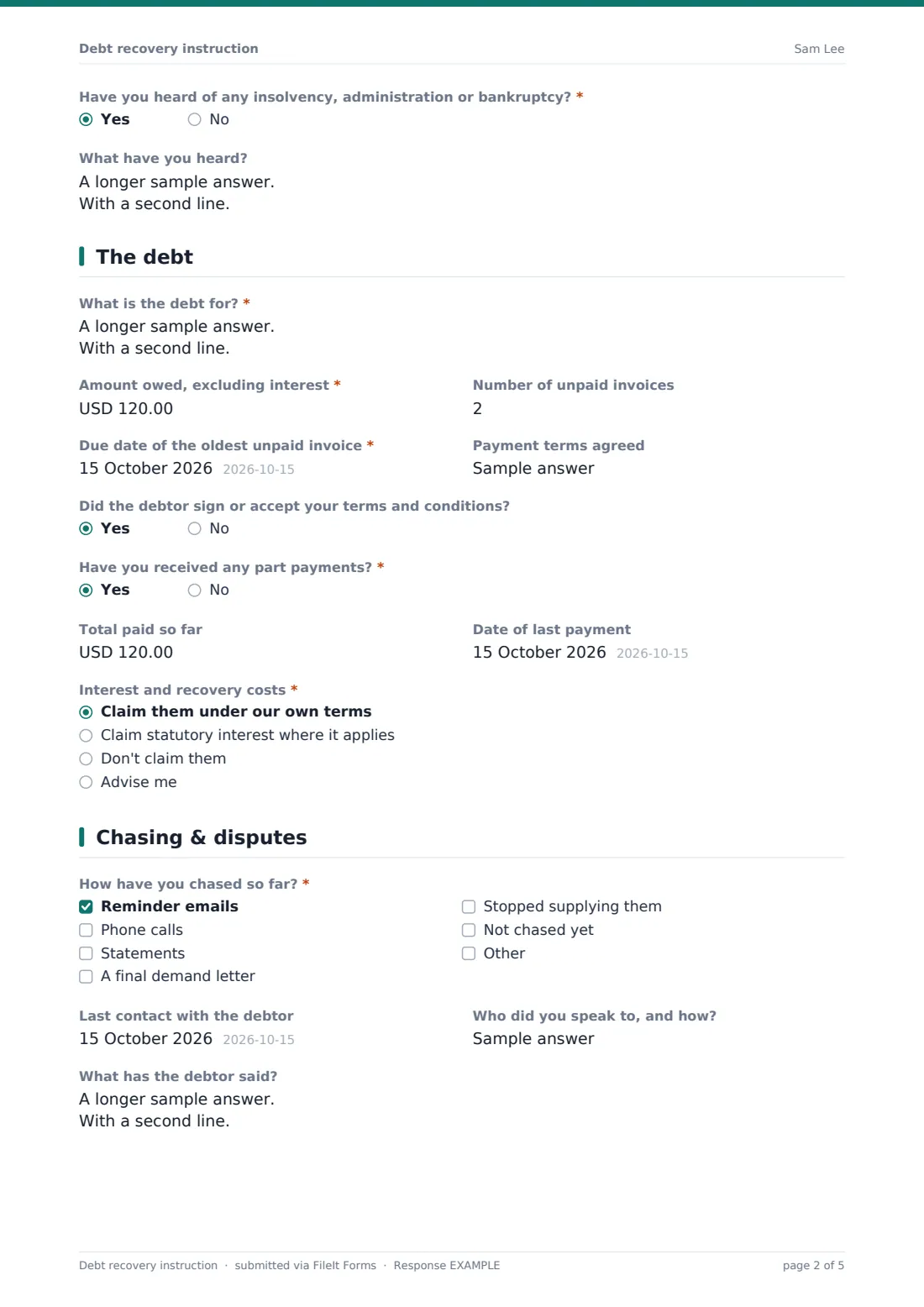
- Have you heard of any insolvency, administration or bankruptcy?*
- What have you heard? asked only when it applies
3 The debt
- What is the debt for?*
- Amount owed, excluding interest*
- Number of unpaid invoices
- Due date of the oldest unpaid invoice*
- Payment terms agreed
- Did the debtor sign or accept your terms and conditions?
- Have you received any part payments?*
- Total paid so far asked only when it applies
- Date of last payment asked only when it applies
- Interest and recovery costs* Claim them under our own terms · Claim statutory interest where it applies · Don't claim them · Advise me
4 Chasing & disputes
- How have you chased so far?* Reminder emails · Phone calls · Statements · A final demand letter · Stopped supplying them · Not chased yet
- Last contact with the debtor
- Who did you speak to, and how?
- What has the debtor said?
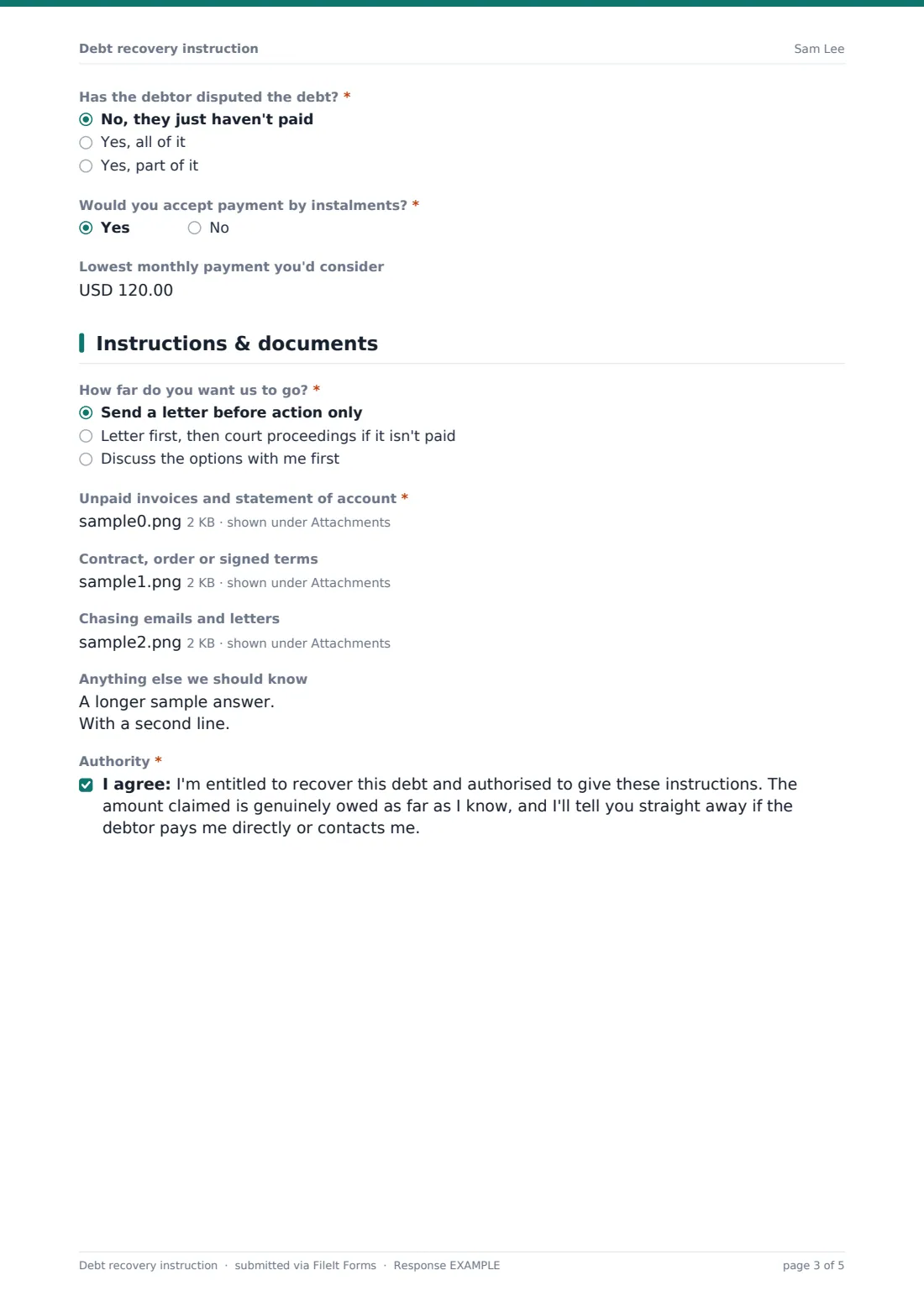
- Has the debtor disputed the debt?* No, they just haven't paid · Yes, all of it · Yes, part of it
- What do they dispute, and what's your answer?* asked only when it applies
- Would you accept payment by instalments?*
- Lowest monthly payment you'd consider asked only when it applies
5 Instructions & documents
- How far do you want us to go?* Send a letter before action only · Letter first, then court proceedings if it isn't paid · Discuss the options with me first
- Unpaid invoices and statement of account*
- Contract, order or signed terms
- Chasing emails and letters
- Anything else we should know
- Authority*
The debt recovery instruction form, page by page
1 You, the creditor
"Your name", the business name if a business is owed the money (left blank by individuals), "Your reference", email, phone and "Your address".
2 The debtor
"Who owes the money?" sorts companies, sole traders or partnerships, and individual consumers, and a company is asked for its registration number. The creditor gives the debtor's name, contact person, address, email and phone. Two questions check the risk: "Is the debtor still trading or living at that address?" and "Have you heard of any insolvency, administration or bankruptcy?".
3 The debt
"What is the debt for?", the amount excluding interest, the number of unpaid invoices, the due date of the oldest one and the payment terms agreed. "Did the debtor sign or accept your terms and conditions?" matters for interest. Part payments ask for the total and the last payment date. "Interest and recovery costs" lets the creditor claim under their own terms or statutory interest, decline, or ask for advice.
4 Chasing & disputes
"How have you chased so far?" lists reminders, calls, statements, a final demand and stopping supply. The creditor gives the last contact, who they spoke to and what the debtor said. "Has the debtor disputed the debt?" asks for details if all or part is disputed. "Would you accept payment by instalments?" asks for the lowest monthly payment.
5 Instructions & documents
"How far do you want us to go?": a letter before action only, a letter then proceedings, or a talk first. Uploads take the unpaid invoices and statement (required), the contract or signed terms and chasing letters. A notes box covers known assets or other creditors, then an authority statement confirms the debt is owed and the creditor will report any direct payment.
Make the template yours
- Put your fee basis, such as a fixed fee per letter or a percentage of recoveries, in the cover text
- Change the currency on the amount questions to match your market
- Rename the interest options to match the late-payment rules where you work
- Add your own reference or portfolio code for agency clients
- Send personal links to regular clients so their contact details are prefilled
Tips for a better debt recovery instruction form
- Check the debtor's legal name against a company register before the first letter
- Treat a disputed debt differently from one that simply hasn't been paid
- Look at the oldest due date early, since limitation periods vary
- Ask for proof the terms were accepted if the creditor wants contractual interest
- Remind creditors to pass on anything the debtor pays them directly
Every response becomes a PDF in your vault
Each instruction is filed as a PDF in the folder you choose, with every invoice and letter attached. Your team is emailed when it arrives.
The Responses table lets you search by creditor, debtor or reference, and the CSV export gives you a list of new instructions with amounts and oldest due dates.
- Start from this template. It opens in the FileIt Forms designer — change any question, add pages, set the rules for when questions appear.
- Share it. Turn on a public link, or send it to people by email, each with their own link. They don’t need a FileIt account.
- Get the answers as PDFs. Each response is saved as a PDF in the vault folder you choose, with uploaded files attached — and listed in a Responses table you can export to CSV.
Debt recovery instruction form: frequently asked questions
Is this debt recovery template free?
Yes. It's one of the starter templates in the Forms app, included on every FileIt account, and you can edit any question.
Can individual consumers be the debtor?
Yes. Choose "An individual consumer". Rules for collecting consumer debts are often stricter, so check them before acting.
Does the form send a letter to the debtor?
No. It only collects the instruction. Your team decides what to send.
Do creditors need a FileIt account?
No. They open your link, answer the questions and submit. No account is needed.
Can we take payment for our fees with it?
No. The form doesn't take payments. Explain your fees in the cover text or engagement terms.