
What is the commercial dispute intake form template?
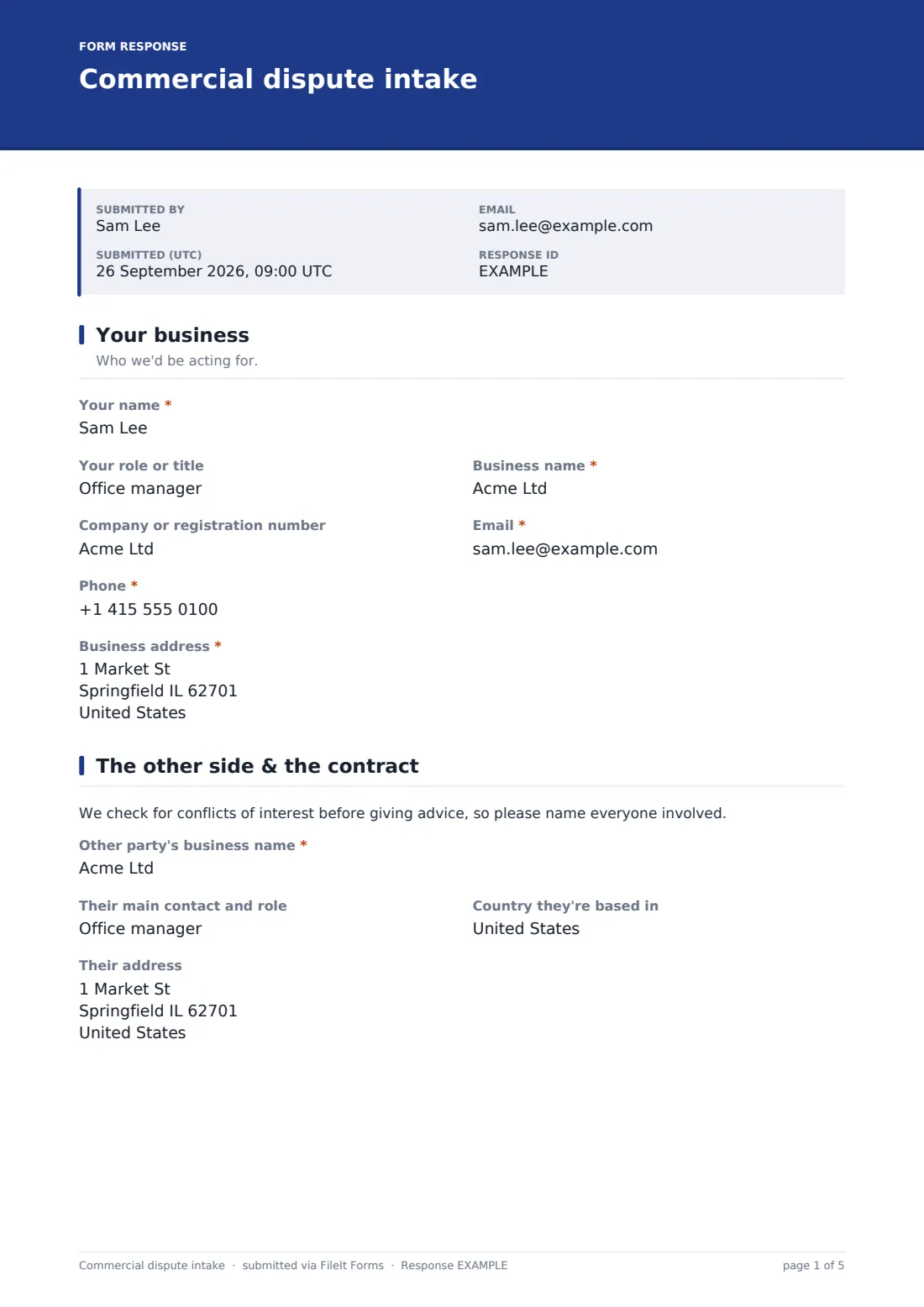
A first call about a commercial dispute often goes on finding out basics: the other side's exact name, whether there's a signed contract, what it says about disputes and whether a deadline is close. This intake form collects those facts first, so the call can be spent on strategy.
It runs over five pages: the client business, the other side and the contract, what went wrong, money and deadlines, then documents. Logic keeps it short. Saying proceedings have started asks for the court and case number. Saying a deadline is coming up asks for the date and what falls due. Naming the other side's lawyers is only asked if they have any.
Each submission is saved as a PDF in your FileIt vault with the contract and correspondence attached, ready for the conflict check and the matter file.
- Best for
- Commercial litigation, dispute resolution and general business law firms
- Filled in by
- Business owners, directors, in-house counsel and finance leads
- Time to complete
- About 15 to 20 minutes, plus uploads
- Includes
- Client business, other party, relationship, contract and dispute clause, dispute type, timeline, stage, amount, losses, deadlines, outcome, urgency, budget, documents, authority
Who uses a commercial dispute intake form?
- A supplier hasn't been paid for four months of deliveries
- A customer says your software didn't do what the contract promised
- A distributor ended an exclusive agreement early
- Two shareholders disagree about running the company
- A contractor's poor work needs to be redone by someone else
- You've just received a letter of claim and need advice quickly
Questions on this commercial dispute intake form
39 questions over 5 pages · includes file upload, conditional questions, multiple pages, consent checkbox.
1 Your business
- Your name*
- Your role or title
- Business name*
- Company or registration number
- Email*
- Phone*
- Business address*
2 The other side & the contract
- Other party's business name*
- Their main contact and role
- Country they're based in
- Their address
- How are you connected to them?* They are our customer · They are our supplier · Contractor or subcontractor (either way round) · Distributor, reseller or agent (either way round) · Landlord or tenant (either way round) · Fellow business partner or shareholder · Licensor or licensee (either way round)
- Anyone else involved
- Do they have lawyers involved yet?*
- Their lawyers asked only when it applies
- Is there a written contract?* Yes, signed by both sides · Terms and conditions or purchase orders only · Agreed by email or verbally · Not sure
- Date of the contract or first order
- Governing law or courts named in it
- Does it say how disputes are resolved? Arbitration · Mediation or negotiation first · Specific courts only · Nothing about disputes · Not sure
3 What went wrong
- What kind of dispute is it?* Unpaid invoices · Goods or services not delivered · Defective goods or poor workmanship · Late performance · Wrongful termination · Exclusivity or non-compete breach · Misuse of confidential information or IP · Partner or shareholder disagreement
- What happened?*
- When did the problem start?
- Is the contract still running?
- What does the other side say about it?
- How far has it gone?* Conversations only · Written complaints exchanged · We've sent a formal letter of claim or demand · We've received a letter of claim · Court or arbitration proceedings have started
- Court or tribunal, case number and next step* asked only when it applies
4 Money, deadlines & outcome
- Amount in dispute*
- How that figure is worked out
- Other losses or costs you've suffered
- Is any deadline coming up?*
- Earliest deadline* asked only when it applies
- What falls due on that date?* asked only when it applies
- What outcome do you want?* Payment of what's owed · Delivery or completion of the work · End the contract · Keep the business relationship · A negotiated settlement · Go to court or arbitration if necessary
- How urgent is it?* Urgent: action needed this week · Soon: within the next month · No fixed timescale
- Budget for legal costs, if you have one
- Might legal expenses insurance cover this?
5 Documents & confirmation
- Contract, terms and orders
- Key emails and letters
- Authority*
The commercial dispute intake form, page by page
1 Your business
The client gives "Your name", "Your role or title", "Business name", "Company or registration number", email, phone and "Business address".
2 The other side & the contract
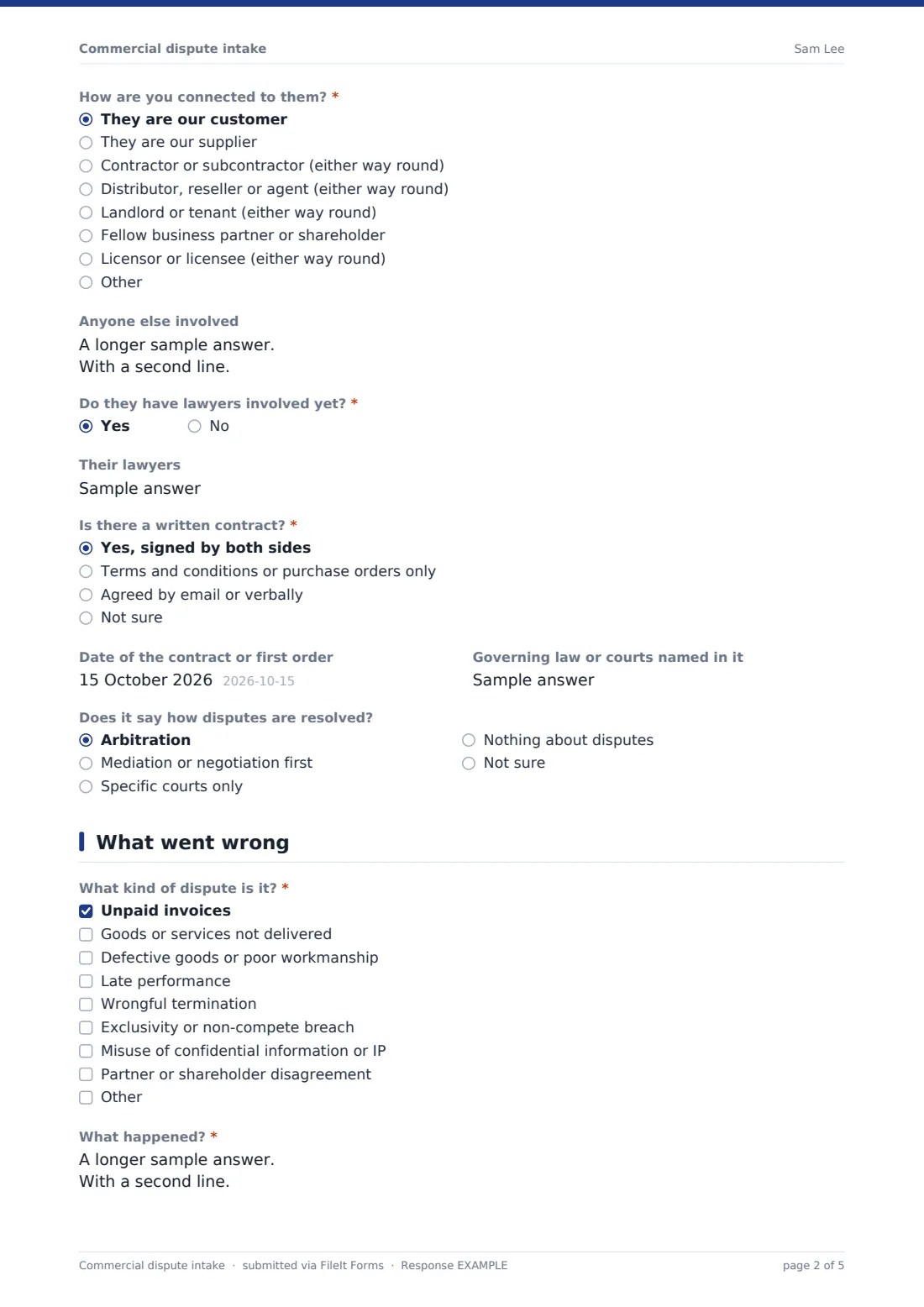
A short note explains the conflict check. The client names the other party, "Their main contact and role", the country they're based in and their address, and picks "How are you connected to them?": they are your customer or supplier, contractor, distributor, landlord or tenant, partner or shareholder, licensor or licensee, or something else. "Anyone else involved" covers guarantors, insurers and parent companies. "Do they have lawyers involved yet?" asks who. "Is there a written contract?", the contract date, "Governing law or courts named in it" and "Does it say how disputes are resolved?" finish the page.
3 What went wrong
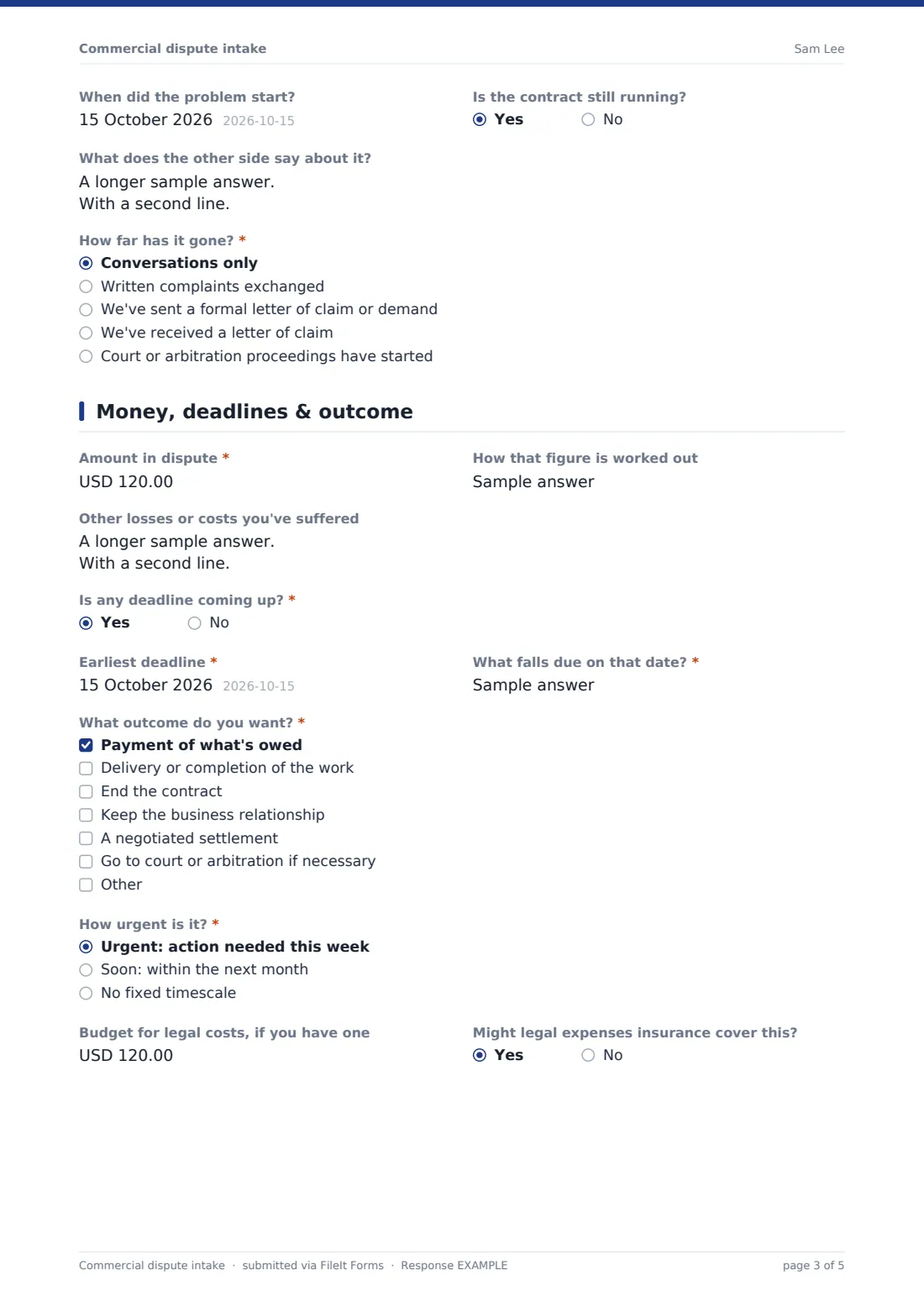
"What kind of dispute is it?" offers unpaid invoices, non-delivery, defects, late performance, termination, exclusivity breaches, misuse of confidential information or IP, and partner disagreements. "What happened?" asks for the story in date order, then the start date, whether the contract is still running and "What does the other side say about it?". "How far has it gone?" runs from conversations to proceedings. If proceedings have started, the client gives the court, case number and next step.
4 Money, deadlines & outcome
The client gives the "Amount in dispute", how it's worked out and other losses. "Is any deadline coming up?" asks for the earliest date and what falls due. They choose the outcomes they want, how urgent it is, an optional budget for legal costs and whether legal expenses insurance might help.
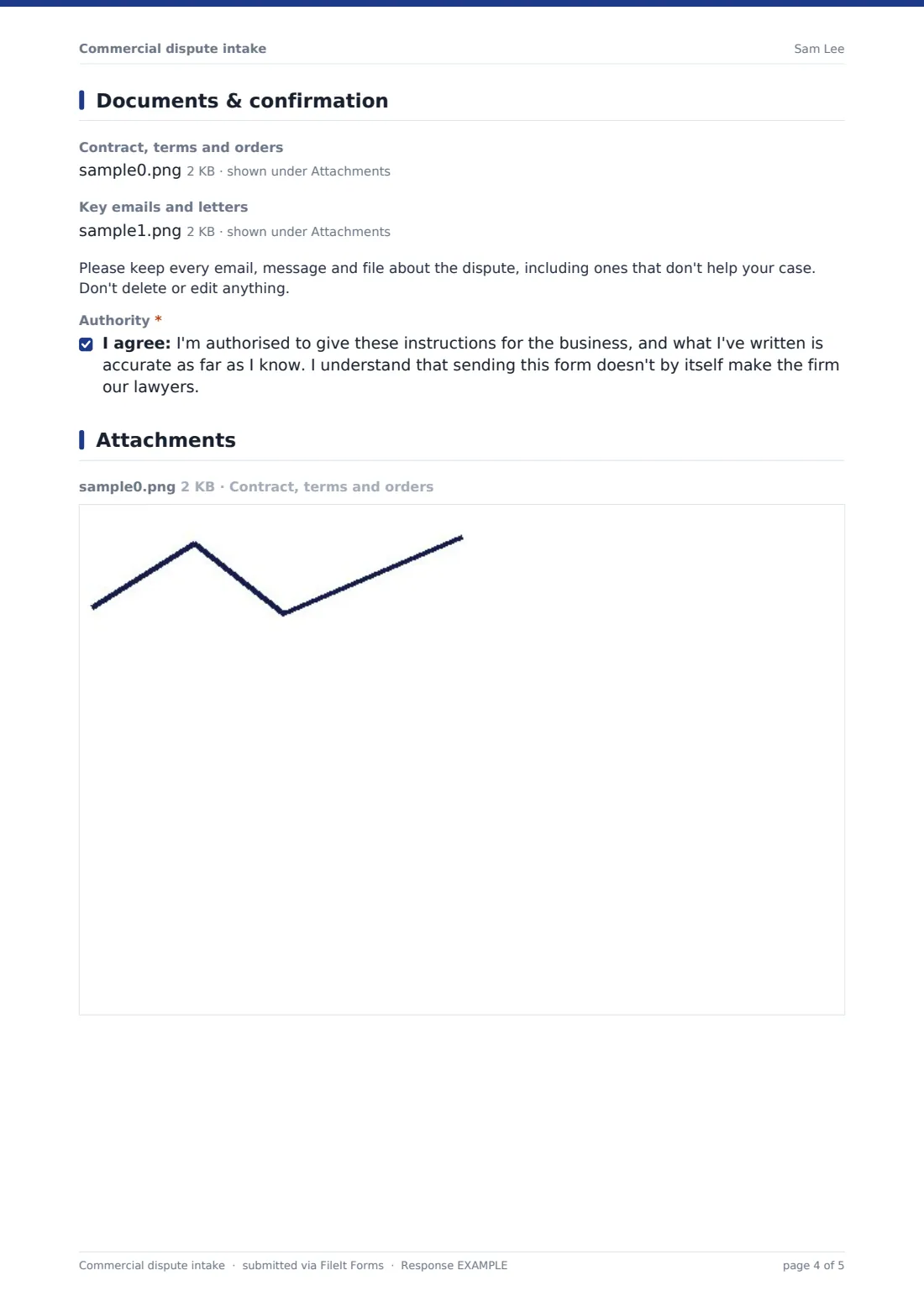
5 Documents & confirmation
Uploads take the contract, terms and orders, plus key emails and letters, up to ten files each. A note asks the client to keep everything about the dispute. An authority statement confirms they can instruct for the business and that the form doesn't by itself make the firm their lawyers.
Make the template yours
- Put your response time and an urgent-matters phone number in the cover text
- Route submissions to an intake or new-matters folder and notify the partner on duty
- Add the practice areas or offices you want clients to choose from
- Change the dispute types to fit your work, such as construction, shipping or franchise disputes
- Remove the budget question if you prefer to talk about fees on the call
Tips for a better commercial dispute intake form
- Run the conflict check on every party named, including the "Anyone else involved" box
- Look at the deadline answer first: it decides how quickly someone needs to call back
- Read the dispute clause answer before advising on court action
- Compare the client's timeline with the correspondence they upload
- Ask for anything missing, such as signed terms, before the first meeting
Every response becomes a PDF in your vault
Each intake is saved as a PDF in the vault folder you choose, with the contract and correspondence attached. You get an email when it arrives, and the client gets a copy if you leave that on.
The Responses table lists every enquiry with search by business or other party, which helps during conflict checks. Export to CSV to report on enquiries by dispute type or value.
- Start from this template. It opens in the FileIt Forms designer — change any question, add pages, set the rules for when questions appear.
- Share it. Turn on a public link, or send it to people by email, each with their own link. They don’t need a FileIt account.
- Get the answers as PDFs. Each response is saved as a PDF in the vault folder you choose, with uploaded files attached — and listed in a Responses table you can export to CSV.
Commercial dispute intake form: frequently asked questions
Is this commercial dispute intake template free?
Yes. It's one of the starter templates in the Forms app, included on every FileIt account, and you can edit any question.
Does submitting the form create a lawyer-client relationship?
The authority statement says it doesn't by itself. Your engagement letter or terms do that, in the usual way.
Do clients need a FileIt account?
No. They open your link, answer the questions and submit. No account is needed.
Can clients upload a lot of documents?
Each of the two upload questions takes up to ten files, including PDFs, Word documents and images. Very large bundles are better shared after the first call.
Can we use it for disputes where we act for the defendant?
Yes. The stage question includes receiving a letter of claim, and you can rename questions to suit.
Does it check for conflicts automatically?
No. It collects the names you need, and your team runs the conflict check in your own system.