What is the small claims case worksheet form template?
Small claims courts are designed for people without lawyers, but they still expect you to know who you're suing, how much you're asking for and why, and what proves it. Most people who go in unprepared don't lose on the facts. They lose track of them — the wrong business name, a total they can't explain, or a key text message they can't find on their phone.
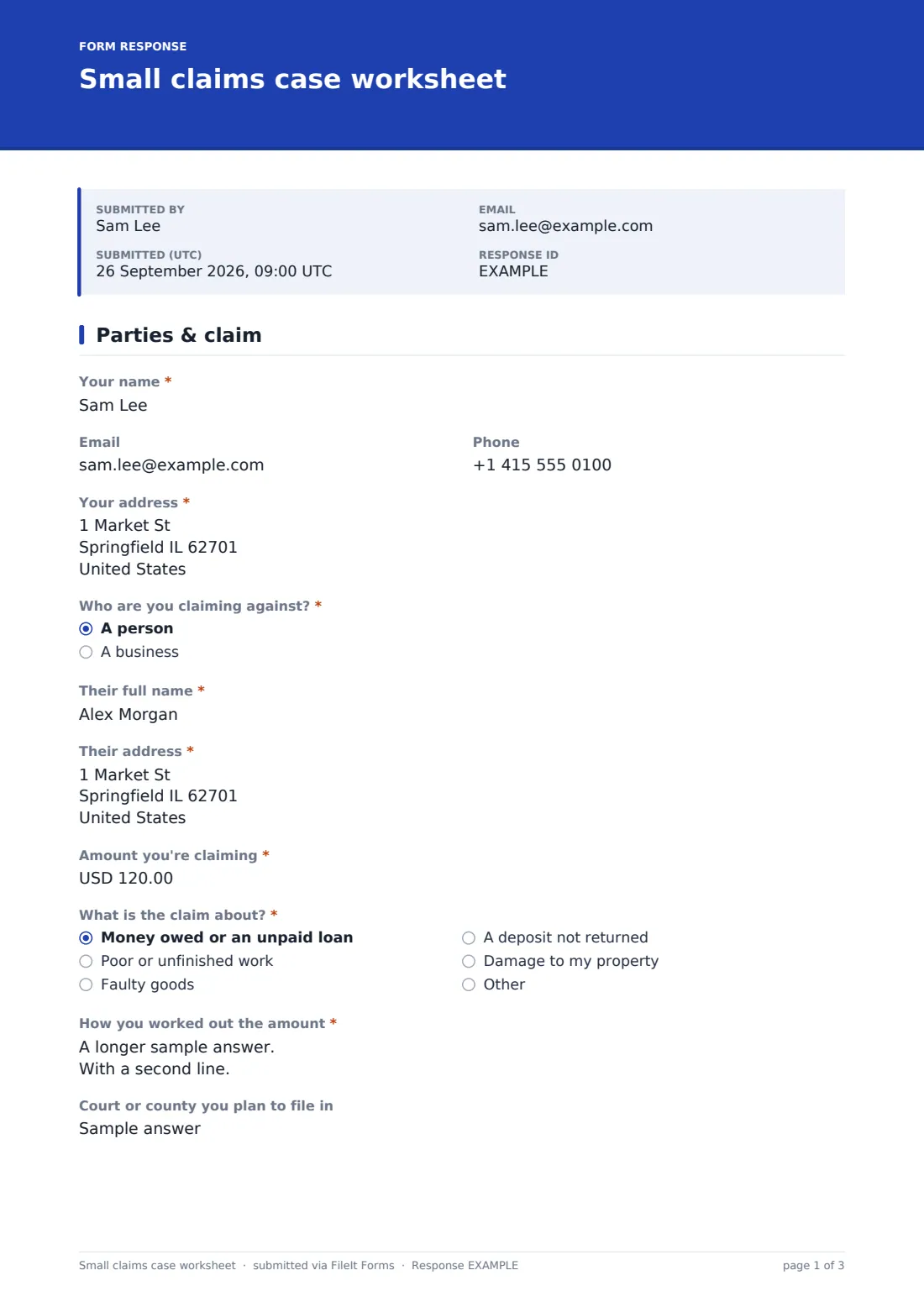
This worksheet walks you through the preparation. It isn't a court form, and the cover says so: courts have their own forms, limits and rules. Page one records you and the other side. "Who are you claiming against?" asks whether it's a person or a business. Choose a business and the form asks for the "Business's full legal name", with a reminder to check the state business register, plus the "Registered agent" and their address, which is often who receives court papers. You then enter the amount, what the claim is about, "How you worked out the amount" item by item, and the court you plan to file in.
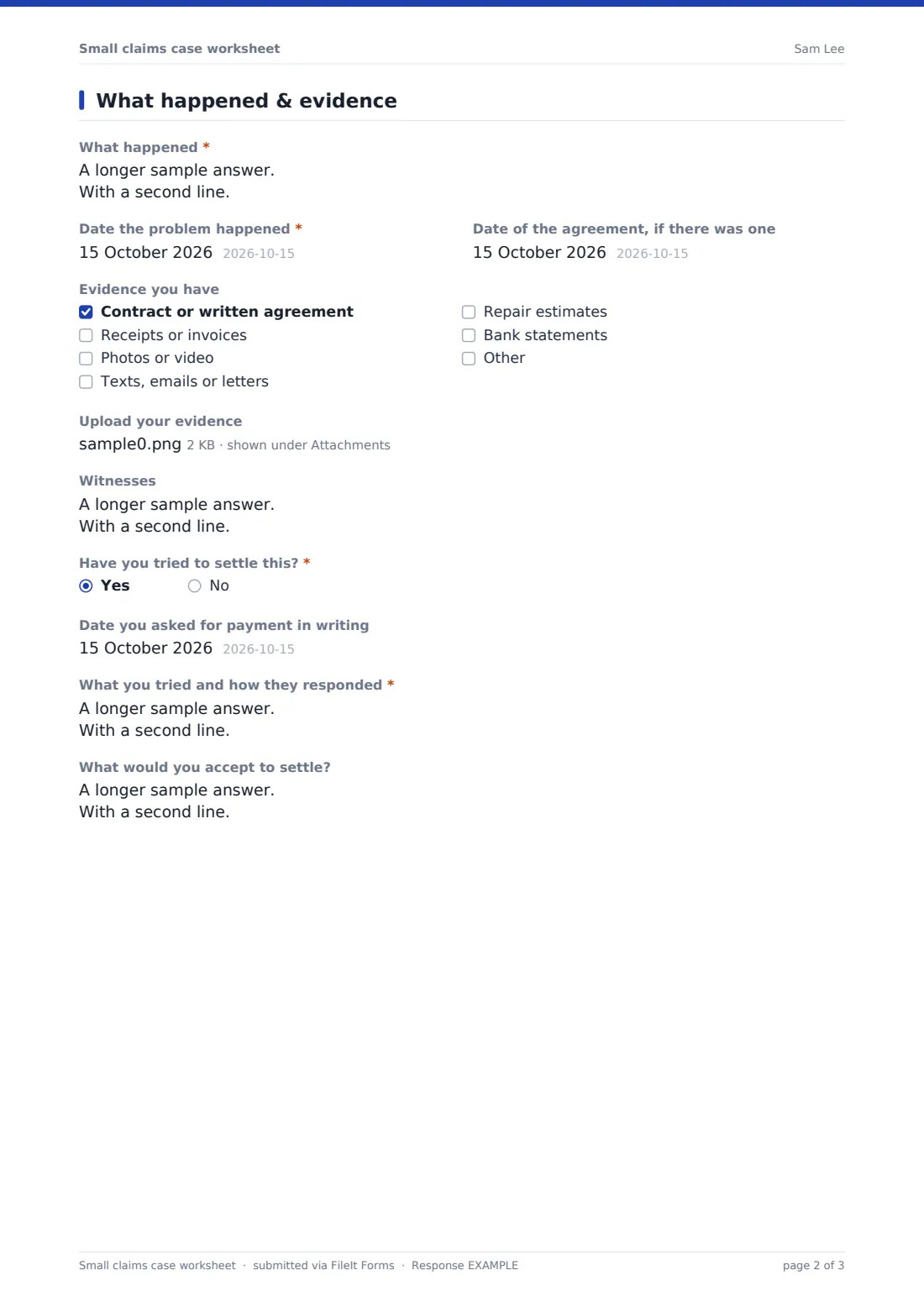
Page two is the case itself. "What happened" asks for the story in date order, followed by the date of the problem and of any agreement. A checklist of "Evidence you have" comes next, with uploads for up to ten files and a box for witnesses. "Have you tried to settle this?" opens the date you asked for payment in writing and how they responded. The finished worksheet is saved as a PDF in your FileIt vault with your evidence attached.
- Best for
- Individuals and small businesses preparing a small claims case
- Filled in by
- The person bringing the claim
- Time to complete
- About 20 minutes, longer with lots of evidence
- Includes
- Person or business defendant with registered agent, amount breakdown, timeline, evidence checklist and uploads, witnesses and settlement attempts
Who uses a small claims case worksheet form?
- A security deposit a landlord hasn't returned
- A contractor who took payment and didn't finish the job
- A friend or relative who hasn't repaid a loan
- Faulty goods a seller refuses to refund
- Damage to your car or property that the other person won't pay for
- A small business chasing an unpaid invoice
Questions on this small claims case worksheet form
24 questions over 2 pages · includes file upload, conditional questions, multiple pages.
1 Parties & claim
- Your name*
- Phone
- Your address*
- Who are you claiming against?* A person · A business
- Their full name* asked only when it applies
- Business's full legal name* asked only when it applies
- Registered agent asked only when it applies
- Registered agent's address asked only when it applies
- Their address*
- Amount you're claiming*
- What is the claim about?* Money owed or an unpaid loan · Poor or unfinished work · Faulty goods · A deposit not returned · Damage to my property
- How you worked out the amount*
- Court or county you plan to file in
2 What happened & evidence
- What happened*
- Date the problem happened*
- Date of the agreement, if there was one
- Evidence you have Contract or written agreement · Receipts or invoices · Photos or video · Texts, emails or letters · Repair estimates · Bank statements
- Upload your evidence
- Witnesses
- Have you tried to settle this?*
- Date you asked for payment in writing asked only when it applies
- What you tried and how they responded* asked only when it applies
- What would you accept to settle?
The small claims case worksheet form, page by page
1 Parties & claim
Your name, email, phone and address. "Who are you claiming against?" changes the next questions: a person asks for "Their full name"; a business asks for the full legal name, the registered agent and the agent's address. Their address is always required. Then "Amount you're claiming", "What is the claim about?" — money owed, poor or unfinished work, faulty goods, a deposit, property damage or other — and "How you worked out the amount", one item per line. "Court or county you plan to file in" is optional.
2 What happened & evidence
"What happened" asks for the events in date order, as you'd explain them to a stranger. "Date the problem happened" is required, and the date of any agreement is optional. "Evidence you have" ticks off contracts, receipts, photos, messages, repair estimates and bank statements. Up to ten files can be uploaded. Witnesses are listed one per line. A yes to "Have you tried to settle this?" opens the date you asked for payment in writing and "What you tried and how they responded". "What would you accept to settle?" closes the worksheet.
Make the template yours
- Change the currency if your court doesn't work in US dollars
- Add the court's claim limit to the help text so you know where you stand
- Add a question for the date you need to file by
- Use it as an intake form if you help people prepare small claims
- File the worksheet and evidence into one vault folder for the case
Tips for a better small claims case worksheet form
- Check the court's claim limit and filing deadline before you start
- Use the business's legal name, not the name on its sign
- Make sure your total matches the item-by-item breakdown
- Put the story in date order and keep opinions out of it
- Ask for payment in writing before filing — many courts like to see that you tried
- Bring printed copies of your evidence to court, one for you and each side
Every response becomes a PDF in your vault
The worksheet is filed as a PDF in your vault, with every uploaded document attached as its own file, and a copy is emailed to you if you gave an email.
Use it as your guide when filling in the court's claim form, and take it with you to the hearing so the dates and amounts are in front of you.
- Start from this template. It opens in the FileIt Forms designer — change any question, add pages, set the rules for when questions appear.
- Share it. Turn on a public link, or send it to people by email, each with their own link. They don’t need a FileIt account.
- Get the answers as PDFs. Each response is saved as a PDF in the vault folder you choose, with uploaded files attached — and listed in a Responses table you can export to CSV.
Small claims case worksheet form: frequently asked questions
Is this small claims worksheet free?
Yes. It's a starter template in FileIt's Forms app, available on every plan including free.
Can I file this with the court?
No. It's a preparation worksheet. Courts have their own claim forms — use this to fill them in accurately.
Does it tell me whether I'll win?
No. It organises your facts and evidence. For advice on your case, speak to a legal aid service or a lawyer.
Why does it ask for a registered agent?
Businesses often name a registered agent to receive legal papers. The form asks only when you're claiming against a business.
How much evidence can I upload?
Up to ten files — PDFs, images or Word documents.