What is the bad debt write-off request form template?
Every business that sells on credit ends up with balances it will never collect. Writing them off is routine, but it's also one of the entries auditors and owners like to question: was the money really gone, did anyone try to collect it, and who decided? When the answer lives in a few emails and a note in the accounting system, it's hard to show.
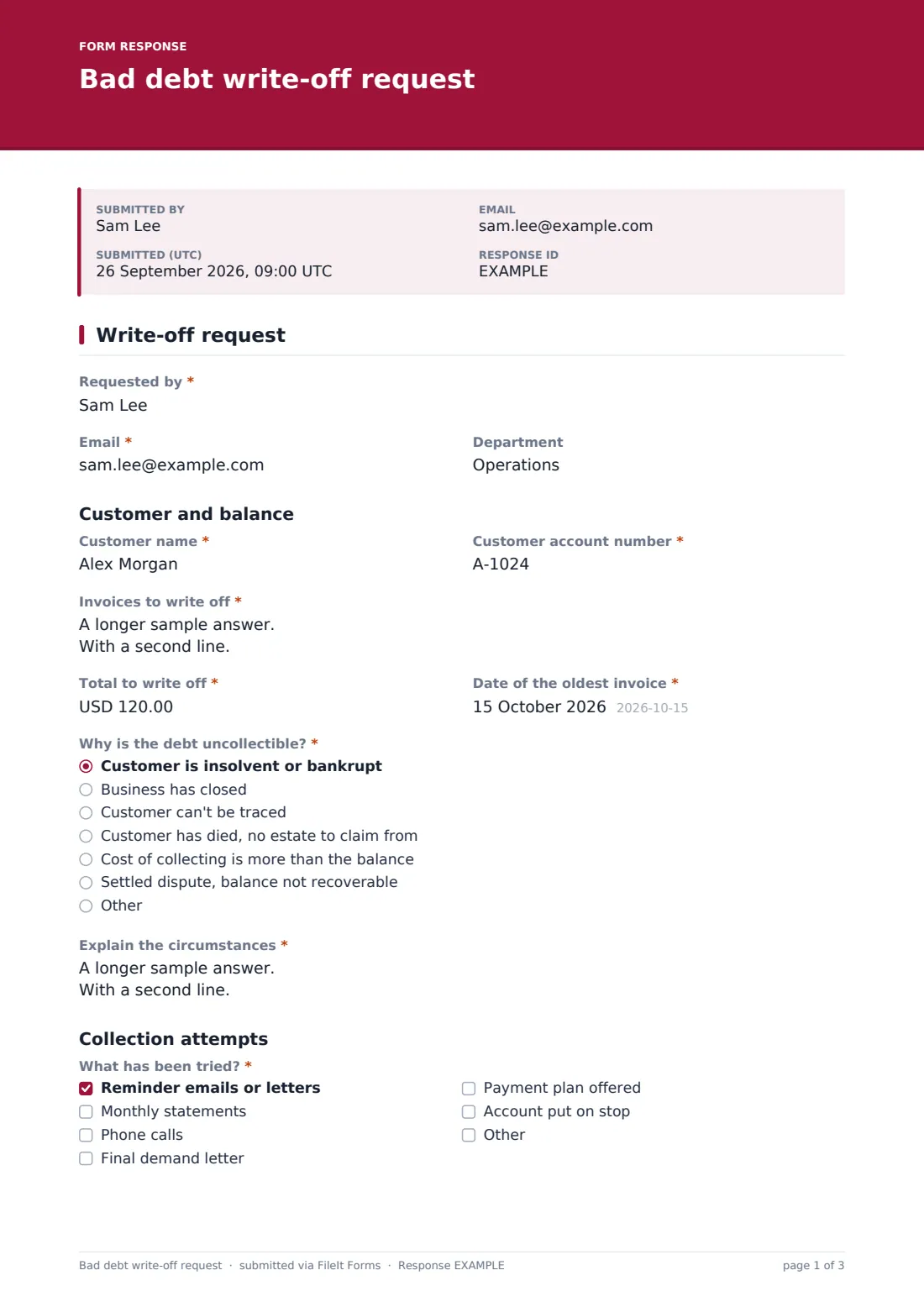
This one-page write-off request puts the case in one place. The requester names the customer and account, lists the invoices with the total and the date of the oldest one, and picks the reason from a short list: insolvency, a closed business, a customer who can't be traced, a death with no estate, a balance too small to chase, or a settled dispute. What has been tried? records the collection steps, from reminders and phone calls to a final demand and putting the account on stop.
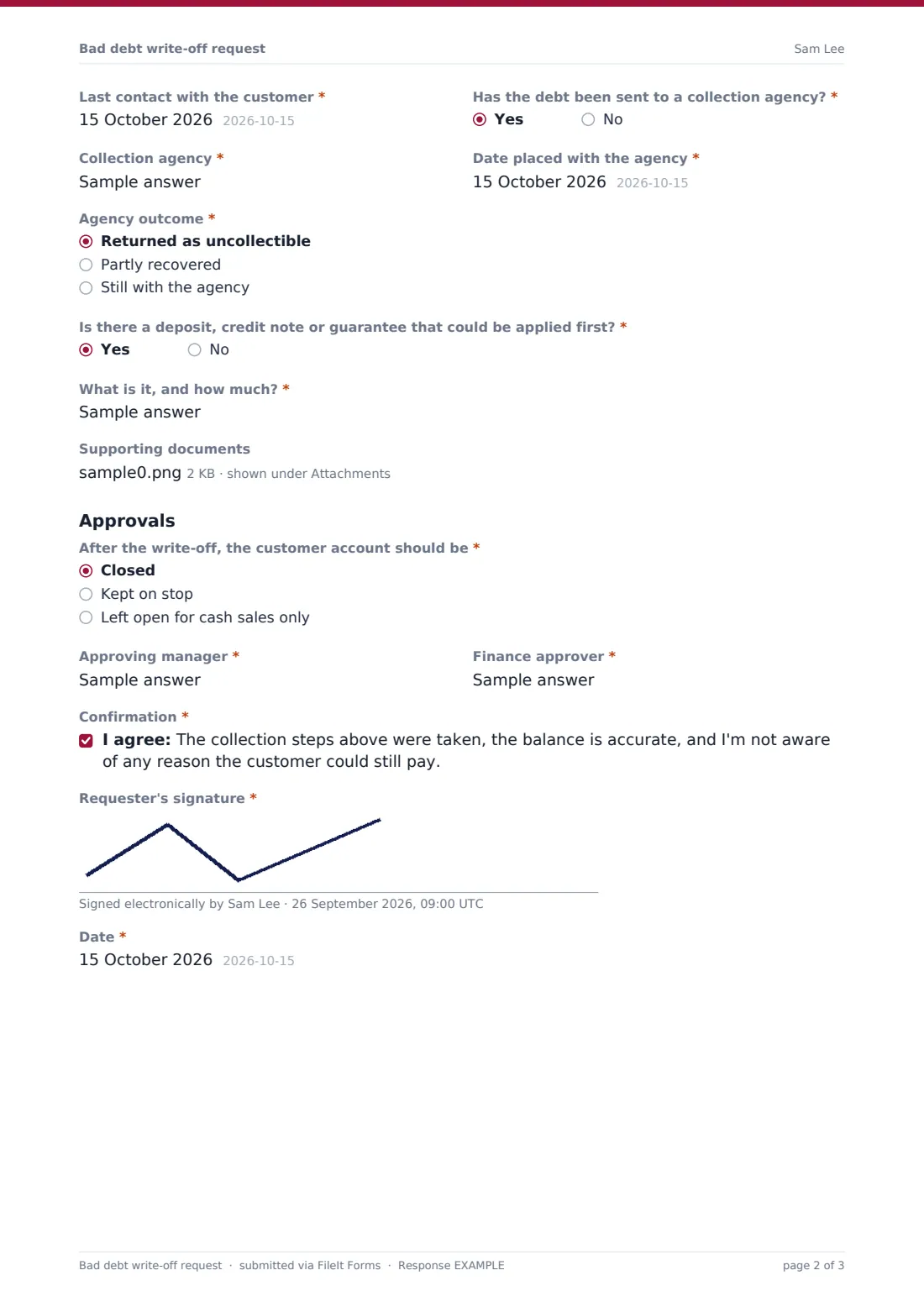
Answering yes to Has the debt been sent to a collection agency? asks which agency, when, and what came of it, including any amount recovered. The request ends with the approving manager, the finance approver and a signed confirmation, and is filed as a PDF in your FileIt vault with the evidence attached.
- Best for
- Credit controllers, small finance teams and bookkeepers
- Filled in by
- The person who chased the debt, usually credit control or accounts receivable
- Time to complete
- About 5 minutes
- Includes
- Invoice list, reasons, collection history, agency follow-up, offsets and two named approvers
Who uses a bad debt write-off request form?
- A wholesaler writing off a retailer that has gone into administration
- An agency clearing a small balance that costs more to chase than it's worth
- A landlord's accountant writing off rent arrears from a tenant who left without a forwarding address
- A finance team tidying the aged debtors report before year end
- A trades business recording an agency's "uncollectible" return
- Preparing documentation that the external accountant can review at year end
Questions on this bad debt write-off request form
26 questions · includes signature, file upload, conditional questions, consent checkbox.
1 Write-off request
- Requested by*
- Email*
- Department
- Customer name*
- Customer account number*
- Invoices to write off*
- Total to write off*
- Date of the oldest invoice*
- Why is the debt uncollectible?* Customer is insolvent or bankrupt · Business has closed · Customer can't be traced · Customer has died, no estate to claim from · Cost of collecting is more than the balance · Settled dispute, balance not recoverable · Other
- Explain the circumstances*
- What has been tried?* Reminder emails or letters · Monthly statements · Phone calls · Final demand letter · Payment plan offered · Account put on stop
- Last contact with the customer*
- Has the debt been sent to a collection agency?*
- Collection agency* asked only when it applies
- Date placed with the agency* asked only when it applies
- Agency outcome* asked only when it applies Returned as uncollectible · Partly recovered · Still with the agency
- Amount recovered by the agency* asked only when it applies
- Is there a deposit, credit note or guarantee that could be applied first?*
- What is it, and how much?* asked only when it applies
- Supporting documents
- After the write-off, the customer account should be* Closed · Kept on stop · Left open for cash sales only
- Approving manager*
- Finance approver*
- Confirmation*
- Requester's signature*
- Date*
The bad debt write-off request form, page by page
1 Write-off request
The form starts with Requested by, email and department. Under Customer and balance come the Customer name, Customer account number, Invoices to write off (one per line, with number, date and amount), Total to write off and Date of the oldest invoice. Why is the debt uncollectible? offers seven answers including insolvency, a closed business and a balance that costs more to collect than it's worth, and Explain the circumstances asks for the story behind it.
Under Collection attempts, What has been tried? lists reminder emails or letters, monthly statements, phone calls, a final demand letter, an offered payment plan and putting the account on stop, plus Other. The requester gives the date of the last contact. A Yes to Has the debt been sent to a collection agency? asks for the agency, the date it was placed and the Agency outcome. A partial recovery asks how much came back.
Is there a deposit, credit note or guarantee that could be applied first? catches money that could reduce the write-off. Supporting documents are optional.
Under Approvals, the requester says whether the account should be closed, kept on stop or left open for cash sales, names the Approving manager and Finance approver, confirms the facts and signs.
Make the template yours
- Add your write-off approval limits to the cover text, so requesters know who has to sign
- Replace the free-text approver fields with dropdowns of your managers
- Make Supporting documents required above a certain amount
- Change the currency for the total and recovered amounts
- Add a field for the accounting period the write-off should post in
- Route requests to a finance-only vault folder
Tips for a better bad debt write-off request form
- Write off only after your normal collection steps are complete, and record the dates
- Check for credit notes, deposits or guarantees before writing off the full balance
- Keep the agency's closing letter; it's often the strongest evidence a debt is gone
- Ask your accountant how write-offs should be treated in your books and for tax; the form records the decision only
- Put the customer on stop at the same time, so the next order doesn't start a new debt
Every response becomes a PDF in your vault
The request is saved as a signed PDF in the vault folder you pick, with statements and letters attached. You're notified by email, and you can add the finance approver to the notification list.
From the Responses table you can see every write-off requested, search by customer, and export to CSV for the year-end file or a bad debt review.
- Start from this template. It opens in the FileIt Forms designer — change any question, add pages, set the rules for when questions appear.
- Share it. Turn on a public link, or send it to people by email, each with their own link. They don’t need a FileIt account.
- Get the answers as PDFs. Each response is saved as a PDF in the vault folder you choose, with uploaded files attached — and listed in a Responses table you can export to CSV.
Bad debt write-off request form: frequently asked questions
Is this bad debt write-off template free?
Yes. It's a starter template in FileIt's Forms app on every account, and you can edit any question.
Does submitting the form write off the debt in my accounts?
No. It records the request and approvals. The journal is posted in your accounting software.
Can approvers sign the form too?
The form names the approving manager and finance approver. If you need their signatures, send the filed PDF for signature with FileIt's e-signature.
What if the agency recovered part of the balance?
Choose Partly recovered as the agency outcome and the form asks for the amount recovered, so the write-off reflects only what's still owed.
Does this decide the tax treatment?
No. Tax rules on bad debts vary, so check with your accountant. The form gives them the facts they'll ask for.
Who can fill it in?
Anyone you share the link with. They don't need a FileIt account.