What is the code enforcement complaint form template?
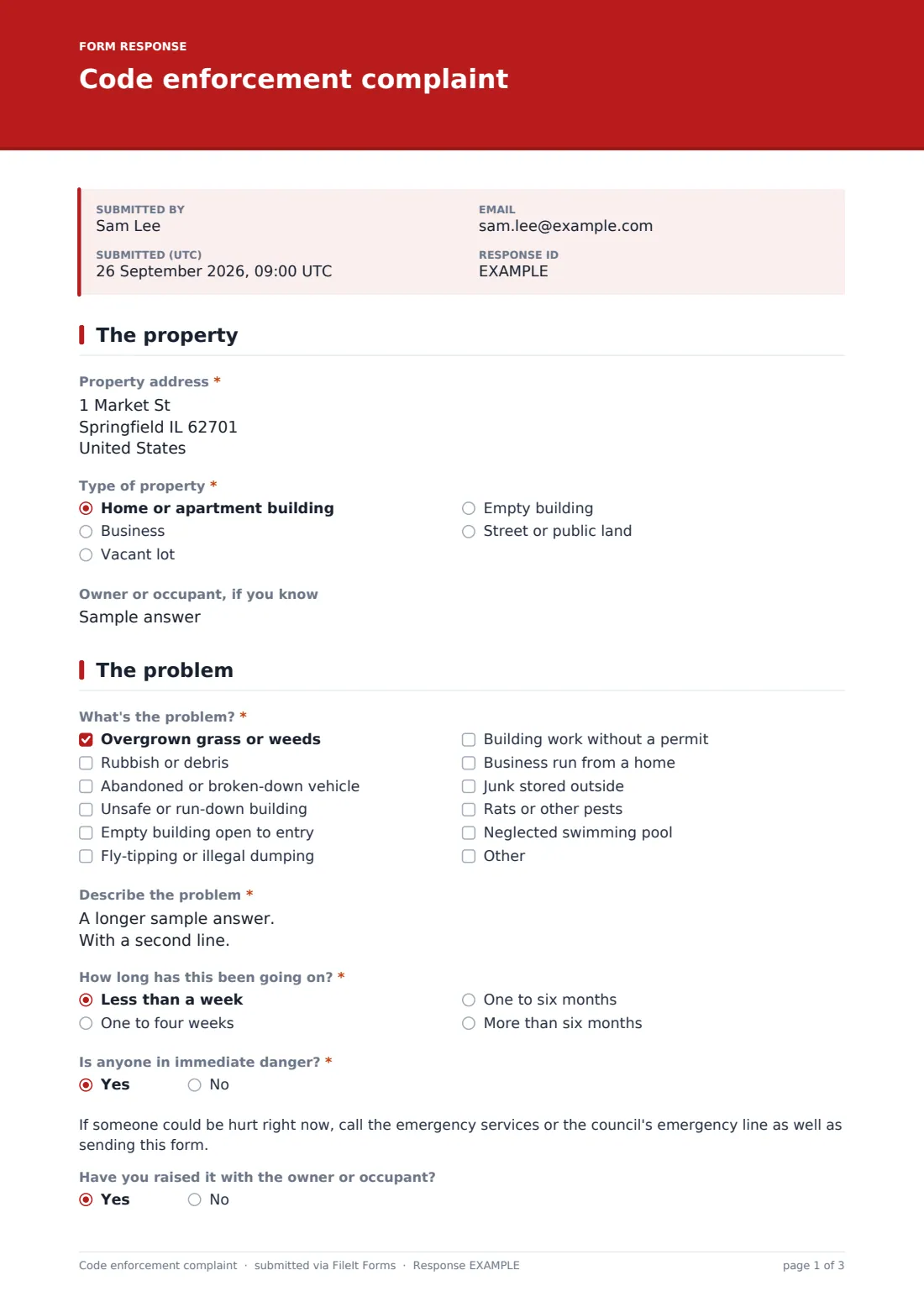
Code enforcement officers need to know where the property is, what's wrong, how long it's been going on and whether anyone is in danger. This form asks those questions first and takes photos, with a reminder not to go onto someone else's land to take them.
Follow-ups depend on the problem. An abandoned or broken-down vehicle asks for the make, colour and plate and whether it's on the street or private land. Building work without a permit asks what work is going on. Saying someone is in immediate danger shows a note telling the resident to call the emergency services as well.
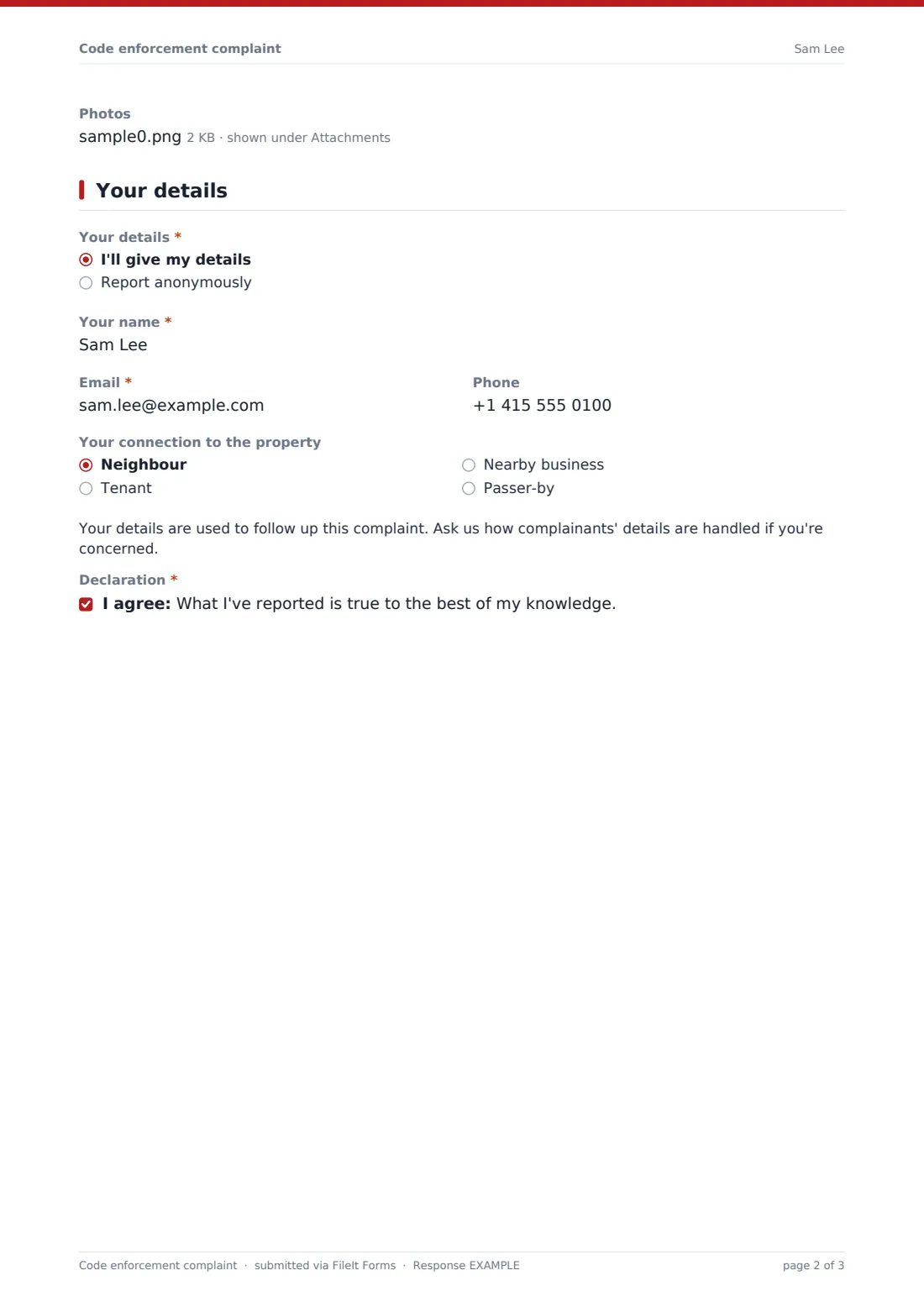
Residents can report anonymously; a note explains that you can't update them or ask follow-up questions. Each complaint is saved as a PDF in FileIt with the photos attached.
- Best for
- Code enforcement, building, housing and environmental health departments
- Filled in by
- Neighbours, tenants, businesses and passers-by
- Time to complete
- About 4 minutes
- Includes
- Property address, type, occupant, problem types, vehicle details, unpermitted work, description, duration, danger, owner contact, photos, optional contact, connection, declaration
Who uses a code enforcement complaint form?
- Long grass and rubbish on a vacant lot
- A car without plates left on a driveway for months
- An empty house with broken windows open to entry
- Building work going on without a permit
- A neglected pool attracting mosquitoes
Questions on this code enforcement complaint form
18 questions over 3 pages · includes file upload, conditional questions, multiple pages, consent checkbox.
1 The property
- Property address*
- Type of property* Home or apartment building · Business · Vacant lot · Empty building · Street or public land
- Owner or occupant, if you know
2 The problem
- What's the problem?* Overgrown grass or weeds · Rubbish or debris · Abandoned or broken-down vehicle · Unsafe or run-down building · Empty building open to entry · Fly-tipping or illegal dumping · Building work without a permit · Business run from a home · Junk stored outside · Rats or other pests · Neglected swimming pool
- Vehicle make, colour and plate* asked only when it applies
- Where is the vehicle?* asked only when it applies On the street · On private land
- What work is going on? asked only when it applies
- Describe the problem*
- How long has this been going on?* Less than a week · One to four weeks · One to six months · More than six months
- Is anyone in immediate danger?*
- Have you raised it with the owner or occupant?
- Photos
3 Your details
- Your details* I'll give my details · Report anonymously
- Your name* asked only when it applies
- Email* asked only when it applies
- Phone asked only when it applies
- Your connection to the property asked only when it applies Neighbour · Tenant · Nearby business · Passer-by
- Declaration*
The code enforcement complaint form, page by page
1 The property
"Property address", "Type of property" (home, business, vacant lot, empty building, or street or public land) and the owner or occupant if known.
2 The problem
"What's the problem?" lists overgrowth, rubbish, abandoned vehicles, unsafe buildings, empty buildings open to entry, dumping, unpermitted work, home businesses, junk stored outside, pests and neglected pools. Vehicles ask for details and where it is, unpermitted work asks what's going on. Then a description, "How long has this been going on?", "Is anyone in immediate danger?", whether it's been raised with the owner, and photos.
3 Your details
"Your details" lets the resident give their details or report anonymously. Named reports ask for name, email, phone and "Your connection to the property", with a privacy note. Everyone confirms the report is true as far as they know.
Make the template yours
- Rename the problem types to match the sections of your local code
- Put your emergency number in the danger note
- Edit the privacy note to explain exactly how your department handles complainants' details
- Notify the inspector for each area by email
- Remove the anonymous option if your policy needs a named complainant
Tips for a better code enforcement complaint form
- Check for open cases at the same address before assigning an inspector
- Use the duration answer to prioritise long-running problems
- Call back named complainants if the photos aren't clear
- Keep complaints with the inspection notes for each property
- Export complaints to CSV to spot repeat addresses
Every response becomes a PDF in your vault
Each complaint is saved as a PDF in the folder you choose, with photos attached, and your code enforcement team is emailed.
The Responses table lists complaints by address and problem type. Export to CSV to load them into your case system.
- Start from this template. It opens in the FileIt Forms designer — change any question, add pages, set the rules for when questions appear.
- Share it. Turn on a public link, or send it to people by email, each with their own link. They don’t need a FileIt account.
- Get the answers as PDFs. Each response is saved as a PDF in the vault folder you choose, with uploaded files attached — and listed in a Responses table you can export to CSV.
Code enforcement complaint form: frequently asked questions
Is this code enforcement template free?
Yes. It's one of the starter templates in the Forms app, included on every FileIt account, and you can edit any question.
Can people complain anonymously?
Yes. They choose "Report anonymously" and the contact questions are skipped. A note explains you can't send them updates.
Will the property owner find out who complained?
The form doesn't share anything with the owner. How complainants' details are handled depends on your policies and public records laws, so edit the privacy note to explain yours.
Do residents need a FileIt account?
No. Residents open your link, answer the questions and submit. No account is needed.
Does the form open a case in our system?
No. Complaints are saved as PDFs and in the Responses table. Copy them across or import the CSV.