What is the chimney inspection report form template?
Homeowners rarely see the inside of their own chimney, so a sweep's report is how they find out whether the fire they light next weekend is safe. A clear record with photos is also how a sweep explains a repair recommendation without it sounding like an upsell.
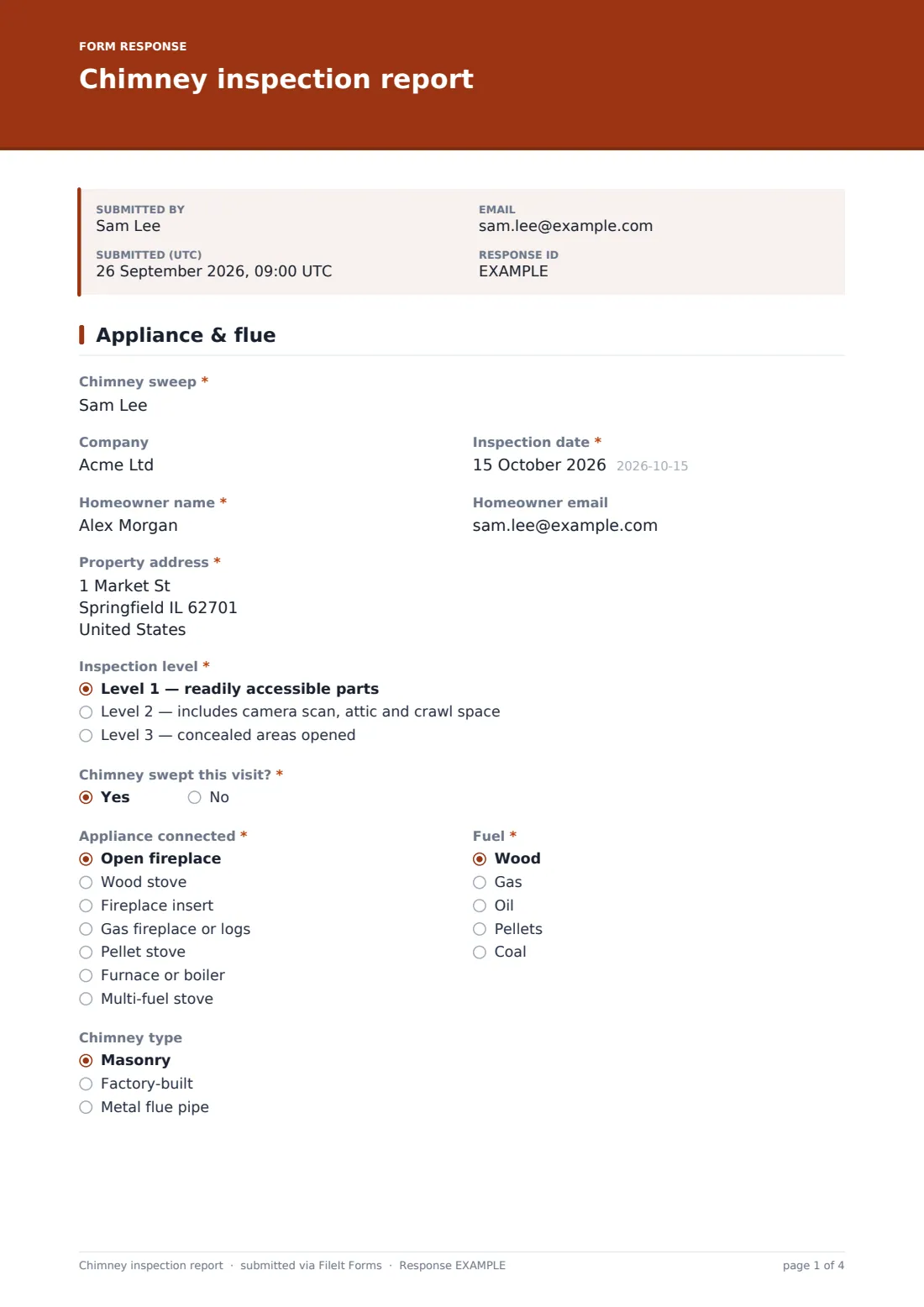
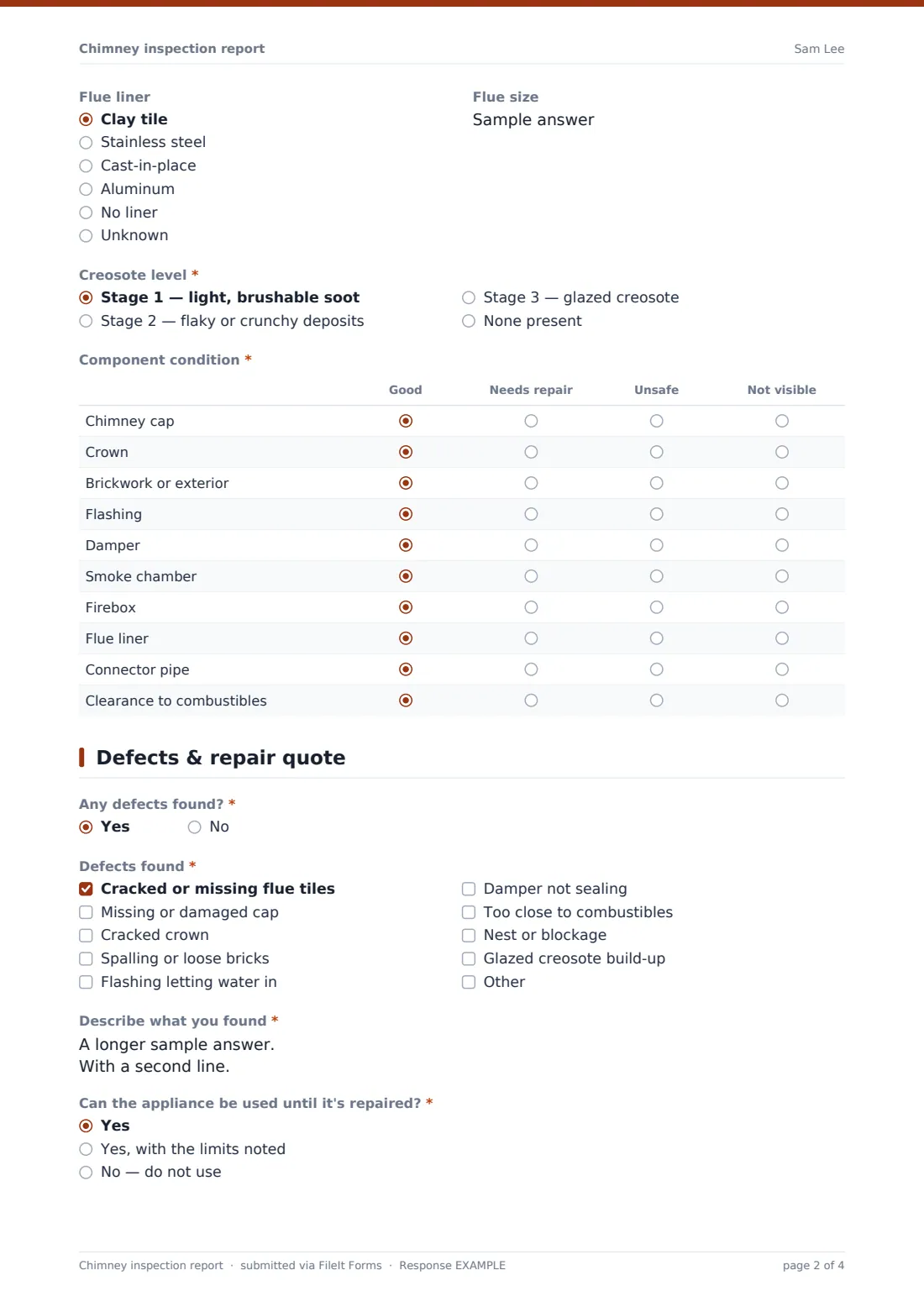
This template captures a chimney inspection over two short pages. The first records the inspection level, the appliance and fuel, the chimney type, the liner, the creosote stage and the condition of ten components from the cap down to the clearance to combustibles. The second starts with one question — "Any defects found?" — and a yes opens the list of defects, a description, a clear answer on whether the appliance can be used meanwhile, and a repair quote section with price and validity date.
Every report is filed as a PDF in your FileIt vault, camera stills included, and the homeowner can receive their own copy by email.
- Best for
- Chimney sweeps, fireplace and stove installers, and home inspectors
- Filled in by
- The sweep or inspector, at the property
- Time to complete
- About 6–8 minutes
- Includes
- Creosote stage, 10-part condition grid, defects, repair quote, photos
Who uses a chimney inspection report form?
- An annual sweep and Level 1 inspection before the heating season
- A camera inspection when a home with a wood stove changes hands
- Checking a chimney after a chimney fire or a lightning strike
- Inspecting before a new insert or stove is connected to an old flue
- A homeowner reporting smoke spilling into the room
- A landlord keeping inspection records for rental homes with fireplaces
Questions on this chimney inspection report form
28 questions over 2 pages · includes signature, file upload, conditional questions, multiple pages, ratings.
1 Appliance & flue
- Chimney sweep*
- Company
- Inspection date*
- Homeowner name*
- Homeowner email
- Property address*
- Inspection level* Level 1 — readily accessible parts · Level 2 — includes camera scan, attic and crawl space · Level 3 — concealed areas opened
- Chimney swept this visit?*
- Appliance connected* Open fireplace · Wood stove · Fireplace insert · Gas fireplace or logs · Pellet stove · Furnace or boiler · Multi-fuel stove
- Fuel* Wood · Gas · Oil · Pellets · Coal
- Chimney type Masonry · Factory-built · Metal flue pipe
- Flue liner Clay tile · Stainless steel · Cast-in-place · Aluminum · No liner · Unknown
- Flue size
- Creosote level* Stage 1 — light, brushable soot · Stage 2 — flaky or crunchy deposits · Stage 3 — glazed creosote · None present
- Component condition* Good · Needs repair · Unsafe · Not visible
2 Defects & repair quote
- Any defects found?*
- Defects found* asked only when it applies Cracked or missing flue tiles · Missing or damaged cap · Cracked crown · Spalling or loose bricks · Flashing letting water in · Damper not sealing · Too close to combustibles · Nest or blockage · Glazed creosote build-up
- Describe what you found* asked only when it applies
- Can the appliance be used until it's repaired?* asked only when it applies Yes · Yes, with the limits noted · No — do not use
- Recommended repairs* asked only when it applies
- Quoted price asked only when it applies
- Quote valid until asked only when it applies
- Photos
- Notes for the homeowner
- Next sweep or inspection
- Charged today
- Homeowner signature
- Sweep signature*
The chimney inspection report form, page by page
1 Appliance & flue
The Chimney sweep, Company, Inspection date, Homeowner name, Homeowner email and Property address come first. Inspection level is Level 1, Level 2 with a camera scan and attic and crawl space, or Level 3 with concealed areas opened, and "Chimney swept this visit?" is a simple yes or no.
Appliance connected and Fuel describe what's burning, from an open fireplace to a pellet stove or boiler. Chimney type, Flue liner and Flue size describe the flue. Creosote level is required, from Stage 1 light soot to Stage 3 glazed creosote, or none present. The Component condition grid rates the cap, crown, brickwork, flashing, damper, smoke chamber, firebox, flue liner, connector pipe and clearance to combustibles as good, needs repair, unsafe or not visible.
2 Defects & repair quote
The second page asks "Any defects found?". Answering yes reveals Defects found — cracked flue tiles, a damaged cap or crown, spalling bricks, leaking flashing, a damper that won't seal, combustibles too close, a nest or blockage, or glazed creosote — plus "Describe what you found" and "Can the appliance be used until it's repaired?".
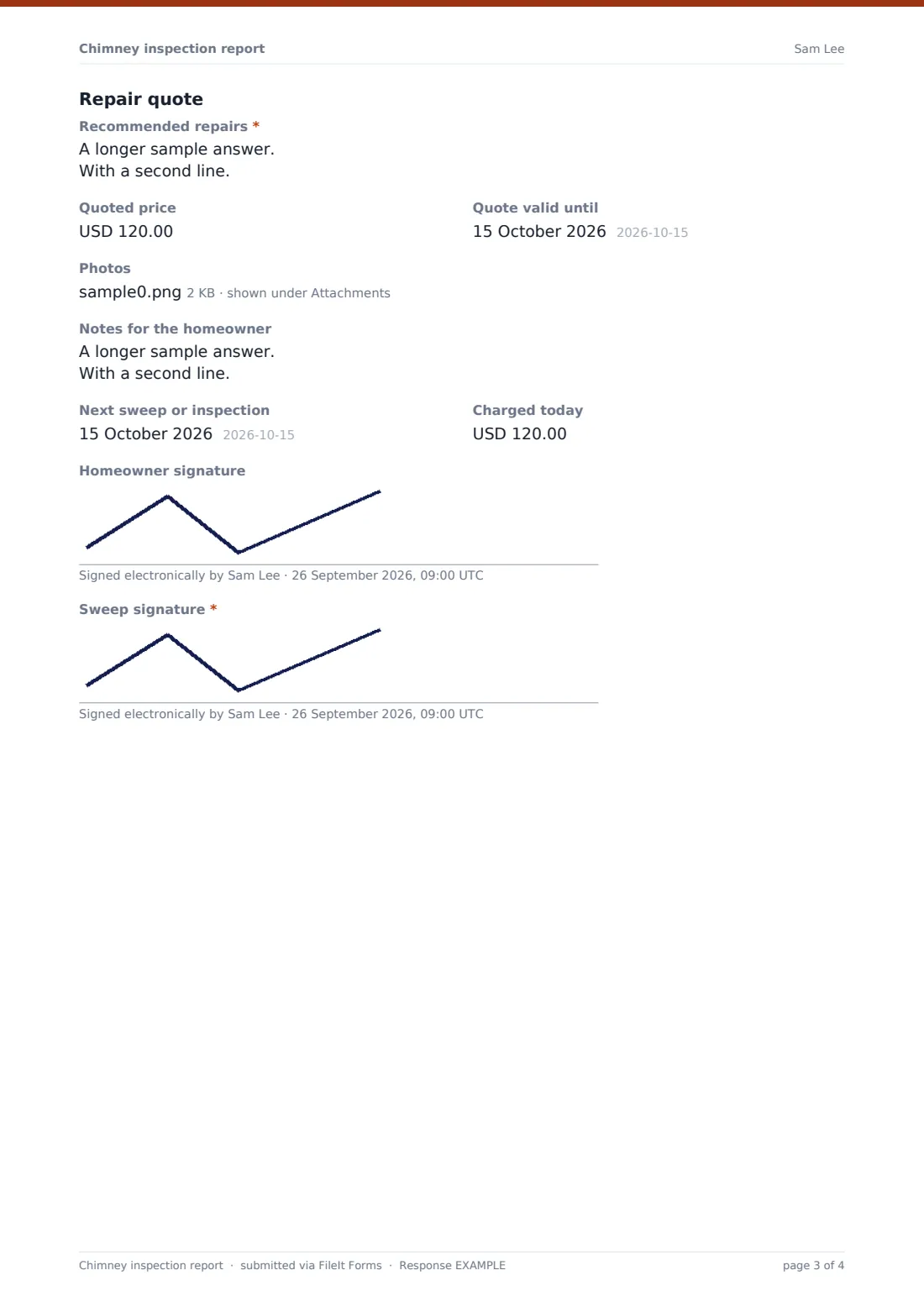
The Repair quote section follows with Recommended repairs, Quoted price and Quote valid until. Every report can carry up to ten photos, Notes for the homeowner, the next sweep date and the amount charged today, then the homeowner's and the sweep's signatures.
Make the template yours
- Remove the inspection levels you don't offer, or rename them to match your local standard
- Add a row to the condition grid for a chimney chase, cricket or rain pan
- Change the currency on the quote and the charge
- Make the homeowner's signature required if your company always gets one
- Copy your office on every report so quotes are followed up the same day
- File each address in its own folder to keep years of sweeps together
Tips for a better chimney inspection report form
- Take the "before" photo of the firebox before you lay a single drop cloth
- Name the creosote stage plainly — homeowners remember the photo, not the term
- If you answer "No — do not use", tell the homeowner face to face too
- Quote while you still remember the access, ladder and scaffold needs
- Note the flue size every time; it saves a trip when quoting a liner
- Set the next visit date before you leave, while the homeowner is listening
Every response becomes a PDF in your vault
The inspection is saved as a PDF in your FileIt vault, named with the date, with every photo and signature in it. The homeowner gets a copy if their email was entered, and the account owner is notified.
Sweeps usually work through open quotes from the Responses table and export next-visit dates to CSV to plan the following season's reminders.
- Start from this template. It opens in the FileIt Forms designer — change any question, add pages, set the rules for when questions appear.
- Share it. Turn on a public link, or send it to people by email, each with their own link. They don’t need a FileIt account.
- Get the answers as PDFs. Each response is saved as a PDF in the vault folder you choose, with uploaded files attached — and listed in a Responses table you can export to CSV.
Chimney inspection report form: frequently asked questions
Is this chimney inspection report template free?
Yes. It's included in the Forms app on every FileIt account, including the free plan.
Does it cover gas and pellet appliances?
Yes. The appliance list includes gas fireplaces and logs, pellet stoves, and furnaces or boilers, alongside wood-burning options.
When does the repair quote appear?
Answer yes to "Any defects found?" and the defects list, description, safe-to-use question and the repair quote section all open.
How many photos can I attach?
Up to ten per report. They're stored with the response and appear in the PDF.
Can the homeowner sign on my tablet?
Yes. Both signatures are drawn on screen, and the homeowner doesn't need a FileIt account.
Does the form decide if a chimney is safe?
No. It records your findings and your judgement. The wording of every option can be changed to fit how you report.