What is the adverse reaction report form template?
Pharmacies, clinics, vaccination services and manufacturers need to hear about suspected side effects, so they can follow up with the patient and spot problems with a product or batch. A useful report says who was affected, exactly which product and batch was involved, what happened and when, how serious it was and how the person is now.
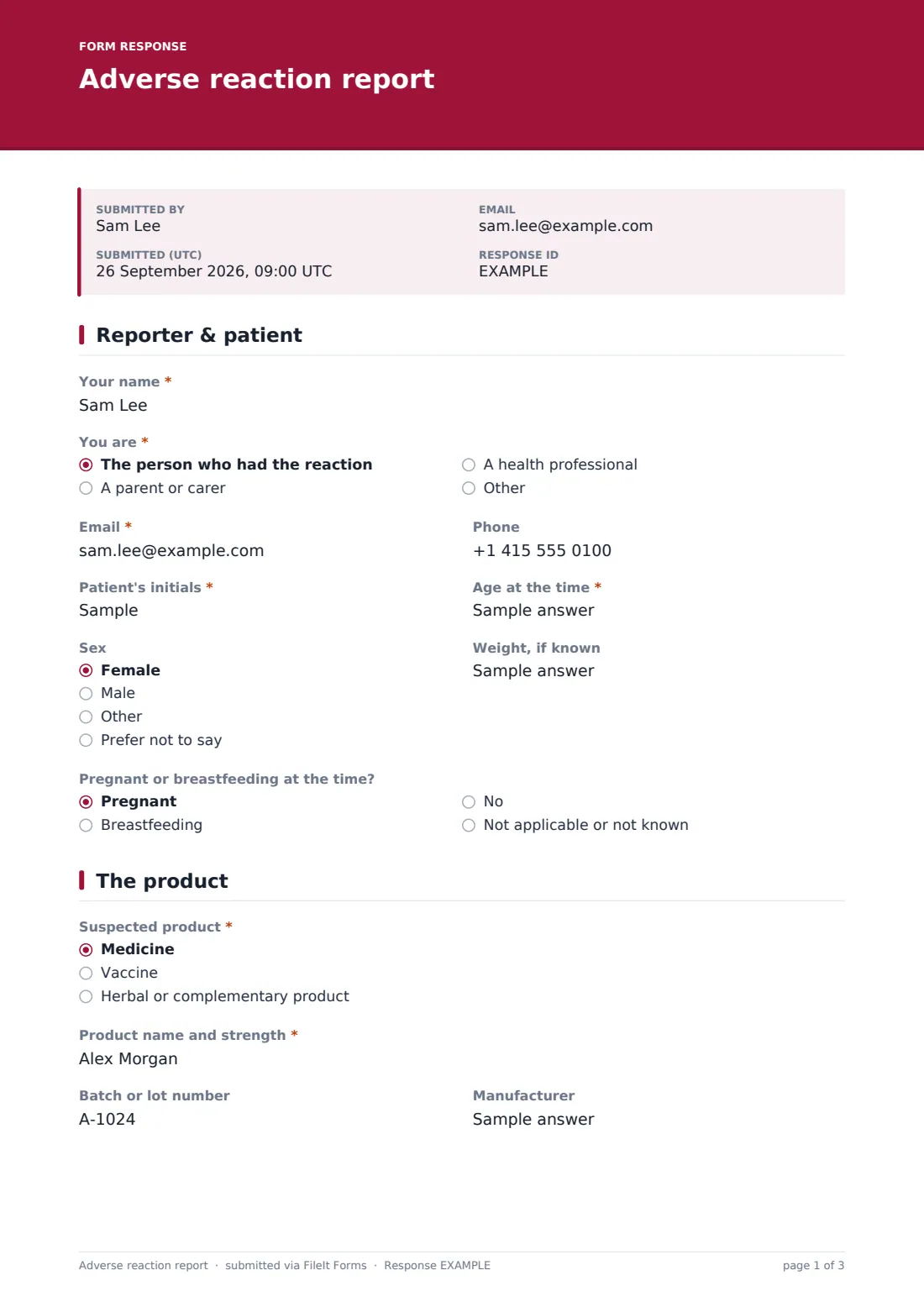
This template can be completed by the person affected, a parent or carer, or a health professional. It identifies the patient by initials, age, sex, weight and pregnancy status rather than full name. The product page records whether it was a medicine, vaccine or herbal product, its name and strength, batch number, manufacturer, dose or vaccine dose number, route, reason for use, start and stop dates, and other recent medicines.
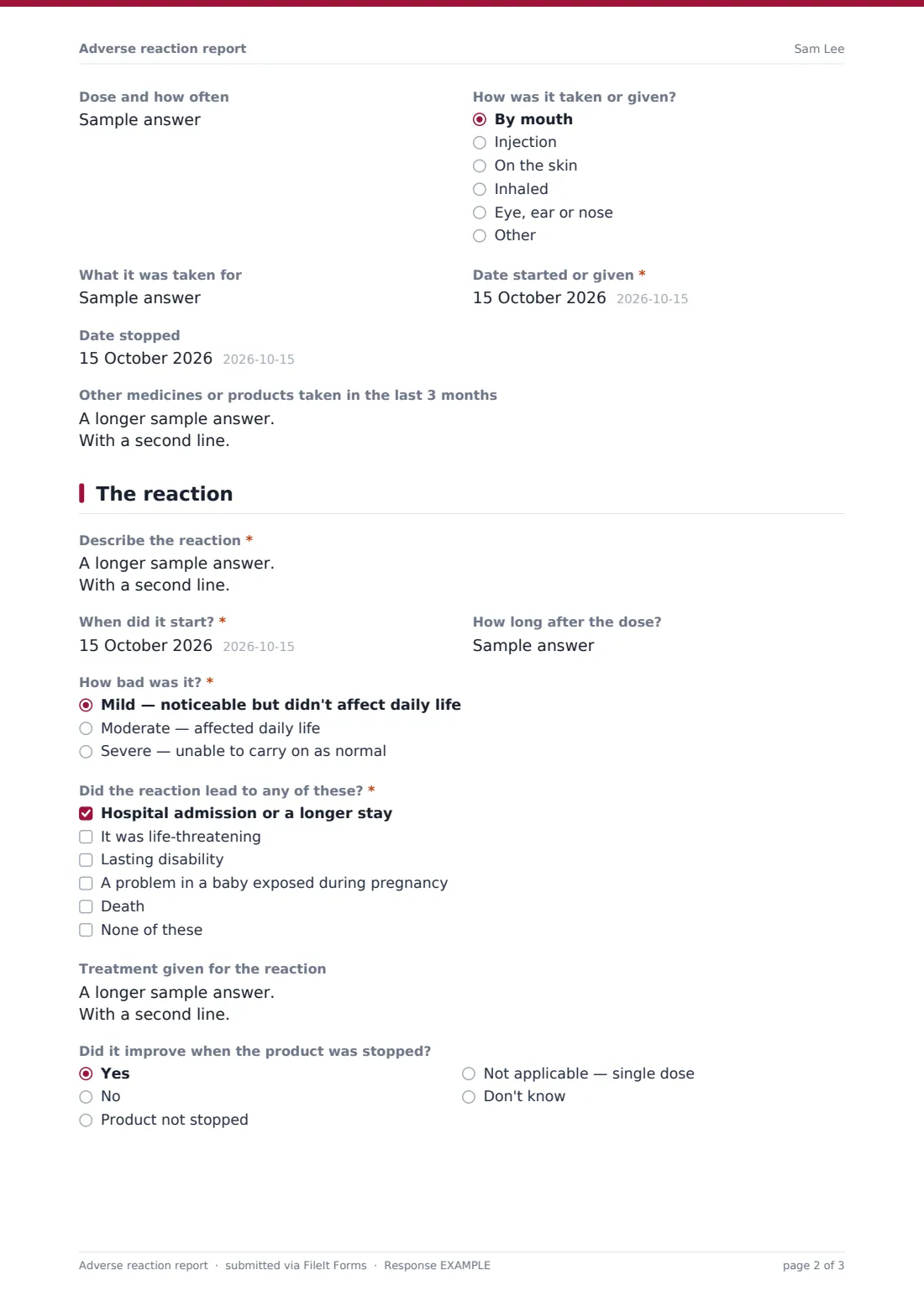
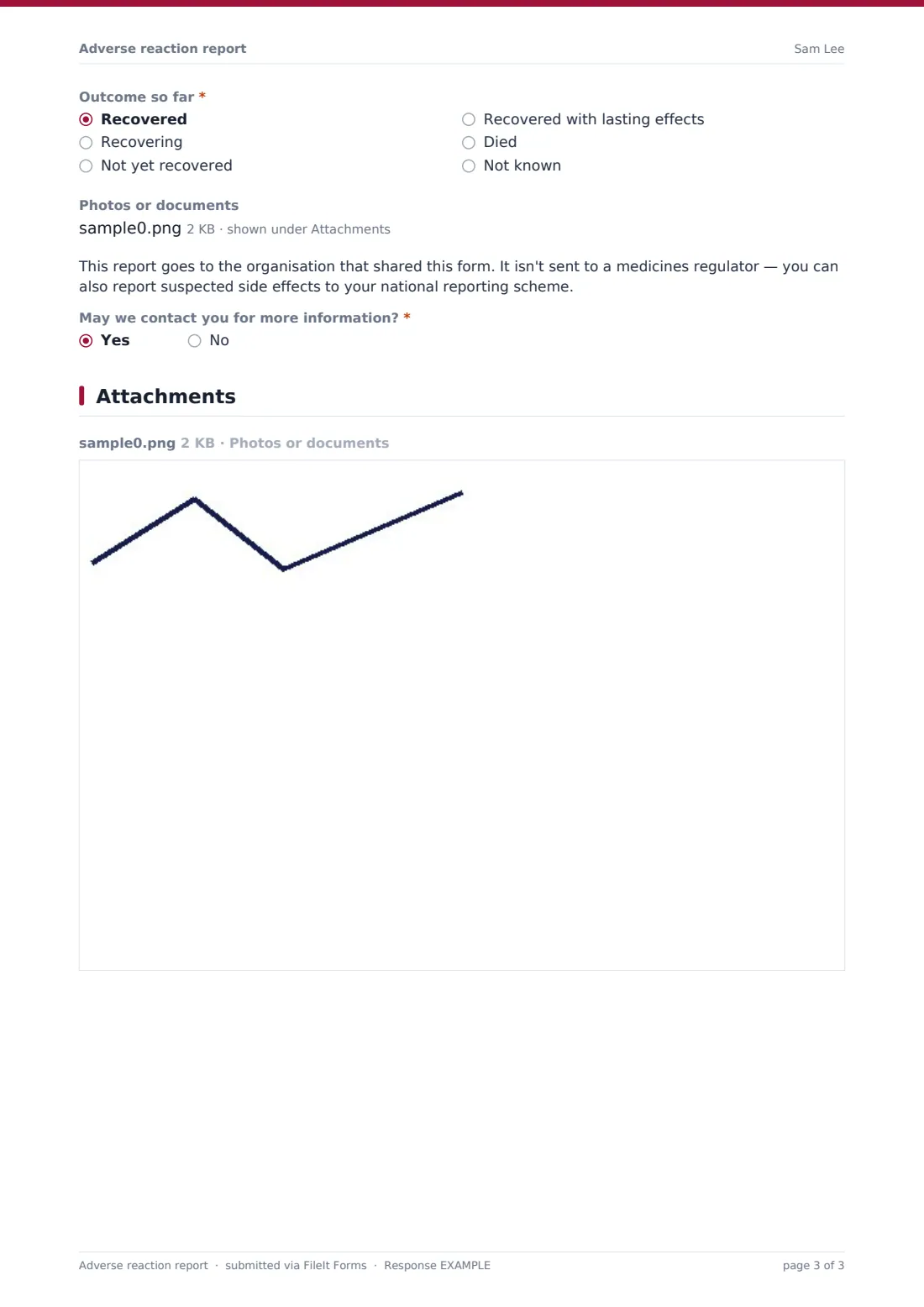
The reaction page asks for a description, onset and time after the dose, severity, serious outcomes such as hospital admission, treatment, whether it improved when the product was stopped and the outcome so far, with photos or documents. A note makes clear the report isn't sent to a regulator. Each report is saved as a PDF in FileIt.
- Best for
- Pharmacies, clinics, vaccination services, care homes and product manufacturers
- Filled in by
- The patient, a parent or carer, or a health professional
- Time to complete
- About 6 minutes
- Includes
- Reporter and patient details, product with batch and dose, reaction timeline, severity and seriousness, outcome, uploads and contact permission
Who uses a adverse reaction report form?
- A pharmacy collecting side-effect reports from customers
- Vaccination clinics following up reactions after a session
- Care homes recording a suspected reaction in a resident
- Clinics gathering details before reporting to a regulator
- Manufacturers or distributors taking reports from the public
- Occupational health teams after a workplace vaccination programme
Questions on this adverse reaction report form
31 questions over 3 pages · includes file upload, conditional questions, multiple pages.
1 Reporter & patient
- Your name*
- You are* The person who had the reaction · A parent or carer · A health professional
- Email*
- Phone
- Your profession and workplace asked only when it applies
- Patient's initials*
- Age at the time*
- Sex Female · Male · Other · Prefer not to say
- Weight, if known
- Pregnant or breastfeeding at the time? Pregnant · Breastfeeding · No · Not applicable or not known
2 The product
- Suspected product* Medicine · Vaccine · Herbal or complementary product
- Product name and strength*
- Batch or lot number
- Manufacturer
- Dose and how often asked only when it applies
- Which dose of the vaccine? asked only when it applies First · Second · Third or later · Booster · Not known
- How was it taken or given? By mouth · Injection · On the skin · Inhaled · Eye, ear or nose · Other
- What it was taken for
- Date started or given*
- Date stopped
- Other medicines or products taken in the last 3 months
3 The reaction
- Describe the reaction*
- When did it start?*
- How long after the dose?
- How bad was it?* Mild — noticeable but didn't affect daily life · Moderate — affected daily life · Severe — unable to carry on as normal
- Did the reaction lead to any of these?* Hospital admission or a longer stay · It was life-threatening · Lasting disability · A problem in a baby exposed during pregnancy · Death · None of these
- Treatment given for the reaction
- Did it improve when the product was stopped? Yes · No · Product not stopped · Not applicable — single dose · Don't know
- Outcome so far* Recovered · Recovering · Not yet recovered · Recovered with lasting effects · Died · Not known
- Photos or documents
- May we contact you for more information?*
The adverse reaction report form, page by page
1 Reporter & patient
The reporter gives their name, whether they're the person affected, a parent or carer or a health professional, and their email and phone. Health professionals add their profession and workplace. The patient is described by initials, age at the time, sex, weight and whether they were pregnant or breastfeeding.
2 The product
Choose medicine, vaccine or herbal product and enter the name and strength, batch or lot number and manufacturer. Medicines ask for dose and frequency; vaccines ask which dose it was. The route, reason for use, start and stop dates and other medicines taken in the last three months complete the page.
3 The reaction
Describe the reaction in order, when it started and how long after the dose, and how bad it was. A required checklist covers serious outcomes — hospital admission, life-threatening, lasting disability, a problem in a baby exposed during pregnancy, death, or none. The reporter adds treatment given, whether it improved when the product was stopped, the outcome so far and up to four photos or documents, then says whether they can be contacted. A note explains the report isn't sent to a regulator.
Make the template yours
- Add the contact details of your pharmacist or medical information team to the cover
- Add the products you supply as a dropdown
- Send reports to your pharmacovigilance or clinical governance inbox
- Add a question for the healthcare professional's assessment of causality
- File reports by product in separate vault folders
- Add a link to your national side-effect reporting scheme in the regulator note
Tips for a better adverse reaction report form
- Get medical help for severe reactions before filling in the form
- Copy the batch number from the packaging or vaccination record — it matters
- Describe what happened in order, with times where you can
- Report even if you're not sure the product caused it
- Follow up on serious reports quickly
- Report to your national regulator as well where your rules require it
Every response becomes a PDF in your vault
Each report is saved as a PDF in the vault folder you choose, with any photos or documents attached. The account owner and any extra addresses can be emailed as soon as a report arrives, and the reporter can receive a copy.
In Responses, filter by product or date, or export to CSV to look for patterns across products and batches.
- Start from this template. It opens in the FileIt Forms designer — change any question, add pages, set the rules for when questions appear.
- Share it. Turn on a public link, or send it to people by email, each with their own link. They don’t need a FileIt account.
- Get the answers as PDFs. Each response is saved as a PDF in the vault folder you choose, with uploaded files attached — and listed in a Responses table you can export to CSV.
Adverse reaction report form: frequently asked questions
Is this adverse reaction report template free?
Yes. It's part of the Forms app, included with every FileIt account, the free plan too.
Is this sent to a medicines regulator?
No. Reports are saved in your FileIt vault. If you need to report to a regulator or national scheme, do that separately — the form's note says so to reporters too.
Who can fill it in?
The person who had the reaction, a parent or carer, or a health professional.
Why only the patient's initials?
Initials, age and sex are usually enough to follow up a report while limiting the personal data collected. You can change this in the designer.
Can people attach photos?
Yes. Up to four photos or documents, such as a rash or the product packaging.
What if the reaction is happening now?
The cover tells people to get medical help first. The form is for reporting, not urgent advice.