What is a rooftop antenna lease?
A flat roof can earn steady rent from a mobile network, a fixed wireless internet provider or a broadcaster. But antennas add weight, need power and cable routes, need access at awkward hours, and can damage a roof warranty if fixed badly. A rooftop antenna lease sets clear limits that protect the building while giving the operator what it needs to run its network.
You describe the roof space and the maximum equipment, the cable and power route and how electricity is paid for. Set the term, an optional renewal option, the starting rent, how often it's paid and the yearly increase, with optional extra rent for added equipment. The operator gets a structural assessment, permits and the owner's approval before installing, and handles radio-frequency safety, signs and interference. The owner can ask for equipment to be moved for roof work. When the lease ends, the operator removes everything and restores the roof within the days you set.
- Best for
- Mobile, 5G small cell, fixed wireless and broadcast antennas on a building roof
- Signed by
- The building owner and the operator, with job titles
- Rent
- Yearly amount paid monthly, quarterly or yearly, with a yearly % increase
- Length
- About 3 pages, initialled on every page
When to use a rooftop antenna lease
- An office or apartment building leasing roof space to a mobile network
- A fixed wireless internet provider installing a relay dish
- A small cell or 5G installation on a commercial roof
- A broadcaster or two-way radio operator adding an antenna
- Replacing an expired or informal rooftop arrangement
What you fill in
22 blanks, then the name and email of each person who signs: building owner, operator.
1 The parties
- Date of this lease*
- Building owner*
- Owner's address for notices*
- Operator (company)*
- Operator's address for notices*
- Operator's 24-hour network operations contact*
2 The site
- Building address*
- Roof space and equipment allowed*
- Cable and power route*
- Electricity* the Operator arranges its own separately metered supply and pays the utility directly · from the building supply through a sub-meter, reimbursed monthly at the Owner's actual cost per unit
- Notice for routine access*
3 Term and rent
- Initial term (years)*
- Start date*
- Renewal option (optional)
- Currency*
- Starting rent per year*
- Rent paid* monthly in advance · quarterly in advance · yearly in advance
- Yearly rent increase (%)*
- Extra rent per additional antenna or cabinet per year (optional)
4 Insurance and law
- Operator's minimum liability cover*
- Days to remove equipment at the end*
- Governing law*
5 Who signs
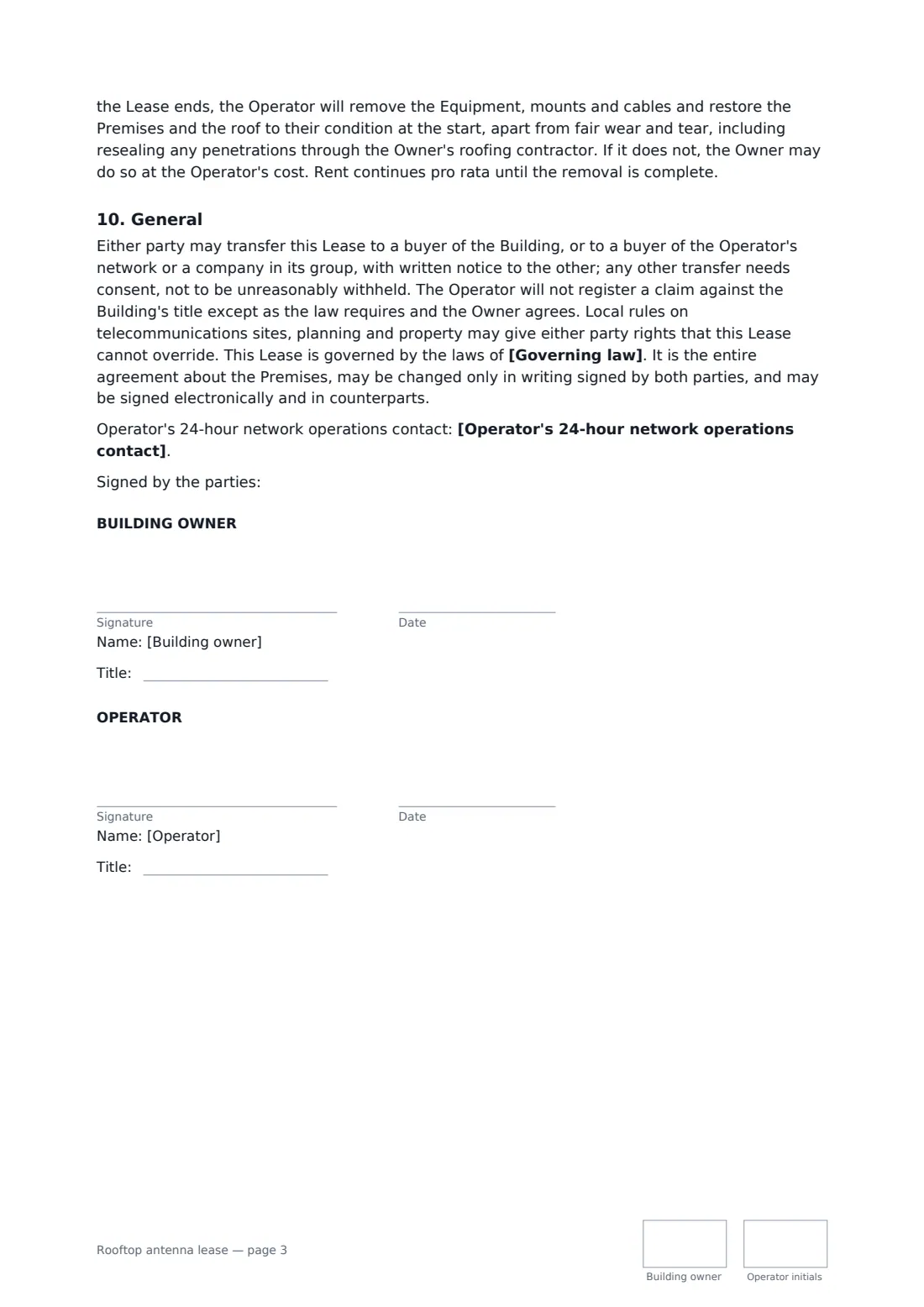
- Building owner signature and date, job title, initials on every page · The owner of the building, or its authorised manager.
- Operator signature and date, job title, initials on every page · The telecom, mobile, internet or broadcast company leasing the roof space.
What the rooftop antenna lease covers
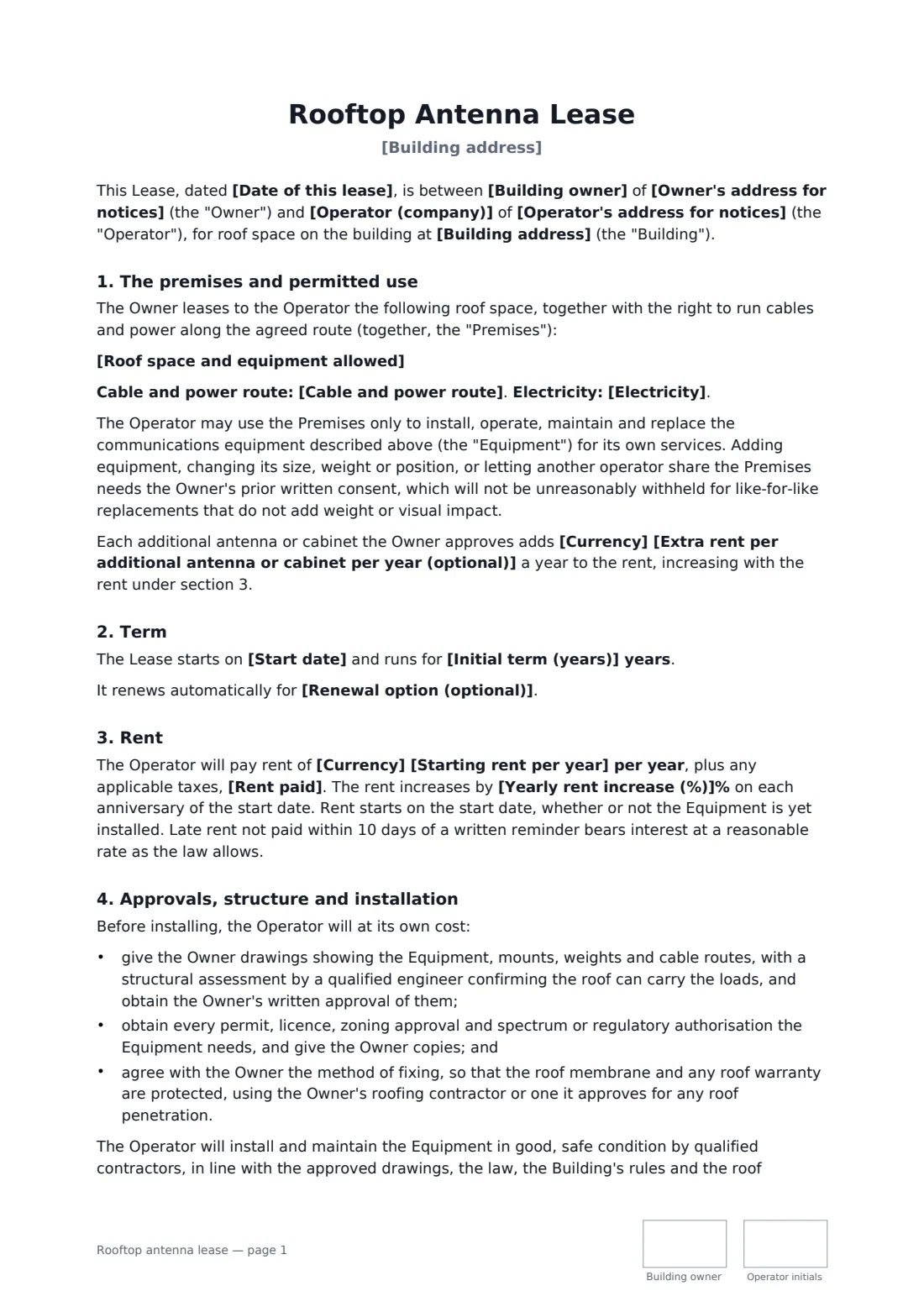
- The premises and permitted use
- Term
- Rent
- Approvals, structure and installation
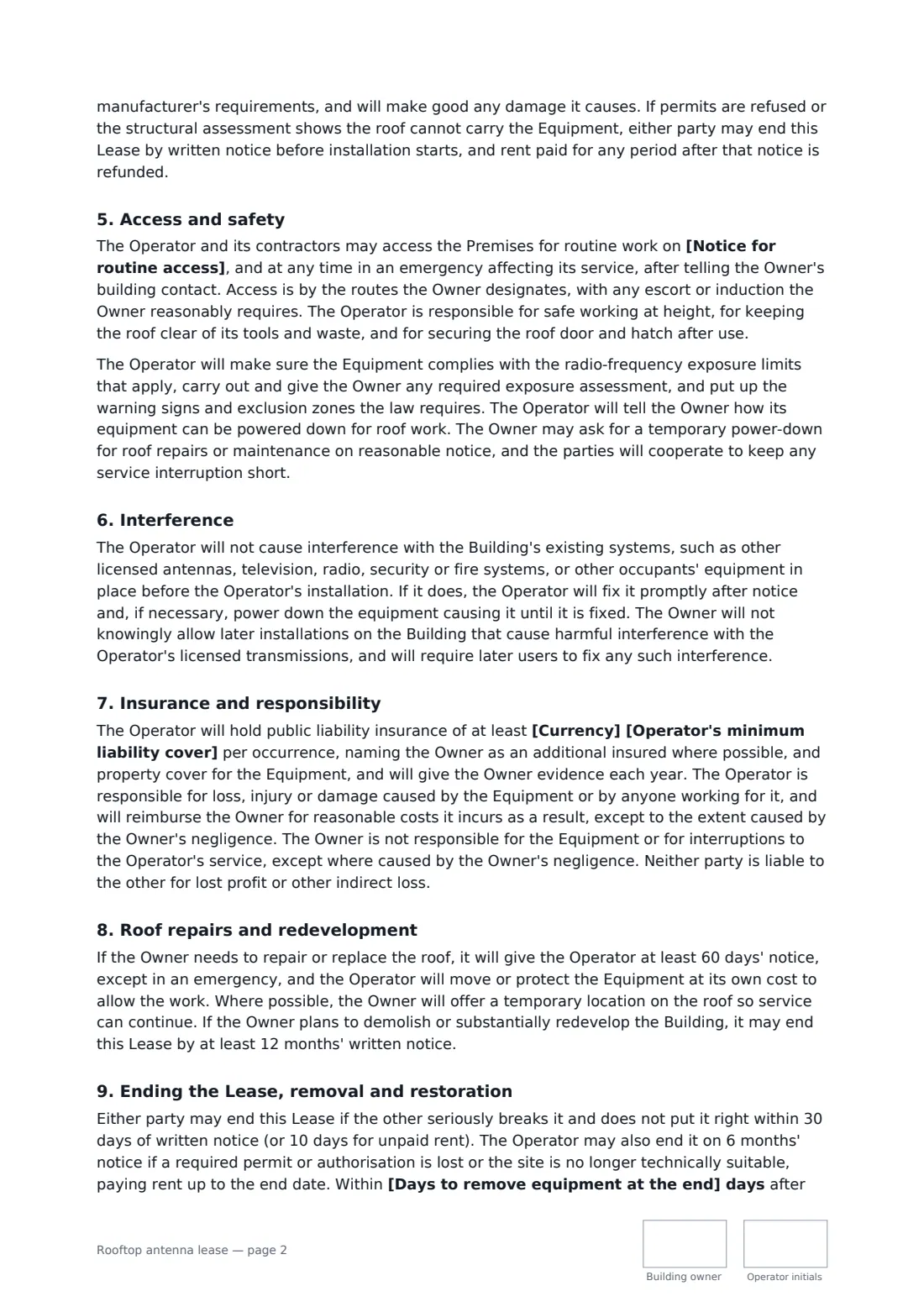
- Access and safety
- Interference
- Insurance and responsibility
- Roof repairs and redevelopment
- Ending the Lease, removal and restoration
- General
Using the rooftop antenna lease, step by step
1 Describe the site
Enter the building, the roof area and maximum equipment, the cable route, the electricity arrangement and the routine access notice.
2 Set term and rent
Enter the start date, initial term and any renewal option, the yearly rent, how it's paid, the yearly increase and any extra-equipment rent.
3 Insurance and restoration
Set the operator's minimum liability cover and the days it has to remove equipment and restore the roof.
4 Sign
Add the operator's 24-hour contact and the governing law, then send. Both parties initial each page and sign on the last.
Tips before you send it
- Ask for the structural assessment and drawings before you agree to any fixing method, and involve your roofer for any roof penetration.
- Check that the installation won't void your roof warranty.
- Telecom sites can have special legal protections in some places that limit removal or rent changes. Take advice before signing a long term.
- Keep the RF exposure assessment, permits and insurance certificates in your vault and diary the yearly rent increase.
Sign it online in minutes
- Fill in the blanks. Names, dates and amounts go straight into the agreement — the preview shows exactly where.
- Name who signs. Tick “This is me” for your own part. FileIt builds the PDF with every signature, date and initials box on the right line, and you can check or move anything before sending.
- Send it. Each signer gets a secure link and signs from any device — no account needed. The signed PDF, with an audit trail and a Certificate of Completion, is filed in your vault and emailed to everyone.
Rooftop antenna lease: frequently asked questions
Who gets the permits?
The operator, at its own cost: every permit, zoning approval and regulatory authorisation the equipment needs. Either side can end the lease before installation if permits are refused or the roof can't carry the load.
What about radio-frequency safety?
The operator must keep the equipment within the exposure limits that apply, give the owner any required assessment, and put up warning signs and exclusion zones. It also explains how the equipment can be powered down for roof work.
Can the owner still repair the roof?
Yes. With 60 days' notice (less in an emergency) the operator moves or protects its equipment at its own cost, and the owner tries to offer a temporary spot so service continues.
Can a lease like this be signed electronically?
Usually, yes, for a lease or licence of roof space. Some places require a long lease to be signed in a particular way or registered, so check local rules if the lease must be recorded. FileIt keeps an audit trail and a Certificate of Completion.