What is a private investigator agreement?
Clients hire private investigators at stressful moments, and the questions come later. What exactly was the investigator asked to do? What did it cost, and why? Were the methods legal? A written agreement answers those questions in advance and protects both sides. The client knows what they're paying for, and the investigator has a record of a legitimate purpose.
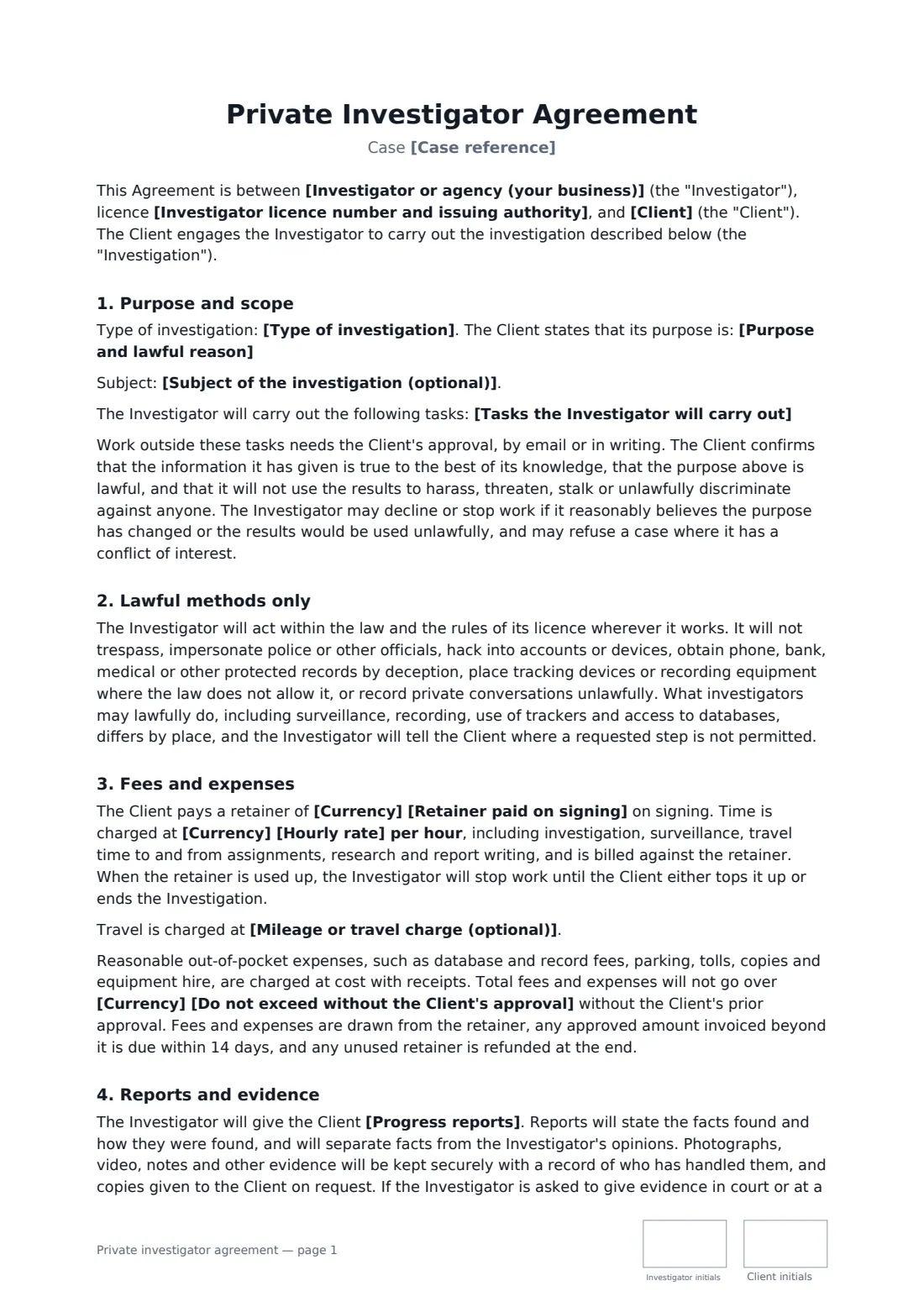
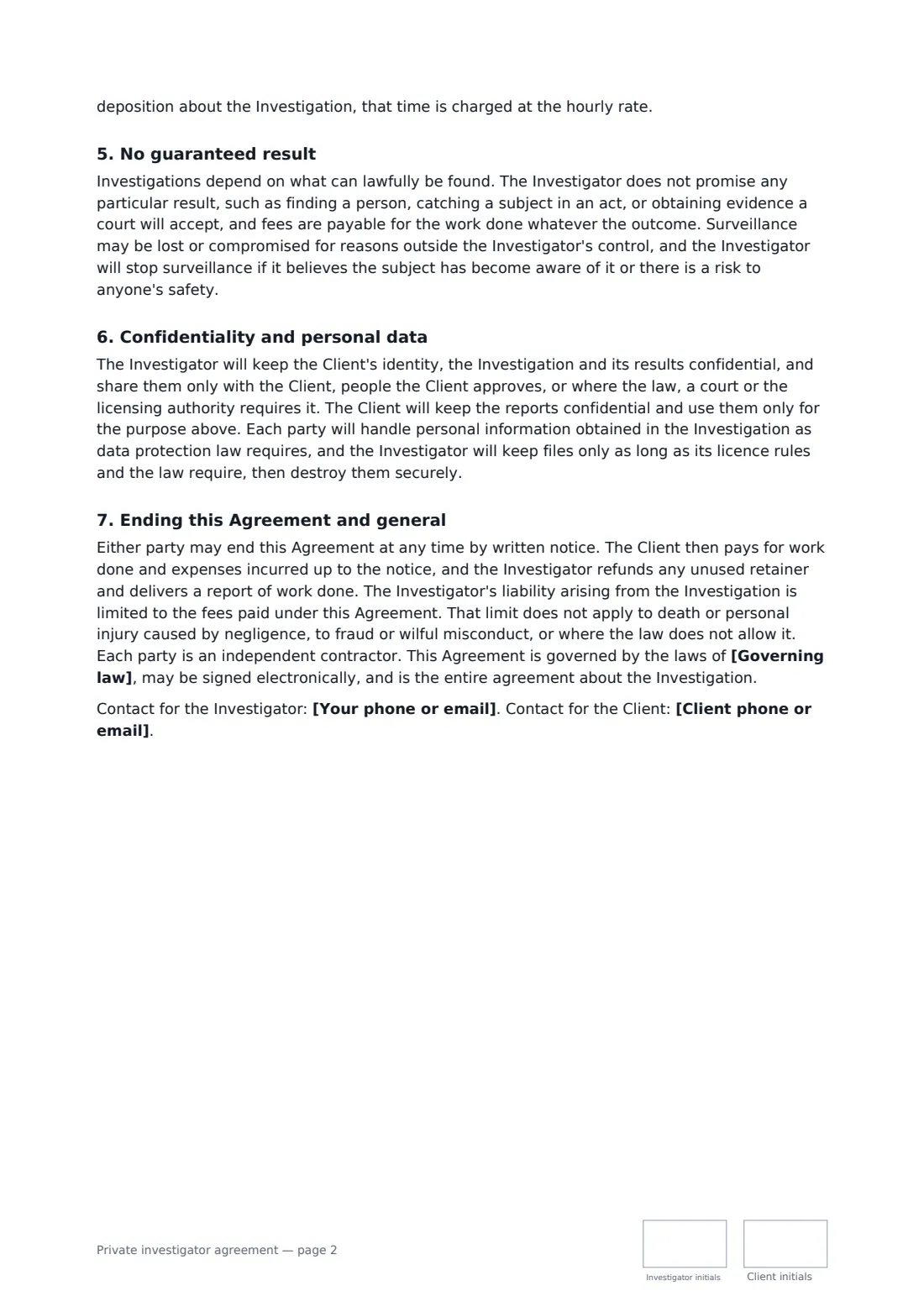
This template records the investigator's licence, a case reference, the type of investigation, the client's stated lawful purpose and the tasks agreed. It lists methods the investigator won't use, such as pretexting for protected records, hacking, impersonating officials or unlawful recording, and notes that what investigators may do varies by place. It sets a retainer, an hourly rate, an optional mileage charge, expenses at cost and a spending cap the investigator can't pass without approval. It also covers reports and evidence handling, says no result is guaranteed, keeps everything confidential, and lets either side end the engagement at any time.
- Best for
- Licensed private investigators and investigation agencies
- Signed by
- The investigator and the client
- Fees
- Retainer, hourly rate, expenses at cost, with a budget cap
- Length
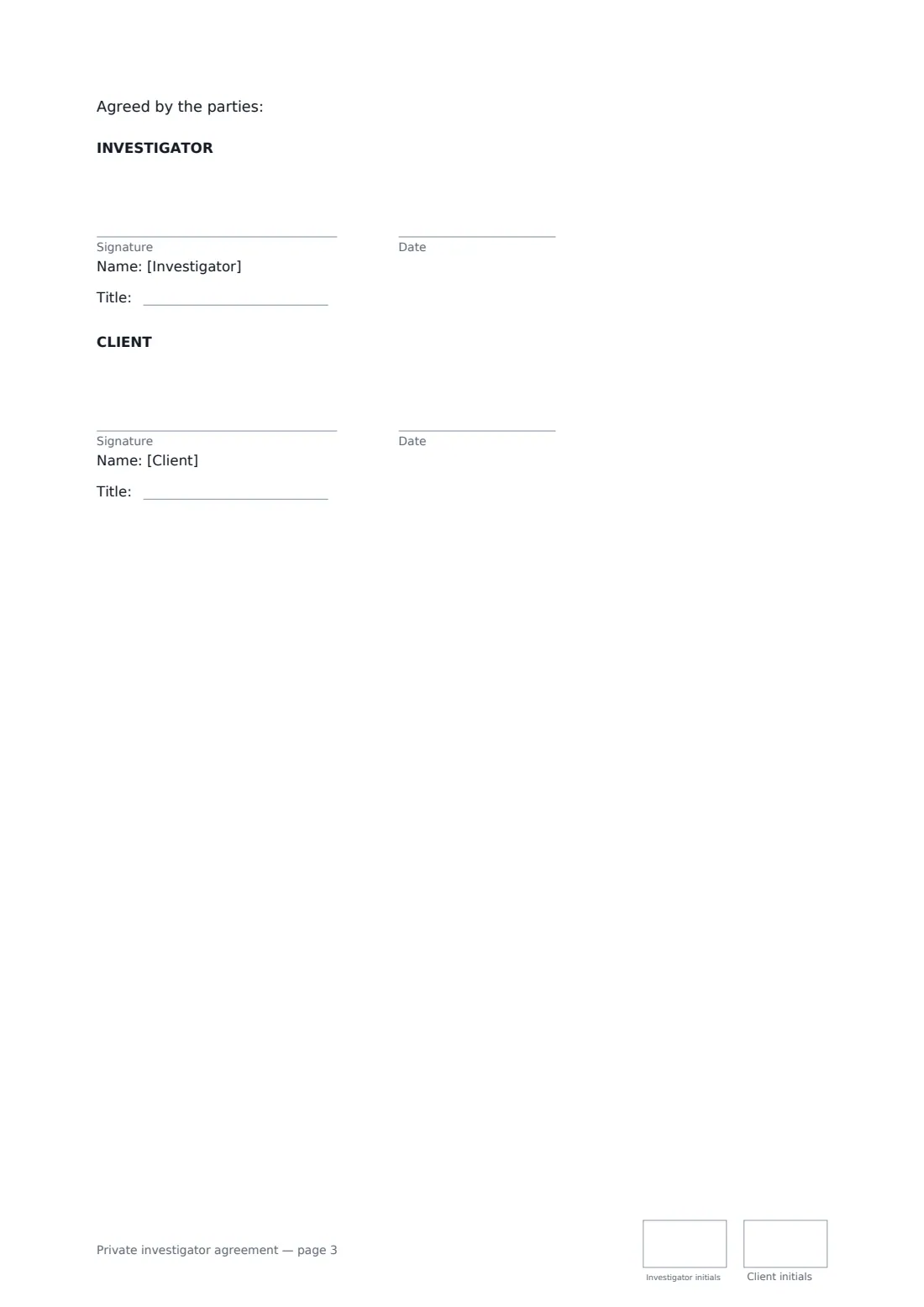
- 3 pages, initialled on every page
When to use a private investigator agreement
- Locating a former tenant or debtor so court papers can be served
- Surveillance for an insurance claim investigation
- Due-diligence background research on a prospective business partner
- A workplace fraud or misconduct investigation for an employer
- Finding witnesses and taking statements for a lawyer's case
What you fill in
17 blanks, then the name and email of each person who signs: investigator, client.
1 The parties
- Investigator or agency (your business)*
- Your phone or email*
- Investigator licence number and issuing authority*
- Client*
- Client phone or email*
2 The investigation
- Case reference*
- Type of investigation* locating a person or asset · surveillance · background or due-diligence research · workplace misconduct or fraud investigation · insurance claim investigation · gathering evidence and witness statements for a legal matter
- Purpose and lawful reason*
- Tasks the Investigator will carry out*
- Subject of the investigation (optional)
3 Fees and expenses
- Currency*
- Retainer paid on signing*
- Hourly rate*
- Mileage or travel charge (optional)
- Do not exceed without the Client's approval*
- Progress reports* a short update at least weekly and a written report at the end · a written report after each day of surveillance and a final report · a final written report only
- Governing law*
4 Who signs
- Investigator signature and date, job title, initials on every page · The licensed investigator or agency.
- Client signature and date, job title, initials on every page · The person or business engaging the investigator. Add a title if signing for a company or law firm.
What the private investigator agreement covers
- Purpose and scope
- Lawful methods only
- Fees and expenses
- Reports and evidence
- No guaranteed result
- Confidentiality and personal data
- Ending this Agreement and general
Using the private investigator agreement, step by step
1 Licence and case
Enter your licence number and issuing authority, the client and a case reference.
2 Purpose and tasks
Choose the type of investigation, record the client's lawful purpose, and list the tasks you'll carry out. Naming the subject is optional.
3 Fees and reports
Set the retainer, hourly rate, any mileage charge and the budget cap, then choose how often you'll report.
4 Send
Add the governing law and send it to the client to sign before work starts.
Tips before you send it
- Check your licensing authority's rules on contracts. Some require particular wording, or the licence number on every agreement.
- Write down the client's purpose in their words. It shows good faith if the use of the results is ever questioned.
- Set a realistic budget cap and update the client before you reach it, so approvals don't stall surveillance.
- Decline cases where the purpose looks like stalking or harassment. The template lets you stop work if you suspect misuse.
Sign it online in minutes
- Fill in the blanks. Names, dates and amounts go straight into the agreement — the preview shows exactly where.
- Name who signs. Tick “This is me” for your own part. FileIt builds the PDF with every signature, date and initials box on the right line, and you can check or move anything before sending.
- Send it. Each signer gets a secure link and signs from any device — no account needed. The signed PDF, with an audit trail and a Certificate of Completion, is filed in your vault and emailed to everyone.
Private investigator agreement: frequently asked questions
Does the investigator guarantee results?
No. The template says fees are payable for work done whatever the outcome, and that surveillance may be lost or stopped for safety.
What methods are ruled out?
Trespass, impersonating officials, hacking, obtaining protected records by deception, unlawful trackers or recording devices, and unlawful recording of private conversations.
What happens when the retainer runs out?
Work stops until the client tops it up or ends the investigation. Total spending can't pass the budget cap without the client's approval, and any unused retainer is refunded.
Can the client end the engagement early?
Yes, at any time by written notice. The client pays for work and expenses up to then and gets a report of work done.
Is the template free?
Yes. It's free with FileIt eSignature, and the client signs from the email link without an account.