What is a medical treatment authorization for a minor?
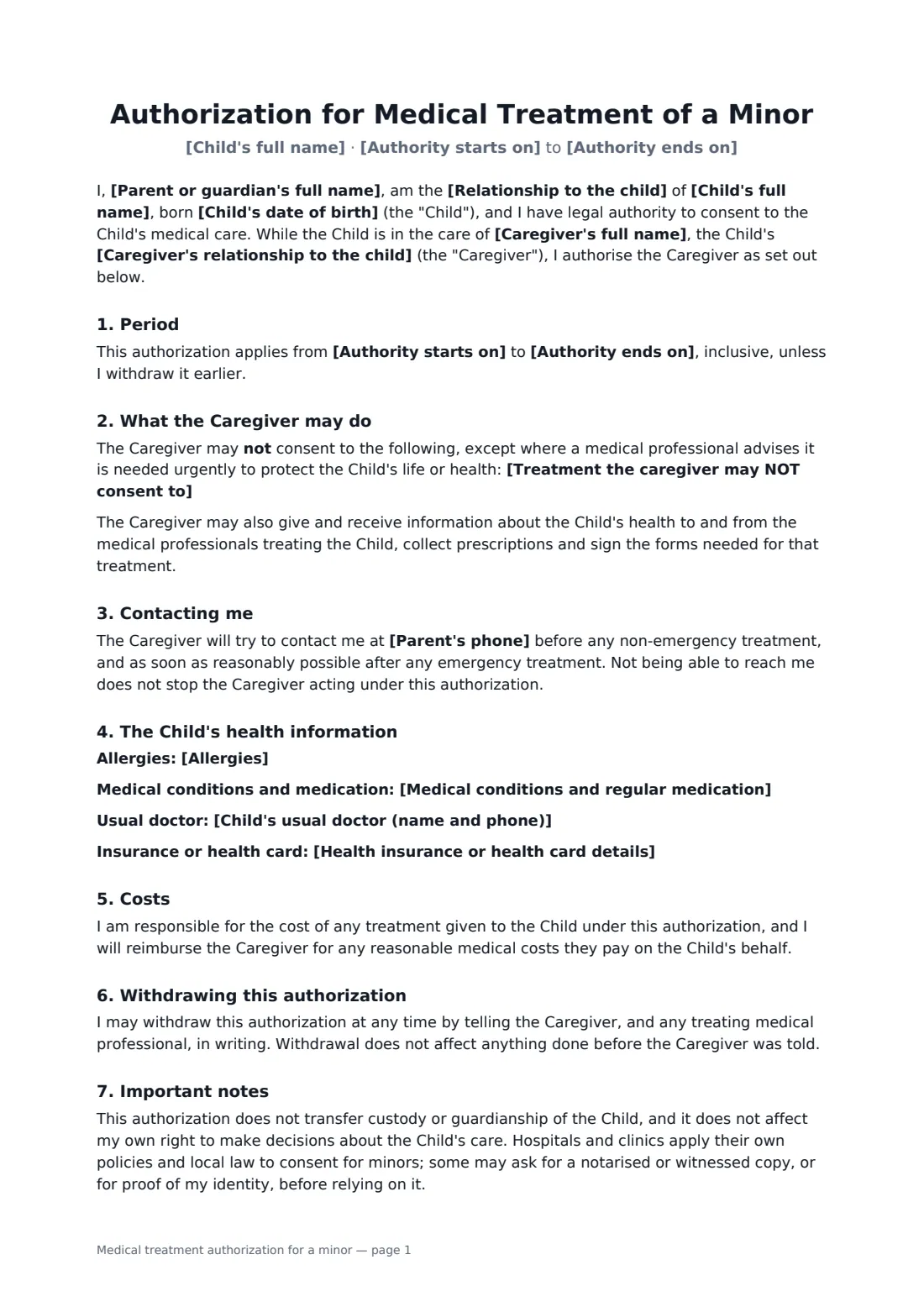
When a child stays with grandparents, travels with a friend's family or is looked after by a sitter for a few days, the adult in charge often has no clear authority to agree to medical treatment. A clinic may hesitate over a sprained wrist, and in an emergency every minute spent tracking down a parent matters. A medical treatment authorization puts your permission in writing, limited to the dates and kinds of care you choose.
This form names you, your child and the caregiver, sets a start and end date, and lets you choose between emergency and routine care or emergency care only. You can list anything the caregiver may not consent to, and record allergies, conditions, medication, the usual doctor and insurance details so they're on hand. It covers contacting you, costs, how to withdraw the authority, and makes clear that it does not transfer custody. The caregiver signs to accept the authority.
- Best for
- Grandparents, relatives, sitters or hosts caring for a child while parents are away
- Signed by
- The parent or guardian, and the caregiver
- Scope
- Emergency and routine care, or emergency care only, with optional exclusions
- Period
- Fixed start and end dates
- Length
- 2 pages
When to use a medical treatment authorization for a minor
- Children staying with grandparents while parents travel
- A child going on holiday with a friend's family
- An overnight or weekend sitter looking after the children
- A teenager staying with relatives for a summer
- A host family caring for a visiting child
What you fill in
17 blanks, then the name and email of each person who signs: parent or guardian, authorised caregiver.
1 Parent or guardian
- Parent or guardian's full name*
- Relationship to the child* Parent · Legal guardian
- Parent's phone*
- Parent's address
2 The child
- Child's full name*
- Child's date of birth*
- Allergies
- Medical conditions and regular medication
- Child's usual doctor (name and phone)
- Health insurance or health card details
3 The caregiver
- Caregiver's full name*
- Caregiver's relationship to the child*
- Caregiver's phone*
4 Scope and period
- Authority starts on*
- Authority ends on*
- What the caregiver may consent to* Emergency and routine care · Emergency care only
- Treatment the caregiver may NOT consent to
5 Who signs
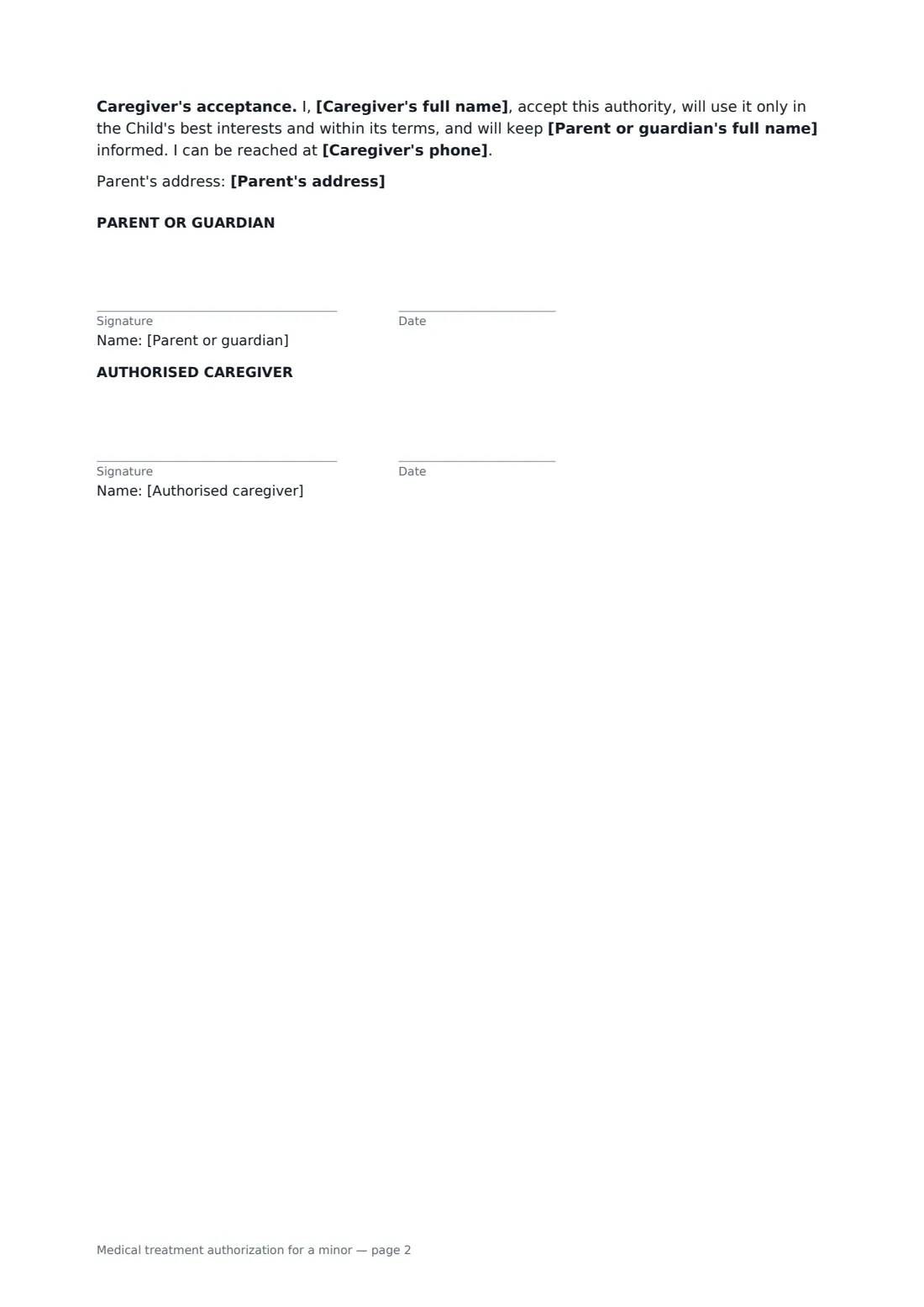
- Parent or guardian signature and date · A parent or legal guardian with authority to consent to the child's medical care.
- Authorised caregiver signature and date · The adult who will look after the child and may consent to treatment. They sign to accept the authority.
What the medical treatment authorization for a minor covers
- Period
- What the Caregiver may do
- Contacting me
- The Child's health information
- Costs
- Withdrawing this authorization
- Important notes
Using the medical treatment authorization for a minor, step by step
1 Enter your details and the child's
Add your name, phone and relationship to the child, then the child's name and date of birth. Record allergies, conditions and medication — if you leave them empty, the form says none, so only do that when it's true.
2 Name the caregiver and the dates
Enter the caregiver's name, relationship and phone, and the dates the authority runs. Keep the window tight — the dates of the trip or stay.
3 Choose the scope
Pick emergency and routine care, or emergency care only. Use the exclusions box for anything you want to decide yourself, such as vaccinations or non-urgent surgery.
4 Send for signature
Add the caregiver as a signer. Both of you sign online, and the signed PDF is filed in your FileIt vault — share a copy with the caregiver to keep with the child's health card.
Tips before you send it
- Give the caregiver a printed or saved copy along with a copy of the child's health or insurance card.
- If both parents share responsibility, consider having each sign their own copy, or check whether one parent's consent is enough where you live.
- Some hospitals or countries expect a notarised or witnessed authorization — check before you rely on an e-signed copy, especially for travel abroad.
- For a trip abroad, pair this with a child travel consent letter.
Sign it online in minutes
- Fill in the blanks. Names, dates and amounts go straight into the agreement — the preview shows exactly where.
- Name who signs. Tick “This is me” for your own part. FileIt builds the PDF with every signature, date box on the right line, and you can check or move anything before sending.
- Send it. Each signer gets a secure link and signs from any device — no account needed. The signed PDF, with an audit trail and a Certificate of Completion, is filed in your vault and emailed to everyone.
Medical treatment authorization for a minor: frequently asked questions
Does this give the caregiver custody of my child?
No. The form says expressly that it does not transfer custody or guardianship and does not affect your own right to decide about your child's care. It only lets the caregiver consent to treatment within the scope and dates you set.
Will a hospital accept it?
Many clinics will rely on a clear written authorization, but each applies its own policy and local law on consent for minors. Some may ask for a notarised copy or proof of identity. In a genuine emergency, doctors can usually treat a child without consent anyway.
Can I limit what the caregiver can agree to?
Yes. Choose emergency care only, and use the exclusions field to list treatment the caregiver may not consent to, except where it's urgently needed to protect the child's life or health.
Can we both sign electronically?
Yes. Electronic signatures are generally valid for everyday consents in the US (ESIGN Act and UETA), the UK, the EU (eIDAS) and Canada. FileIt adds an audit trail and a Certificate of Completion to the signed PDF. Where a notarised form is required, use that process instead.
Is this the same as a parental consent form for a trip?
No. A parental consent form gives an organiser permission for a child to join an activity. This form gives a specific adult authority to consent to medical care for a period while the child is in their care.