What is a medication administration authorization?
Schools, nurseries, after-school clubs, camps and childminders should not give a child medicine without a parent's written authorization. Verbal instructions get misremembered and handwritten notes go missing. A clear medication form tells staff exactly what to give, how much, how and when, and makes both sides' responsibilities plain.
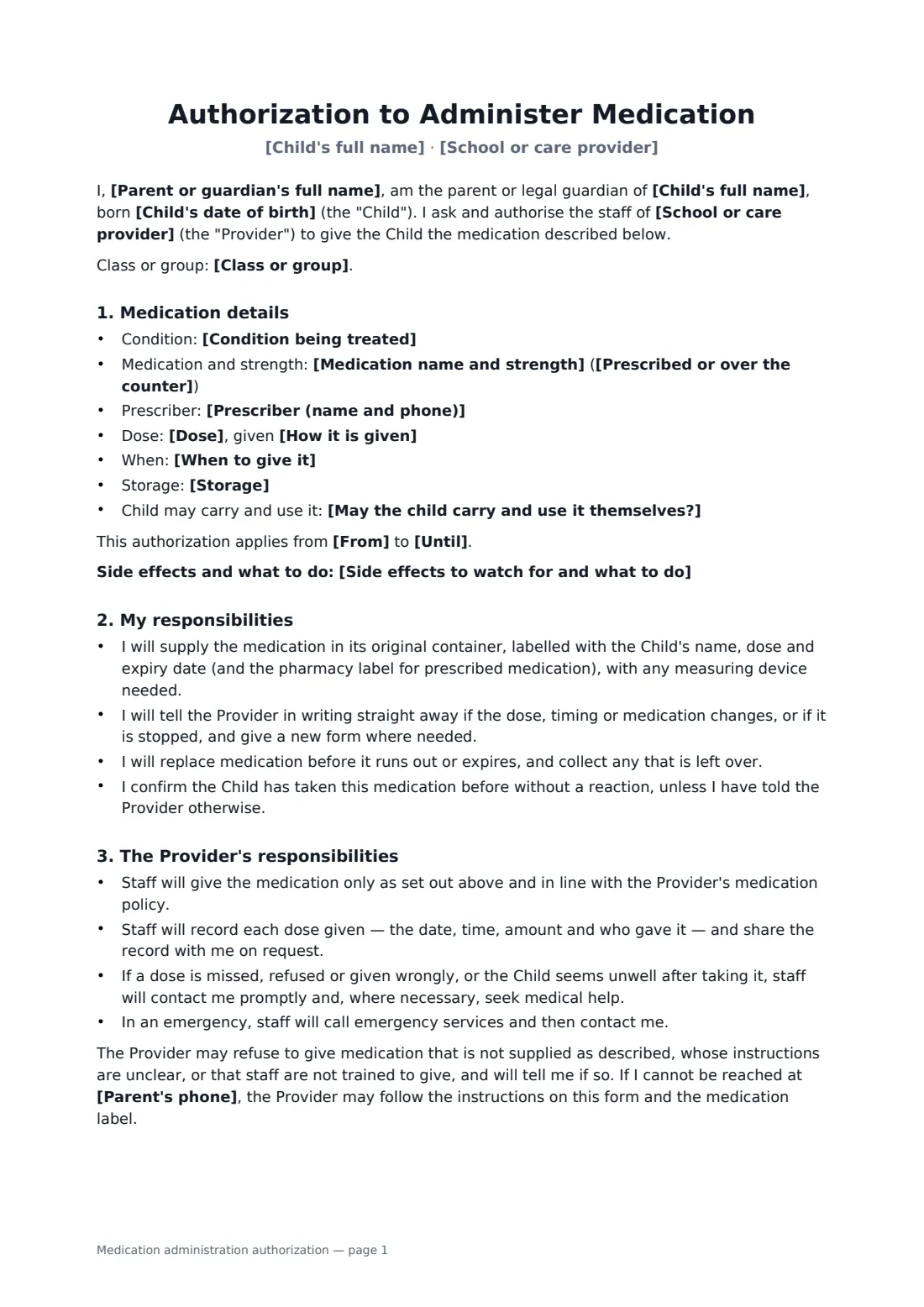
This form records the child, the condition, the medication and strength, whether it's prescribed, the prescriber, dose and route, timing, start and end dates, storage, whether the child may carry it, and side effects to watch for. The parent agrees to supply it in its labelled container and update you on changes; you agree to give it only as instructed, keep a dosing record, and contact the parent if anything goes wrong. Ongoing medication such as an inhaler is renewed at least yearly.
- Best for
- Schools, nurseries, childminders, after-school clubs, camps
- Signed by
- The parent or guardian and the provider
- Records
- Medication, dose, route, timing, storage, self-carry, side effects
- Duration
- A short course with an end date, or ongoing until withdrawn
- Length
- 2 pages
When to use a medication administration authorization
- A course of antibiotics during the school day
- An asthma inhaler kept at school or carried by the child
- An adrenaline auto-injector for a severe allergy
- Regular medication for a child at summer camp
- Pain relief at nursery, where the setting's policy allows it
What you fill in
18 blanks, then the name and email of each person who signs: parent or guardian, school or care provider.
1 Provider
- School or care provider*
2 The child
- Child's full name*
- Child's date of birth*
- Class or group
3 Parent or guardian
- Parent or guardian's full name*
- Parent's phone*
4 The medication
- Condition being treated*
- Medication name and strength*
- Prescribed or over the counter* Prescribed · Over the counter
- Prescriber (name and phone)
- Dose*
- How it is given*
- When to give it*
- From*
- Until
- Storage
- May the child carry and use it themselves?* No · Yes — with staff supervision · Yes — independently
- Side effects to watch for and what to do
5 Who signs
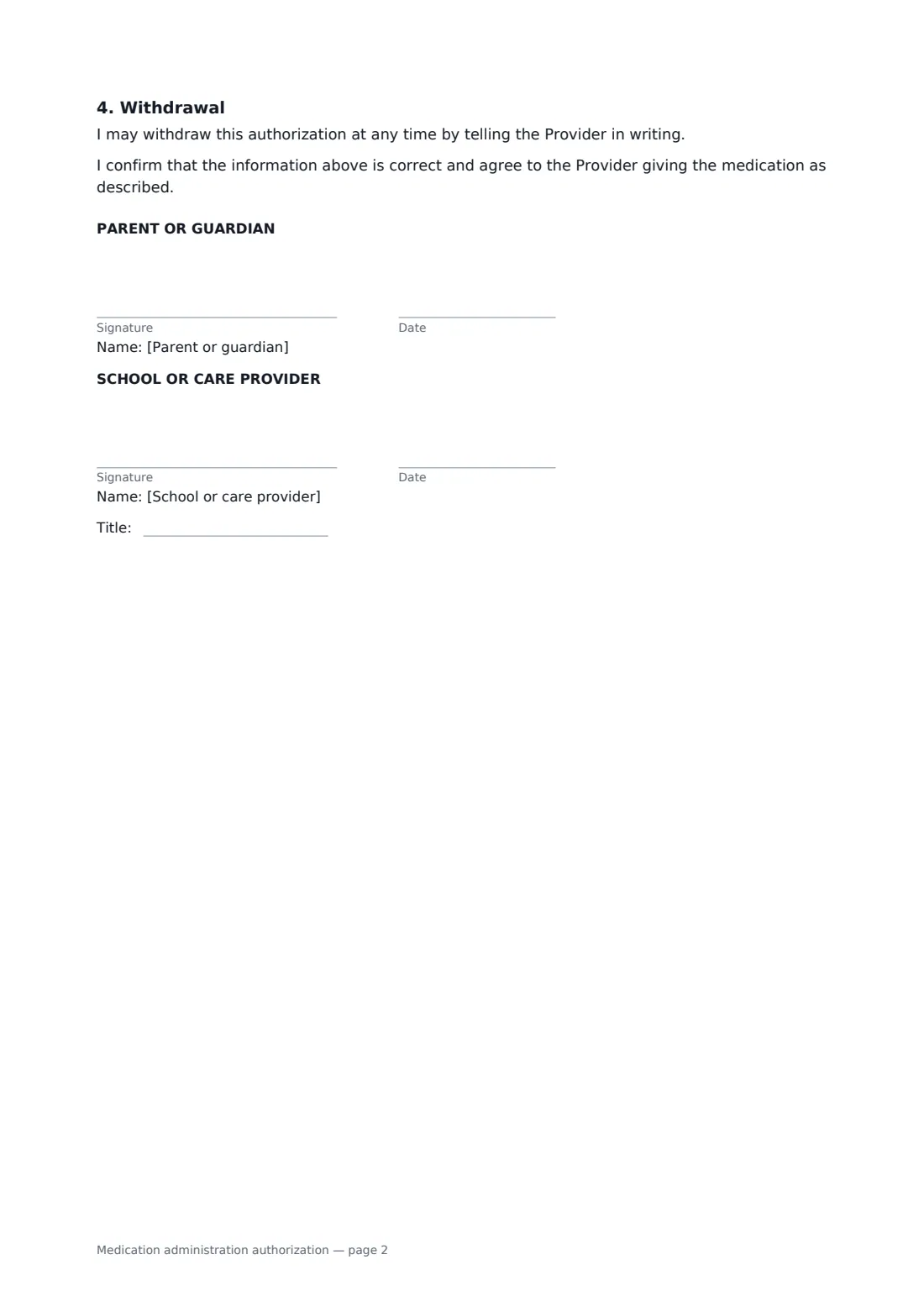
- Parent or guardian signature and date · A parent or legal guardian of the child.
- School or care provider signature and date, job title · The school, nursery, camp or childminder who will give the medication.
What the medication administration authorization covers
- Medication details
- My responsibilities
- The Provider's responsibilities
- Withdrawal
Using the medication administration authorization, step by step
1 Add the child and parent
Your setting's name fills in from your account. Enter the child's name, date of birth and class or group, and the parent's name and phone.
2 Describe the medication
Enter the condition, the medication and strength, whether it's prescribed, the prescriber, the dose, how it's given and when. Copy the label exactly.
3 Set dates, storage and self-carry
Add the start date and, for a short course, the end date. Note how it should be stored and whether the child may carry it themselves. Add side effects to watch for.
4 Send to the parent
The parent checks the details and signs on their phone; you countersign. Keep the signed form with your medication records — it's also stored in your FileIt vault.
Tips before you send it
- Follow your own medication policy and any local rules — many settings only give prescribed medicine or need a prescriber's letter.
- Check the medication label against the form when it's handed over.
- Keep a separate dosing log and share it with the parent.
- For a child with a serious condition, pair this with an individual health care plan.
Sign it online in minutes
- Fill in the blanks. Names, dates and amounts go straight into the agreement — the preview shows exactly where.
- Name who signs. Tick “This is me” for your own part. FileIt builds the PDF with every signature, date box on the right line, and you can check or move anything before sending.
- Send it. Each signer gets a secure link and signs from any device — no account needed. The signed PDF, with an audit trail and a Certificate of Completion, is filed in your vault and emailed to everyone.
Medication administration authorization: frequently asked questions
Can we give over-the-counter medicine with this form?
The form records whether medicine is prescribed or over the counter. Whether you may give over-the-counter medicine at all depends on your setting's policy and local rules.
Does the prescriber need to sign?
This form is signed by the parent and the provider and records the prescriber's details. If your policy or local rules require the prescriber to sign or write a letter, collect that separately.
How long does the authorization last?
Until the end date you set, or for ongoing medication until withdrawn — the parent agrees to renew it at least yearly and whenever anything changes.
Can parents sign electronically?
Yes. Parents don't need a FileIt account to sign. The signed PDF includes an audit trail and a Certificate of Completion.
What if the child refuses the medicine?
Staff contact the parent promptly. The form says staff will do so for a missed, refused or wrong dose, or if the child seems unwell afterwards.