What is a cargo claim notice?
When freight arrives damaged, short or late — or doesn't arrive at all — the first step is a written claim to the carrier or forwarder. Contracts of carriage, carriers' terms and the laws or international conventions that apply often set notice periods and time limits, and some can be short, so a clear written notice sent early protects your position.
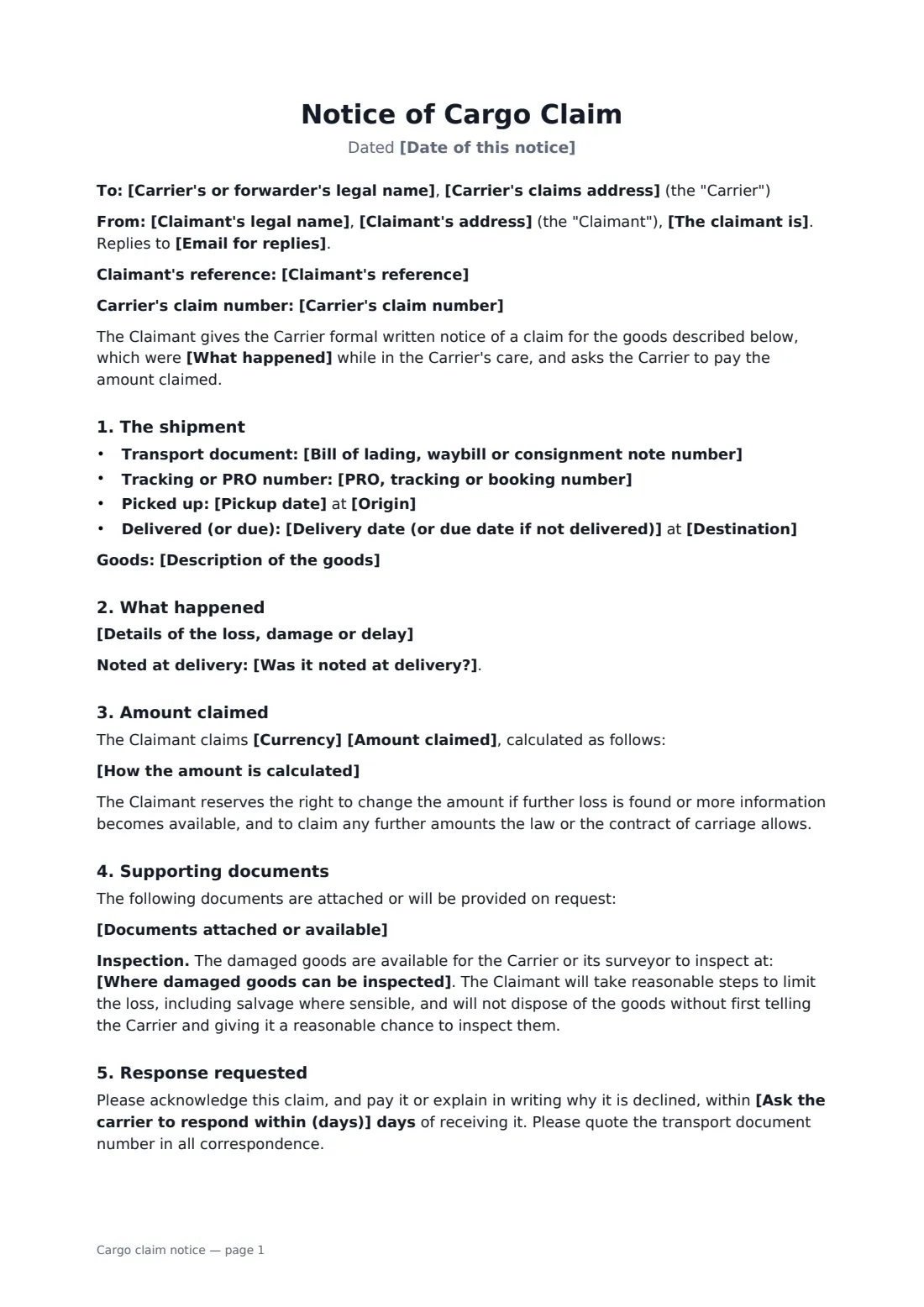
This notice sets out who is claiming and in what capacity, the carrier's details and claim number, the transport document and tracking numbers, pickup and delivery dates and places, a description of the goods, what happened, whether it was noted on delivery or found later as concealed damage, the amount claimed and how it is calculated, the supporting documents, where damaged goods can be inspected, and the response time you ask for. It reserves your rights, and the carrier signs only to acknowledge receipt — not to accept liability.
- Best for
- Shippers, consignees and owners of goods claiming for lost, damaged, short or delayed freight
- Signed by
- The claimant, and the carrier or forwarder acknowledging receipt
- Covers
- Damage, loss, shortage, delay, temperature damage and contamination
- Length
- 2 pages
When to use a cargo claim notice
- A consignee receiving pallets crushed in transit, noted on the delivery receipt
- A shipper whose full truckload never arrived
- Concealed damage found after the packaging was opened
- A refrigerated load rejected for temperature damage
- A freight broker or forwarder claiming with written authority for its customer
What you fill in
26 blanks, then the name and email of each person who signs: claimant, carrier.
1 Claimant
- Date of this notice*
- Claimant's legal name*
- The claimant is* the shipper · the consignee · the owner of the goods · acting for the owner of the goods with written authority
- Claimant's address
- Email for replies*
- Claimant's reference
2 Carrier
- Carrier's or forwarder's legal name*
- Carrier's claims address
- Carrier's claim number
3 The shipment
- Bill of lading, waybill or consignment note number*
- PRO, tracking or booking number
- Pickup date*
- Delivery date (or due date if not delivered)*
- Origin*
- Destination*
- Description of the goods*
4 The claim
- What happened* damaged · lost (not delivered) · short-delivered (part missing) · delayed · spoiled or temperature-damaged · contaminated
- Details of the loss, damage or delay*
- Was it noted at delivery?* Yes — noted as an exception on the delivery receipt · No — the damage was concealed and found after delivery · Not applicable — the goods were not delivered
- Date concealed damage was found
- Currency*
- Amount claimed*
- How the amount is calculated*
- Documents attached or available*
- Where damaged goods can be inspected
- Ask the carrier to respond within (days)*
5 Who signs
- Claimant signature and date, job title · The shipper, consignee or owner of the goods making the claim, or someone authorised to claim for them.
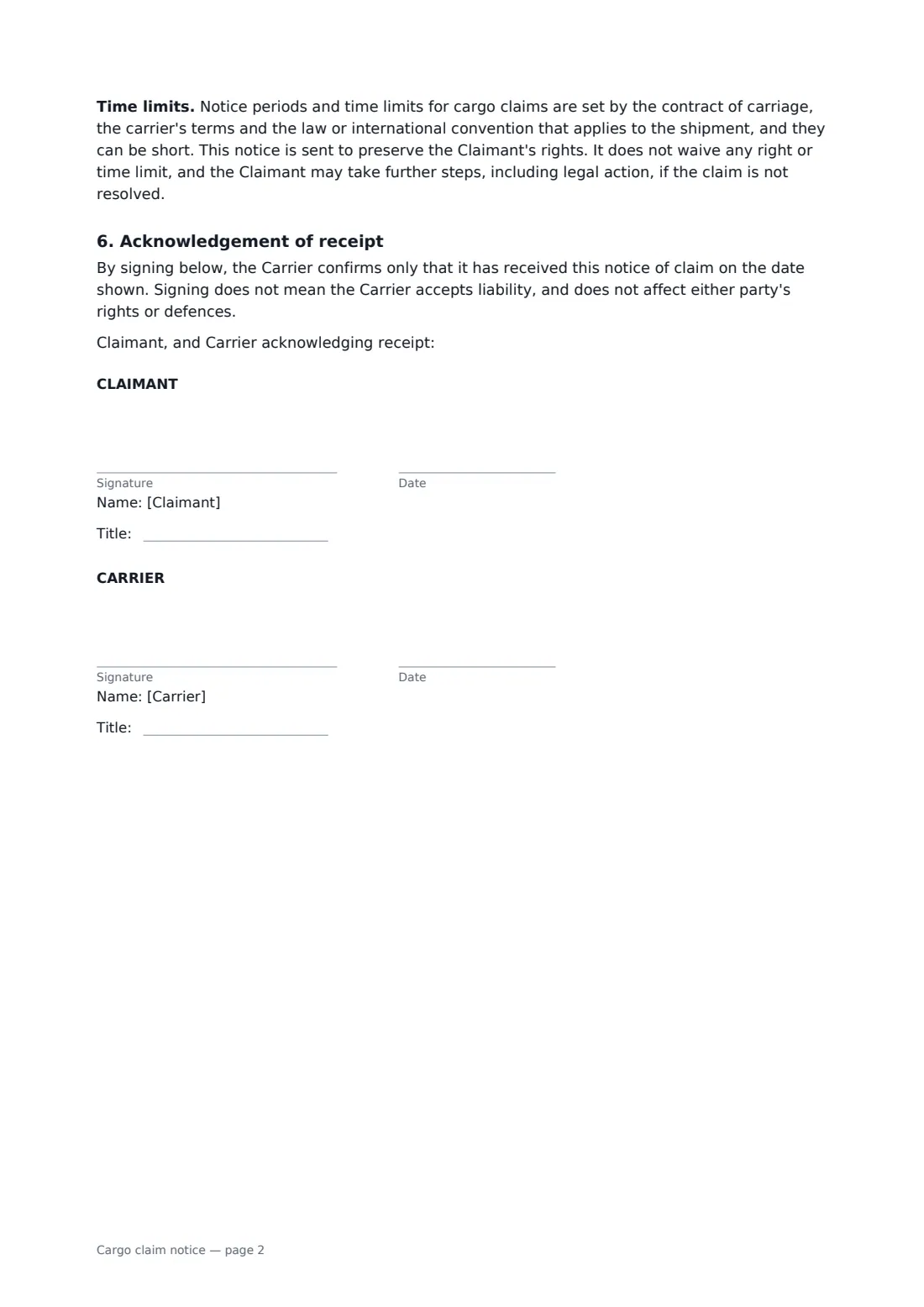
- Carrier signature and date, job title · An authorised person at the carrier or forwarder, signing only to acknowledge receipt.
What the cargo claim notice covers
- The shipment
- What happened
- Amount claimed
- Supporting documents
- Response requested
- Acknowledgement of receipt
Using the cargo claim notice, step by step
1 Identify the shipment
Enter the bill of lading, waybill or consignment note number, any tracking or PRO number, the pickup and delivery dates and places, and a description of the goods, with their weight and any seal numbers.
2 Describe what happened
Choose the type of problem, describe the loss, damage or delay in detail, and say whether it was noted on the delivery receipt or found later as concealed damage (with the date it was found).
3 State the amount and evidence
Enter the amount claimed and how it is calculated — for example the invoice value of damaged items plus freight on them — and list the documents you attach, such as photos, invoices and repair estimates.
4 Offer inspection and set a response time
Say where damaged goods can be inspected, and how many days you ask the carrier to take to pay or decline the claim.
5 Send for acknowledgement
Send it to the carrier's claims contact. Their signature records the date they received your notice, and the signed copy is filed in your vault.
Tips before you send it
- Note visible damage or shortage on the delivery receipt before signing it, and take photos before unpacking further.
- Send the notice as soon as you can. Time limits for cargo claims vary by contract, carrier terms and the law or convention that applies, and some are short.
- Keep the damaged goods and packaging until the carrier has had a chance to inspect them, unless that is unsafe.
- If you are claiming for someone else, attach your written authority to act for the owner of the goods.
Sign it online in minutes
- Fill in the blanks. Names, dates and amounts go straight into the agreement — the preview shows exactly where.
- Name who signs. Tick “This is me” for your own part. FileIt builds the PDF with every signature, date box on the right line, and you can check or move anything before sending.
- Send it. Each signer gets a secure link and signs from any device — no account needed. The signed PDF, with an audit trail and a Certificate of Completion, is filed in your vault and emailed to everyone.
Cargo claim notice: frequently asked questions
Does the carrier admit liability by signing?
No. The carrier signs only to confirm it received the notice on the date shown. The notice says signing doesn't mean the carrier accepts liability and doesn't affect either party's rights or defences.
How long do I have to make a cargo claim?
It depends on the contract of carriage, the carrier's terms and the law or international convention that applies to the shipment — and the periods can be short. This template doesn't set a legal deadline; it is designed to be sent early to preserve your rights. Check the terms that apply to your shipment.
What if I find more damage later?
The notice reserves your right to change the amount if further loss is found or more information becomes available, and to claim any further amounts the law or the contract of carriage allows.
Can a cargo claim notice be signed electronically?
Yes. A written notice and its acknowledgement can generally be signed electronically in most countries, including under the US ESIGN Act and UETA, the UK, the EU (eIDAS) and Canada. FileIt keeps an audit trail and a Certificate of Completion showing when the carrier signed. Check the carrier's terms for any required claim format.
Is this template free?
Yes. The template is free to use with the eSignature app in FileIt, and the people you send it to don't need a FileIt account to sign.