What is a freight forwarding agreement?
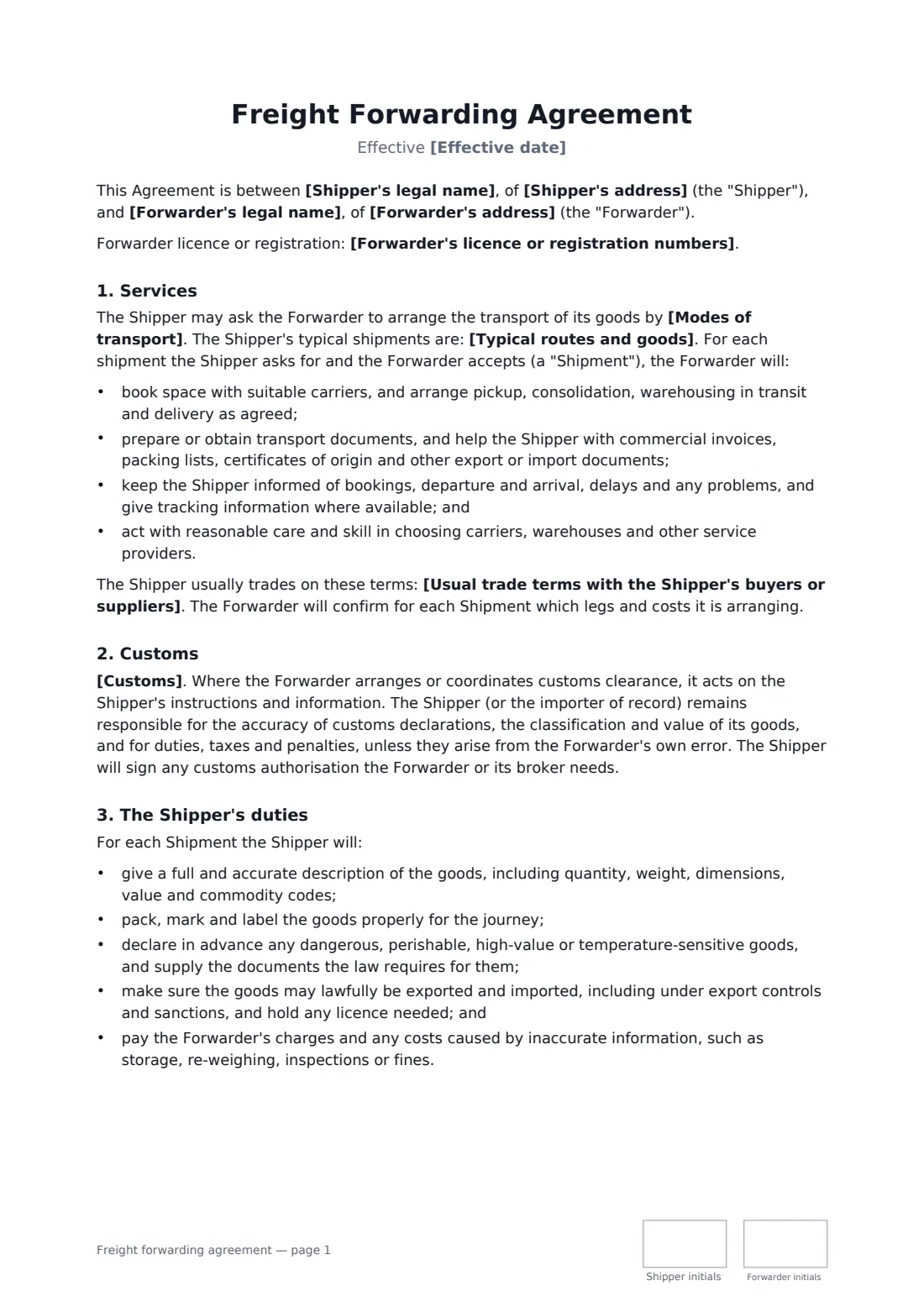
A freight forwarding agreement is the standing contract between a business that ships goods and the forwarder that arranges their transport. The forwarder books carriers, handles documents and coordinates customs; the shipper describes and packs its goods properly and pays the charges. The agreement matters most when something goes wrong — goods are lost, damaged or held — because it decides who is responsible and up to what limit.
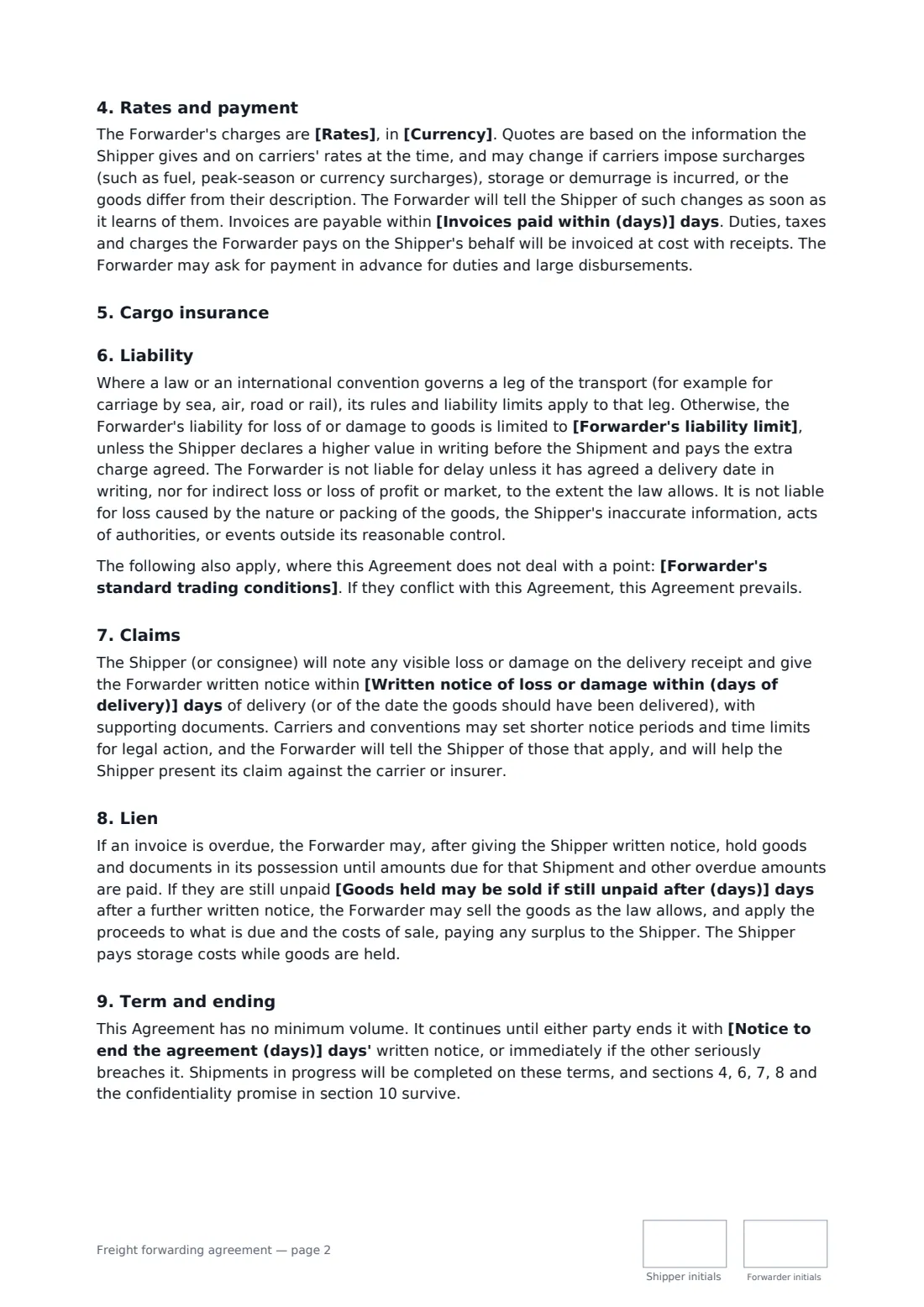
This template covers the modes of transport and typical routes, whether the forwarder acts as the shipper's agent or as a principal issuing its own transport document, the services for each shipment, three customs options, the shipper's duties (description, packing, dangerous goods, export controls and sanctions), rates by quote or rate sheet and how surcharges are passed on, cargo insurance options, liability limits with international conventions applying where they govern a leg, optional standard trading conditions, claim notices, the forwarder's lien on goods for overdue invoices, and ending the agreement.
- Best for
- Importers, exporters and online sellers using a freight forwarder for regular shipments
- Signed by
- The shipper and the forwarder, each with a job title
- Capacity
- The forwarder as the shipper's agent, or as a principal with its own transport document
- Length
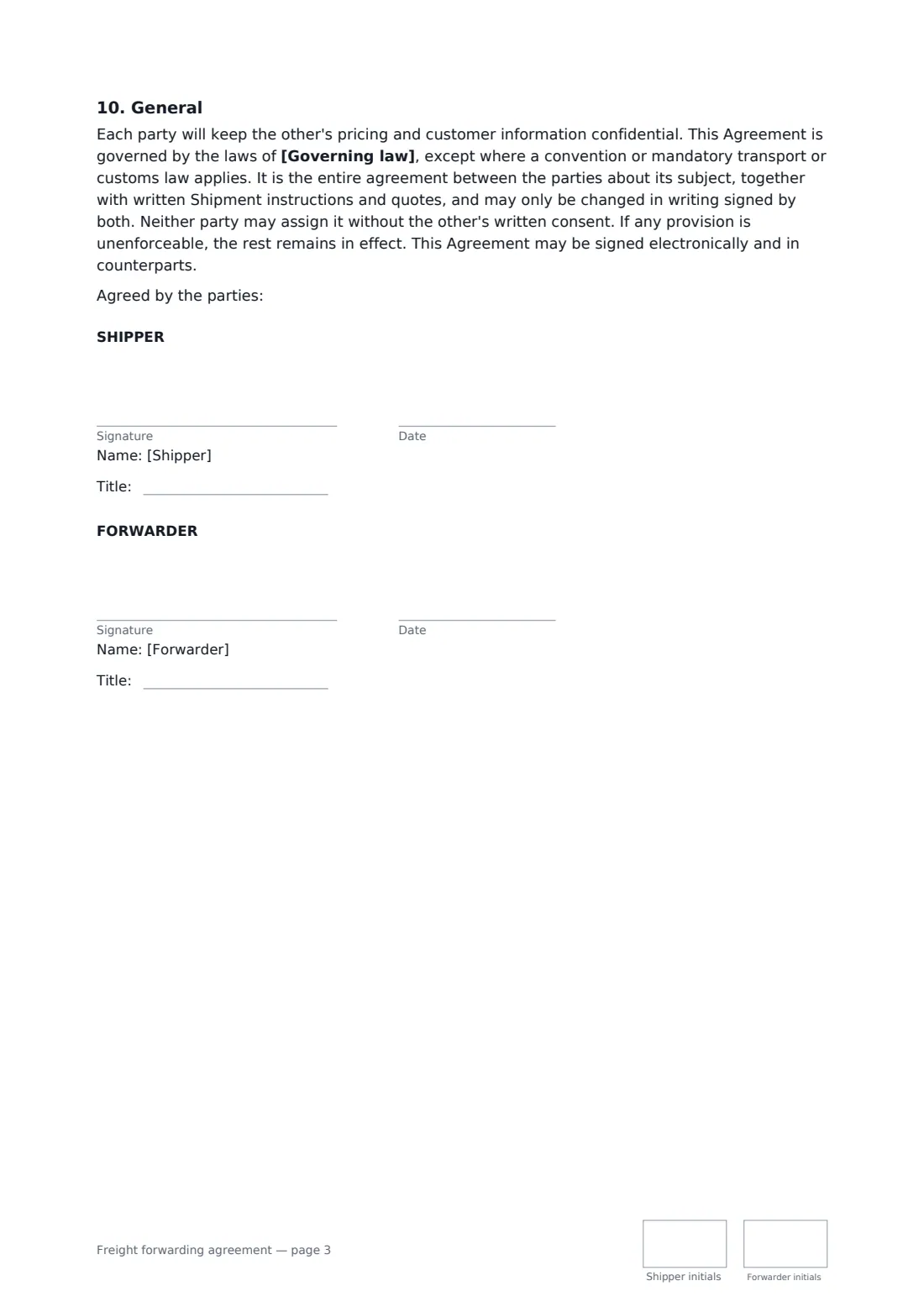
- 3 pages, initialled on every page
When to use a freight forwarding agreement
- An importer bringing container loads from overseas suppliers to its warehouse
- An exporter shipping air freight to customers abroad
- An online seller moving stock to a fulfilment centre in another country
- A manufacturer consolidating part loads from several suppliers
- Replacing a forwarder's one-sided booking terms with an agreed contract
What you fill in
21 blanks, then the name and email of each person who signs: shipper, forwarder.
1 The parties
- Effective date*
- Shipper's legal name*
- Shipper's address
- Forwarder's legal name*
- Forwarder's licence or registration numbers
- Forwarder's address
2 Services
- Modes of transport* ocean freight · air freight · road freight · rail freight · ocean, air and road freight · any mode the parties agree for each shipment
- Typical routes and goods*
- The Forwarder acts* as the Shipper's agent, arranging transport with carriers · as a principal, issuing its own transport document (such as a house bill of lading or air waybill)
- Customs* The Forwarder will arrange customs clearance, itself or through a licensed customs broker · The Forwarder will coordinate with the Shipper's own customs broker · The Shipper arranges its own customs clearance
- Usual trade terms with the Shipper's buyers or suppliers
3 Rates and payment
- Currency*
- Rates* as quoted in writing for each shipment · under a rate sheet the parties agree in writing, reviewed periodically
- Invoices paid within (days)*
4 Insurance and liability
- Cargo insurance* The Forwarder will arrange cargo insurance when the Shipper asks in writing, at the Shipper's cost · The Forwarder will arrange cargo insurance on every shipment, at the Shipper's cost · The Shipper arranges its own cargo insurance
- Forwarder's liability limit*
- Forwarder's standard trading conditions
- Written notice of loss or damage within (days of delivery)*
5 Term and other terms
- Goods held may be sold if still unpaid after (days)*
- Notice to end the agreement (days)*
- Governing law*
6 Who signs
- Shipper signature and date, job title, initials on every page · An authorised person at the business whose goods are being shipped.
- Forwarder signature and date, job title, initials on every page · An authorised person at the freight forwarding company.
What the freight forwarding agreement covers
- Services
- Customs
- The Shipper's duties
- Rates and payment
- Cargo insurance
- Liability
- Claims
- Lien
- Term and ending
- General
Using the freight forwarding agreement, step by step
1 Describe the services
Choose the modes of transport, describe your typical routes and goods, and choose whether the forwarder acts as your agent or as a principal. Add your usual trade terms with buyers or suppliers if that helps the forwarder know which legs it arranges.
2 Decide customs
Choose whether the forwarder arranges customs clearance (itself or through a licensed customs broker), coordinates with your own broker, or leaves customs to you.
3 Rates, payment and insurance
Choose rates by quote per shipment or by an agreed rate sheet, set the payment days, and pick a cargo insurance option — on request, on every shipment, or arranged by you.
4 Liability, claims and lien
Enter the forwarder's liability limit, name its standard trading conditions if they should apply, and set the claim notice period and how many days goods may be held before sale for unpaid invoices.
5 Send for signature
Send it to the forwarder. Once signed, it's filed in your vault — keep it with each shipment's documents.
Tips before you send it
- Carriers' and forwarders' liability is usually limited and often much less than the value of the goods. Insure valuable cargo.
- Notice periods and time limits for cargo claims can be short, and international conventions may set them. Note damage on the delivery receipt and report it at once.
- If you name the forwarder's standard trading conditions, read them first — they apply wherever the agreement is silent.
- Accurate descriptions and commodity codes avoid most customs delays and fines, and the template makes the shipper responsible for them.
Sign it online in minutes
- Fill in the blanks. Names, dates and amounts go straight into the agreement — the preview shows exactly where.
- Name who signs. Tick “This is me” for your own part. FileIt builds the PDF with every signature, date and initials box on the right line, and you can check or move anything before sending.
- Send it. Each signer gets a secure link and signs from any device — no account needed. The signed PDF, with an audit trail and a Certificate of Completion, is filed in your vault and emailed to everyone.
Freight forwarding agreement: frequently asked questions
Is a freight forwarder the same as a carrier?
Not usually. A forwarder arranges transport with carriers such as shipping lines, airlines and trucking companies. Acting as your agent, it is responsible for its own care in arranging the shipment; acting as a principal (issuing its own house bill of lading or air waybill), it takes responsibility for the carriage it covers, within the liability limits.
Who pays customs duties?
The shipper or importer of record, unless the duties or penalties arise from the forwarder's own error. Duties the forwarder pays on the shipper's behalf are invoiced at cost with receipts, and the forwarder may ask for them in advance.
What is the forwarder's lien?
If an invoice is overdue, the forwarder may hold goods and documents it has until it is paid, after written notice. If amounts are still unpaid the number of days you set after a second notice, it may sell the goods as the law allows, apply the proceeds to what is due and pay any surplus to the shipper.
Can a freight forwarding agreement be signed electronically?
In most countries, including the US (ESIGN Act and UETA), the UK, the EU (eIDAS) and Canada, an electronic signature is generally valid for an ordinary commercial contract like this one. FileIt keeps an audit trail and a Certificate of Completion with the signed PDF as evidence of who signed and when.
Is this template free?
Yes. The template is free to use with the eSignature app in FileIt, and the people you send it to don't need a FileIt account to sign.