What is SF 180?
Standard Form 180 (SF 180), Request Pertaining to Military Records, is prescribed by the National Archives and Records Administration (NARA). It is used to request information and copies from military service records: the DD Form 214 (report of separation), the Official Military Personnel File (OMPF), medical or service treatment records, dental records and other documents.
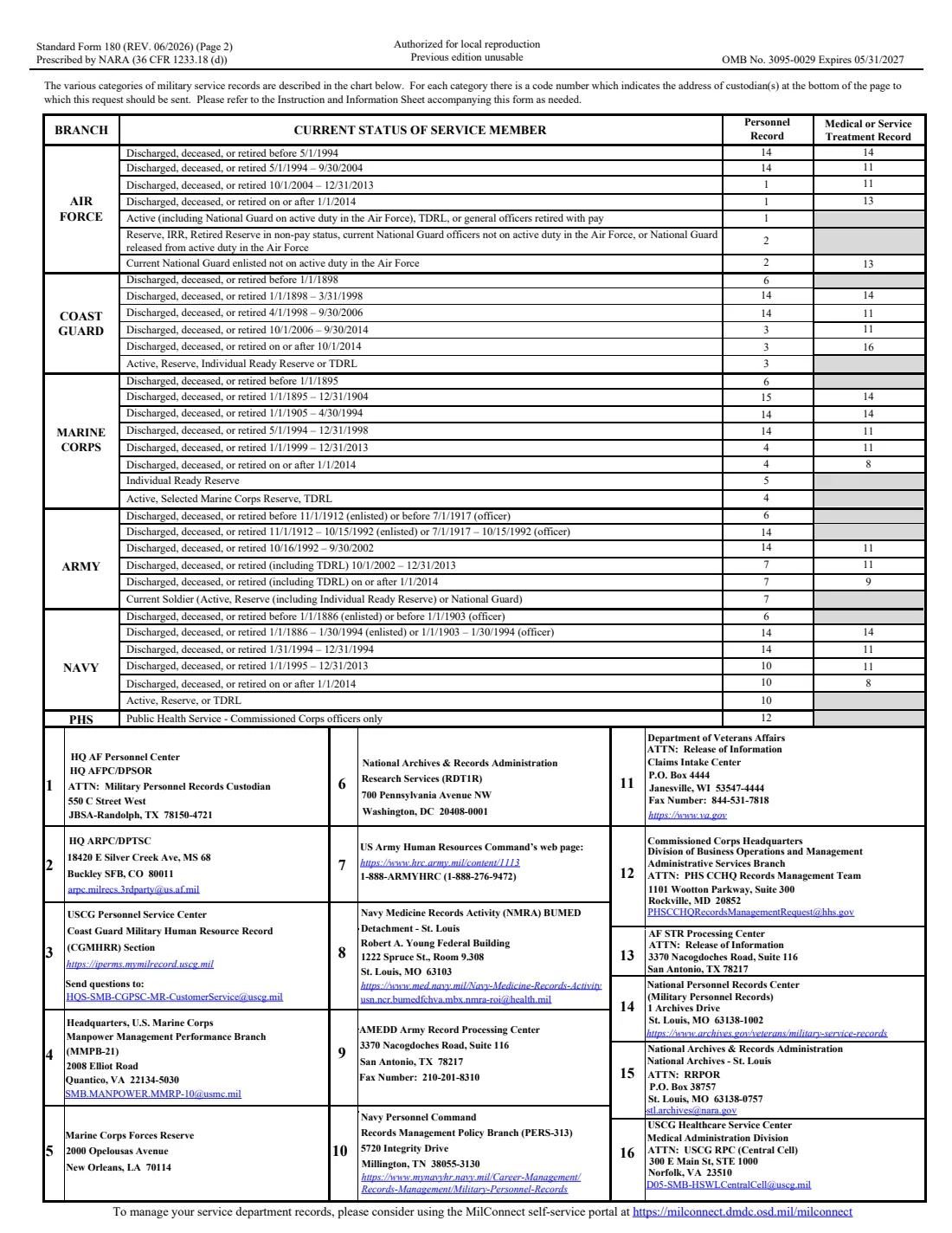
Records aren't all kept in one place. Personnel records of members who were discharged, retired or died in service less than 62 years ago, and medical records, are in the custody of the military service departments; older personnel records are archival records held by NARA. Page 3 of the form is a chart, by branch and by the date the member left service, that gives the code of the office to mail your request to — often the National Personnel Records Center in St. Louis.
FileIt walks you through every item, pre-fills the veteran's name and date of birth from your family's People records, and prints your answers into the official SF 180 (Rev. 06/2026) PDF. You then sign it and send it to the address shown for your case on page 3. The form also notes that requests can be submitted online through NARA's eVetRecs.
- Who fills it
- The veteran, next of kin of a deceased veteran, a legal guardian or authorized representative, or another requester
- Sent to
- The records office for the branch and separation date — see the chart on page 3 of the form
- Signature
- The requester signs Section III, item 5 (not needed for archival records)
- Fees
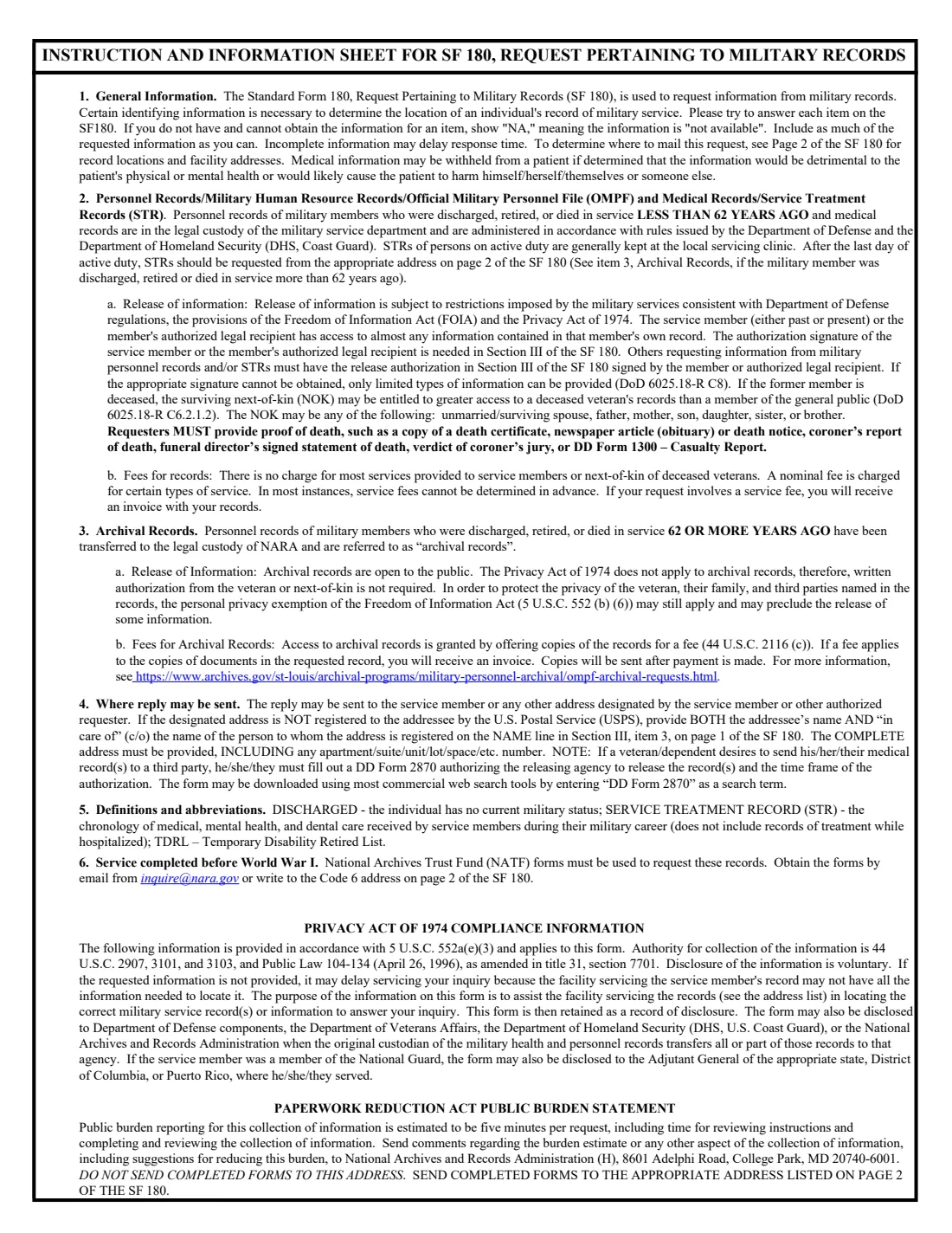
- No charge for most services to service members and next of kin; archival records are copied for a fee
- Edition
- SF 180 (Rev. 06/2026), OMB 3095-0029, expires 05/31/2027
- Agency
- National Archives and Records Administration (NARA)
Who needs to fill out SF 180?
- Veterans who need a copy of their DD Form 214 for VA benefits, a VA home loan, a job application, or to replace lost papers.
- Next of kin of a deceased veteran — unmarried surviving spouse, father, mother, son, daughter, sister or brother — arranging burial honors, survivor benefits or settling an estate.
- Legal guardians and authorized representatives acting for a veteran, with proof of their authority.
- Genealogists and family historians researching a relative's service. Records of members who left service 62 or more years ago are archival and open to the public.
- Veterans who want their military medical or dental records, or who are seeking a correction of their records.
When to use SF 180
- When you need proof of military service or of the character of discharge for benefits, and don't have your DD 214.
- After a veteran dies, when the family needs the DD 214 for burial benefits or survivor claims.
- When you want the whole personnel file or the medical records, not only the DD 214.
- When you prefer or need a paper request. The form itself points to eVetRecs for online requests, and to milConnect for recent veterans' DD 214s.
What you need before you start
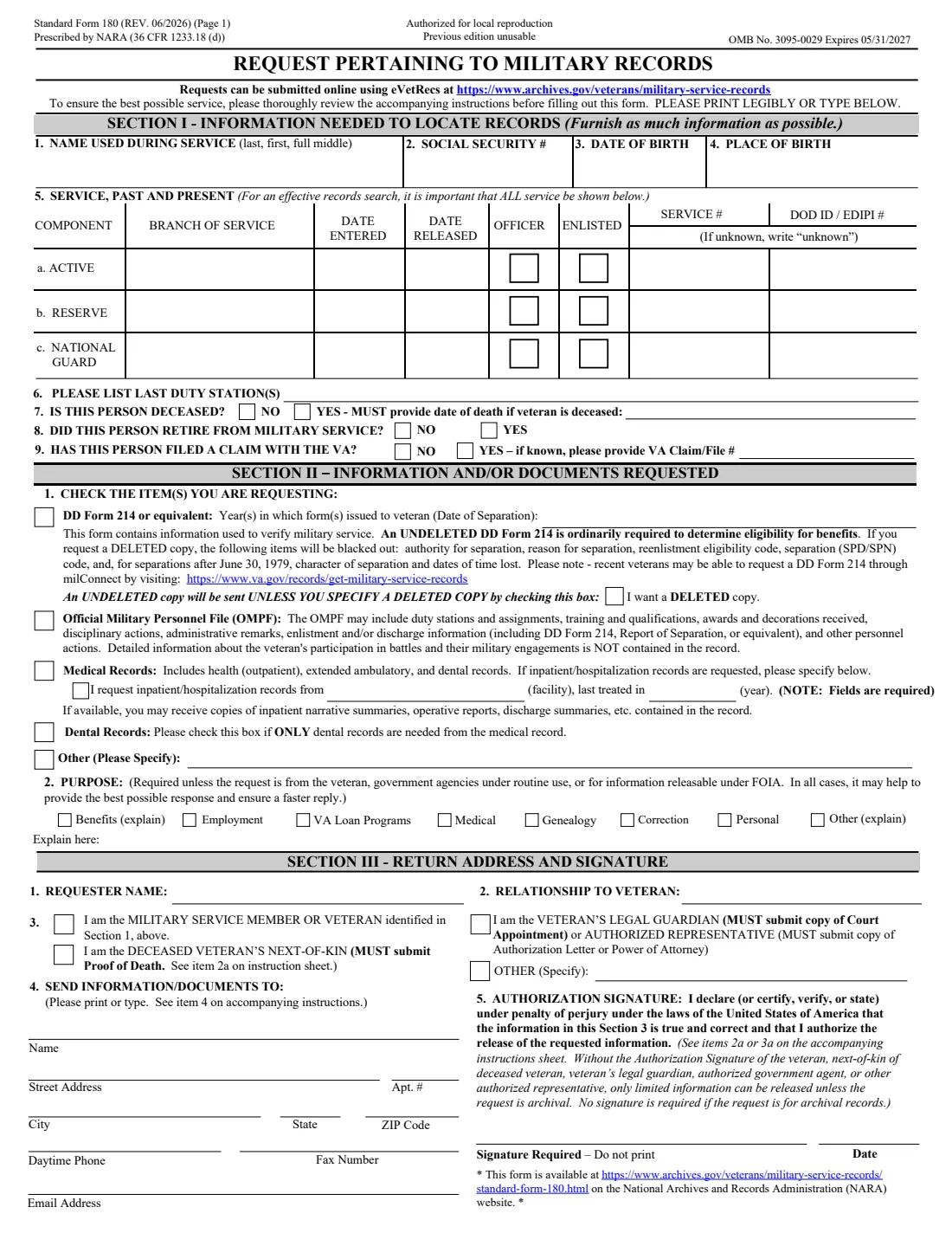
- The veteran's complete name used during service, Social Security number, date and place of birth.
- Each period of service: active duty, reserve and National Guard, with branch, dates entered and released, officer or enlisted, service number and DoD ID if known.
- The last duty station, whether the veteran is deceased (and the date of death), whether they retired, and any VA claim number.
- Which records you want and why (the purpose is required unless you are the veteran).
- Your name, relationship to the veteran and the address where the records should be sent.
- For next of kin: proof of death, such as a copy of the death certificate, obituary, or a funeral director's signed statement. For a guardian or representative: a copy of the court appointment, authorization letter or power of attorney.
What’s on SF 180
The 2026 edition has 3 pages. FileIt asks for it in 8 parts, and it is signed by Requester (veteran or next of kin):
- Section I: The service member (items 1–4)Requester (veteran or next of kin)
- Item 5: Service, past and presentRequester (veteran or next of kin)
- Items 6–9: Last duty station, death, retirement and VA claimRequester (veteran or next of kin)
- Section II, item 1: What you're requestingRequester (veteran or next of kin)
- Section II, item 2: PurposeRequester (veteran or next of kin)
- Section III, items 1–3: Who is askingRequester (veteran or next of kin)
- Section III, item 4: Send the records toRequester (veteran or next of kin)
- Section III, item 5: Authorization signatureRequester (veteran or next of kin)
How to fill out SF 180, step by step
1 Section I, items 1–4: Who the veteran is
Enter the name used during service (last, first, full middle), Social Security number, date of birth and place of birth. Furnish as much as you can; the instructions say to write "NA" (not available) for an item you don't have and can't obtain.
2 Item 5: Service, past and present
List every component the person served in — active, reserve and National Guard — with the branch, the dates entered and released, officer or enlisted, and the service number and DoD ID/EDIPI number. Write "unknown" if you don't know a number. Showing all service matters for an effective records search.
3 Items 6–9: Duty station, death, retirement, VA claim
Give the last duty station, whether the person is deceased (the date of death is required if so), whether they retired from military service, and whether they have filed a VA claim, with the VA claim or file number if known.
4 Section II, item 1: What you want
Tick DD Form 214 (and the year(s) of separation), the Official Military Personnel File, medical records (with the facility and year for inpatient records), dental records only, or Other. An undeleted DD 214 is sent unless you ask for a deleted copy — and an undeleted copy is ordinarily required for benefits.
5 Section II, item 2: Purpose
Tick the purpose — benefits, employment, VA loan programs, medical, genealogy, correction, personal or other — and explain Benefits or Other on the line below. The purpose is required unless the veteran is asking, a government agency requests under routine use, or the information is releasable under FOIA.
6 Section III: Requester, address and signature
Give your name and relationship to the veteran, tick whether you are the veteran, the next of kin of a deceased veteran, a legal guardian or authorized representative, or other, and give the complete address where the records should go. Then sign and date item 5 under penalty of perjury. Without an authorized signature only limited information can be released, except for archival records.
Common mistakes to avoid
- Leaving out reserve or National Guard service — show all service so the right records are found.
- Ticking "I want a DELETED copy" when you need the DD 214 for benefits; benefits ordinarily require the undeleted copy.
- Forgetting proof of death when asking as next of kin of a deceased veteran.
- Mailing the form to the wrong office. Use the page 3 chart for the branch and the date the member left service.
- Printing your name in the signature box — the form says "Signature Required – Do not print".
- Giving an incomplete mailing address; include any apartment, suite or unit number, and a "c/o" name if the address isn't registered to the addressee.
After you fill it out
Sign and date Section III, item 5 and attach any required proof (death certificate, court appointment, power of attorney). Mail or fax the request to the office shown for your case on page 3 of the form. Don't send it to NARA's College Park burden-statement address.
The instructions say most services to service members and next of kin are free, with a nominal fee for certain services that is invoiced with the records; archival records are provided as copies for a fee, and you'll receive an invoice first.
FileIt keeps the completed request in your vault. When the DD 214 arrives, upload it to the veteran's folder in FileIt so the family can find it when it's needed for benefits or a burial.
Fill out SF 180 online with FileIt
- Pick the person. Choose someone from People and FileIt fills in their name, date of birth, address and other details it already knows.
- Answer plain-language questions. One part of the form at a time, with the official help text beside each question — 66 fields in all. Your answers save as you go.
- Check the live preview. Watch your answers land on the real National Archives and Records Administration (NARA) form, and let FileIt do any worksheet arithmetic.
- Generate the official PDF. FileIt prints your answers into the agency’s own PDF and files it in that person’s folder in your vault. Sign it, or send it for e-signature.
FileIt fills the form — it never files or submits anything for you. Deliver the finished form to whoever asked for it, the way the form’s instructions say.
Start SF 180 now — it’s freeSF 180: frequently asked questions
How do I get a copy of my DD 214?
Complete an SF 180, tick DD Form 214 and give the year of separation, sign it, and send it to the office for your branch and separation date on page 3. The form notes that recent veterans may be able to get it through milConnect, and that requests can also be made online with eVetRecs.
Who can request a deceased veteran's records?
The next of kin — the unmarried surviving spouse, father, mother, son, daughter, sister or brother — who must provide proof of death. If the veteran left service 62 or more years ago the records are archival and open to the public.
What does it cost?
According to the instruction sheet there is no charge for most services provided to service members or the next of kin of deceased veterans; a nominal fee is charged for certain services and invoiced with the records. Archival records are copied for a fee, and copies are sent after payment.
Where do I send the SF 180?
It depends on the branch and when the member left service. Page 3 of the form lists each case with a code number and the matching address; many older records go to the National Personnel Records Center, 1 Archives Drive, St. Louis, MO 63138-1002.
What's the difference between a deleted and an undeleted DD 214?
A deleted copy blacks out the authority and reason for separation, reenlistment eligibility code, separation code and, for separations after June 30, 1979, character of separation and dates of time lost. An undeleted copy is ordinarily required to determine eligibility for benefits.
Does FileIt send the request for me?
No. FileIt fills in the official PDF and keeps a copy in your vault; you sign it and mail or fax it to the records office yourself.
Official sources
- Blank form (PDF), published by National Archives and Records Administration (NARA): https://www.gsa.gov/system/files/2026-07/SF180-26a.pdf
- Official instructions and guidance: https://www.archives.gov/veterans/military-service-records/standard-form-180.html
- Edition shown on this page: SF 180 (Rev. 06/2026), OMB 3095-0029, expires 05/31/2027 (checked 2026-09-28).
FileIt is not affiliated with or endorsed by National Archives and Records Administration (NARA) or any government. This page explains the form in general terms and is not legal, tax or immigration advice. Always read the official instructions, and check that you are using the edition the recipient accepts. Page last reviewed 2026-09-28.