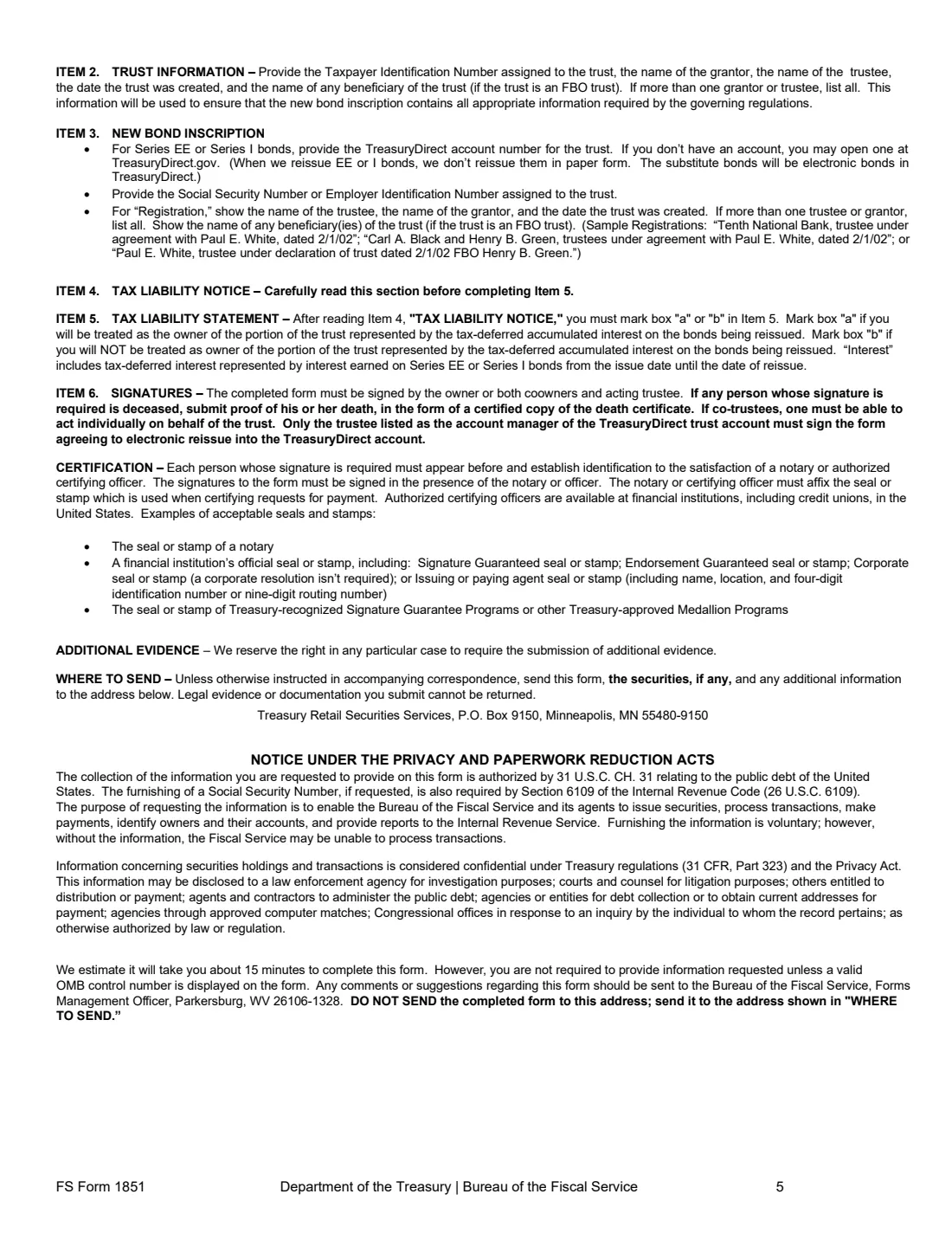
What is FS Form 1851?
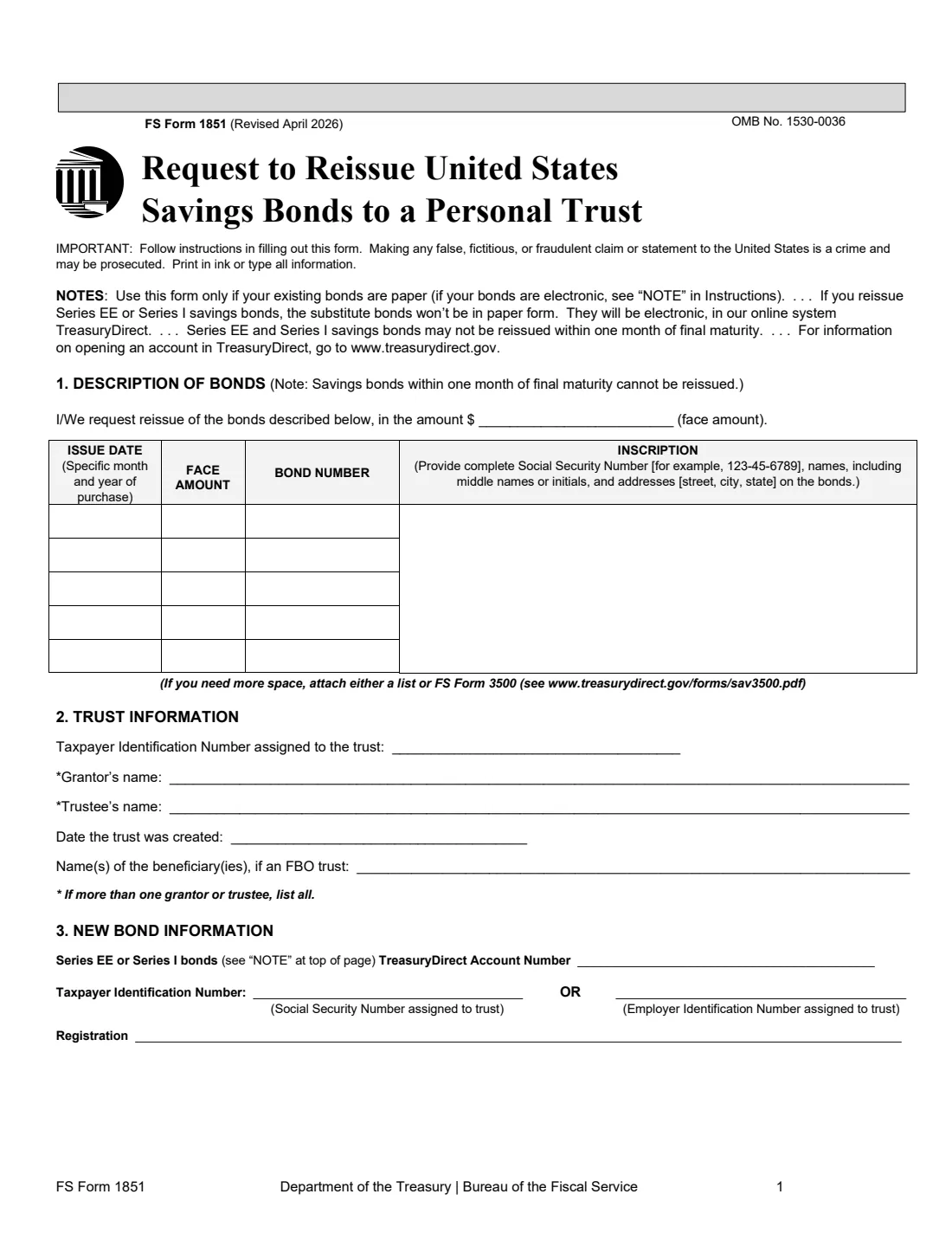
FS Form 1851 asks the Bureau of the Fiscal Service to reissue paper U.S. Savings Bonds in the name of a personal trust. It's the form estate planners point to when a revocable living trust should hold the bonds, so they pass under the trust rather than through probate. The trust can be created by the owner, either coowner, or in some cases another person, as long as an owner or coowner is a beneficiary.
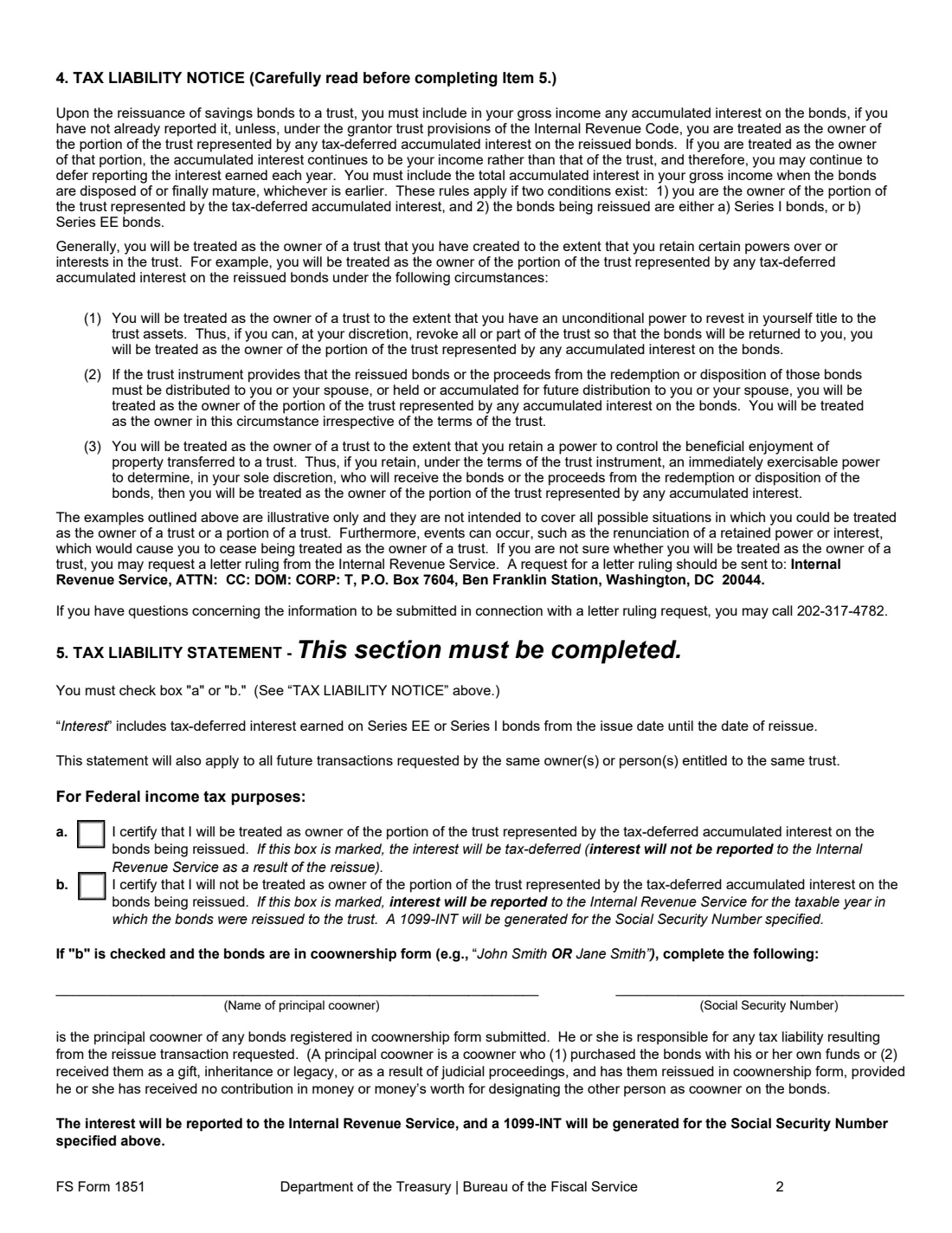
You describe each bond (issue date, face amount, bond number and its current inscription), give the trust's taxpayer identification number, grantor, trustee and creation date, and say how the new bonds should be registered. The April 2026 revision also asks you to certify, in its tax liability statement, whether you'll be treated as owner of the accumulated interest. That choice decides whether the interest stays tax-deferred or is reported to the IRS for the year of the reissue. Series EE and I bonds come back as electronic bonds in the trust's TreasuryDirect account.
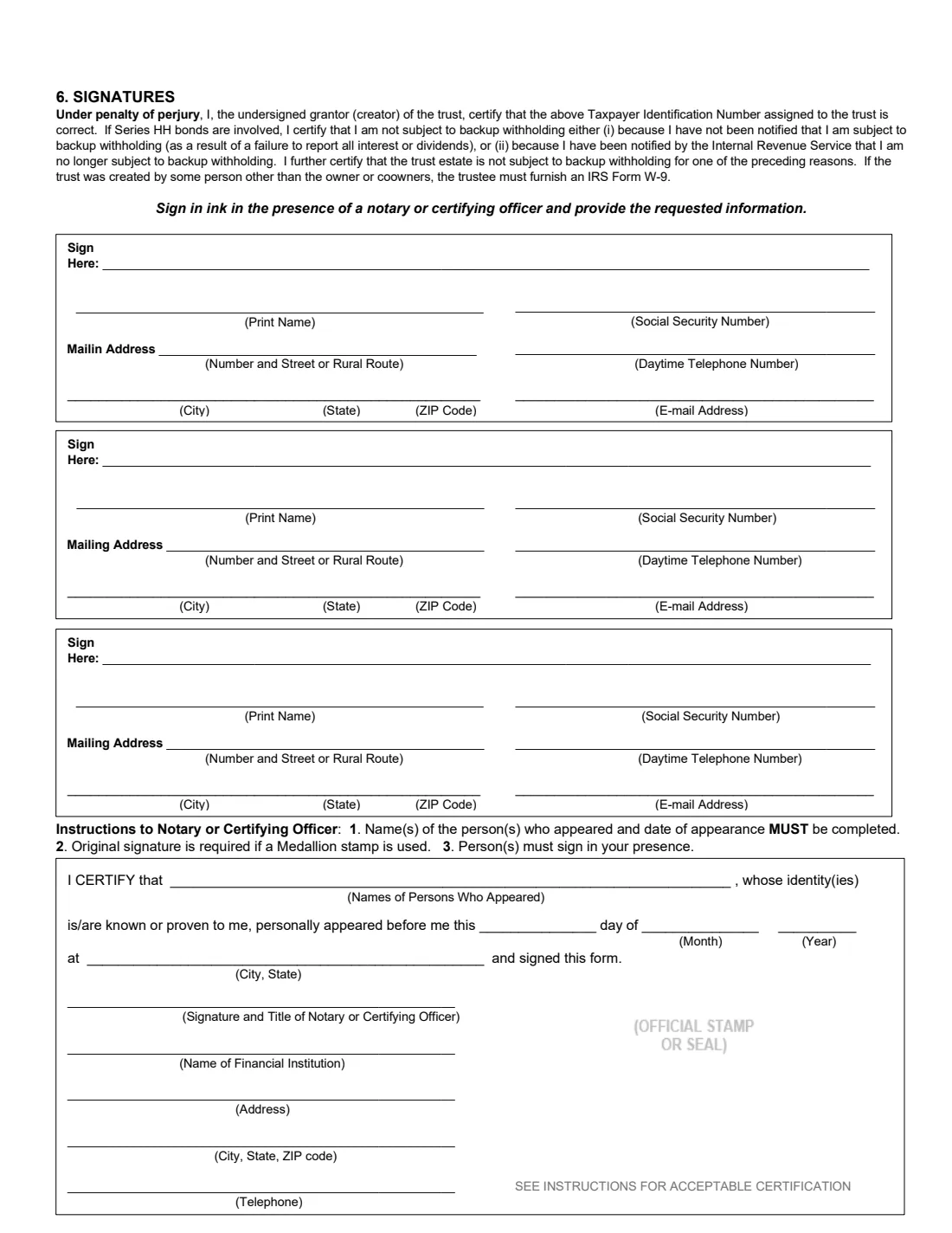
FileIt walks through each item, checks the bond list and that each inscription fits its two lines, and prints your answers into the Treasury's PDF. The owner, any coowner and the trustee then sign in front of a notary or certifying officer, and you mail it with the bonds. FileIt doesn't file anything with Treasury.
- Who signs
- The owner or both coowners, and the acting trustee, before a notary or certifying officer.
- Bonds
- Paper savings bonds only. Five fit on the form; attach a list or FS Form 3500 for more.
- New bonds
- Series EE and I are reissued electronically into the trust's TreasuryDirect account.
- Send to
- Treasury Retail Securities Services, P.O. Box 9150, Minneapolis, MN 55480-9150, with the bonds.
- Edition
- Revised April 2026 (OMB No. 1530-0036)
- Agency
- U.S. Department of the Treasury, Bureau of the Fiscal Service
Who needs to fill out FS Form 1851?
- Owners who have set up a revocable living trust and want their paper savings bonds held by it.
- Coowners moving jointly held bonds into a trust one of them created.
- Families tidying up an estate plan so bonds don't sit outside the trust.
- Someone else who created a trust benefiting the owner or a coowner (for Series EE, a trust whose beneficiary is related to the owner by blood or marriage).
When to use FS Form 1851
- After the trust exists and has its own taxpayer identification number.
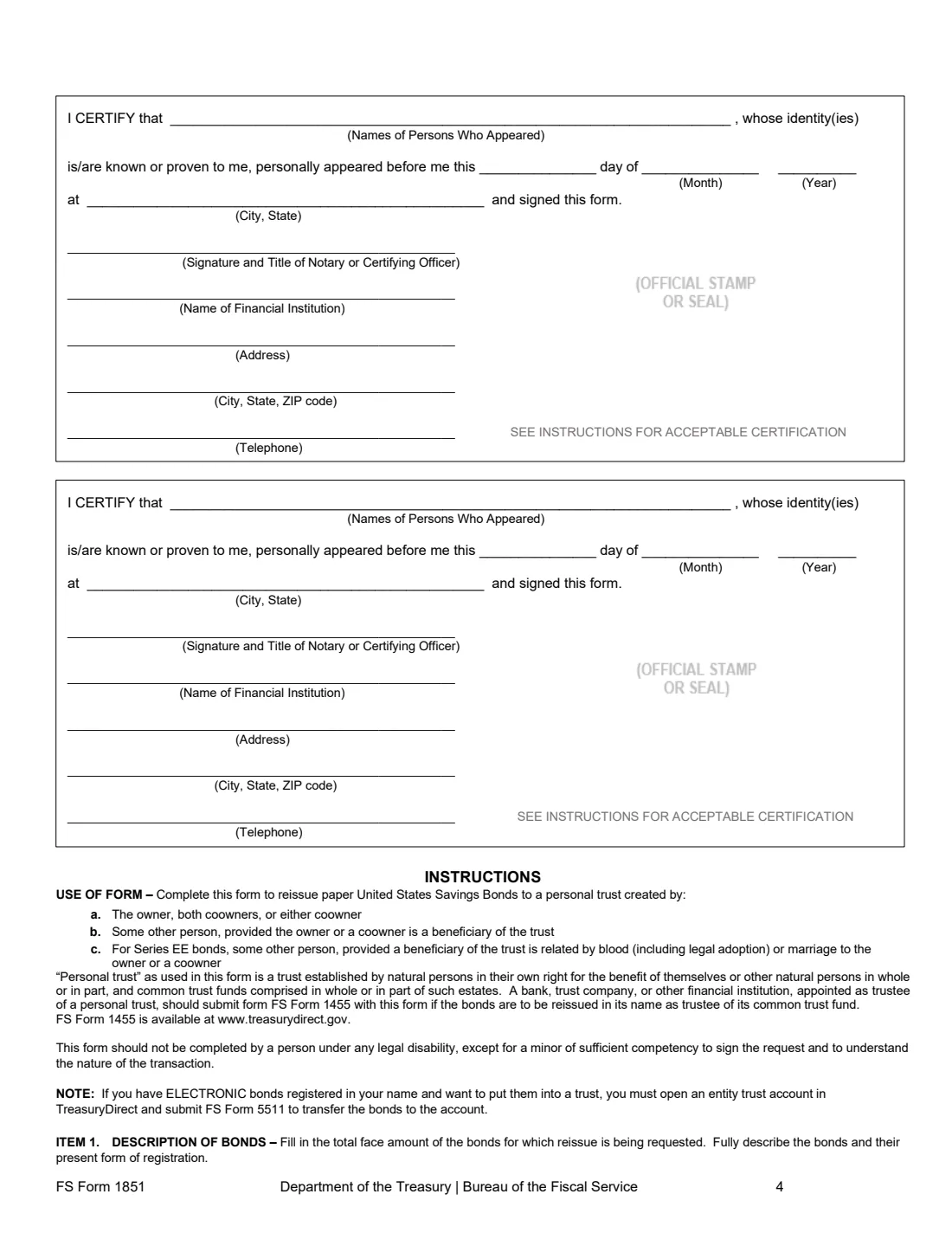
- When the bonds are paper. Electronic bonds move with FS Form 5511 into an entity trust account in TreasuryDirect instead.
- Not within one month of a bond's final maturity: the form says those can't be reissued.
What you need before you start
- The paper bonds, for each bond's issue date, face amount, serial number and exact inscription.
- The trust's taxpayer identification number (SSN or EIN), creation date, grantor(s), trustee(s) and any FBO beneficiaries.
- The trust's TreasuryDirect account number for Series EE or I bonds.
- A decision on box a or b of the tax liability statement, ideally after talking to a tax adviser.
- Each signer's Social Security number, address, daytime phone and email.
- An appointment with a notary or a certifying officer at a bank or credit union.
What’s on FS Form 1851
The 2026 edition has 5 pages. FileIt asks for it in 7 parts, and it is signed by Owner or principal coowner and Coowner or beneficiary and Trustee (treasurydirect account manager):
- 1. Description of bondsOwner or principal coowner
- 2. Trust informationOwner or principal coowner
- 3. New bond informationOwner or principal coowner
- 5. Tax liability statementOwner or principal coowner
- 6. Signature: owner or principal coownerOwner or principal coowner
- Second signer: coowner or beneficiaryCoowner or beneficiary
- Third signer: trustee (TreasuryDirect trust account manager)Trustee (treasurydirect account manager)
How to fill out FS Form 1851, step by step
1 1. Description of bonds
Give the total face amount, then list each bond: issue date (month and year), face amount, bond number and the inscription as printed, with full Social Security numbers, names and addresses. FileIt warns if an inscription won't fit the two lines in the table.
2 2. Trust information
The trust's taxpayer identification number, the grantor's and trustee's names (list everyone if there are several), the date the trust was created, and the beneficiaries if it's an FBO trust.
3 3. New bond information
The trust's TreasuryDirect account number, its SSN or EIN, and the registration. Treasury's examples include "Paul E. White, trustee under declaration of trust dated 2/1/02 FBO Henry B. Green".
4 4 and 5. Tax liability
Item 4 explains when the grantor trust rules treat you as owner of the accumulated interest. In item 5 you tick a (interest stays tax-deferred) or b (interest is reported for the year of the reissue on a 1099-INT). With b and bonds in coownership form, you also name the principal coowner.
5 6. Signatures
Up to three signers: the owner or principal coowner, the other coowner, and the trustee who manages the trust's TreasuryDirect account. Each gives their contact details and signs in ink before the notary or certifying officer, who completes the certificate.
Common mistakes to avoid
- Using this form for electronic bonds already in TreasuryDirect.
- Leaving item 5 blank: the form says box a or b must be checked.
- Writing a registration that doesn't name the trustee, grantor and trust date.
- Signing before you're in front of the notary or certifying officer.
- Forgetting the trustee's IRS Form W-9 when someone other than the owner created the trust.
- Sending bonds that are within a month of final maturity.
After you fill it out
Sign with the notary or certifying officer, then mail the form, the bonds and any evidence to Treasury Retail Securities Services, P.O. Box 9150, Minneapolis, MN 55480-9150. Evidence you send can't be returned.
Watch the trust's TreasuryDirect account for the reissued Series EE or I bonds.
Keep a copy with your trust papers. FileIt files the PDF in the person's vault folder so it sits next to the trust documents.
Fill out FS Form 1851 online with FileIt
- Pick the person. Choose someone from People and FileIt fills in their name, date of birth, address and other details it already knows.
- Answer plain-language questions. One part of the form at a time, with the official help text beside each question — 59 fields in all. Your answers save as you go.
- Check the live preview. Watch your answers land on the real U.S. Department of the Treasury, Bureau of the Fiscal Service form, and let FileIt do any worksheet arithmetic.
- Generate the official PDF. FileIt prints your answers into the agency’s own PDF and files it in that person’s folder in your vault. Sign it, or send it for e-signature.
FileIt fills the form — it never files or submits anything for you. Deliver the finished form to whoever asked for it, the way the form’s instructions say.
Start FS Form 1851 now — it’s freeFS Form 1851: frequently asked questions
Can I put my savings bonds in my living trust?
Yes, paper bonds can be reissued to a personal trust with FS Form 1851, as long as the trust meets the form's rules on who created it and who benefits.
Will reissuing to a trust trigger tax on the interest?
It depends on item 5. If you're treated as owner of the part of the trust holding the accumulated interest (box a), it stays tax-deferred. Otherwise (box b) the interest is reported for the year of the reissue. The form suggests an IRS letter ruling if you're unsure.
Do I get paper bonds back?
Not for Series EE or I. The form says they're reissued as electronic bonds in TreasuryDirect, so the trust needs an account there.
Who has to sign?
The owner or both coowners and the acting trustee. For EE and I bonds, the trustee who is account manager of the trust's TreasuryDirect account signs to agree to the electronic reissue.
What if my bonds are already electronic?
The instructions say to open an entity trust account in TreasuryDirect and submit FS Form 5511 to transfer them.
Does FileIt send the form to Treasury?
No. FileIt fills the official PDF and keeps a copy in your vault. You sign it before a notary or certifying officer and mail it yourself.
Official sources
- Blank form (PDF), published by U.S. Department of the Treasury, Bureau of the Fiscal Service: https://www.treasurydirect.gov/forms/sav1851.pdf
- Official instructions and guidance: https://www.treasurydirect.gov/forms/
- Edition shown on this page: FS Form 1851 (Revised April 2026), OMB No. 1530-0036 (checked 2026-10-19).
FileIt is not affiliated with or endorsed by U.S. Department of the Treasury, Bureau of the Fiscal Service or any government. This page explains the form in general terms and is not legal, tax or immigration advice. Always read the official instructions, and check that you are using the edition the recipient accepts. Page last reviewed 2026-10-19.