
What is FS Form 5336?
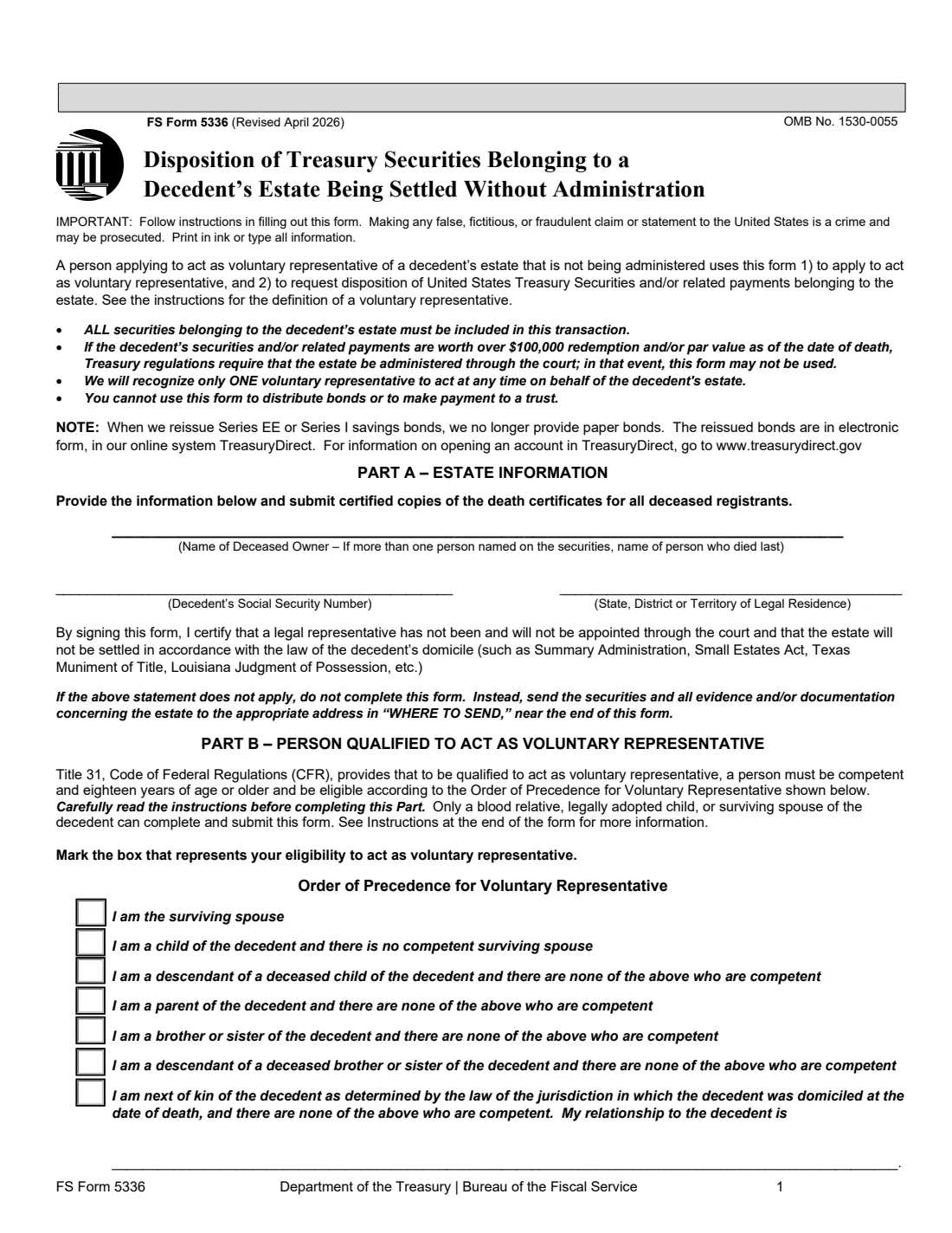
When someone dies owning U.S. Savings Bonds or other Treasury securities and nobody is appointed by a court, FS Form 5336 lets a close relative act as voluntary representative. The form allows it only when the decedent's securities and related payments were worth $100,000 or less at the date of death, and only one voluntary representative is recognized for an estate at a time.
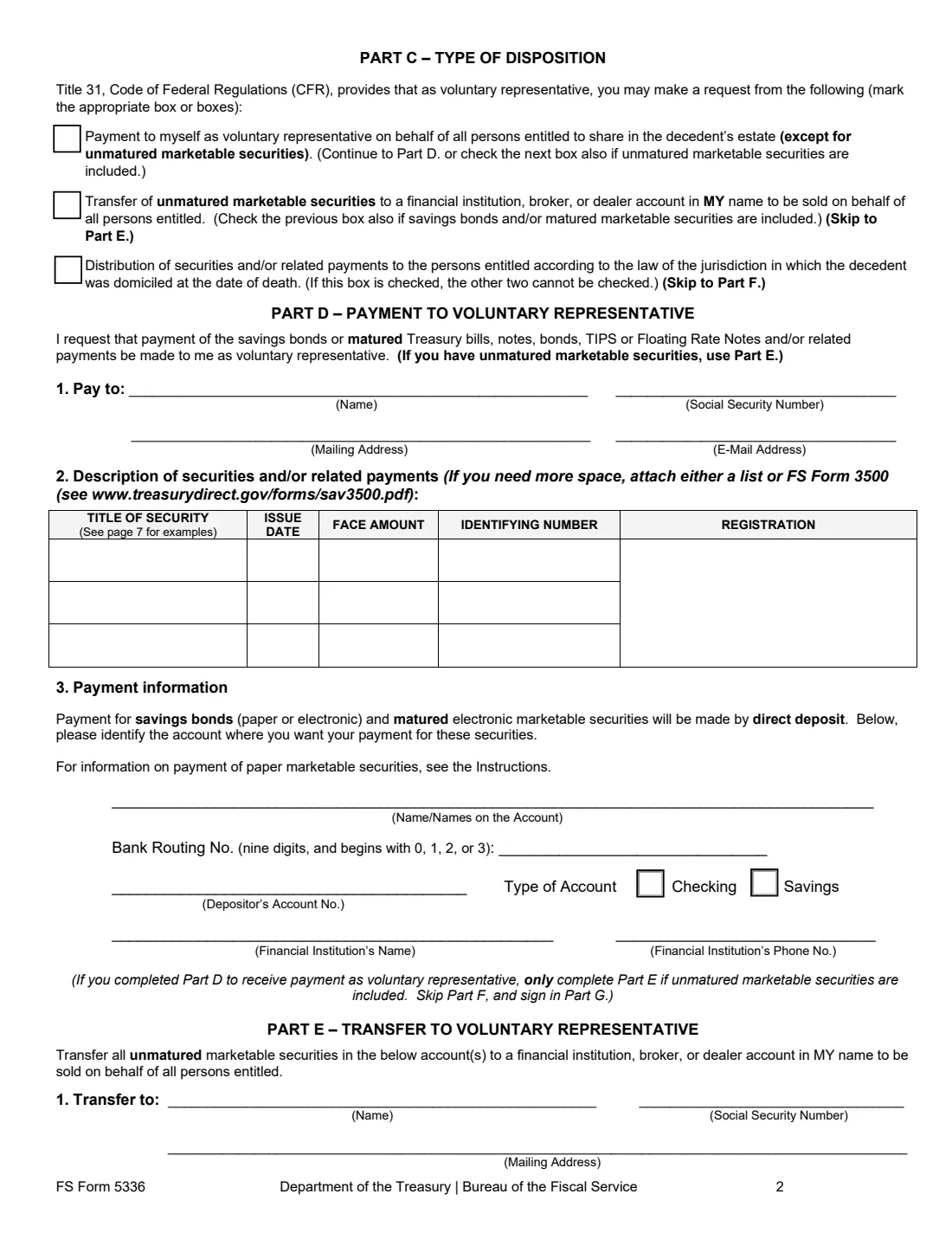
You give the decedent's name, Social Security number and state of residence, choose your place in Treasury's order of precedence (surviving spouse first, then children, grandchildren, parents, siblings, their descendants, and other next of kin), and pick what should happen: payment to you on behalf of everyone entitled, transfer of unmatured marketable securities to a brokerage account in your name, or distribution straight to the people entitled under state law. All of the decedent's securities go on one form.
FileIt asks the questions in that order, opens the right parts for your choice, checks the routing numbers and that each registration fits on the form, and prints the result on Treasury's April 2026 PDF. You sign in front of a certifying officer, or a notary if only paper savings bonds are involved.
- Who fills it
- One relative: the surviving spouse, or the next person in Treasury's order of precedence, 18 or older and competent.
- Limit
- Securities and related payments worth $100,000 or less at the date of death; above that the estate goes through the court.
- Certification
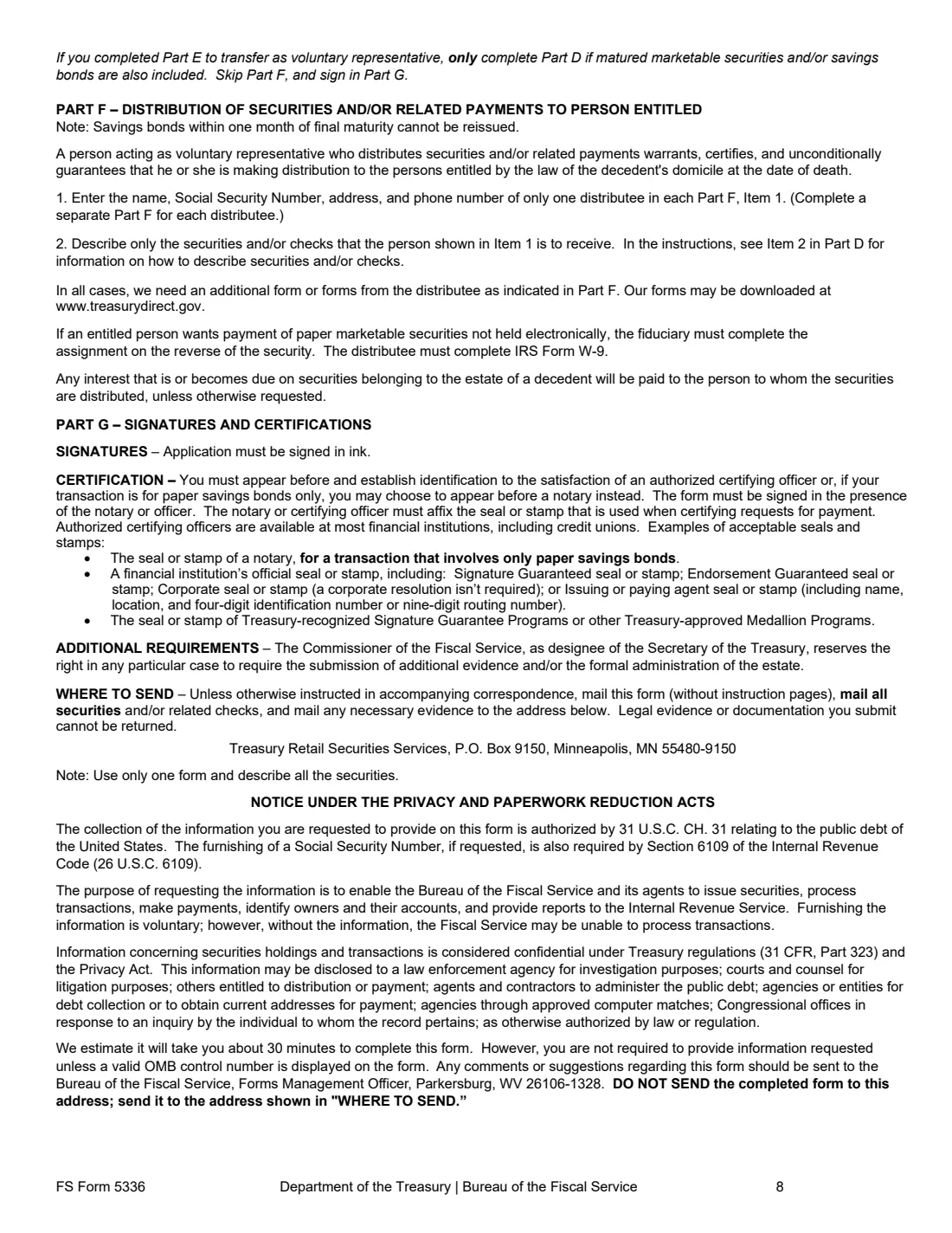
- A certifying officer at a financial institution, or a notary when only paper savings bonds are involved.
- Send to
- Treasury Retail Securities Services, P.O. Box 9150, Minneapolis, MN 55480-9150.
- Edition
- Revised April 2026 (OMB No. 1530-0055)
- Agency
- U.S. Department of the Treasury, Bureau of the Fiscal Service
Who needs to fill out FS Form 5336?
- A surviving spouse settling savings bonds left by their husband or wife.
- Adult children whose parent died with bonds and no surviving spouse.
- Grandchildren, parents, brothers and sisters, or other next of kin when no one closer can act.
- Families where the estate is small and no executor or small-estate procedure is being used.
When to use FS Form 5336
- When no legal representative has been or will be appointed by a court.
- When the estate isn't being settled under a state procedure such as Summary Administration or a Small Estates Act.
- Not when you hold a document establishing entitlement other than an unprobated will: the instructions say to send that to Treasury instead.
What you need before you start
- Certified copies of the death certificates of every deceased person named on the securities.
- The decedent's Social Security number and state of legal residence.
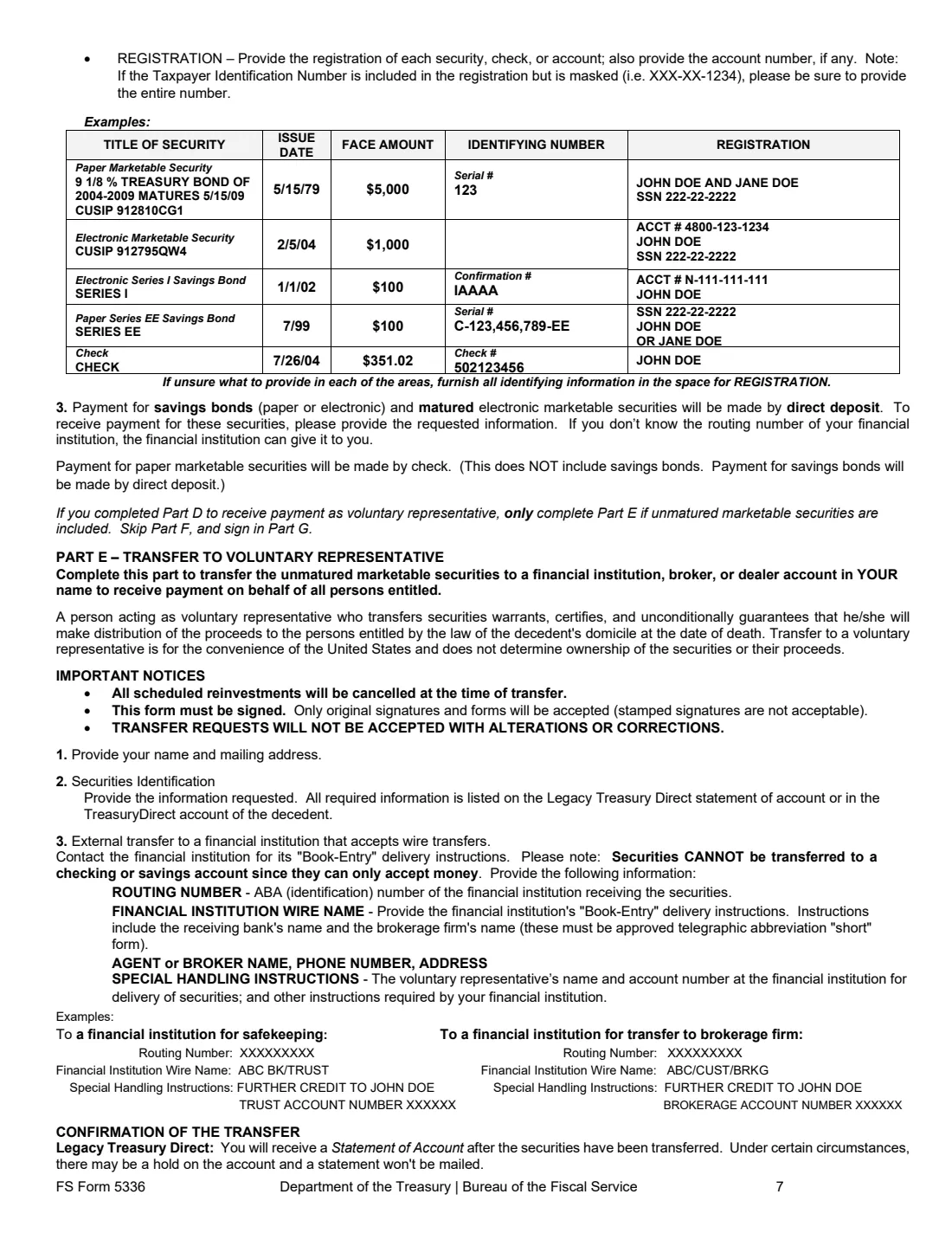
- Every security and check: title or series, issue date, face amount, serial or confirmation number and registration.
- For payment to you, your bank's routing number and your account number.
- For a transfer, the decedent's account numbers and the receiving institution's routing number and "Book-Entry" wire instructions.
- For a distribution, each distributee's name, SSN, address and contact details.
What’s on FS Form 5336
The 2026 edition has 8 pages. FileIt asks for it in 9 parts, and it is signed by Voluntary representative:
- Part A: Estate informationVoluntary representative
- Part B: Your right to act as voluntary representativeVoluntary representative
- Part C: Type of dispositionVoluntary representative
- Part D: Payment to you as voluntary representativeVoluntary representative
- Part E: Transfer to you as voluntary representativeVoluntary representative
- Part F: First distributeeVoluntary representative
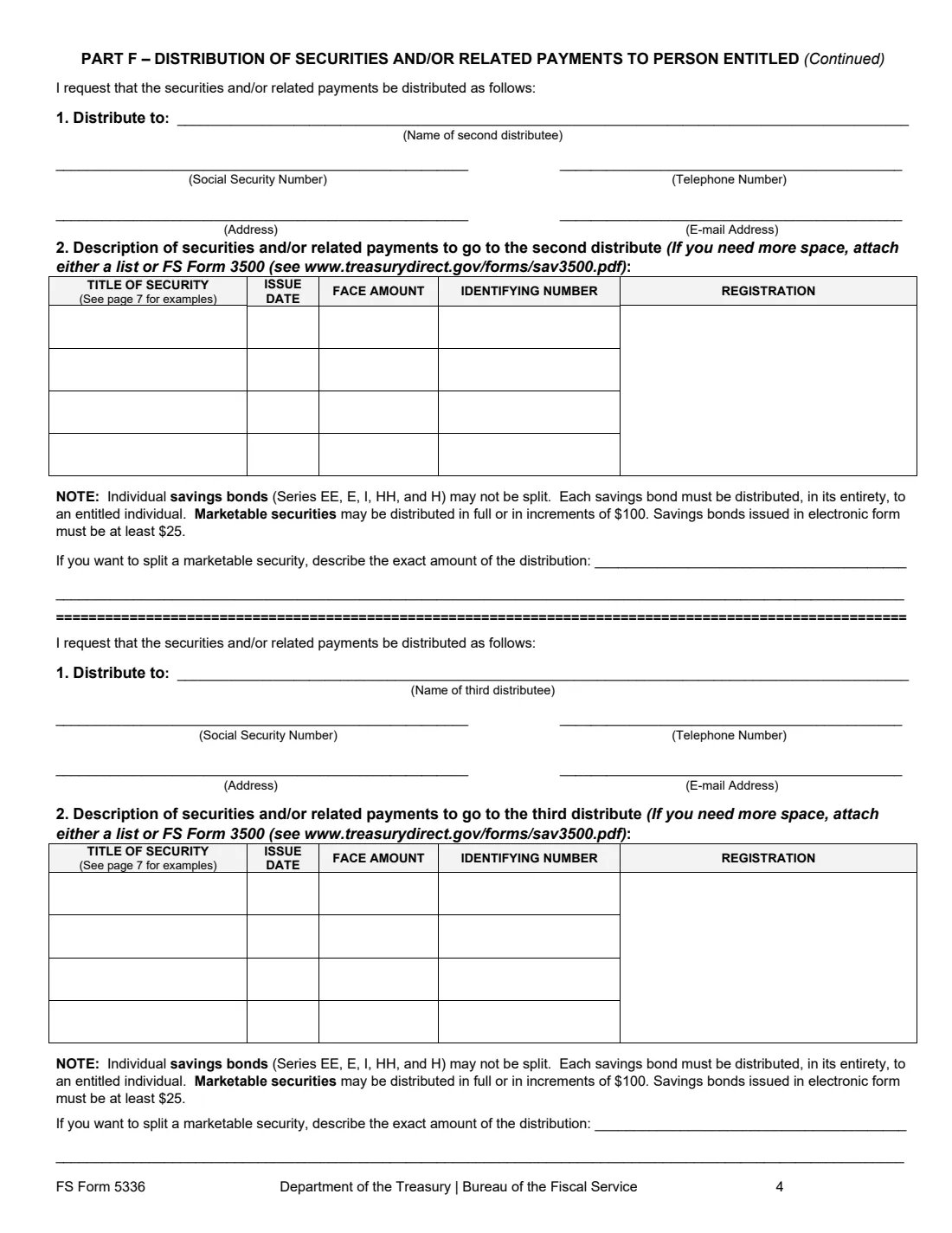
- Part F: Second distributeeVoluntary representative
- Part F: Third distributeeVoluntary representative
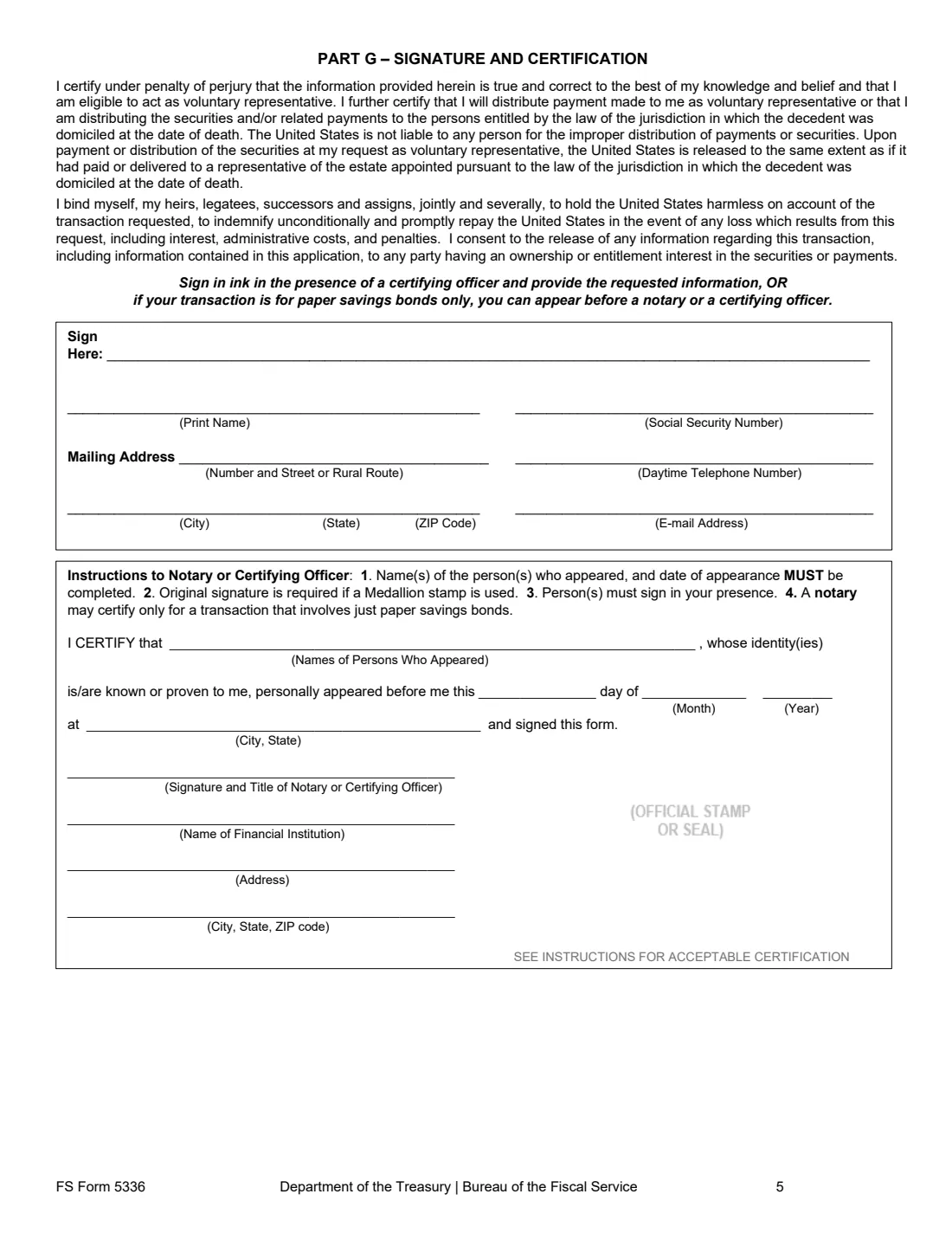
- Part G: Signature and certificationVoluntary representative
How to fill out FS Form 5336, step by step
1 Part A: Estate information
The decedent's name (the one who died last if several are named), Social Security number and state, district or territory of residence. By signing you certify that no court representative is involved and no state small-estate procedure is being used.
2 Part B: Order of precedence
Read from the top and tick the first line that fits you. If you're next of kin under state law, write your relationship. Only a blood relative, legally adopted child or surviving spouse can use the form, even with a power of attorney.
3 Part C: Type of disposition
Payment to yourself (for savings bonds and matured securities) and transfer to your brokerage account (for unmatured marketable securities) can be combined. Distribution directly to the persons entitled stands alone.
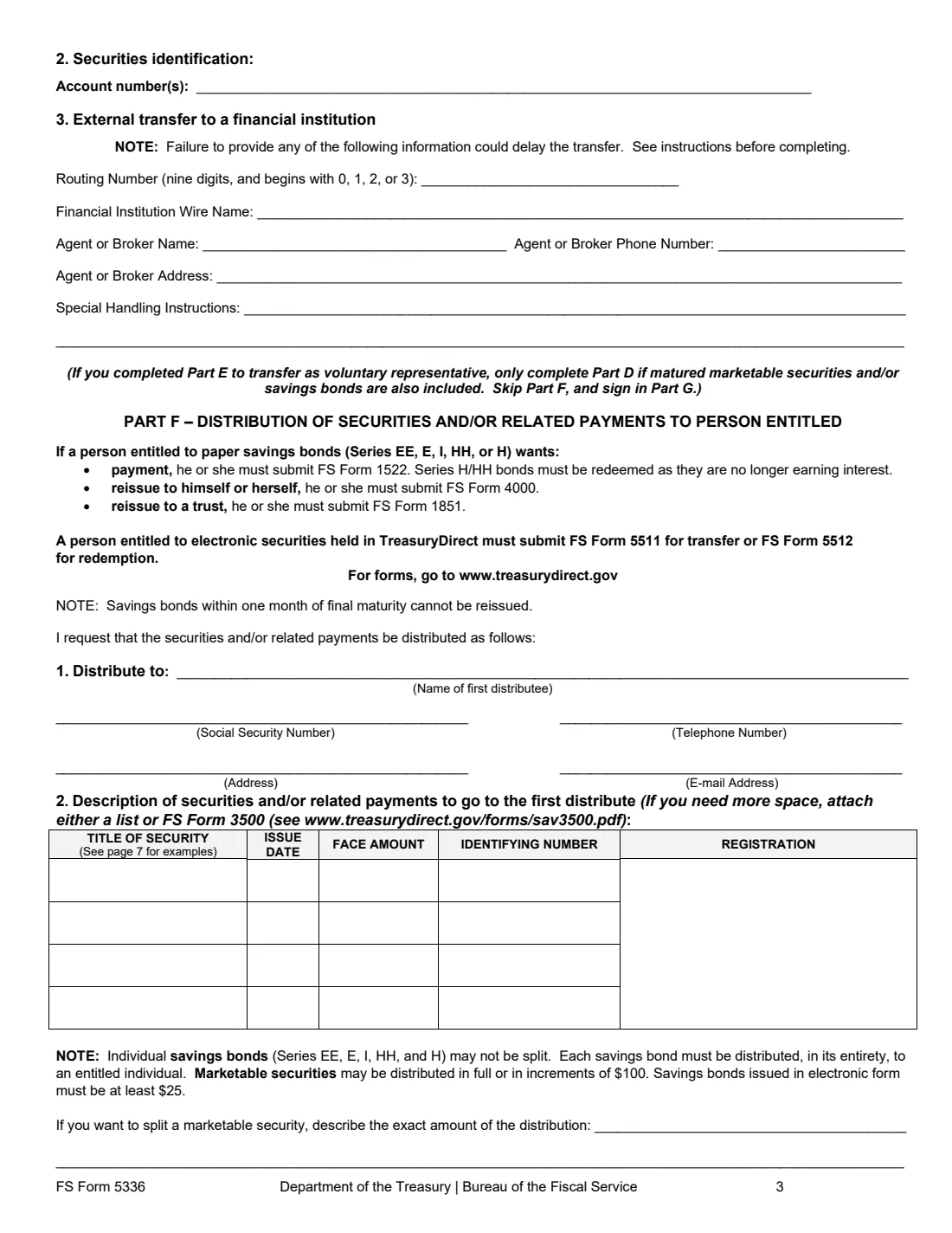
4 Parts D, E and F
D lists what's paid to you and the account for direct deposit. E gives the accounts to transfer and the receiving institution's wire details. F names each distributee and only the securities that person receives; savings bonds can't be split, and marketable securities split in $100 steps.
5 Part G: Signature
You certify under penalty of perjury that you're eligible and will distribute to the persons entitled, and agree to indemnify the United States. Sign in ink in front of the certifying officer or notary.
Common mistakes to avoid
- Using the form when the estate exceeds $100,000 or is going through probate.
- Leaving some of the decedent's securities off: all of them must be included.
- Ticking distribution together with payment or transfer.
- Choosing a line in the order of precedence when someone higher on the list is competent to act.
- Trying to pay or distribute to a trust, which the form doesn't allow.
- Forgetting that each distributee also sends their own form, such as FS Form 1522 or 4000.
After you fill it out
Sign before the certifying officer or notary and mail the form (without the instruction pages), the securities and checks, and the death certificates to Treasury Retail Securities Services, P.O. Box 9150, Minneapolis, MN 55480-9150.
Distribute what you receive to the people entitled under the law of the decedent's state: the form makes you guarantee it.
Keep the filled form with the estate papers. FileIt stores it in the vault, in the folder of the person you chose.
Fill out FS Form 5336 online with FileIt
- Pick the person. Choose someone from People and FileIt fills in their name, date of birth, address and other details it already knows.
- Answer plain-language questions. One part of the form at a time, with the official help text beside each question — 131 fields in all. Your answers save as you go.
- Check the live preview. Watch your answers land on the real U.S. Department of the Treasury, Bureau of the Fiscal Service form, and let FileIt do any worksheet arithmetic.
- Generate the official PDF. FileIt prints your answers into the agency’s own PDF and files it in that person’s folder in your vault. Sign it, or send it for e-signature.
FileIt fills the form — it never files or submits anything for you. Deliver the finished form to whoever asked for it, the way the form’s instructions say.
Start FS Form 5336 now — it’s freeFS Form 5336: frequently asked questions
How do I cash savings bonds of someone who died without probate?
If their Treasury securities total $100,000 or less and no court case or state small-estate procedure is used, the closest eligible relative can apply as voluntary representative on FS Form 5336 and ask for payment.
Who has priority to file?
The surviving spouse, then a child, then a descendant of a deceased child, a parent, a brother or sister, a descendant of a deceased sibling, and finally next of kin under state law, each only when no one above is competent.
Can more than one relative sign?
No. Treasury recognizes only one voluntary representative at a time for an estate.
Will I owe tax on the interest?
The instructions say your Social Security number may be used to report all the interest to the IRS, and point to IRS Publication 550 or a tax adviser.
Can I use a notary?
Only if the transaction involves just paper savings bonds. Otherwise you need a certifying officer, available at most banks and credit unions.
Does FileIt send this to Treasury?
No. FileIt prepares the official PDF and keeps it in your vault. You sign it with the officer and mail it yourself.
Official sources
- Blank form (PDF), published by U.S. Department of the Treasury, Bureau of the Fiscal Service: https://www.treasurydirect.gov/forms/sav5336.pdf
- Official instructions and guidance: https://www.treasurydirect.gov/forms/
- Edition shown on this page: FS Form 5336 (Revised April 2026), OMB No. 1530-0055 (checked 2026-10-19).
FileIt is not affiliated with or endorsed by U.S. Department of the Treasury, Bureau of the Fiscal Service or any government. This page explains the form in general terms and is not legal, tax or immigration advice. Always read the official instructions, and check that you are using the edition the recipient accepts. Page last reviewed 2026-10-19.