What is FinCEN Form 105?
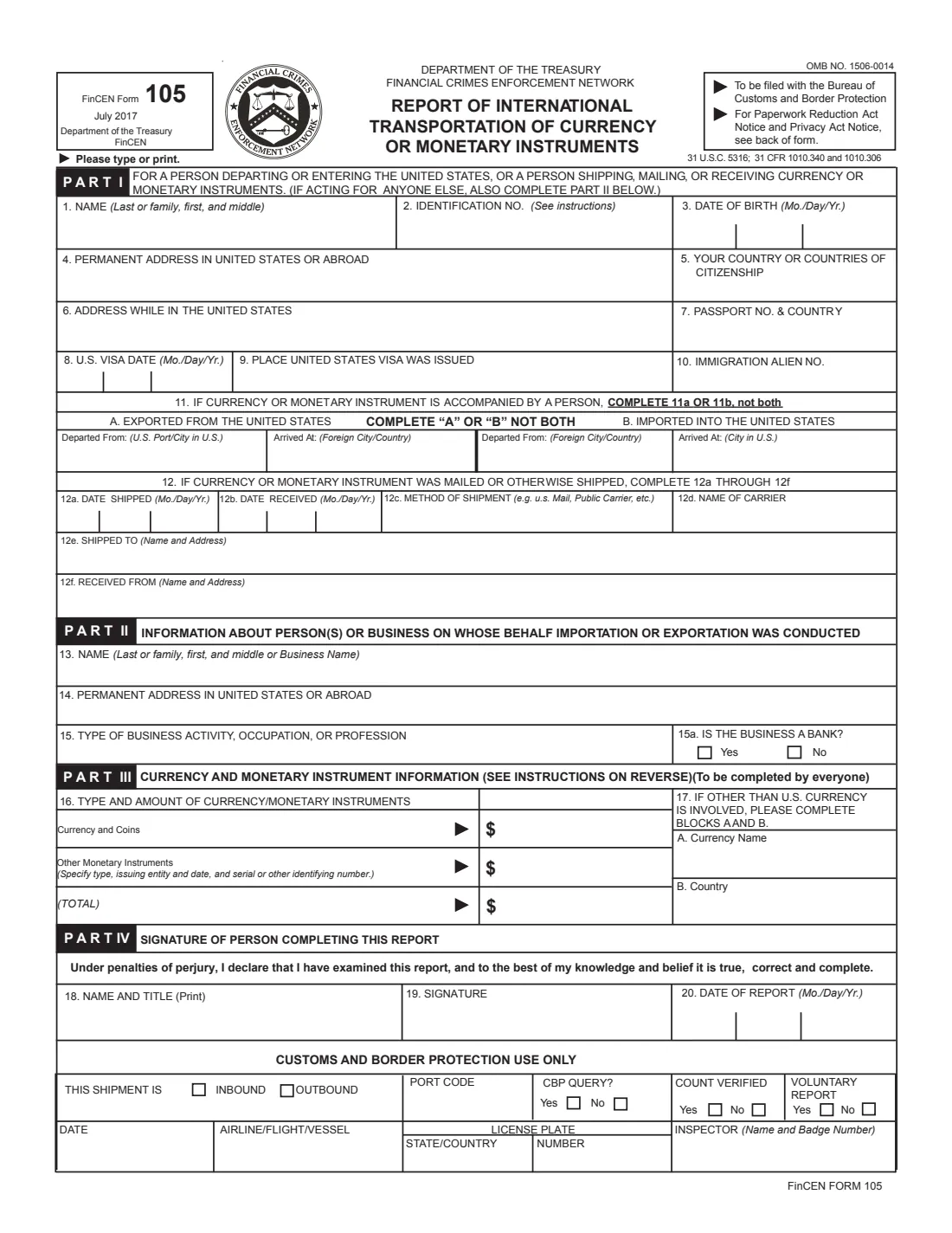
FinCEN Form 105, the Report of International Transportation of Currency or Monetary Instruments (often called the CMIR), is required by 31 U.S.C. 5316 and the Bank Secrecy Act regulations. It is a Financial Crimes Enforcement Network (FinCEN) form that is filed with U.S. Customs and Border Protection (CBP).
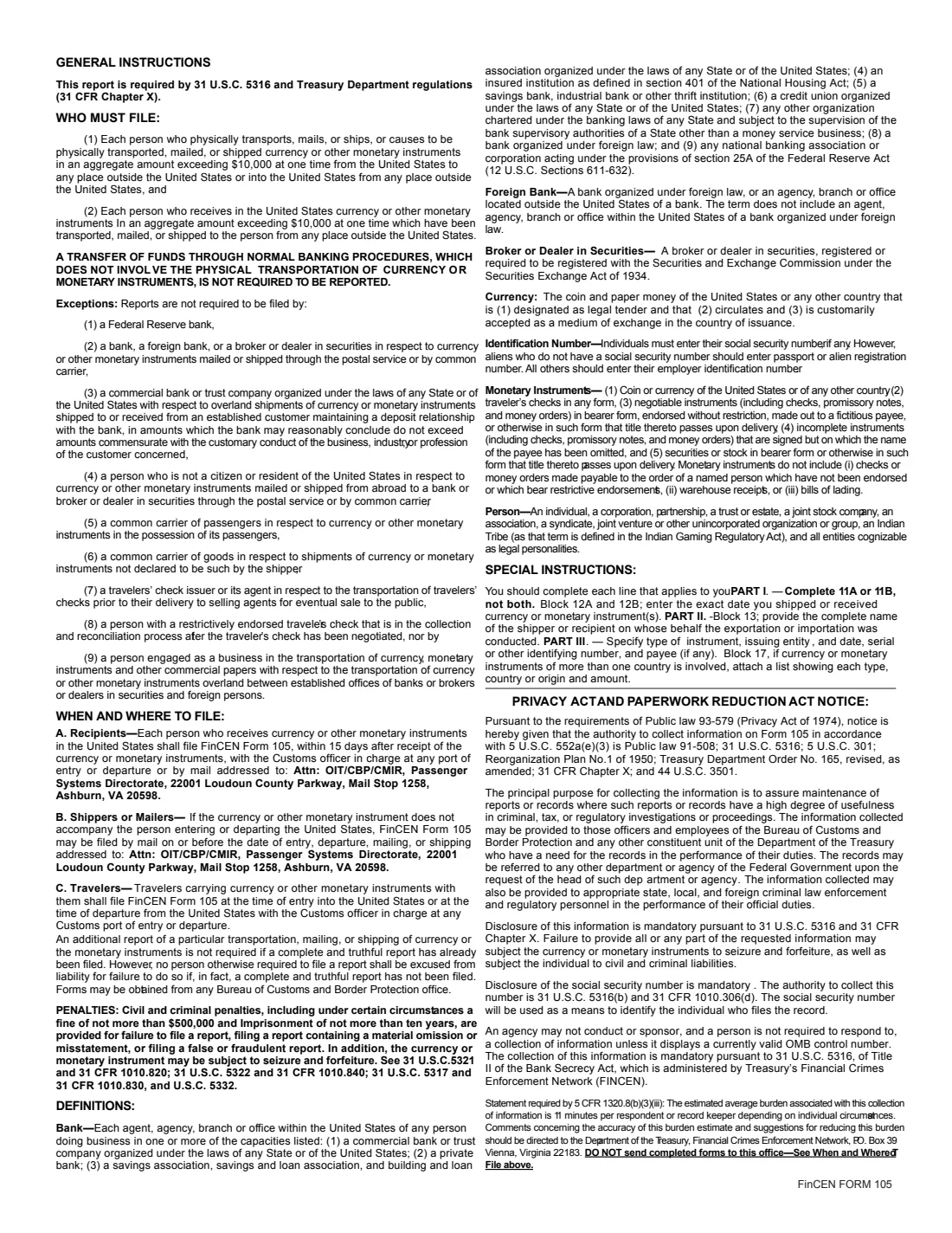
You must file it when you physically transport, mail or ship — or cause to be transported, mailed or shipped — currency or other monetary instruments totalling more than $10,000 at one time into or out of the United States. People in the United States who receive more than $10,000 from abroad file one too. Carrying that much money is legal; not reporting it is not. A transfer of funds through normal banking procedures that doesn't involve physically moving currency or monetary instruments does not need to be reported.
FileIt asks you each item in plain English, adds up the total in item 16 and prints your answers into the official July 2017 FinCEN Form 105 PDF. You then print it, sign it by hand and hand it to the CBP officer, or mail it to CBP if you are a shipper or recipient.
- Who fills it
- The traveler, shipper, mailer or recipient of more than $10,000 in currency or monetary instruments
- Filed with
- U.S. Customs and Border Protection — at the port of entry or departure, or by mail
- Threshold
- An aggregate amount exceeding $10,000 at one time
- Recipients
- File within 15 days after receipt
- Signatures
- The person completing the report signs Part IV under penalties of perjury
- Edition
- FinCEN Form 105, July 2017 (OMB 1506-0014)
Who needs to fill out FinCEN Form 105?
- Travelers entering or leaving the United States carrying more than $10,000 in total in cash (U.S. or foreign) and other monetary instruments — including families traveling together whose combined cash is over the limit.
- Anyone who mails or ships more than $10,000 in currency or monetary instruments into or out of the United States.
- People in the United States who receive more than $10,000 in currency or monetary instruments mailed or shipped to them from abroad.
- Someone carrying or shipping money on behalf of another person or a business (who then completes Part II as well).
- Not needed for a normal bank wire or other bank transfer that doesn't physically move cash or instruments. The instructions also list exceptions, for example for banks and brokers shipping by mail or common carrier, and for common carriers of passengers.
When to use FinCEN Form 105
- At the time of entry into or departure from the United States, when you carry the money with you — you file with the CBP officer at the port.
- On or before the date of entry, departure, mailing or shipping, when the money travels without you (mail it to CBP).
- Within 15 days after you receive currency or monetary instruments from outside the United States.
- Only once per movement: a new report isn't needed if a complete and truthful report has already been filed for that transportation, mailing or shipment.
What you need before you start
- Your full name, date of birth, permanent address, and your address while in the United States (if different).
- Your identification number: your Social Security number if you have one; otherwise a passport or alien registration number. Businesses use their EIN.
- Your citizenship, passport number and issuing country, and U.S. visa date and place of issue if you travel on a visa.
- Where you're departing from and arriving at — or, for mail and shipments, the dates shipped and received, method, carrier, and the sender and recipient names and addresses.
- The U.S. dollar amounts of currency and coins and of other monetary instruments, with each instrument's type, issuer, date and serial number.
- The currency name and country, if other than U.S. currency is involved.
- The name and address of the person or business you're acting for, if any, and its line of business.
What’s on FinCEN Form 105
The 2017 edition has 2 pages. FileIt asks for it in 5 parts, and it is signed by Person completing the report:
- Part I: About you (items 1–10)Person completing the report
- Items 11–12: How the money is movingPerson completing the report
- Part II: Person or business you're acting for (items 13–15a)Person completing the report
- Part III: Currency and monetary instruments (items 16–17)Person completing the report
- Part IV: Signature (items 18–20)Person completing the report
How to fill out FinCEN Form 105, step by step
1 Part I, items 1–10: About you
Enter your name (last, first, middle), identification number, date of birth, permanent address, citizenship, U.S. address, passport number and country, and — if you hold a U.S. visa — the visa date and where it was issued, plus any immigration alien number. The instructions say individuals give their Social Security number if they have one; aliens without one give a passport or alien registration number.
2 Item 11: Money that travels with a person
If the currency or instruments accompany a person, complete 11a (exported: departed from a U.S. port or city, arriving at a foreign city and country) or 11b (imported: departed from a foreign city and country, arrived at a U.S. city) — not both.
3 Item 12: Money that is mailed or shipped
If it was mailed or otherwise shipped, complete 12a to 12f: the exact date shipped, the exact date received, the method of shipment (for example U.S. Mail or a public carrier), the carrier's name, and the names and addresses it was shipped to and received from.
4 Part II, items 13–15a: Who you're acting for
If you're moving the money on behalf of someone else, give the complete name and permanent address of that person or business, its type of business, occupation or profession, and whether it is a bank. Skip Part II if the money is yours.
5 Part III, items 16–17: The amounts
Everyone completes Part III. Give the U.S. dollar amount of currency and coins, the amount of other monetary instruments (with type, issuing entity and date, and serial or other identifying number), and the total. If foreign currency is involved, give its name and country; if more than one country's currency is involved, attach a list showing each type, country and amount.
6 Part IV, items 18–20: Sign
Print your name (and title if you sign for a business), sign under penalties of perjury and date the report. The Customs and Border Protection use-only block at the bottom is left for the officer.
Common mistakes to avoid
- Counting only U.S. dollars. Foreign currency and monetary instruments such as traveler's checks and bearer checks count toward the $10,000 too.
- Splitting the money between family members to stay under the limit — the report is about the aggregate amount moved at one time.
- Completing both 11a and 11b. Choose the one for your direction of travel.
- Leaving out the details of other monetary instruments — the instructions ask for type, issuing entity, date, serial or other identifying number, and payee.
- Assuming a bank wire needs a CMIR. A transfer through normal banking procedures that doesn't physically move currency or instruments doesn't.
- Filing late as a recipient: the deadline is 15 days after receipt.
After you fill it out
Print the PDF and sign item 19 by hand. Travelers hand the form to the CBP officer in charge at the port of entry or departure. Shippers, mailers and recipients may mail it to the address in the form's instructions: Attn: OIT/CBP/CMIR, Passenger Systems Directorate, 22001 Loudoun County Parkway, Mail Stop 1258, Ashburn, VA 20598.
Keep a copy in your FileIt vault with your travel documents. The form warns that failing to file, or filing a report with a material omission or misstatement, can bring civil and criminal penalties — in some circumstances a fine of up to $500,000 and imprisonment of up to ten years — and the money may be seized and forfeited.
Don't send the form to FinCEN's Vienna, Virginia address — the form says completed forms go to CBP, not there.
Fill out FinCEN Form 105 online with FileIt
- Pick the person. Choose someone from People and FileIt fills in their name, date of birth, address and other details it already knows.
- Answer plain-language questions. One part of the form at a time, with the official help text beside each question — 35 fields in all. Your answers save as you go.
- Check the live preview. Watch your answers land on the real Financial Crimes Enforcement Network (FinCEN) / U.S. Customs and Border Protection form, and let FileIt do any worksheet arithmetic.
- Generate the official PDF. FileIt prints your answers into the agency’s own PDF and files it in that person’s folder in your vault. Sign it, or send it for e-signature.
FileIt fills the form — it never files or submits anything for you. Deliver the finished form to whoever asked for it, the way the form’s instructions say.
Start FinCEN Form 105 now — it’s freeFinCEN Form 105: frequently asked questions
Is it illegal to travel with more than $10,000 in cash?
No. There is no limit on how much you may carry into or out of the United States, but amounts over $10,000 in total must be reported on FinCEN Form 105.
Does the $10,000 include foreign currency and checks?
Yes. Currency means the coin and paper money of the United States or any other country, and monetary instruments include traveler's checks and checks, money orders and securities in bearer form or endorsed without restriction. Checks made payable to a named person that are not endorsed are not monetary instruments.
Where do I give the form?
Travelers give it to the Customs officer in charge at the port of entry or departure. Shippers, mailers and recipients can mail it to CBP at the address printed in the instructions.
Do I need to file for a wire transfer?
No. The form says a transfer of funds through normal banking procedures, which does not involve the physical transportation of currency or monetary instruments, is not required to be reported.
What identification number do I use?
Individuals enter their Social Security number, if any. Aliens who don't have one enter a passport or alien registration number. Others enter their employer identification number.
Can I file it online with FileIt?
FileIt fills in the official PDF for you and keeps a copy in your vault. It does not file anything with CBP — you sign the printed form and hand it to the officer or mail it yourself.
Official sources
- Blank form (PDF), published by Financial Crimes Enforcement Network (FinCEN) / U.S. Customs and Border Protection: https://www.fincen.gov/sites/default/files/shared/fin105_cmir.pdf
- Official instructions and guidance: https://www.fincen.gov/sites/default/files/shared/fin105_cmir.pdf
- Edition shown on this page: FinCEN Form 105, July 2017 (OMB 1506-0014) (checked 2026-09-28).
FileIt is not affiliated with or endorsed by Financial Crimes Enforcement Network (FinCEN) / U.S. Customs and Border Protection or any government. This page explains the form in general terms and is not legal, tax or immigration advice. Always read the official instructions, and check that you are using the edition the recipient accepts. Page last reviewed 2026-09-28.