What is 164 NR — Non-resident tax card request 2026?
Tax on salaries and pensions paid in Luxembourg is withheld according to a tax card, the fiche de retenue d'impôt, issued by the Administration des contributions directes (ACD). Form 164 NR F is the version for non-resident employees and pensioners who are not assimilated to residents — including many of the cross-border workers who live in France, Belgium or Germany and work in Luxembourg.
The form itself says that a non-resident's tax card is issued and updated automatically — for example when an employer registers you with the social security centre (CCSS) — except for changes of address or civil status, which the RTS Non-résidents office only makes on request. With form 164 NR you can ask for a card, a correction or a duplicate, and have reductions entered: children in your household, children you support who don't live with you, travel expenses between home and your Luxembourg workplaces, the allowance for staying in work (AMVP), and contributions for compulsory social security as a self-employed person.
The official form is four pages in French. FileIt explains each part in English, lets you switch on only what applies, pre-fills your name and date of birth, prints your national identification number in every header box and amounts in the form's 1.234,56 style, and saves the ACD's own PDF in your vault, ready to sign. You send it yourself: FileIt never submits anything to the ACD.
- Who fills it
- Each non-resident employee or pensioner not assimilated to a resident, individually
- Given to
- The ACD's Bureau RTS Non-résidents (its address is printed on the form)
- When
- During 2026, when your tax card needs issuing, correcting or a reduction adding
- Signatures
- The taxpayer signs; the spouse column is for information only
- Edition
- Modèle 164 NR F for 2026 (164NRF-26-101); a German version (164 NR D) also exists
- Delivery of the card
- By post, within 30 working days on average according to the form
Who needs to fill out 164 NR — Non-resident tax card request 2026?
- Cross-border employees and pensioners living in France, Belgium, Germany or elsewhere who are taxed as non-residents in Luxembourg.
- Non-residents whose address or civil status changed — the form says these changes are only made on request.
- Parents who want children in their household taken into account on the tax card, including children aged 21 or over who are studying or receive continued family allowance.
- Non-residents who mainly pay the upkeep of a child who doesn't live with them (at most €5,424 a year per child, according to the form).
- Commuters who want the travel-expense lump sum based on where they live and work, and older workers asking for the AMVP allowance.
When to use 164 NR — Non-resident tax card request 2026
- When you start work or receive a pension in Luxembourg and no tax card was issued, or yours shows the wrong details.
- When you move or your civil status changes — for non-residents the update is not automatic.
- When you need a duplicate of your 2026 tax card.
- Not for joint taxation or assimilation to a resident: the form says partners asking for joint taxation file modèle 100, married non-residents asking for assimilation file modèle 166 (and, where needed, 164 R) or apply on Guichet.lu, and a resident spouse uses modèle 164 R.
What you need before you start
- Your 13-digit Luxembourg national identification number (matricule) and date of birth, and your spouse's details if you are married.
- Your current address and, if you moved in 2026, the previous one with the date.
- Proof documents listed in the form's notes where they apply: a household composition or residence certificate from your commune (for French residents, a copy of an electricity or gas bill), marriage or separation documents, an employer's certificate of your workplace, a recent social security affiliation certificate.
- The names and registration numbers of your employers, the ADEM or pension funds in 2026, with the periods and the municipalities of your workplaces.
- Children's names and dates of birth or matricules, the school or university for children aged 21 or over, and the annual costs for children outside your household.
- For travel expenses: the municipalities of your workplaces, the periods and how many days a week or month you work there.
What’s on 164 NR — Non-resident tax card request 2026
The 2026 edition has 4 pages. FileIt asks for it in 11 parts, and it is signed by Taxpayer:
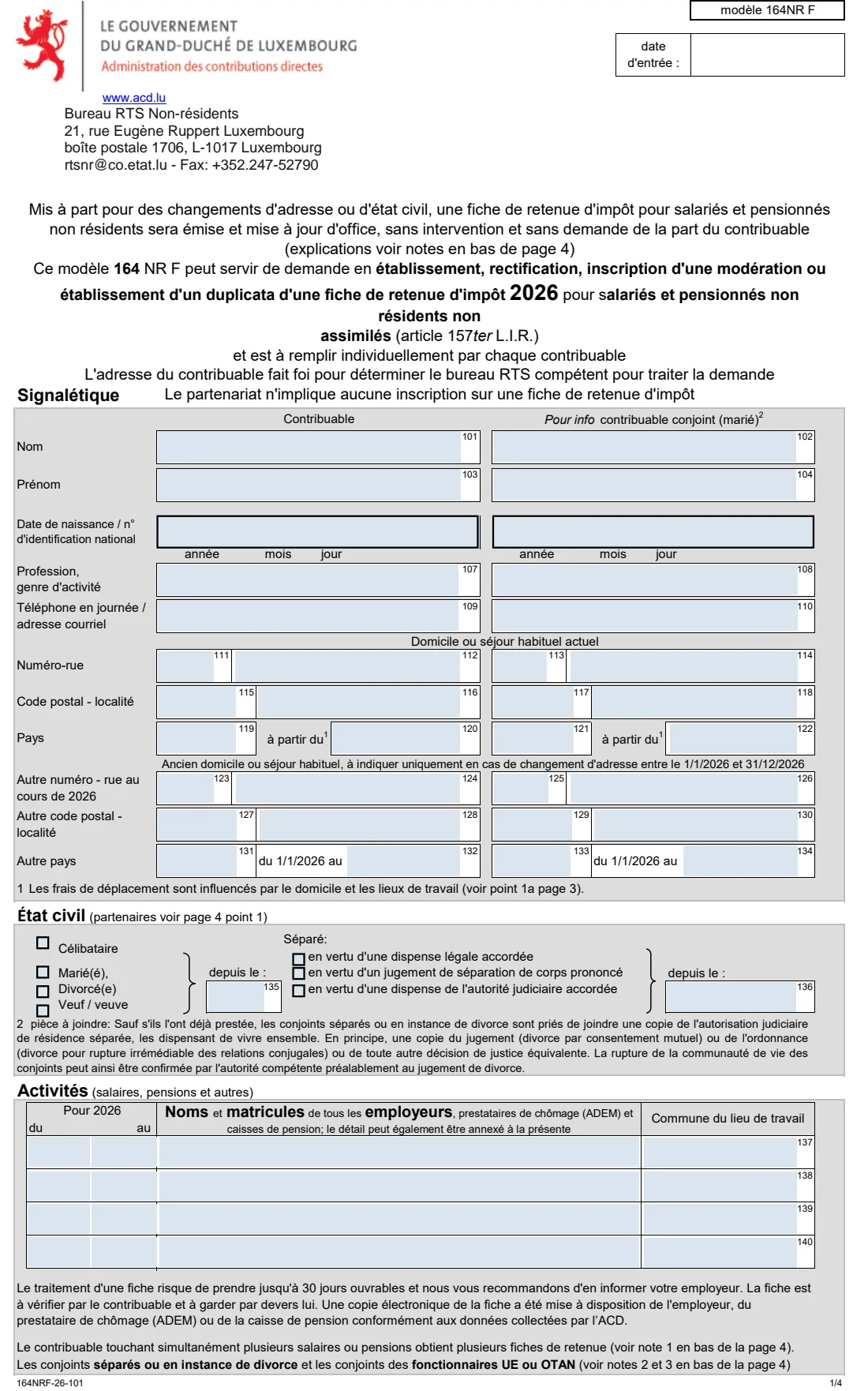
- Signalétique — you, the taxpayer (contribuable)Taxpayer
- Your spouse (for information — contribuable conjoint)Taxpayer
- Previous address in 2026 (ancien domicile)Taxpayer
- État civil — civil statusTaxpayer
- Activités — salaries, pensions and other income in 2026Taxpayer
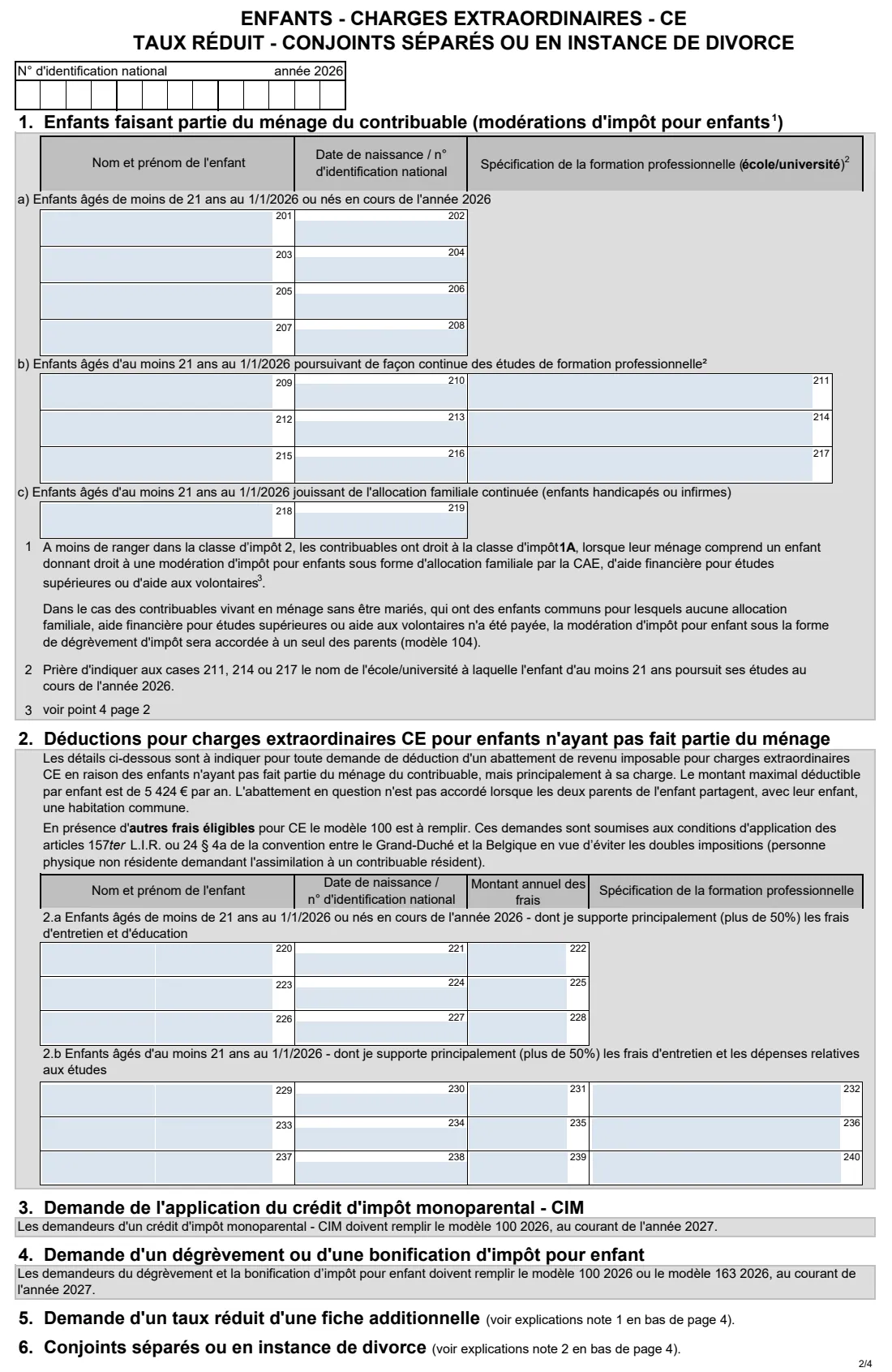
- 1. Children in your household (Enfants faisant partie du ménage)Taxpayer
- 2. Children not in your household (charges extraordinaires — CE)Taxpayer
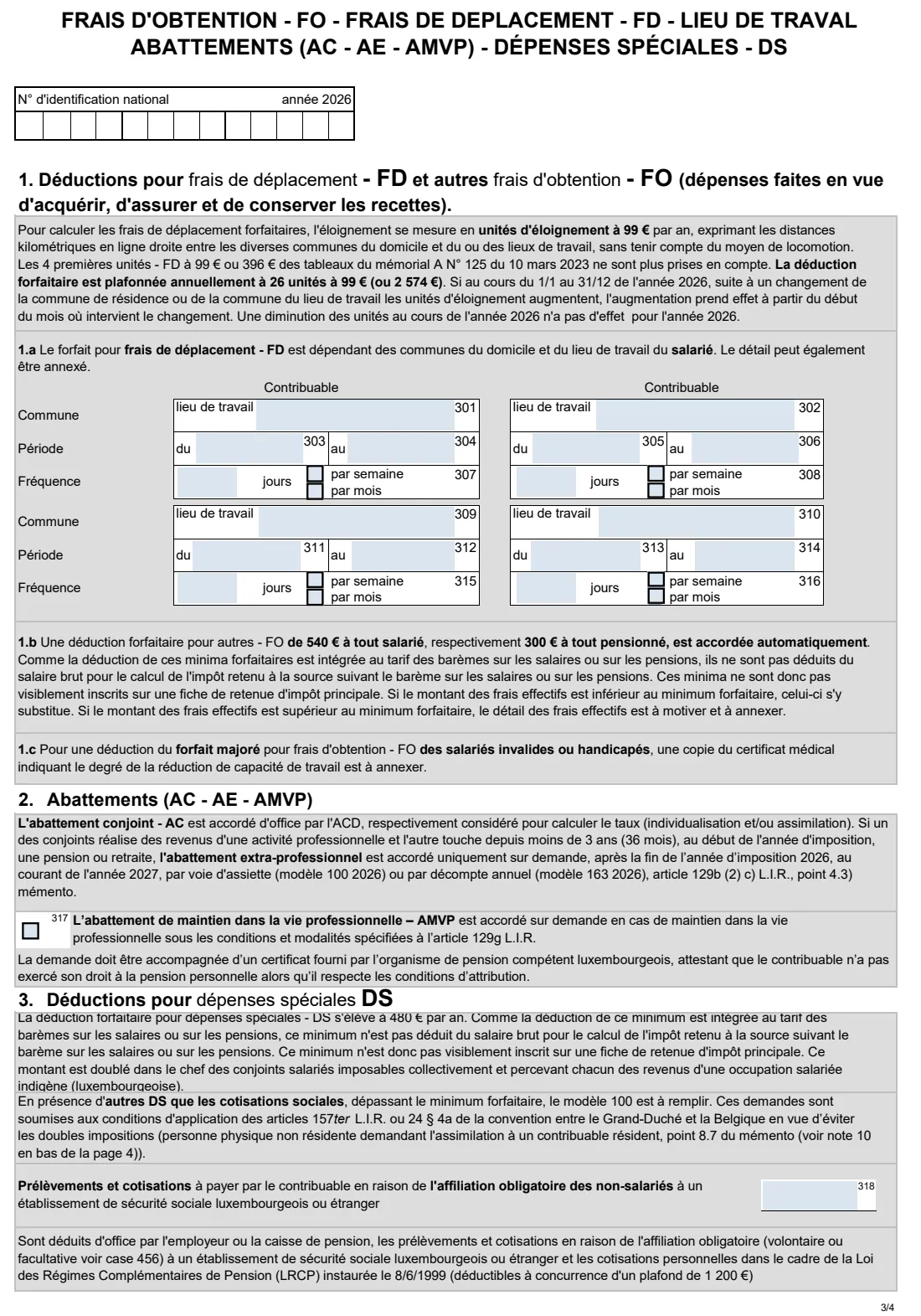
- 1.a Travel expenses (frais de déplacement — FD)Taxpayer
- 2. Allowance for staying in work (AMVP)Taxpayer
- 3. Special expenses (dépenses spéciales — DS): contributions for compulsory affiliation of the self-employedTaxpayer
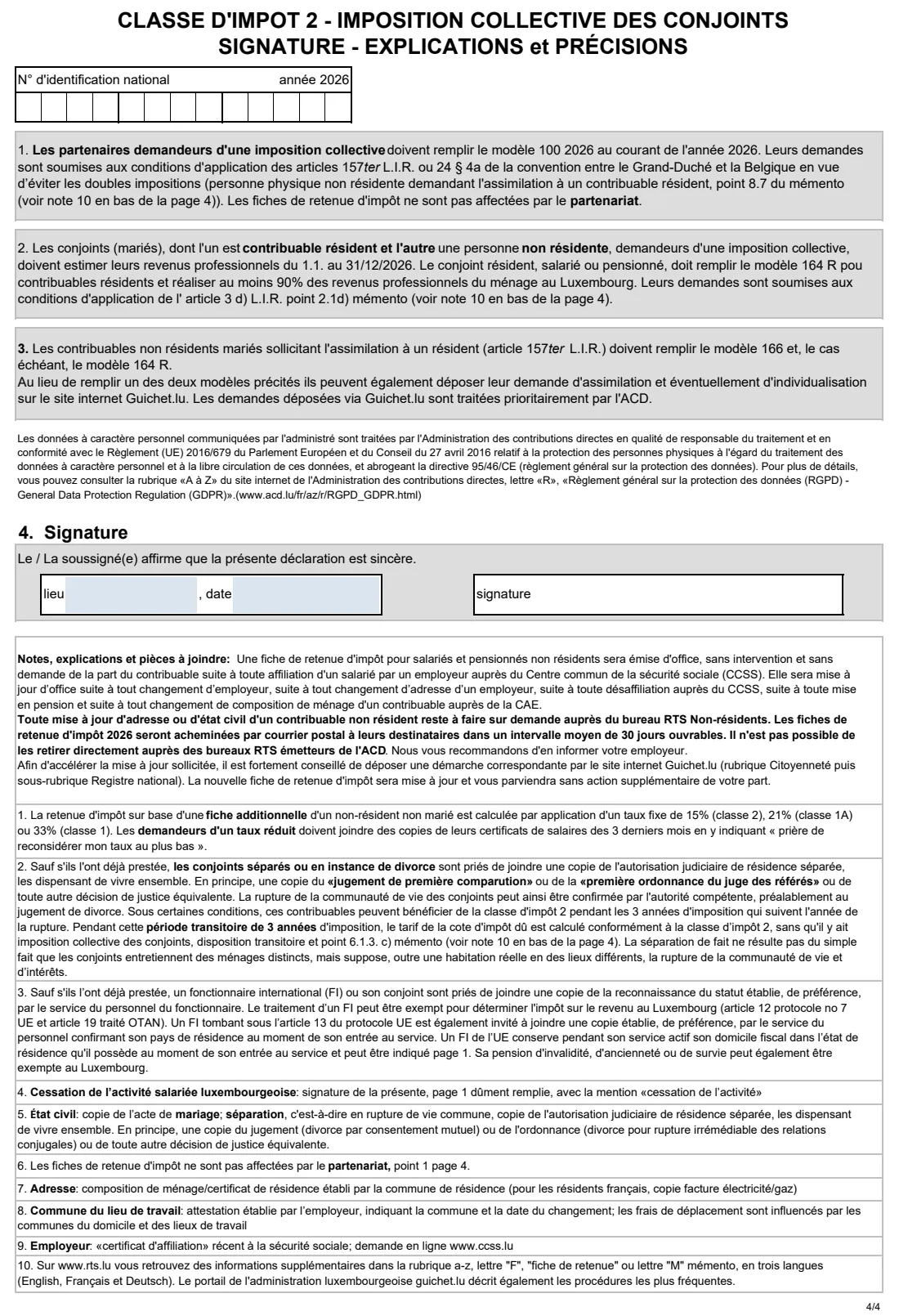
- 4. SignatureTaxpayer
How to fill out 164 NR — Non-resident tax card request 2026, step by step
1 Signalétique (personal details)
Page 1 has a column for you and one marked 'pour info' for your spouse. Give surname, first name, national identification number (its first eight digits are the date of birth), occupation, a daytime phone or email, and your home address with the date you moved there. If you changed address during 2026, the lines below record where you lived from 1 January until the move.
2 État civil (civil status)
Tick single, married, divorced or widowed with the date. Married people living apart tick the basis of their separation and give its date, and attach a copy of the court authorisation unless already provided. The form notes that a registered partnership has no effect on tax cards.
3 Activités (income in 2026)
Each employer, the ADEM or a pension fund paying you in 2026, with the period and the municipality of the workplace. Several salaries or pensions at once mean several tax cards; the form explains that a non-resident's additional card is taxed at a fixed rate unless a reduced rate is requested with the last three months' pay slips.
4 Enfants (children)
Page 2 lists children in your household under 21 on 1 January 2026 or born in 2026, those 21 or over in continuous vocational training (with the school or university), and those 21 or over receiving continued family allowance. Part 2 is for children who don't live with you but whose costs you mainly pay, with the annual amount.
5 Frais de déplacement and AMVP
Page 3: the municipality of each workplace, the period and how often you go there (days per week or per month). The form explains the distance units of €99, the 4 units no longer counted and the cap of 26 units. Box 317 requests the AMVP allowance, with a certificate from the Luxembourg pension body. Box 318 is for contributions for compulsory affiliation as a self-employed person.
6 Signature
Page 4: place, date and your signature, affirming the declaration is sincere. The notes below list the documents to attach and explain the rules for separated spouses and international officials.
Common mistakes to avoid
- Using 164 NR when you are a resident (use 164 R) or when you ask to be assimilated to a resident (the form points to modèle 166).
- Expecting a change of address to be picked up automatically — for non-residents it has to be requested.
- A national identification number that doesn't start with the date of birth; FileIt checks it.
- Putting a child in the wrong age row — the cut-off is the child's age on 1 January 2026.
- Claiming more than €5,424 a year for a child outside the household, or claiming it when both parents live with the child.
- Typing amounts with a decimal comma in FileIt — enter a point for cents; FileIt prints 1.234,56.
- Forgetting the attachments or the signature.
After you fill it out
Download the completed form from your FileIt vault and check every page. Sign it by hand or with FileIt's optional e-signature, and add the documents the notes ask for.
Send it to the Bureau RTS Non-résidents at the address printed on page 1. The form recommends the Guichet.lu procedure to speed up an address update, and suggests telling your employer.
Tax cards are sent by post within about 30 working days on average and can't be collected at the RTS offices, according to the form. Keep the card and a copy of this request in FileIt's vault.
Fill out 164 NR — Non-resident tax card request 2026 online with FileIt
- Pick the person. Choose someone from People and FileIt fills in their name, date of birth, address and other details it already knows.
- Answer plain-language questions. One part of the form at a time, with the official help text beside each question — 143 fields in all. Your answers save as you go.
- Check the live preview. Watch your answers land on the real Administration des contributions directes (ACD) form, and let FileIt do any worksheet arithmetic.
- Generate the official PDF. FileIt prints your answers into the agency’s own PDF and files it in that person’s folder in your vault. Sign it, or send it for e-signature.
FileIt fills the form — it never files or submits anything for you. Deliver the finished form to whoever asked for it, the way the form’s instructions say.
Start 164 NR — Non-resident tax card request 2026 now — it’s free164 NR — Non-resident tax card request 2026: frequently asked questions
What is the difference between form 164 R and 164 NR?
164 R is for residents and for non-residents assimilated to residents. 164 NR is for non-resident employees and pensioners who are not assimilated — typically cross-border workers taxed as non-residents.
Do I need form 164 NR if my employer already registered me?
Often not: the form says a non-resident's tax card is issued and updated automatically after registration with the CCSS or a change of employer. You need it for changes of address or civil status, a duplicate, or reductions such as children or travel expenses.
Where do I send form 164 NR?
To the ACD's Bureau RTS Non-résidents, whose postal address is printed at the top of page 1. FileIt doesn't send it for you.
Can I fill in form 164 NR in English?
Yes, with FileIt. The questions and help are in English and the answers are printed into the ACD's French PDF.
How long does it take?
The form says tax cards are sent by post within an average of 30 working days and that processing can take up to 30 working days.
Does my spouse sign?
No. The spouse column on page 1 is for information only, and the form is signed by the taxpayer. Each taxpayer fills in their own form.
Can I ask for joint taxation with this form?
No. The form says partners asking for joint taxation file modèle 100, married non-residents asking for assimilation to a resident file modèle 166 (and, where needed, 164 R) or apply on Guichet.lu, and a couple where one spouse is resident uses modèle 164 R.
Official sources
- Blank form (PDF), published by Administration des contributions directes (ACD): https://impotsdirects.public.lu/dam-assets/fr/formulaires/fiches_d_impot/2026/164nrf-2026.pdf
- Official instructions and guidance: https://impotsdirects.public.lu/fr/formulaires/fiches_d_impot.html
- Edition shown on this page: Modèle 164 NR F, 2026 (164NRF-26-101) (checked 2026-09-28).
FileIt is not affiliated with or endorsed by Administration des contributions directes (ACD) or any government. This page explains the form in general terms and is not legal, tax or immigration advice. Always read the official instructions, and check that you are using the edition the recipient accepts. Page last reviewed 2026-09-28.