What is 164 R — Tax card request 2026?
In Luxembourg, the tax your employer or pension fund withholds from each payment depends on your tax card — the fiche de retenue d'impôt — issued by the Administration des contributions directes (ACD). For residents it is normally issued and updated automatically: when an employer registers you with the CCSS, when your civil status or address changes at the commune, or when your household changes with the family benefits fund (CAE). Form 164 R F (modèle 164 R F) is how you ask the ACD for something it would not pick up by itself.
With the 2026 form you can request a tax card, have one corrected, ask for a duplicate, or have tax reductions (modérations) entered on it: children in your household, the single-parent tax credit (CIM), travel expenses between home and work, special expenses such as insurance premiums, loan interest, home-savings and old-age provision contracts, and extraordinary charges such as care costs or supporting a child who doesn't live with you. It is for resident employees and pensioners and for non-residents assimilated to residents under article 157ter of the income tax law (L.I.R.), and each taxpayer fills in their own.
The official form is six pages in French. FileIt explains every part in English, lets you switch on only the parts that apply to you, pre-fills your name and date of birth from your People record, and works out the form's own calculations — the totals, the ceilings for insurance and home-savings contributions, and the lower-of amounts that go into the deductible boxes — printing amounts in the form's 1.234,56 style. The finished form is the ACD's own PDF, saved in your FileIt vault, ready to sign by hand or through FileIt's optional e-signature. You send it yourself: FileIt never submits anything to the ACD.
- Who fills it
- Each taxpayer individually — resident employees and pensioners, and assimilated non-residents
- Given to
- The ACD's competent RTS office (bureau RTS), by post or through MyGuichet.lu
- When
- During 2026, when your tax card needs issuing, correcting or a reduction adding
- Signatures
- The taxpayer signs; both spouses sign where the form requires it
- Edition
- Modèle 164 R F for 2026 (164RF-26-101)
- Processing
- The form says it can take up to 30 working days
Who needs to fill out 164 R — Tax card request 2026?
- Resident employees and pensioners in Luxembourg whose tax card is missing, wrong or needs a duplicate.
- Parents who want the tax reduction for children in their household shown on the card, including children aged 21 or over who are still studying or receive continued family allowance.
- Single parents in tax class 1A asking for the single-parent tax credit (crédit d'impôt monoparental).
- Commuters who want the travel-expense lump sum (frais de déplacement) based on where they live and work.
- People paying deductible special expenses — life or liability insurance, consumer loan interest, home-savings (épargne-logement) or old-age provision contracts, maintenance to a former spouse — who want them reflected in their withholding during the year.
- Taxpayers with extraordinary charges, such as invalidity, domestic help and childcare costs, or the upkeep of a child who is not part of their household.
- Married couples where one spouse lives in Luxembourg and the other doesn't, who ask for joint taxation at tax class 2.
When to use 164 R — Tax card request 2026
- When you start work or receive a pension and no tax card has been issued, or the card you have shows the wrong details.
- When a change in your situation during 2026 — a move, a new workplace, a birth — affects a reduction that isn't updated automatically.
- When you want a reduction for expenses applied through withholding during the year rather than waiting until after the year ends.
- When you need a duplicate of your 2026 tax card.
- Some reliefs can't be requested on this form: the form notes that the child tax rebate and bonus, the extra-professional allowance and gifts are only granted after the end of 2026, through a tax return (modèle 100) or annual adjustment (modèle 163).
What you need before you start
- Your 13-digit national identification number (matricule) and date of birth, and your spouse's if they are part of the request.
- Your current address, and your previous address if you moved in 2026.
- The names and registration numbers of your employers, the ADEM or your pension funds in 2026, and the municipality where you work.
- Your children's names, dates of birth or matricules, and the school or university for children aged 21 or over who are studying.
- For travel expenses: the municipalities of your workplaces, the periods, and how many days a week or month you work there.
- For special expenses: insurers, policy details and 2026 premiums; lenders, loan purpose, debt at 31.12.2025 and estimated 2026 interest; home-savings and pension contract details.
- For extraordinary charges: the amounts, a description, and supporting documents such as medical certificates or cost details.
- Copies of any documents the form asks you to attach, such as a court authorisation for separated spouses or a pension body certificate for the AMVP allowance.
What’s on 164 R — Tax card request 2026
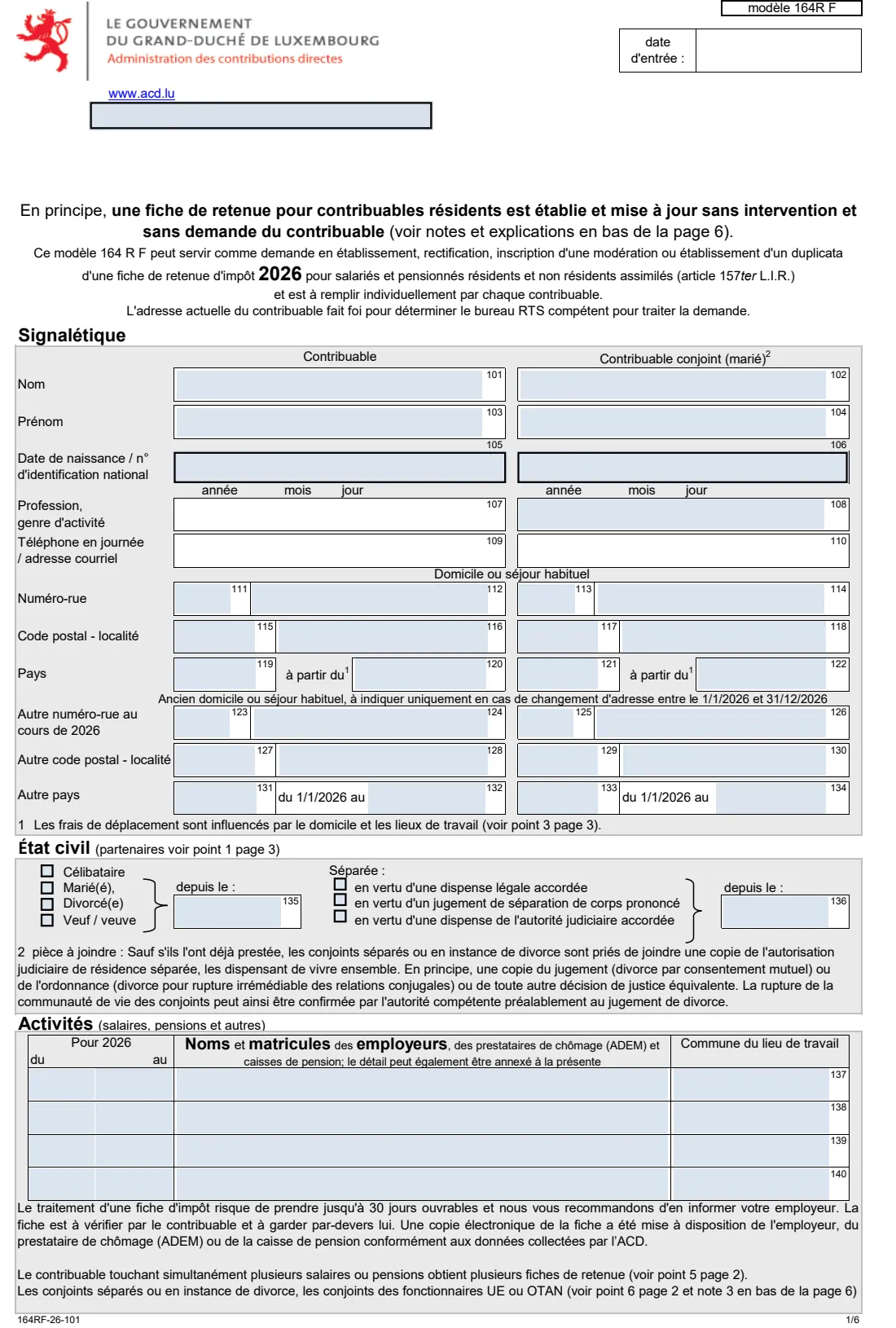
The 2026 edition has 6 pages. FileIt asks for it in 23 parts, and it is signed by Taxpayer and Spouse:
- Signalétique — the taxpayer (contribuable)Taxpayer
- Previous address in 2026 (ancien domicile)Taxpayer
- État civil — civil statusTaxpayer
- Activités — salaries, pensions and other income in 2026Taxpayer
- Contribuable conjoint — your spouse (married)Spouse
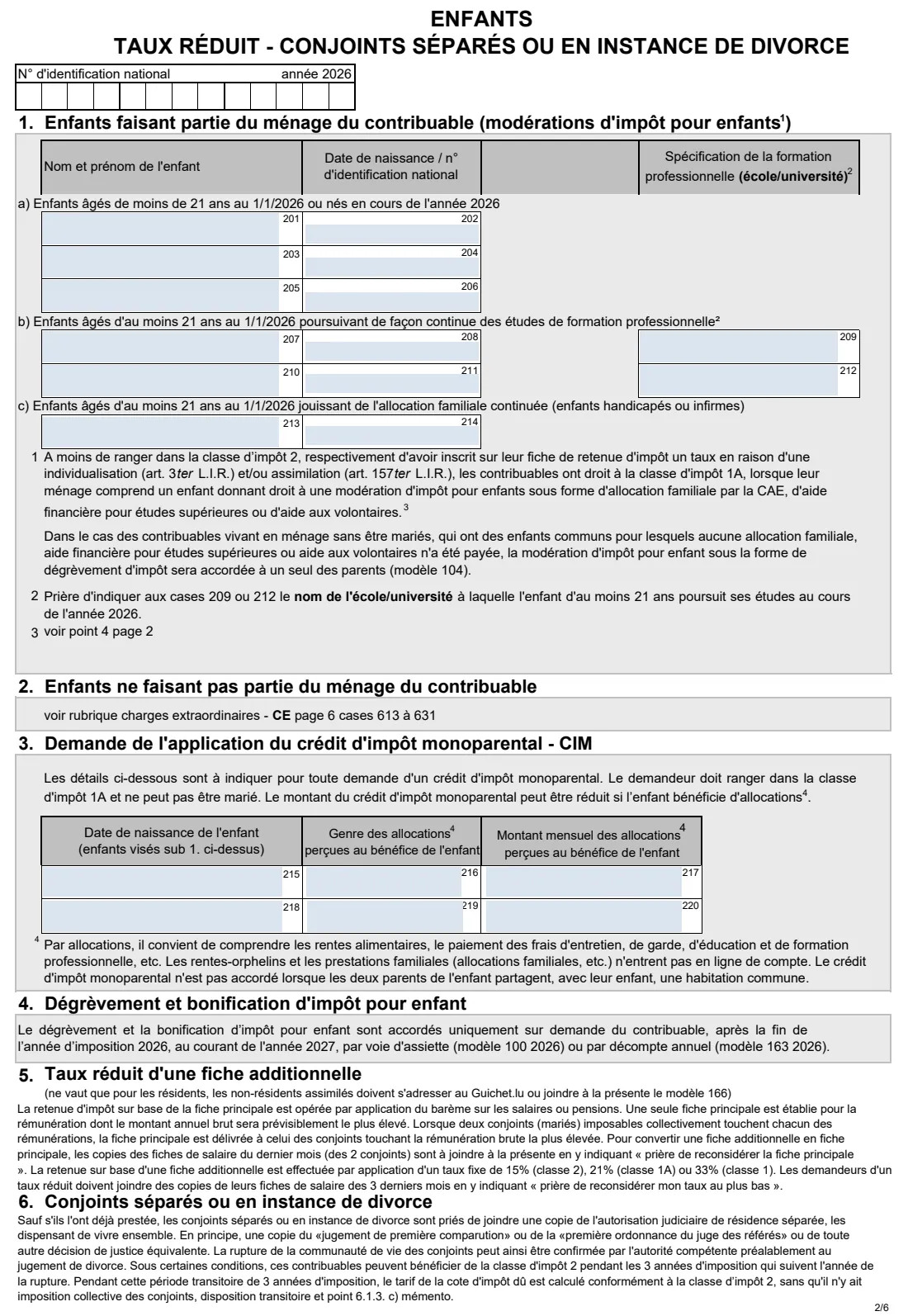
- 1. Children in your household (Enfants faisant partie du ménage)Taxpayer
- 3. Single-parent tax credit (crédit d'impôt monoparental — CIM)Taxpayer
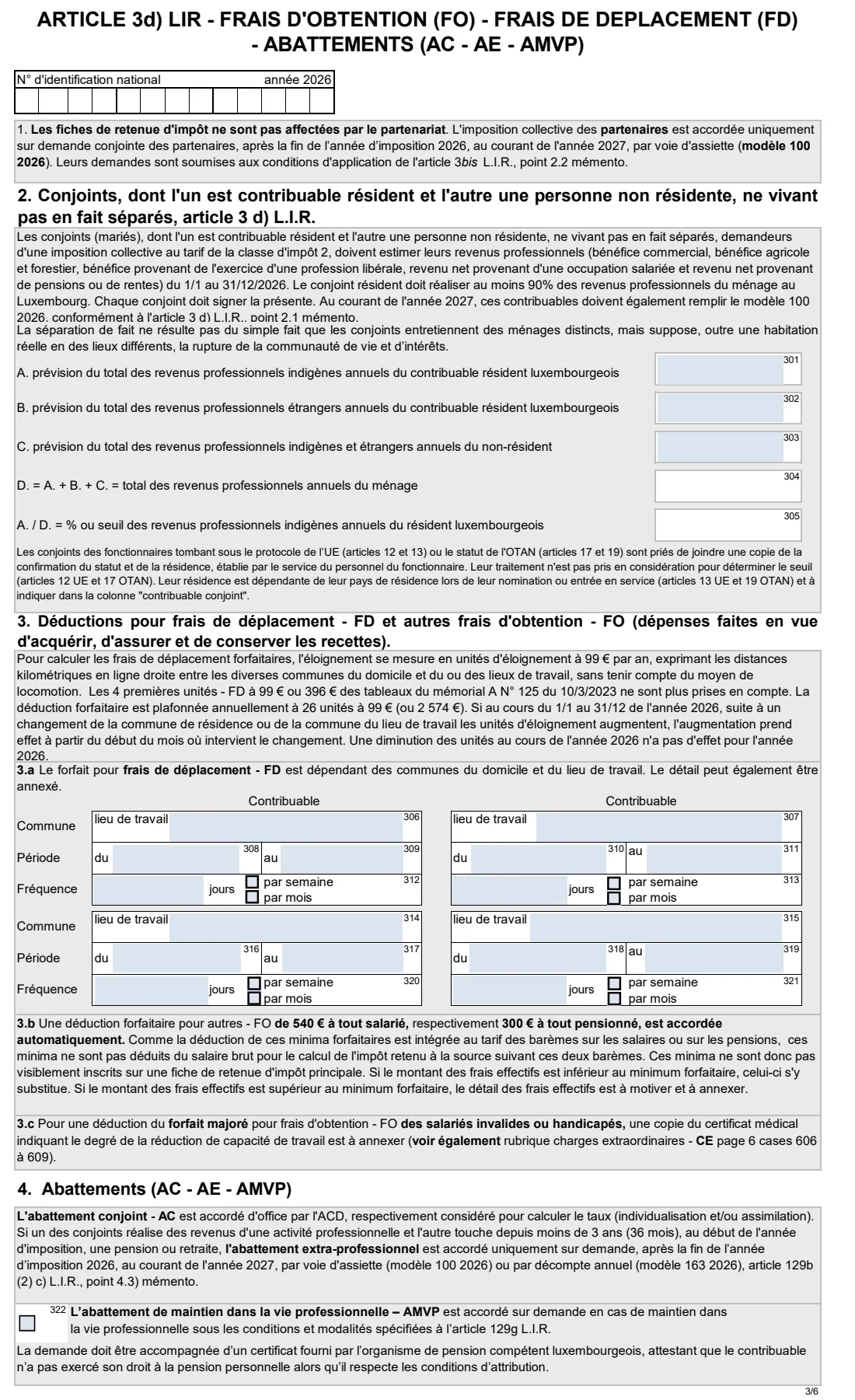
- 2. Spouses, one resident and one non-resident, not separated (article 3 d) L.I.R.)Taxpayer
- 3.a Travel expenses (frais de déplacement — FD)Taxpayer
- 4. Allowance for staying in work (abattement de maintien dans la vie professionnelle — AMVP)Taxpayer
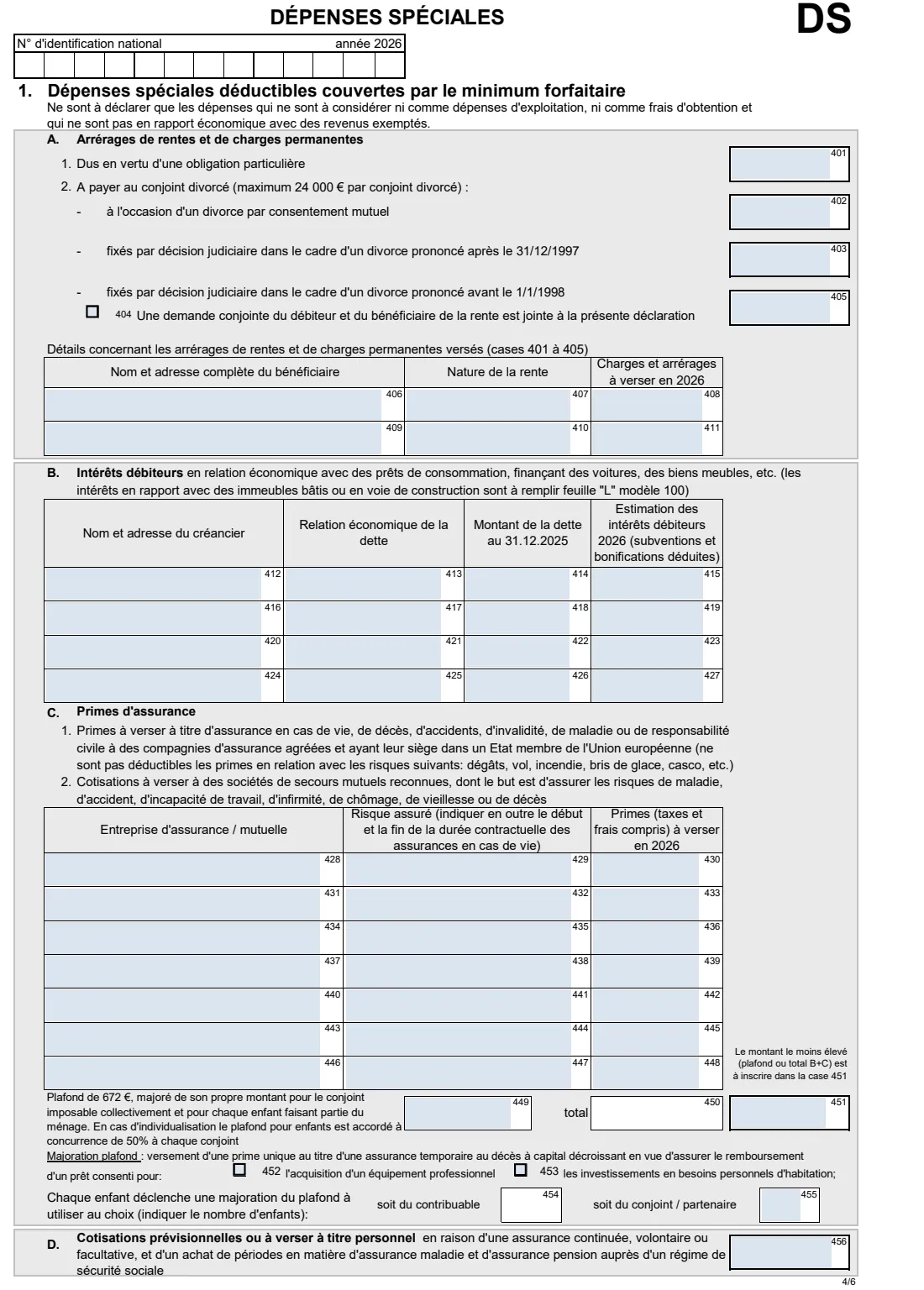
- Special expenses A. Annuities and permanent charges (arrérages de rentes)Taxpayer
- Special expenses B. Debit interest on consumer loans (intérêts débiteurs)Taxpayer
- Special expenses C. Insurance premiums (primes d'assurance)Taxpayer
- Special expenses D. Voluntary social security contributionsTaxpayer
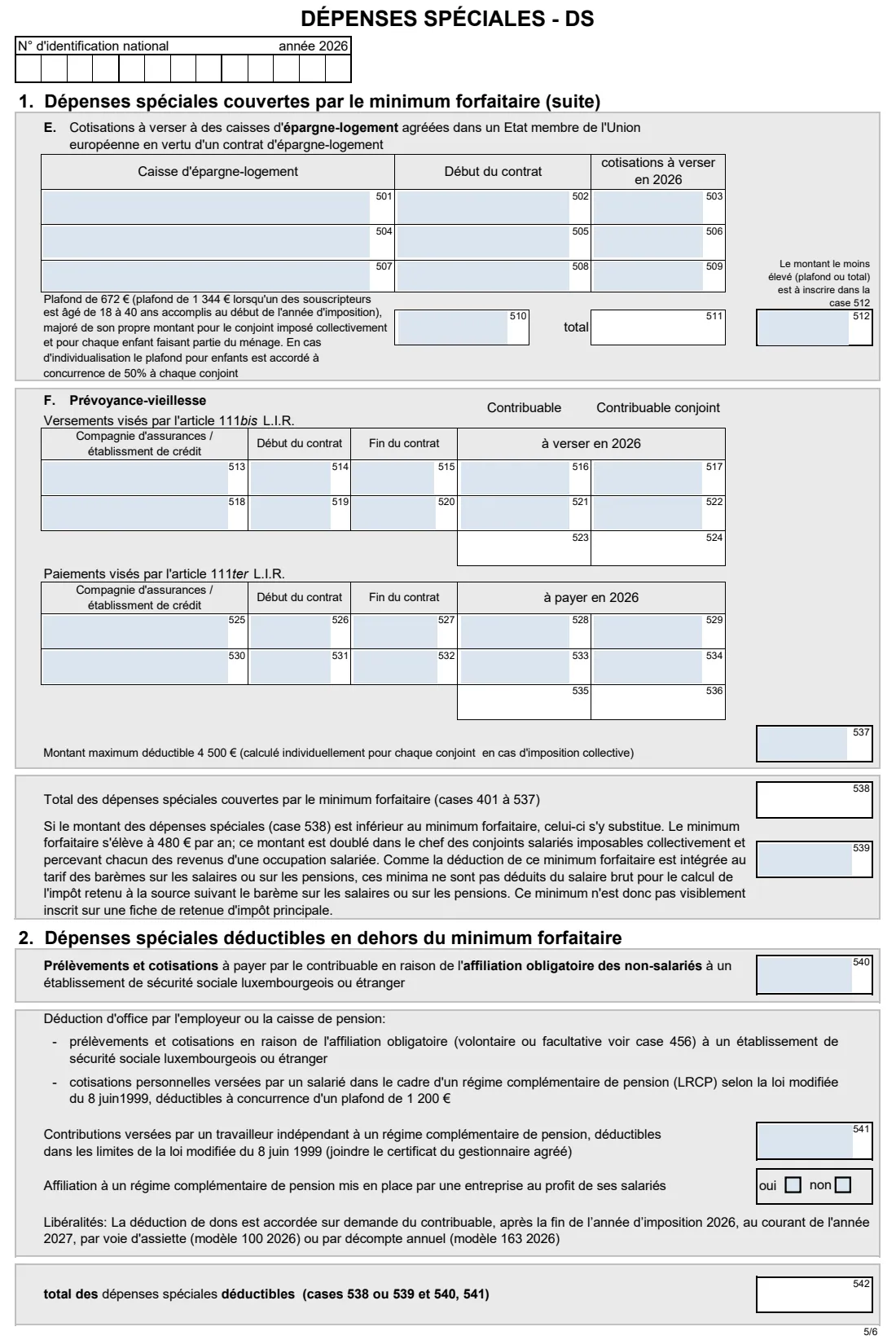
- Special expenses E. Home-savings contracts (épargne-logement)Taxpayer
- Special expenses F. Old-age provision (prévoyance-vieillesse)Taxpayer
- 2. Special expenses outside the lump-sum minimumTaxpayer
- Special expenses — totals (worked out by FileIt)Taxpayer
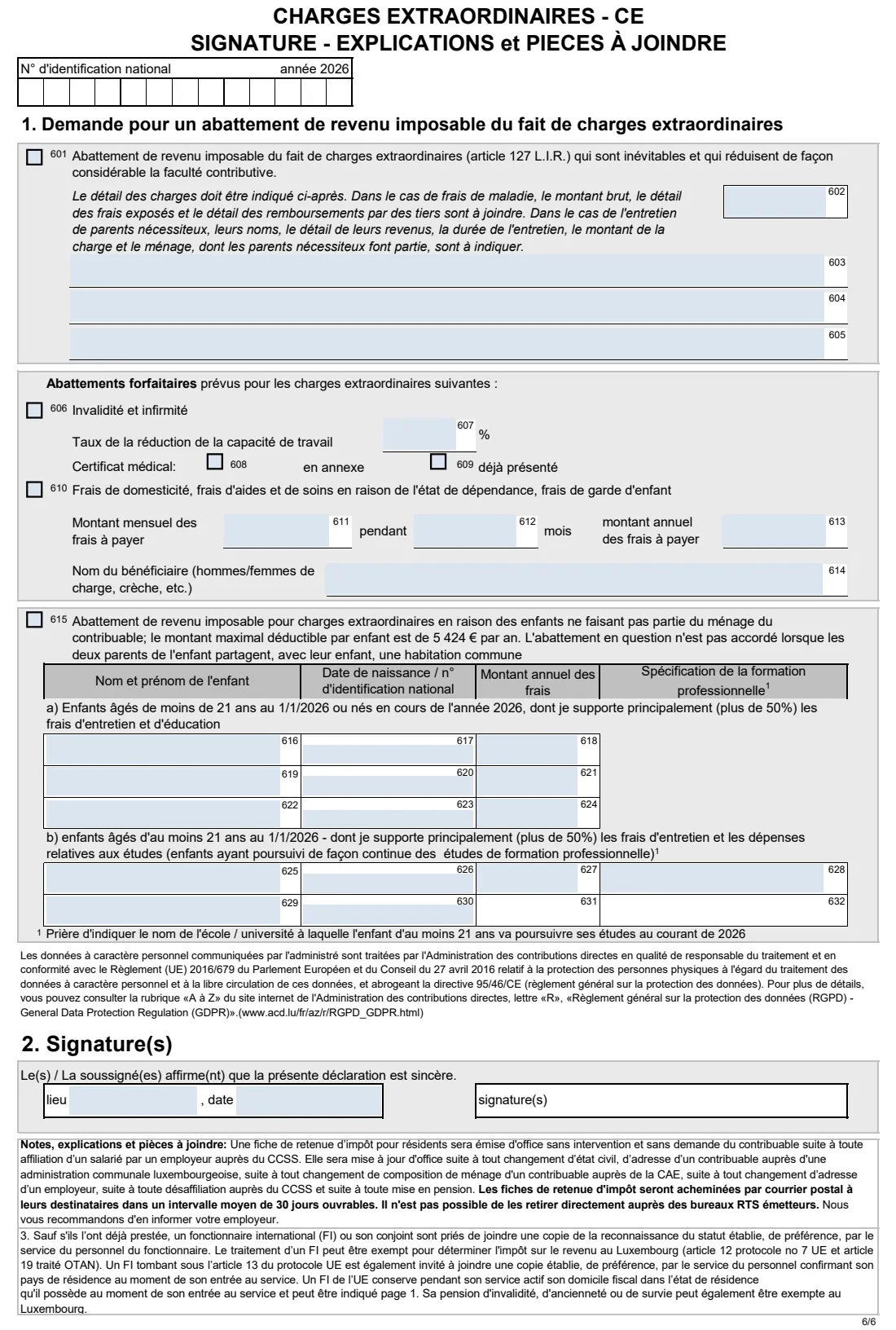
- Extraordinary charges (charges extraordinaires — CE, article 127 L.I.R.)Taxpayer
- Lump-sum allowance: invalidity and infirmity (606)Taxpayer
- Lump-sum allowance: domestic help, care and childcare (610)Taxpayer
- Children not in your household (615)Taxpayer
- 2. Signature(s)Taxpayer
How to fill out 164 R — Tax card request 2026, step by step
1 Signalétique (personal details)
Page 1 has a column for you (contribuable) and one for your spouse if you are married (contribuable conjoint). Give surname, first name, your 13-digit national identification number — its first eight digits are your date of birth — occupation, a daytime phone or email, and your home address with the date you moved there.
If you changed address during 2026, the lines below record where you lived from 1 January until the move, because travel-expense deductions depend on where you live and work. At the top you can choose the RTS office; the form says your current address decides which office is competent.
2 État civil (civil status)
Tick single, married, divorced or widowed and give the date. Married people living apart tick the basis of their separation — a legal dispensation, a judgment of judicial separation, or a dispensation from the court — and the date. Separated spouses or spouses in divorce proceedings attach a copy of the court authorisation, unless they have already provided it. Registered partners: the form notes that tax cards are not affected by the partnership.
3 Activités (income in 2026)
List each employer, unemployment benefit provider (ADEM) and pension fund paying you in 2026, with the period and the municipality of the workplace. If you receive several salaries or pensions at the same time you get several tax cards: a main card for the income expected to be the highest, and additional cards taxed at a fixed rate.
4 Enfants (children)
Page 2 lists children who are part of your household: those under 21 on 1 January 2026 or born in 2026, those 21 or over who are continuously in vocational training (with the school or university), and those 21 or over receiving continued family allowance because of a disability. The footnote explains when this gives entitlement to tax class 1A.
Children who are not part of your household are declared under extraordinary charges on page 6 instead.
5 Crédit d'impôt monoparental (single-parent tax credit)
For each child, give the date of birth, the type of allowances received for the child (such as maintenance payments) and their monthly amount. The applicant must be in tax class 1A and can't be married, and the credit may be reduced if the child receives allowances. It isn't granted when both parents share a home with the child.
6 Resident and non-resident spouses (article 3 d) L.I.R.)
For married couples where one spouse is resident and the other is not, not in fact living apart, who ask for joint taxation at tax class 2. You estimate the resident's Luxembourg professional income, the resident's foreign income and the non-resident's total income for 2026; FileIt adds them up and works out the resident's share, which must be at least 90%. Each spouse signs, and the form says a tax return for 2026 must also be filed in 2027.
7 Frais de déplacement (travel expenses) and AMVP
Give the municipality of each workplace, the period and how often you go there (days per week or per month). The form explains that the lump sum is counted in distance units, that the first units no longer count and that it is capped, so the figures come from the ACD's tables rather than your own mileage. A lump sum for other costs of earning income is granted automatically.
Page 3 also has box 322 to request the allowance for staying in work (AMVP) under article 129g L.I.R., which needs a certificate from the Luxembourg pension body.
8 Dépenses spéciales (special expenses)
Pages 4 and 5 cover annuities and maintenance to a former spouse, interest on consumer loans, insurance premiums and mutual society contributions, voluntary social security contributions, home-savings contracts, old-age provision contracts under articles 111bis and 111ter L.I.R., and contributions outside the lump-sum minimum. FileIt totals each block, works out the ceilings printed on the form and fills in the lower of ceiling and total where the form asks for it.
The form also explains that a lump-sum minimum for special expenses is built into the withholding tables, so it doesn't appear on a main tax card.
9 Charges extraordinaires (extraordinary charges)
Page 6 is for unavoidable costs that considerably reduce your ability to pay: a general claim with details (for medical costs, the gross amount, the costs and any refunds; for needy relatives, their names, income and the duration and amount of support), lump-sum allowances for invalidity and for domestic help, care and childcare, and an allowance for children who don't live with you but whose upkeep you mainly pay — at most €5,424 a year per child according to this edition.
10 Signature(s)
Give the place and date and sign to affirm that the declaration is sincere. Where both spouses' details and the non-resident spouse part apply, both spouses sign.
Common mistakes to avoid
- Filing a request the ACD would have handled automatically — the form itself says a resident's tax card is normally issued and updated without any request.
- Filling in one form for a couple: the form is to be completed individually by each taxpayer.
- Giving a national identification number that doesn't start with the date of birth; FileIt checks that the first eight digits match.
- Putting a child in the wrong age row — the cut-off is the child's age on 1 January 2026. FileIt checks each row against the date of birth.
- Asking for the single-parent tax credit while married, or the non-resident spouse regime without the 90% Luxembourg income share.
- Forgetting the attachments the form asks for, such as the court authorisation for separated spouses, medical certificates or the pension body's certificate for the AMVP.
- Typing amounts with a decimal comma in FileIt — enter them with a point for cents; FileIt prints them in the form's own 1.234,56 style.
- Leaving the form unsigned or without place and date.
After you fill it out
Download the completed form from your FileIt vault and check every page. Sign it by hand, or use FileIt's optional e-signature to collect your signature and, where needed, your spouse's. Add any documents the form tells you to attach.
Send it to the RTS office that is competent for your current address, by post, or attach it to a request through MyGuichet.lu. The form warns that processing can take up to 30 working days and recommends telling your employer. It also explains that tax cards are sent by post within an average of 30 working days and can't be collected at the RTS offices, and that an electronic copy is made available to your employer, the ADEM or your pension fund.
When the new tax card arrives, check it and keep it — FileIt's vault is a good place for both the card and a copy of this request. If your situation changes again during 2026, or for next year's reliefs, file a new request; some items can only be claimed after the year ends in a tax return or annual adjustment.
Fill out 164 R — Tax card request 2026 online with FileIt
- Pick the person. Choose someone from People and FileIt fills in their name, date of birth, address and other details it already knows.
- Answer plain-language questions. One part of the form at a time, with the official help text beside each question — 289 fields in all. Your answers save as you go.
- Check the live preview. Watch your answers land on the real Administration des contributions directes (ACD) form, and let FileIt do any worksheet arithmetic.
- Generate the official PDF. FileIt prints your answers into the agency’s own PDF and files it in that person’s folder in your vault. Sign it, or send it for e-signature.
FileIt fills the form — it never files or submits anything for you. Deliver the finished form to whoever asked for it, the way the form’s instructions say.
Start 164 R — Tax card request 2026 now — it’s free164 R — Tax card request 2026: frequently asked questions
What is the fiche de retenue d'impôt?
It is your Luxembourg tax card: it tells your employer or pension fund which tax class, rate and deductions to use when withholding tax from your pay or pension. The ACD issues it, and for residents it is usually created and updated automatically.
Do I need form 164 R if my details are already correct?
Usually not. The form says a resident's tax card is issued and updated without any request following CCSS registration, changes at the commune or the CAE, a change of employer address, deregistration or retirement. Use 164 R when something isn't picked up automatically or you want a reduction entered.
Can I fill in form 164 R in English online?
Yes, with FileIt. The questions and help are in English, while the answers are printed into the ACD's official French PDF. FileIt does the form's arithmetic, then saves the finished PDF in your vault for you to sign and send.
Where do I send form 164 R?
To the RTS office competent for your current address, by post, or through MyGuichet.lu. FileIt doesn't send it for you. The form prints the office's address when you choose it at the top of page 1.
How long does it take to get my tax card?
The form says processing can take up to 30 working days, and that tax cards are sent by post within an average of 30 working days. They can't be collected directly at the RTS offices.
Should my spouse fill in a separate form?
The form is to be completed individually by each taxpayer. Your spouse's details go in the spouse column on page 1, and both of you sign where the form requires it, such as the resident and non-resident spouse regime.
Can I claim the child tax bonus on this form?
No. The form explains that the child tax rebate and bonus are only granted on request after the end of the 2026 tax year, through a tax return (modèle 100) or an annual adjustment (modèle 163).
What is the single-parent tax credit (CIM)?
It is a tax credit for single parents in tax class 1A who aren't married. On this form you list each child's date of birth and any allowances received for the child, since the credit may be reduced when the child receives maintenance or similar allowances.
What should non-residents use?
This form is for residents and for non-residents assimilated to residents under article 157ter L.I.R. For the reduced rate of an additional tax card, the form says assimilated non-residents should contact Guichet.lu or attach form 166.
Official sources
- Blank form (PDF), published by Administration des contributions directes (ACD): https://impotsdirects.public.lu/dam-assets/fr/formulaires/fiches_d_impot/2026/164rf-2026.pdf
- Official instructions and guidance: https://impotsdirects.public.lu/fr/formulaires/fiches_d_impot.html
- Edition shown on this page: Modèle 164 R F, 2026 (164RF-26-101) (checked 2026-09-26).
FileIt is not affiliated with or endorsed by Administration des contributions directes (ACD) or any government. This page explains the form in general terms and is not legal, tax or immigration advice. Always read the official instructions, and check that you are using the edition the recipient accepts. Page last reviewed 2026-09-26.