

What is CRMR1 Mandatory reconsideration request?
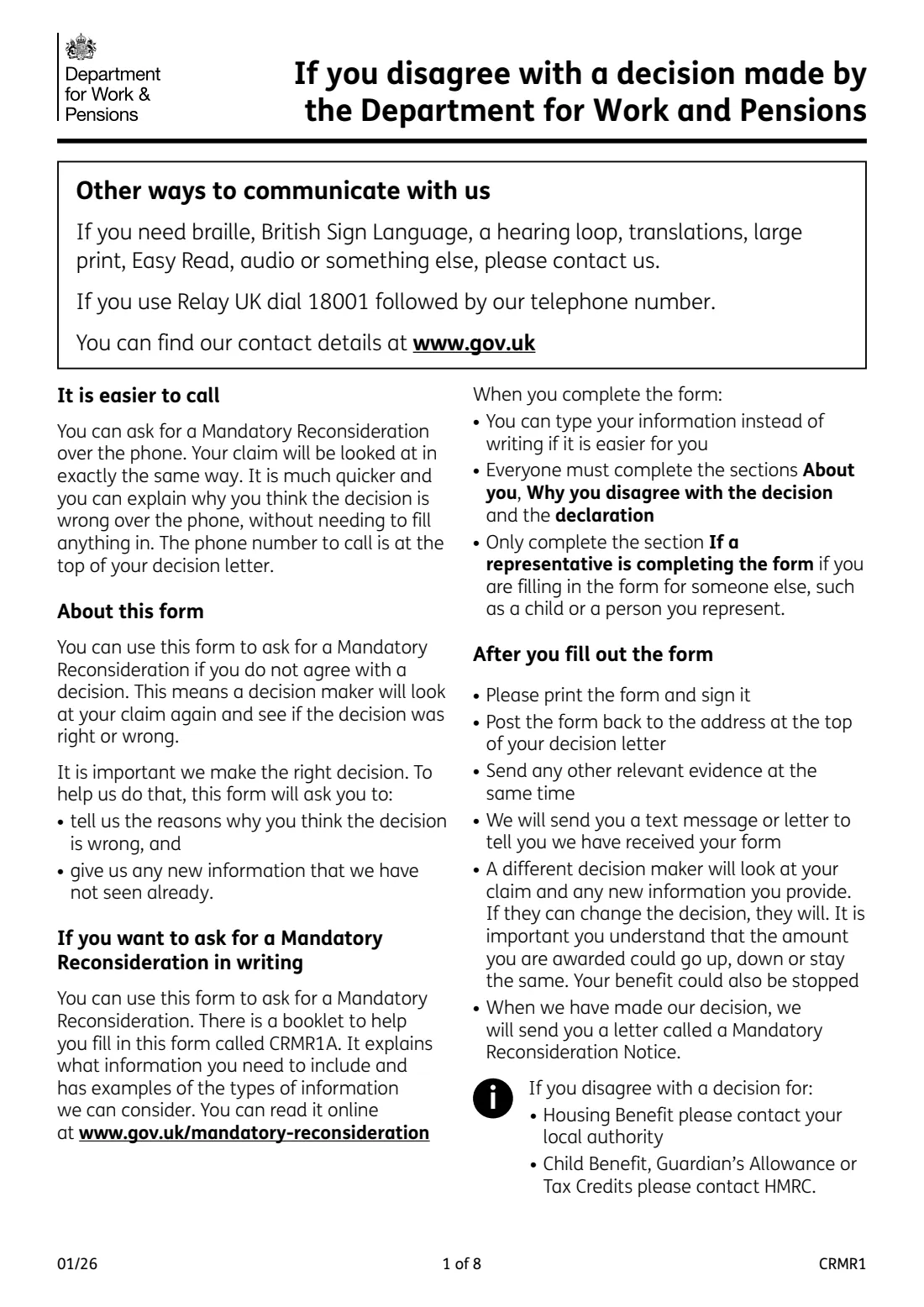
Form CRMR1, 'If you disagree with a decision made by the Department for Work and Pensions', is how you ask for a mandatory reconsideration in writing. A different DWP decision maker looks at your claim again, with any new information you send, and decides whether the original decision was right. It covers benefits such as Personal Independence Payment (PIP), Universal Credit, Employment and Support Allowance (ESA), Carer's Allowance, Attendance Allowance, Disability Living Allowance, Pension Credit and Jobseeker's Allowance.
You usually need a mandatory reconsideration before you can appeal to the Social Security and Child Support Tribunal: GOV.UK says you cannot appeal until you get your Mandatory Reconsideration Notice. DWP also points out that asking by phone, on the number at the top of your decision letter, is quicker — the claim is looked at in exactly the same way. The CRMR1 is the written route, and DWP strongly recommends it if you can't call.
FileIt walks you through the form's 21 questions in plain English, leaves out the representative pages if you are filling it in for yourself, checks that each explanation fits its box on the printed form, and prints your answers into DWP's own CRMR1 PDF. Your details can be pre-filled from the People records in your FileIt vault, and the completed form is saved in that person's folder. You print it, sign it by hand and post it yourself; FileIt never sends anything to DWP.
- Who fills it
- The person the decision is about, or a representative such as a carer, parent, appointee or legal Deputy
- Sent to
- The address at the top of your decision letter, by post
- Time limit
- Usually within one month of the date on the decision letter — later only with a good reason, which the form asks for
- Cost
- Free to ask. DWP won't refund the cost of any new evidence
- Signatures
- Signed and dated by hand by the claimant or their representative
- Edition
- CRMR1 01/26
- Read first
- DWP booklet CRMR1A, 'How to disagree with a decision made by the Department for Work and Pensions'
Who needs to fill out CRMR1 Mandatory reconsideration request?
- Anyone who has had a DWP benefit decision they think is wrong — for example a PIP award with too few points, an ESA or Universal Credit decision, or a refused Carer's Allowance claim — and wants to ask in writing rather than by phone.
- Parents and carers challenging a decision about a child's benefit, such as Disability Living Allowance for children.
- Appointees, legal Deputies, relatives and friends asking on someone else's behalf (they fill in questions 09 to 15).
- Not for Housing Benefit (contact your local council) or Child Benefit, Guardian's Allowance and tax credits (contact HMRC).
When to use CRMR1 Mandatory reconsideration request
- As soon as you decide to challenge a decision — GOV.UK says you usually need to ask within one month of the date on your decision letter, and a written request must arrive by then.
- After one month only if you have a good reason, such as being in hospital or a bereavement. Question 16 asks you to explain why the request is late.
- If DWP gave you a written statement of reasons, GOV.UK says you must ask within 14 days of the date on that statement.
- Before a tribunal appeal: you can't appeal to the Social Security and Child Support Tribunal until you have your Mandatory Reconsideration Notice.
What you need before you start
- Your decision letter — it has the date of the decision, the benefit, your National Insurance number and the address to send the form to.
- The claimant's name, date of birth, National Insurance number, address and phone numbers.
- If you are a representative: your own name, address and phone number, your relationship to the claimant, and signed authority to act for them unless you are already their appointee or Deputy with DWP, or their parent or legal guardian.
- A clear note of each part of the decision you disagree with and why — for PIP, the activities and points you think are wrong.
- Any new evidence DWP hasn't seen, such as new medical reports, care plans, test or scan results, or a current repeat prescription list.
What’s on CRMR1 Mandatory reconsideration request
The 2026 edition has 8 pages. FileIt asks for it in 6 parts, and it is signed by Claimant:
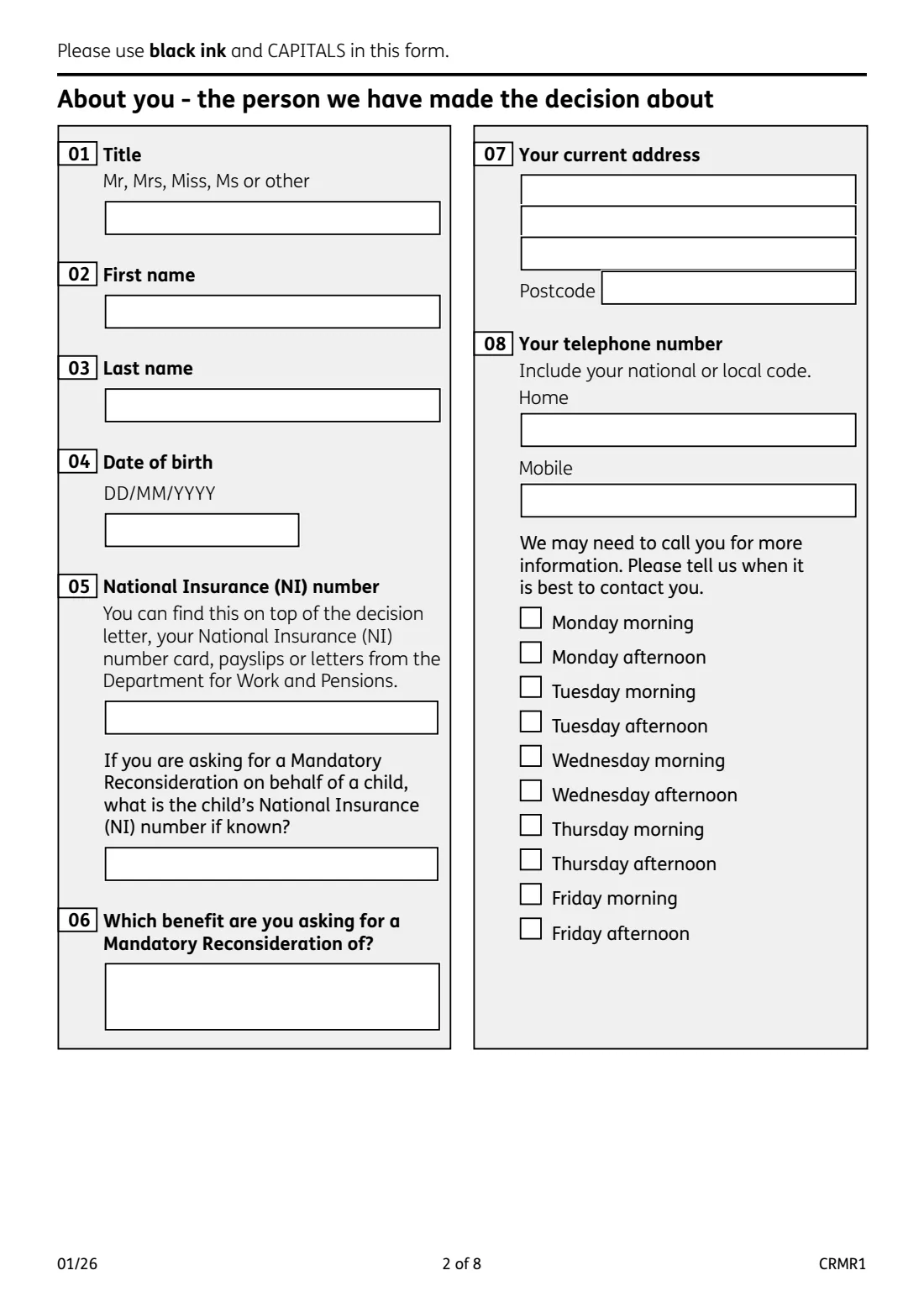
- About you — the person the decision is about (01–08)Claimant
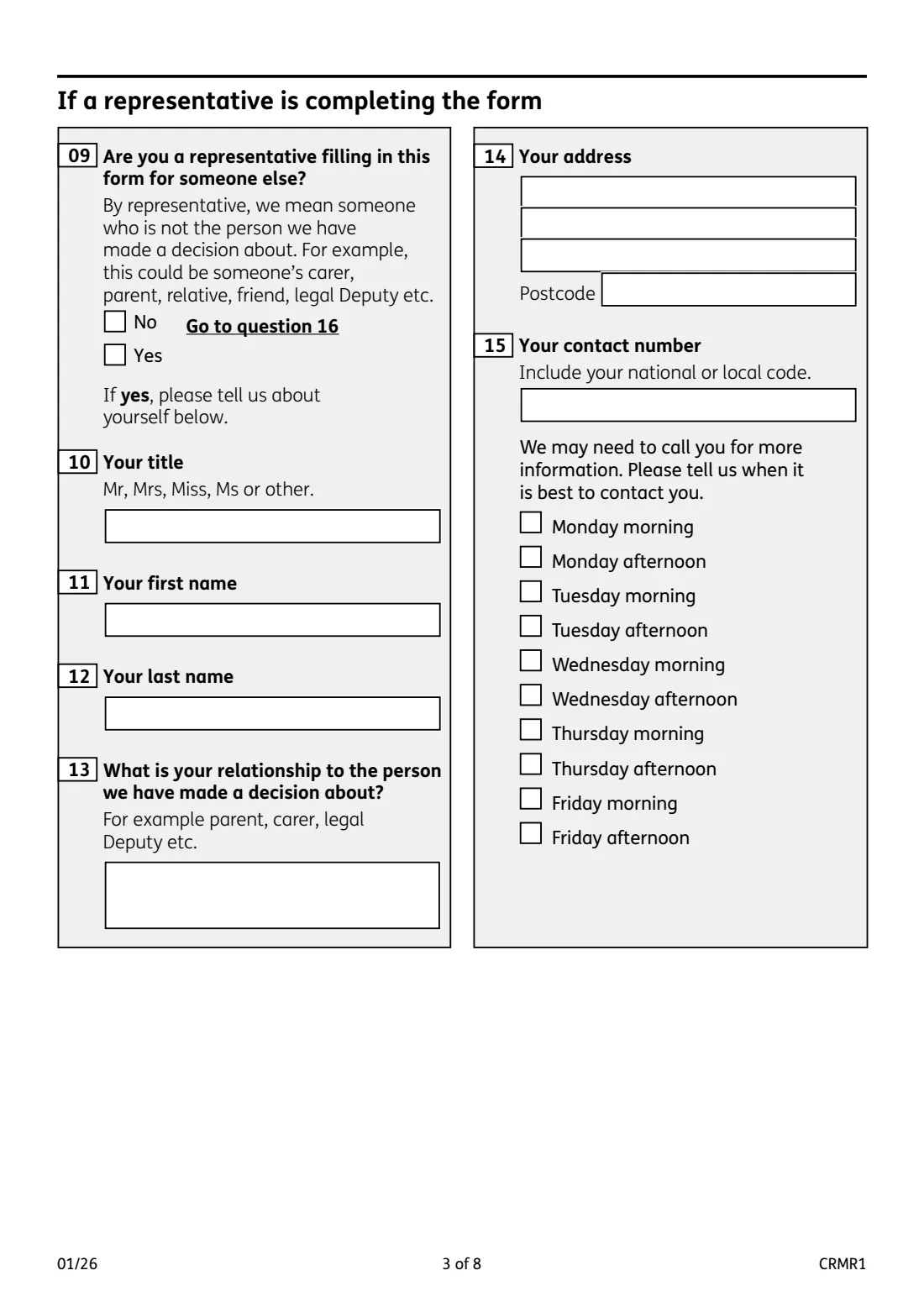
- If a representative is filling in the form (09–15)Representative
- About the original decision (16)Claimant
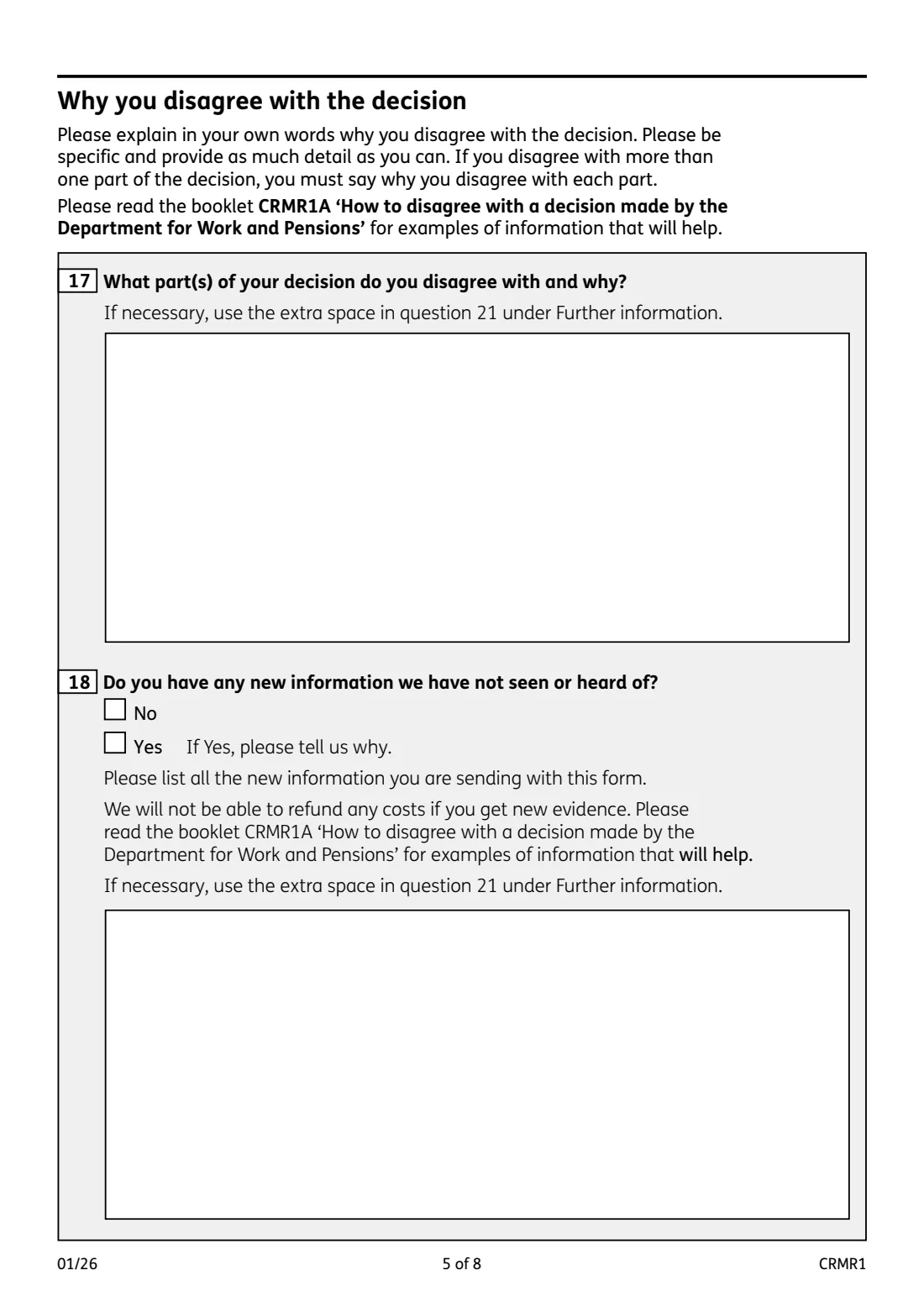
- Why you disagree with the decision (17–20)Claimant
- Further information (21)Claimant
- What to do now and declarationClaimant
How to fill out CRMR1 Mandatory reconsideration request, step by step
1 About you (questions 01 to 08)
Always about the person DWP made the decision about, even when someone else fills in the form. Give their title, name, date of birth, National Insurance number (or a child's number, if known), the benefit the decision is about, their current address and phone numbers.
Tick every time of day that suits for a call. DWP says that if they need more information they will try to contact you at the times you give.
2 If a representative is completing the form (questions 09 to 15)
Question 09 asks whether you are a representative — someone who is not the person the decision is about, such as a carer, parent, relative, friend or legal Deputy. If not, tick No and go to question 16.
A representative gives their own title, name, relationship to the claimant, address and contact number, and the best times to call them.
3 About the original decision (question 16)
Say whether you are asking within one month of the date on the decision letter. If not, explain why — for example a stay in hospital, a bereavement, or the letter reaching you late. Extra space is in question 21.
4 Why you disagree with the decision (questions 17 to 20)
Question 17 is the heart of the form: which part or parts of the decision you disagree with, and why each is wrong. Be specific and describe what actually happens, including on bad days.
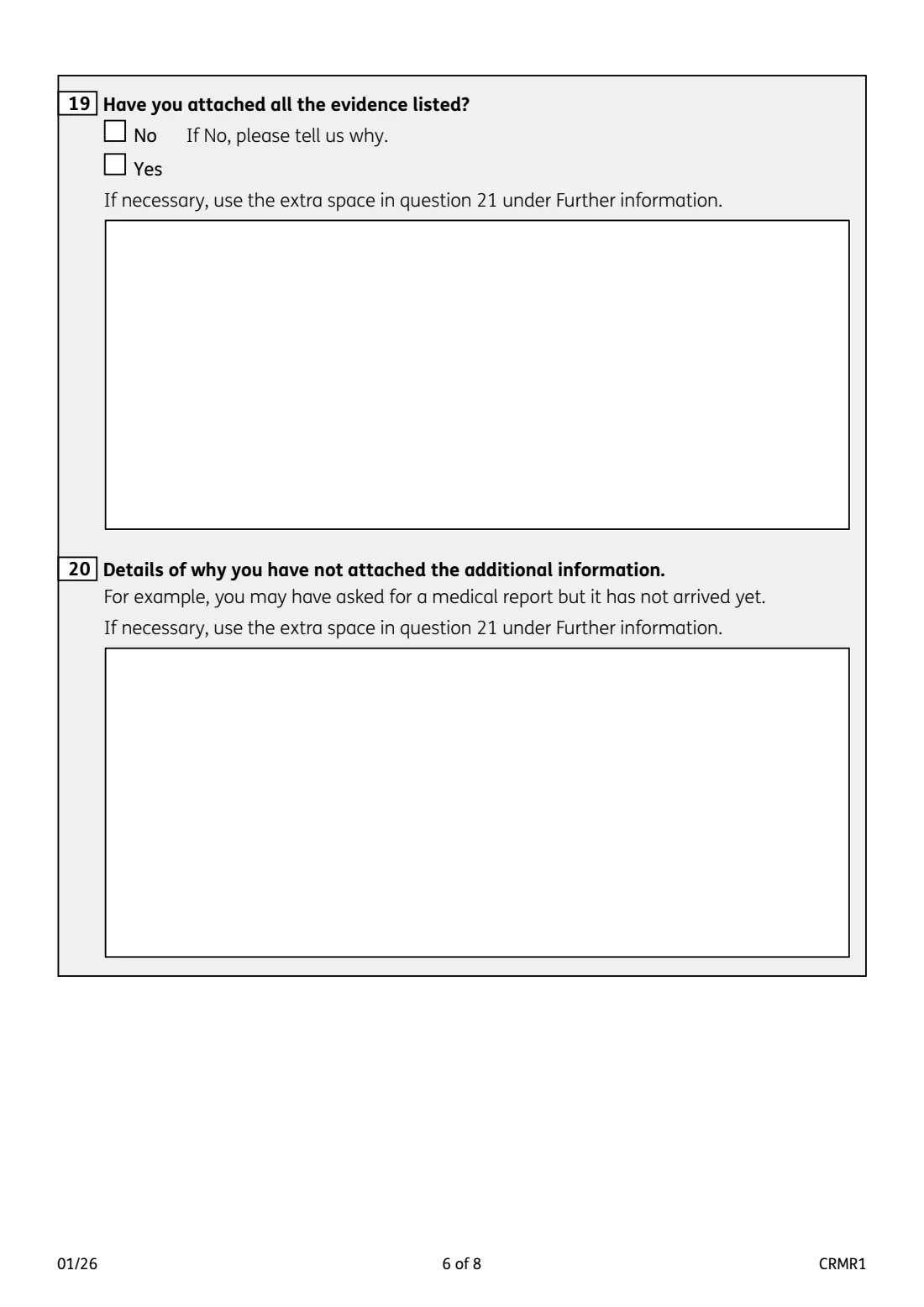
Question 18 asks whether you have new information DWP hasn't seen, and to list everything you are sending. Question 19 asks whether it is all attached, and question 20 is where you explain anything still to come — for example a medical report you've asked for that hasn't arrived yet.
5 Further information (question 21)
A full page for anything that didn't fit elsewhere, or anything else DWP should know. Start each part with the question number it continues.
6 What to do now and declaration
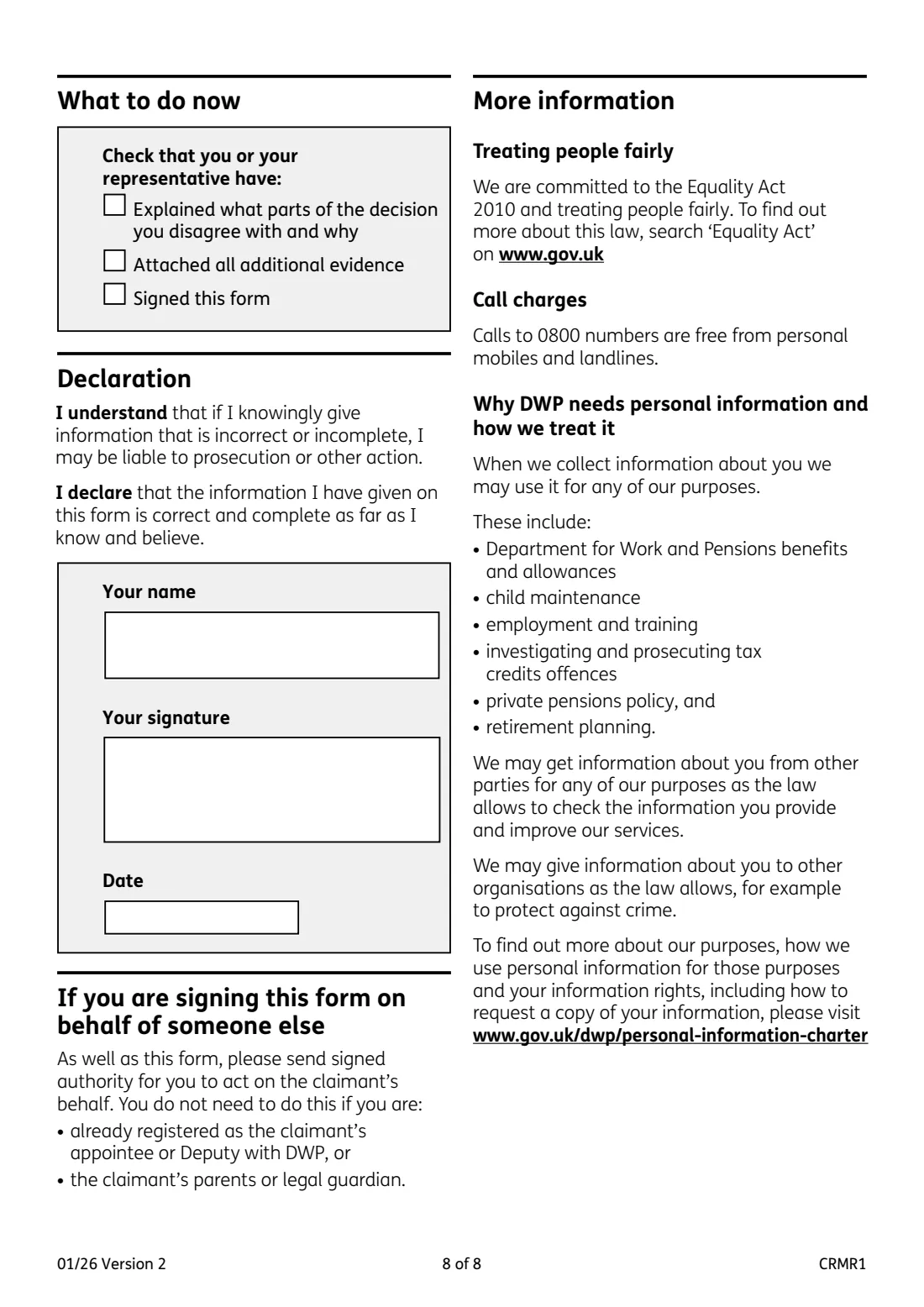
Check you have explained what you disagree with and why, attached your evidence and signed. The declaration says the information is correct and complete as far as you know, and warns that knowingly giving incorrect or incomplete information can lead to prosecution or other action. Print your name, then sign and date the form by hand.
Common mistakes to avoid
- Saying only that you disagree. Explain which part of the decision is wrong and why, part by part.
- Sending evidence DWP already has, general factsheets about a condition, appointment letters or bus and train tickets — the CRMR1A booklet asks you not to.
- Leaving question 16 blank when you are past the one-month limit. Give your reason for asking late.
- A representative forgetting to include signed authority to act for the claimant, when they aren't already the appointee, Deputy, parent or legal guardian.
- Using this form for Housing Benefit, Child Benefit, Guardian's Allowance or tax credits, which are challenged elsewhere.
- Forgetting to sign and date the declaration.
After you fill it out
Print the completed CRMR1 from FileIt, sign and date the declaration on page 8, and post it with any evidence to the address at the top of your decision letter. DWP suggests writing the claimant's full name, date of birth and National Insurance number at the top of each piece of evidence.
DWP will send you a text message or letter to say they have received the form. A different decision maker then looks at the whole claim, and the amount you get could go up, down or stay the same — your benefit could also stop.
You'll get a letter called a Mandatory Reconsideration Notice with the outcome. If you still disagree, you can appeal to the Social Security and Child Support Tribunal, usually within one month of the date on that notice. Keep a copy of the CRMR1 and the notice in the claimant's FileIt folder.
Fill out CRMR1 Mandatory reconsideration request online with FileIt
- Pick the person. Choose someone from People and FileIt fills in their name, date of birth, address and other details it already knows.
- Answer plain-language questions. One part of the form at a time, with the official help text beside each question — 60 fields in all. Your answers save as you go.
- Check the live preview. Watch your answers land on the real Department for Work and Pensions (DWP) form, and let FileIt do any worksheet arithmetic.
- Generate the official PDF. FileIt prints your answers into the agency’s own PDF and files it in that person’s folder in your vault. Sign it, or send it for e-signature.
FileIt fills the form — it never files or submits anything for you. Deliver the finished form to whoever asked for it, the way the form’s instructions say.
Start CRMR1 Mandatory reconsideration request now — it’s freeCRMR1 Mandatory reconsideration request: frequently asked questions
What is a mandatory reconsideration?
It's asking DWP to look at a benefit decision again. A different decision maker reviews your claim using the facts, the information they hold, any new information you send and the law, and decides whether the original decision was right.
Do I have to use form CRMR1?
No. You can ask by phone on the number on your decision letter, which DWP says is quickest, or by letter. For Universal Credit you can also ask through your journal. DWP strongly recommends the CRMR1 if you are asking by post.
How long do I have to ask?
Usually one month from the date on your decision letter, and a written request must arrive by then. You can ask later if you have a good reason, such as being in hospital or a bereavement, and explain it in question 16.
Can my PIP award go down?
Yes. The whole claim is looked at again, so the amount could go up, go down or stay the same, and the benefit could stop.
Is the CRMR1 the same as an appeal?
No. The CRMR1 asks DWP itself to reconsider. If you disagree with the Mandatory Reconsideration Notice you then appeal to the independent Social Security and Child Support Tribunal, which you can't do until you have that notice.
Can I fill in a CRMR1 for my child or a parent?
Yes. Answer Yes to question 09 and give your own details in questions 10 to 15; the About you section is still about the person the decision is about. Send signed authority to act for them unless you are already their appointee or Deputy with DWP, or their parent or legal guardian.
Where do I send the CRMR1?
To the address at the top of your decision letter, with any new evidence. FileIt prepares the form but you post it yourself.
Official sources
- Blank form (PDF), published by Department for Work and Pensions (DWP): https://assets.publishing.service.gov.uk/media/696f75507e827090d02d422b/crmr1.pdf
- Official instructions and guidance: https://assets.publishing.service.gov.uk/media/696f7567011505255b2d421b/crmr1a.pdf
- Edition shown on this page: CRMR1 01/26 (checked 2026-09-28).
FileIt is not affiliated with or endorsed by Department for Work and Pensions (DWP) or any government. This page explains the form in general terms and is not legal, tax or immigration advice. Always read the official instructions, and check that you are using the edition the recipient accepts. Page last reviewed 2026-09-28.