What is COP44A Court of Protection fee help?
Applications to the Court of Protection, such as asking to be appointed as someone's deputy, usually carry a court fee. Form COP44A asks the court for help with that fee, sometimes called fee remission. Depending on the fee payer's savings, benefits and income, the court may waive the fee completely or ask for part of it.
Whose finances count depends on the kind of case. In a Property and Affairs case, the court looks at the savings and income of the person who lacks, or may lack, capacity. In a Health and Personal Welfare case, it looks at the applicant's savings and income, and their partner's if they have one. The form also lets you ask for a refund if a fee has already been paid.
FileIt asks the questions in plain English, follows the form's 'go to' routes so you only answer what applies, adds up the monthly income, and prints your answers into the court's own COP44A PDF. People's names, dates of birth and National Insurance numbers can be pre-filled from your FileIt vault. You print it, sign it and send it with your evidence. FileIt never submits anything.
- Who fills it
- The applicant to the Court of Protection, such as a family member applying to be a deputy
- Sent to
- Court of Protection, PO Box 70185, First Avenue House, 42-49 High Holborn, London WC1A 9JA (DX 160013 Kingsway 7)
- Savings limit
- Help is unlikely with more than £4,250 in savings and investments, or more than £16,000 if the fee payer is 66 or over
- Income limit
- Less than £1,420 a month if single, or £2,130 with a partner, plus £425 for each child up to 13 and £710 for each child 14 or older
- Signatures
- Only the applicant signs the declaration and statement of truth
- Edition
- COP44A (05.26), 5 pages; notes COP44B
Who needs to fill out COP44A Court of Protection fee help?
- Family members or friends applying to the Court of Protection, for example to become a deputy for property and financial affairs, who can't easily afford the court fee.
- People making a Health and Personal Welfare application who get income-based JSA, income-related ESA, Income Support, Universal Credit (earning less than £6,000 a year) or Pension Credit guarantee credit.
- Applicants in a Property and Affairs case where the person who lacks capacity has little savings or a low income.
- Anyone who paid a Court of Protection fee and thinks the fee payer would have qualified for a reduced fee, within 3 months of the final order.
- Not usually for people whose solicitor is paid by legal aid: COP44B says the solicitor pays the fee and recovers it from the Legal Aid Agency.
When to use COP44A Court of Protection fee help
- With your Court of Protection application, instead of paying the full fee.
- After paying a fee, to ask for a refund. COP44B says this must be within 3 months of the final order, and your answers should describe the fee payer's finances when the fee was paid.
- Once for each fee you want help with.
What you need before you start
- Names, dates of birth and National Insurance numbers for the person the application relates to, for you, and for your partner if their finances count.
- The postcode of the person who lacks capacity. The form says it's used to check benefit status with DWP.
- Your Court of Protection case number, if you have one, and the date the fee was paid if you're asking for a refund.
- The fee payer's total savings and investments, and which benefits they get.
- The ages of any financially dependent children.
- Monthly income before tax, by type: wages, Child Benefit, tax credits, maintenance, pensions, rent and other income.
- Evidence of income, such as the last 3 months' bank statements and recent payslips. COP44B lists what the court accepts.
What’s on COP44A Court of Protection fee help
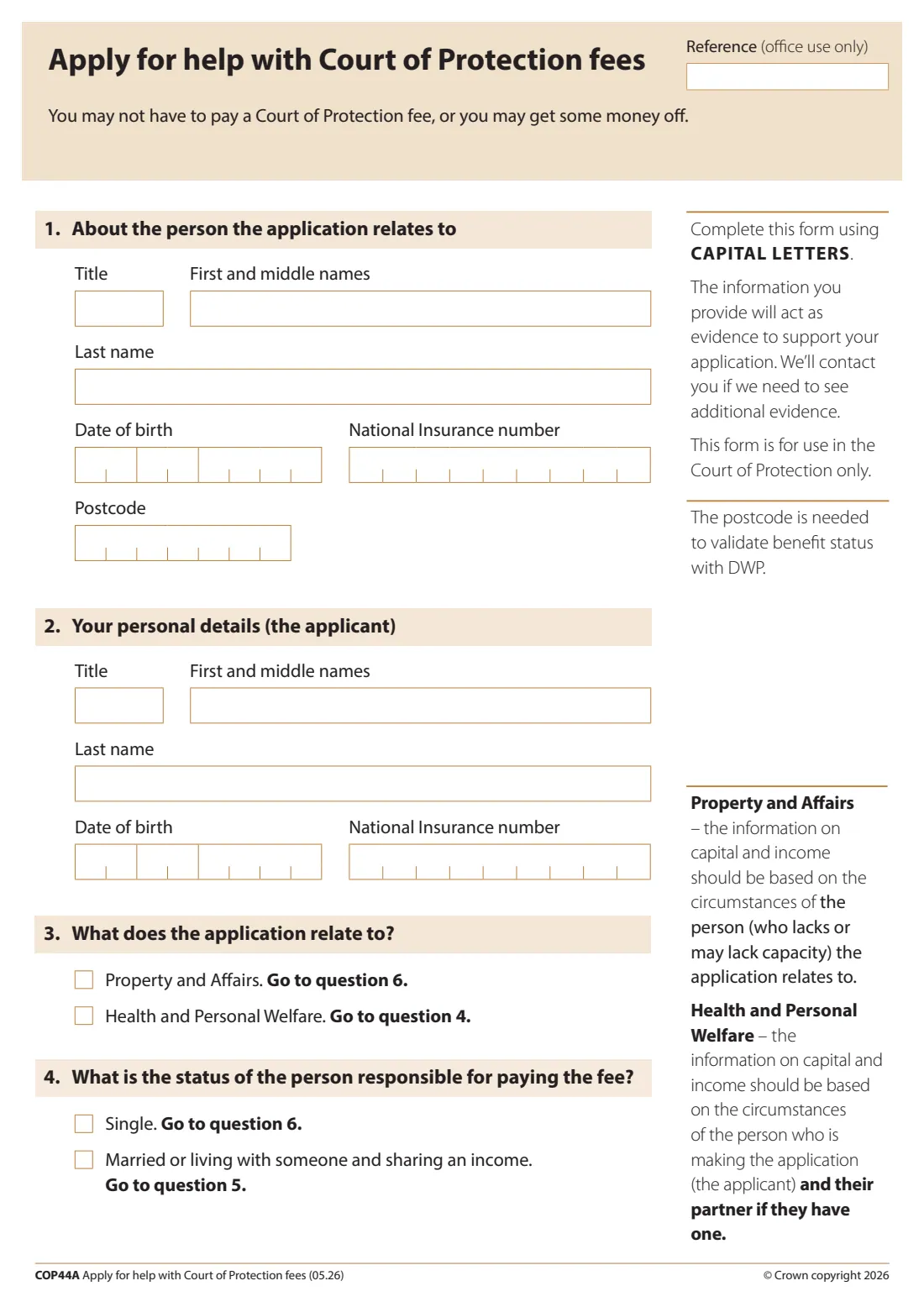
The 2026 edition has 5 pages. FileIt asks for it in 8 parts, and it is signed by Applicant:
- 1. About the person the application relates toApplicant
- 2. Your personal details (the applicant)Applicant
- 3-5. What the application is aboutApplicant
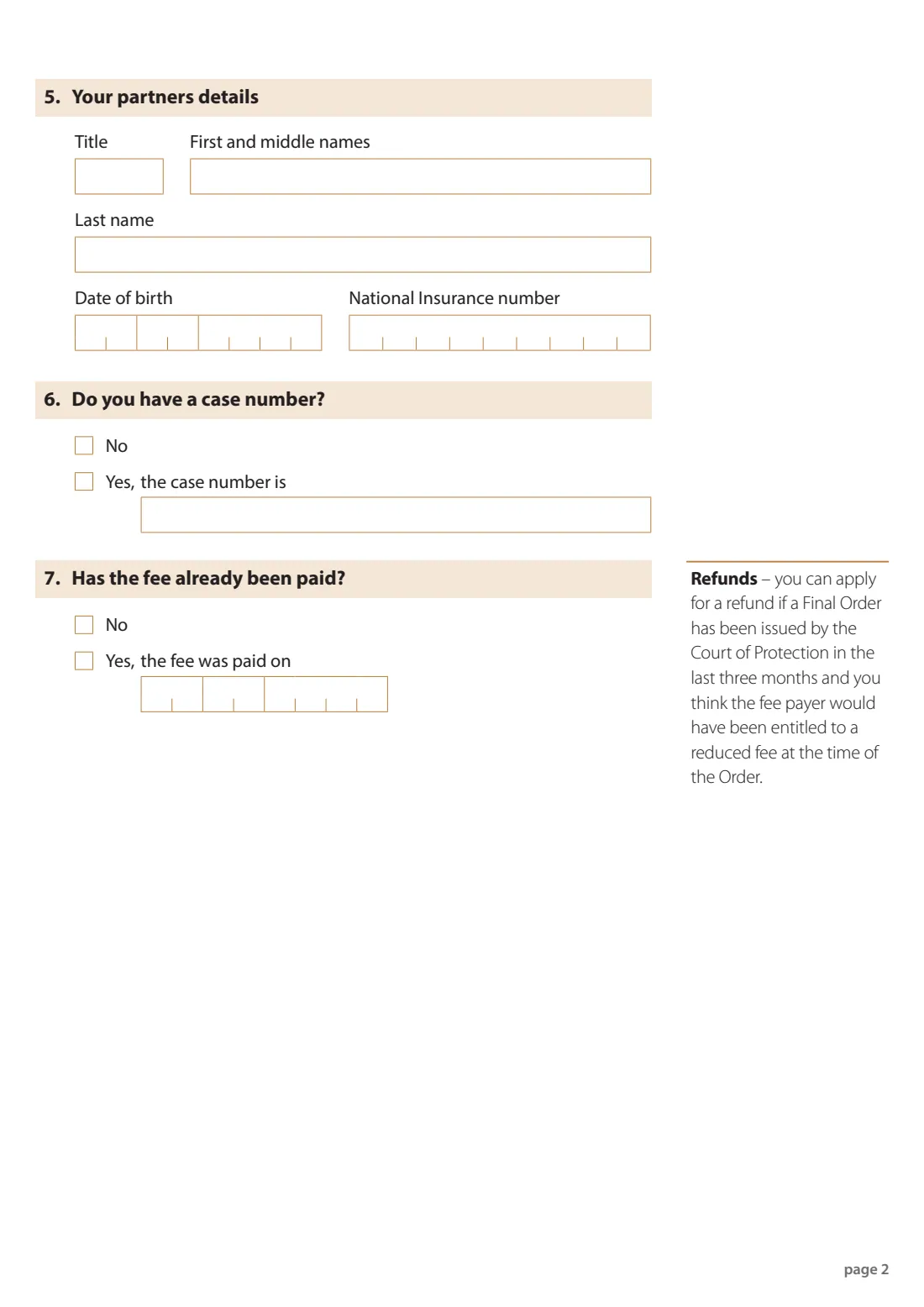
- 6-7. Case and feeApplicant
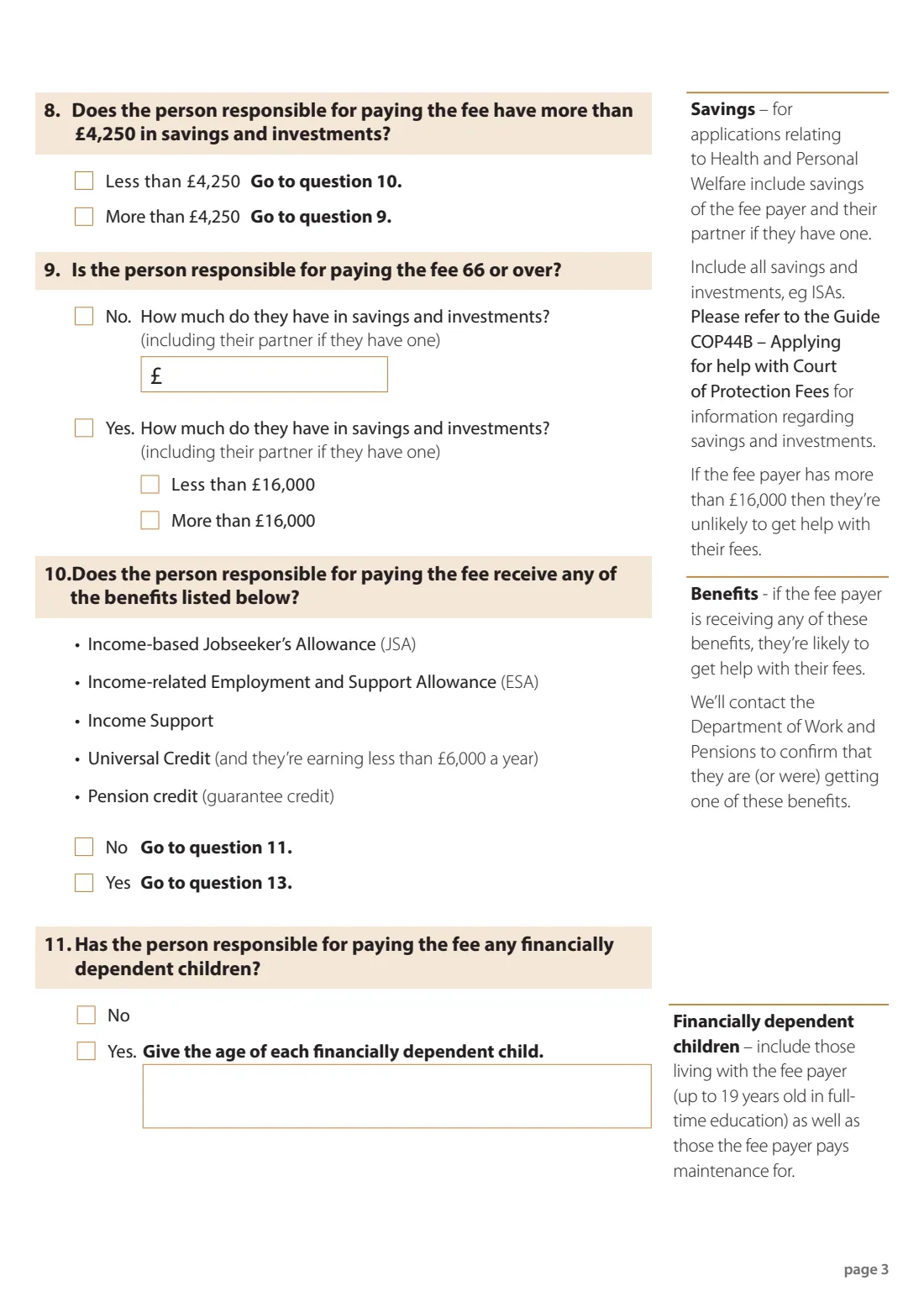
- 8-11. Savings, benefits and childrenApplicant
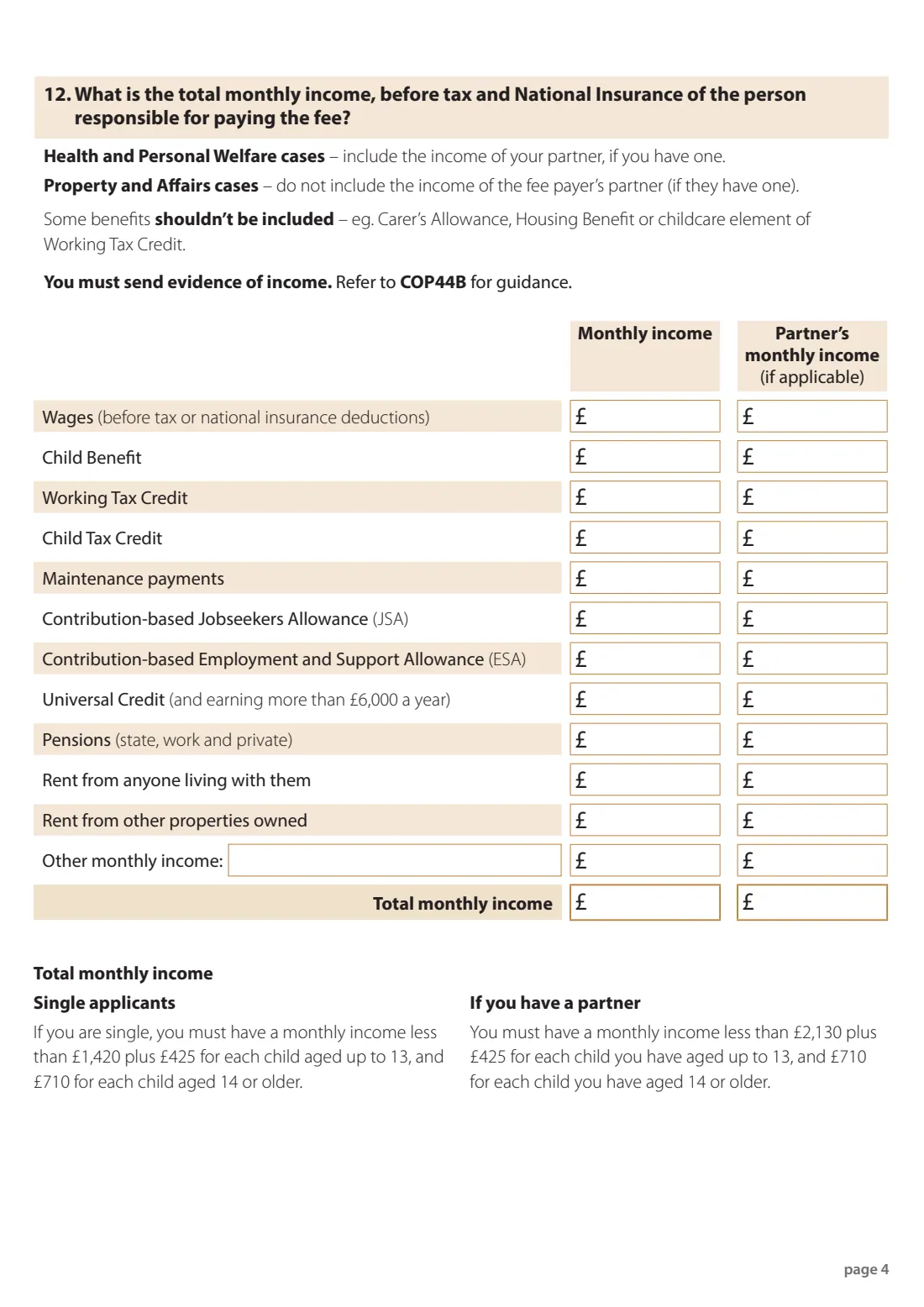
- 12. Total monthly incomeApplicant
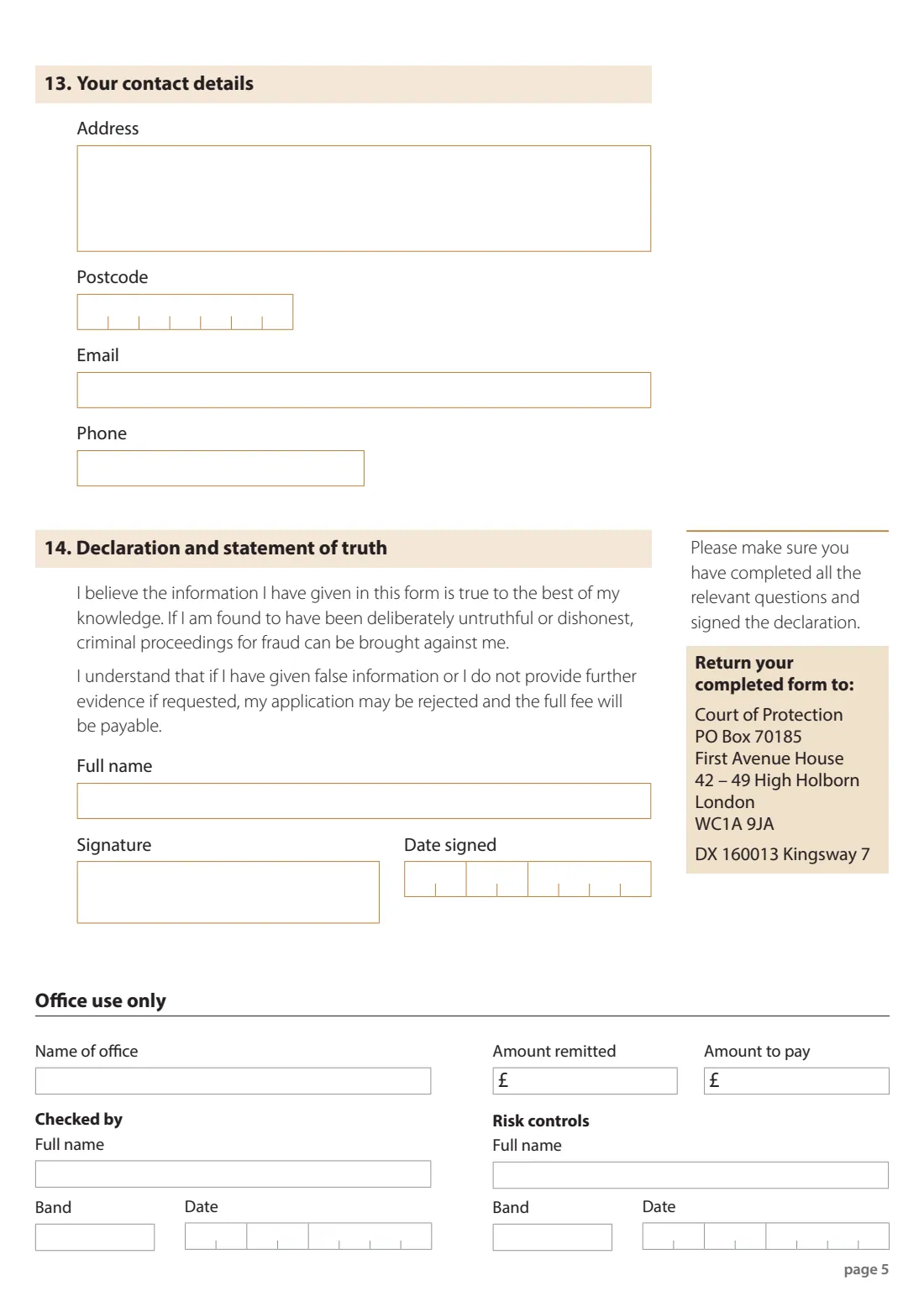
- 13. Your contact detailsApplicant
- 14. Declaration and statement of truthApplicant
How to fill out COP44A Court of Protection fee help, step by step
1 People (questions 1, 2 and 5)
Question 1 is the person the application relates to: the person who lacks, or may lack, capacity. Question 2 is you, the applicant. Question 5 is your partner, and only applies to a Health and Personal Welfare case where you are married or living with someone and sharing an income.
2 What the case is about (questions 3 and 4)
Tick Property and Affairs or Health and Personal Welfare, not both: COP44B says an application with both ticked is returned. For Health and Personal Welfare, question 4 asks whether you are single or living with a partner. If your partner is the person the application relates to, COP44B says to include only your own savings and income.
3 Case number and refunds (questions 6 and 7)
Give the case number from the court's letters if the case has started. If the fee has already been paid, give the date. For a refund, COP44B asks for proof of payment and evidence of benefits and income at the time the fee was paid.
4 Savings and benefits (questions 8 to 10)
Say whether the fee payer has more than £4,250 in savings and investments, including ISAs, shares and second homes. COP44B lists what to leave out. If they have more and are under 66, give the amount. If they are 66 or over, say whether it's more or less than £16,000.
Question 10 asks whether they get income-based JSA, income-related ESA, Income Support, Universal Credit (earning less than £6,000 a year) or Pension Credit guarantee credit. If they do, skip to your contact details: the court checks this with DWP.
5 Children and income (questions 11 and 12)
List the ages of financially dependent children, then the monthly income before tax and National Insurance by type. Include a partner's income only in a Health and Personal Welfare case. Leave out benefits such as Carer's Allowance, Housing Benefit and the childcare element of Working Tax Credit. FileIt adds up the totals.
6 Contact details and declaration (questions 13 and 14)
Your address, postcode, email and phone. Then your full name, signature and date under the statement of truth. Only the applicant can sign it.
Common mistakes to avoid
- Ticking both Property and Affairs and Health and Personal Welfare. COP44B says the application will be returned.
- Using the wrong person's finances: the person who lacks capacity for Property and Affairs, and the applicant (with partner) for Health and Personal Welfare.
- Including a partner's income in a Property and Affairs case.
- Counting benefits that shouldn't be included, such as Carer's Allowance, Housing Benefit, Attendance Allowance or PIP.
- Not sending evidence of income, or sending bank statements without the account holder's name on them.
- Asking for a refund more than 3 months after the final order.
After you fill it out
Print the form, check it, and sign and date the declaration. Only the applicant can sign.
Send it with your evidence to Court of Protection, PO Box 70185, First Avenue House, 42-49 High Holborn, London WC1A 9JA. If you've worked out that you have to pay part of the fee, COP44B says to include a cheque for that amount payable to HM Courts and Tribunals Service. FileIt doesn't send anything for you.
COP44B says the court aims to process help with fees applications in 5 working days. If it's refused, you can appeal in writing to the Court of Protection's delivery manager by the date in the refusal letter. Keep a copy of the form and your evidence in FileIt.
Fill out COP44A Court of Protection fee help online with FileIt
- Pick the person. Choose someone from People and FileIt fills in their name, date of birth, address and other details it already knows.
- Answer plain-language questions. One part of the form at a time, with the official help text beside each question — 68 fields in all. Your answers save as you go.
- Check the live preview. Watch your answers land on the real HM Courts & Tribunals Service (Court of Protection) form, and let FileIt do any worksheet arithmetic.
- Generate the official PDF. FileIt prints your answers into the agency’s own PDF and files it in that person’s folder in your vault. Sign it, or send it for e-signature.
FileIt fills the form — it never files or submits anything for you. Deliver the finished form to whoever asked for it, the way the form’s instructions say.
Start COP44A Court of Protection fee help now — it’s freeCOP44A Court of Protection fee help: frequently asked questions
What is form COP44A for?
It asks the Court of Protection to waive or reduce its application fee because the fee payer has little savings, gets certain benefits or has a low income. It can also be used to ask for a refund within 3 months of a final order.
Whose income counts on COP44A?
In a Property and Affairs case, the income and savings of the person who lacks, or may lack, capacity, and not their partner's. In a Health and Personal Welfare case, the applicant's, plus their partner's if they have one, unless the partner is the person the application is about.
What are the savings limits?
The form says help is unlikely if the fee payer has more than £4,250 in savings and investments. If they are 66 or over, COP44B says they may still get help with £16,000 or less.
Which benefits make it likely I'll get help?
Income-based Jobseeker's Allowance, income-related Employment and Support Allowance, Income Support, Universal Credit (earning less than £6,000 a year) and Pension Credit guarantee credit. The court checks with DWP.
What are the income limits?
A single fee payer must have a monthly income less than £1,420, and a couple less than £2,130, plus £425 for each child aged up to 13 and £710 for each child aged 14 or older. Above the limit you may still get part of the fee paid: COP44B explains the calculation and the EX160C calculator.
Where do I send COP44A?
To Court of Protection, PO Box 70185, First Avenue House, 42-49 High Holborn, London WC1A 9JA, or DX 160013 Kingsway 7.
Can someone else sign it for me?
No. COP44B says only the applicant can sign and date the declaration and statement of truth.
Official sources
- Blank form (PDF), published by HM Courts & Tribunals Service (Court of Protection): https://assets.publishing.service.gov.uk/media/6a6070bb0dd52549f5f96cb5/COP44A_0526_save.pdf
- Official instructions and guidance: https://www.gov.uk/government/publications/apply-for-help-with-court-of-protection-fees-form-cop44a/notes-on-completing-the-application-for-help-with-fees-cop44b
- Edition shown on this page: COP44A (05.26) (checked 2026-09-28).
FileIt is not affiliated with or endorsed by HM Courts & Tribunals Service (Court of Protection) or any government. This page explains the form in general terms and is not legal, tax or immigration advice. Always read the official instructions, and check that you are using the edition the recipient accepts. Page last reviewed 2026-09-28.