What is Anlage Kind (KG 1)?
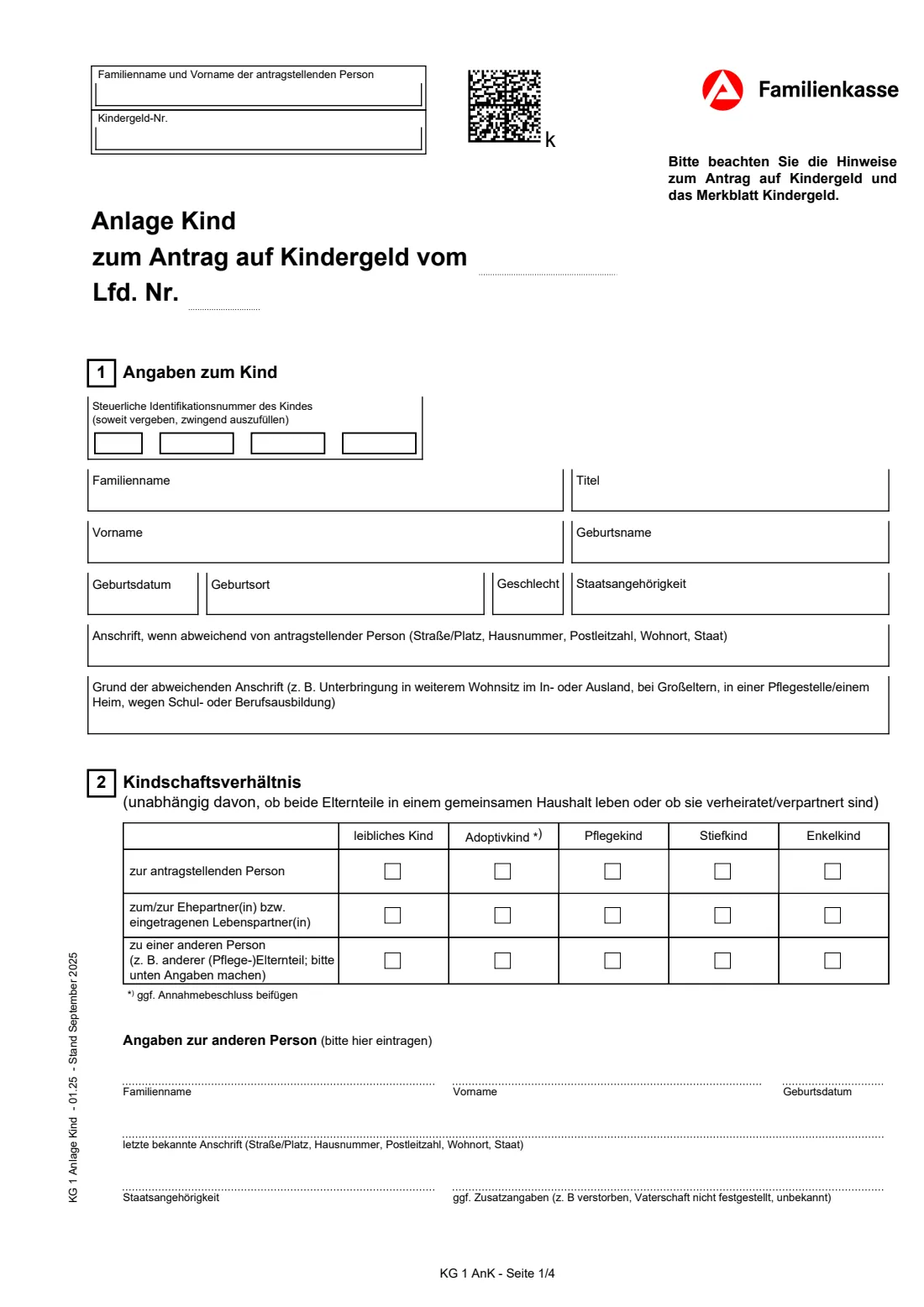
The Anlage Kind (child supplement) belongs to the German child benefit application KG 1, the Antrag auf Kindergeld. KG 1 is about you and your household; the Anlage Kind is about one particular child — who they are, how they are related to you and to other people, and, for a young adult, what they are doing now. You fill in a separate Anlage Kind for each child you are claiming for and send them all together with KG 1 to the Familienkasse. The current edition is KG 1 Anlage Kind - 01.25, Stand September 2025.
Most parents of a young child only need parts 1 and 2 plus a handful of yes/no questions. Part 3 is where it gets detailed: child benefit continues beyond 18 only in specific situations set out in § 32 (4) of the Income Tax Act (EStG), such as training, study, a voluntary service or a disability that began before 25, and the Anlage asks you to show which one applies and for which dates.
FileIt explains every question of the Anlage Kind in English, with the German wording shown alongside, and prints your answers onto the official German PDF. The child's name, date of birth, tax identification number and the other parent's details can be pre-filled from the People records in your FileIt vault. The filled PDF is saved in the child's vault folder. FileIt does not send it to the Familienkasse: you sign it by hand and post it with KG 1 yourself.
- Who fills it
- The applicant who signs KG 1 — one Anlage Kind per child
- Given to
- Your Familienkasse, by post, attached to the main application KG 1
- When
- Whenever you apply for Kindergeld for a child, including a child aged 18 or over who still qualifies
- Signatures
- The applicant signs and dates by hand (a legal representative for an applicant under 18)
- Edition
- KG 1 Anlage Kind - 01.25 - Stand September 2025
Who needs to fill out Anlage Kind (KG 1)?
- Every parent or entitled person applying for Kindergeld with KG 1 — the Anlage is required for each child claimed.
- Parents of a newborn claiming child benefit for the first time.
- Parents of a child aged 18 to 24 who is at school, university, in vocational training, in a voluntary service or between two stages of training.
- Parents of a child under 21 who is without a job and registered as a job-seeker with an Agentur für Arbeit or Jobcenter.
- Parents of an adult child who cannot support themselves because of a disability that began before age 25.
- Adoptive parents, foster parents, step-parents and grandparents claiming for a child in their household.
When to use Anlage Kind (KG 1)
- Together with KG 1 whenever you make a new claim — never on its own as a first application.
- For each additional child you start claiming for, with a new serial number (Lfd. Nr.).
- When your child is about to turn 18 or is already 18 or over and one of the situations in part 3 applies.
- Apply promptly: because the Anlage travels with KG 1, the same six-month limit on backdated payments applies.
What you need before you start
- The child's 11-digit tax identification number, sent to the child's registered address shortly after birth.
- The child's full name, birth name if different, date and place of birth, sex and nationality.
- The child's address and the reason, if they do not live with you.
- The other parent's name, date of birth, last known address and nationality, if they do not live with you.
- For an adopted child, the family court's adoption order (Annahmebeschluss); for a child born abroad, official proof of the parent-child relationship such as the foreign birth certificate.
- For a child 18 or over: school or university enrolment certificates, the training contract, or the voluntary service provider's certificate, with start and end dates.
- Form KG 11a, completed and signed, if the child has no training place or is registered as a job-seeker.
- Details of the child's jobs and weekly working hours if they have finished a first training or degree.
- Any previous Kindergeld claims, foreign child-related benefits, or work abroad in the last five years.
What’s on Anlage Kind (KG 1)
The 2025 edition has 4 pages. FileIt asks for it in 9 parts:
- About this Anlage Kind (Kopfzeile)Applicant (antragsteller/in)
- 1 About the child (Angaben zum Kind)Child
- 2 The child's relationship to you and others (Kindschaftsverhältnis)Child
- 3 Child aged 18 or over (Angaben für ein volljähriges Kind)Child
- 4 Child benefit already applied for or received for this child (Kindergeld bereits beantragt oder erhalten)Child
- 5 Working in the public service (Tätigkeit im öffentlichen Dienst)Child
- 6 Child-related benefits from outside Germany (Geldleistung von einer Stelle außerhalb Deutschlands)Child
- 7 Work abroad or for a foreign employer in the last 5 years (in den letzten 5 Jahren vor der Antragstellung)Child
- Declaration and signature (Unterschrift)Applicant (antragsteller/in)
How to fill out Anlage Kind (KG 1), step by step
1 Header (Kopfzeile)
Enter the name of the applicant who signs KG 1, your Kindergeld number if you already have one, the date of the KG 1 this Anlage belongs to (zum Antrag auf Kindergeld vom), and a serial number (Lfd. Nr.) — 1 for the first child, 2 for the second, and so on.
2 1 Angaben zum Kind (about the child)
The child's tax identification number must be given if it has been issued. For a child now living abroad who got a number in Germany, give that number; if none was ever issued, for example because the child lives in another EU country, the Familienkasse will tell you what other proof of identity it needs.
Then give the child's name, any academic title (rare), birth name, date and place of birth, sex and nationality. If the child does not live at your address, give their address and the reason — for example living with grandparents, in foster care or a care home, at a second home, or away for school or training.
3 2 Kindschaftsverhältnis (the child's relationship to you and others)
Tick how the child is related to you, to your spouse or registered partner, and to one other person: biological child, adopted child, foster child, stepchild or grandchild. Answer regardless of whether the parents live together or are married. For an adopted child, enclose the adoption order.
The "other person" is typically the child's other biological parent who does not live with you, or an unmarried (foster) parent who does. The form says these details are always required: give their name, date of birth, last known address and nationality. If they have died, add "verstorben"; if paternity has not been legally established, write "unbekannt" or "Vaterschaft nicht festgestellt".
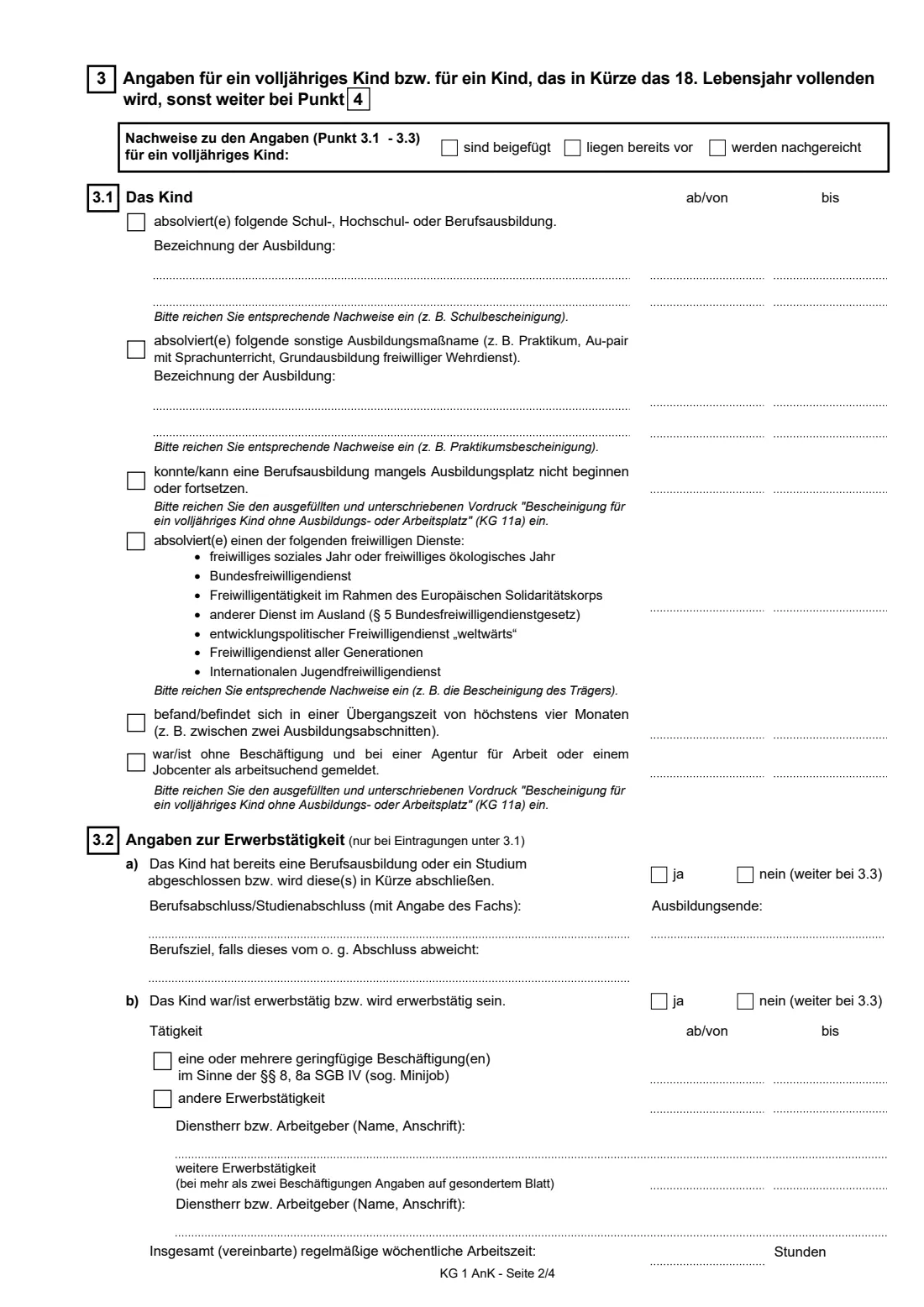
4 3 Angaben für ein volljähriges Kind (child aged 18 or over)
Skip this part for a child under 18 who is not about to turn 18. Otherwise, first say whether the proof is attached, already with the Familienkasse, or will follow. Under 3.1 tick each situation that applies with its dates: school, university or vocational training; another training measure such as an internship or au-pair stay with language classes; unable to start or continue training for lack of a place; a recognised voluntary service (such as a voluntary social or ecological year or the Bundesfreiwilligendienst); a transition of up to four months between two stages; or without a job and registered as a job-seeker.
The form's notes set the age limits: job-seeking counts only up to 21, and training, transition, lack of a training place and voluntary service count up to 25. For "no training place" and "job-seeking" you also send the signed form KG 11a.
5 3.2 Angaben zur Erwerbstätigkeit (employment)
Answer only if you ticked something under 3.1. Question a) asks whether the child has already completed a vocational training or degree, or will soon, with the qualification, end date and any different career goal. Question b) asks whether the child was, is or will be working, split into minijobs and other employment, with dates, employer and the total agreed regular weekly hours.
These questions matter because, after a first completed training or degree, work of more than 20 hours a week (other than a minijob) can end the entitlement.
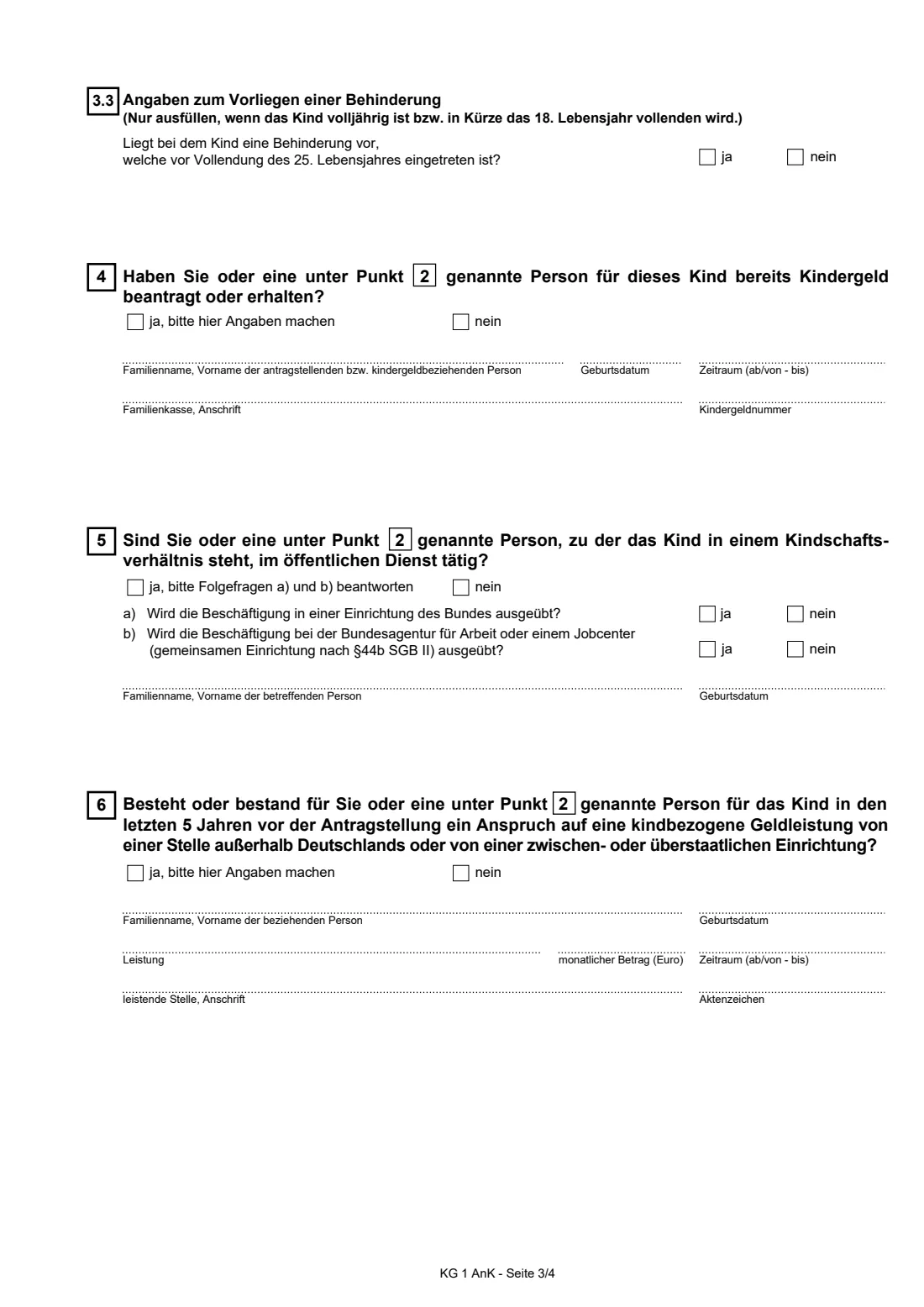
6 3.3 Angaben zum Vorliegen einer Behinderung (disability)
Only for an adult child: say whether the child has a disability that began before their 25th birthday. A child who cannot support themselves because of such a disability can be considered without an upper age limit; the Familienkasse will ask for evidence.
7 4 Kindergeld already applied for or received
Say whether you or a person named in part 2 of KG 1 has already applied for or received child benefit for this child. If yes, give that person's name and date of birth, the period, the Familienkasse and its address, and the child benefit number.
8 5 Tätigkeit im öffentlichen Dienst (public service)
Say whether you, or a person in part 2 to whom the child is related, works in the public service — as a civil servant or pensioner of one, an employee of the federal government, a Land, a municipality or another public-law body, a judge, or a professional or fixed-term soldier. If yes, answer whether the job is with a federal institution, and whether it is with the Bundesagentur für Arbeit or a Jobcenter. Churches and church-run institutions and the charitable welfare associations do not count as public service.
9 6 Child-related benefits from outside Germany
Say whether, in the five years before this application, you or a person in part 2 had a claim to a child-related payment for this child from a body outside Germany or from an international or supranational body — for example family benefits in another country, or a child allowance from an employer such as the European Union. If yes, give the benefit, the monthly amount in euros, the period, the paying body and its reference number.
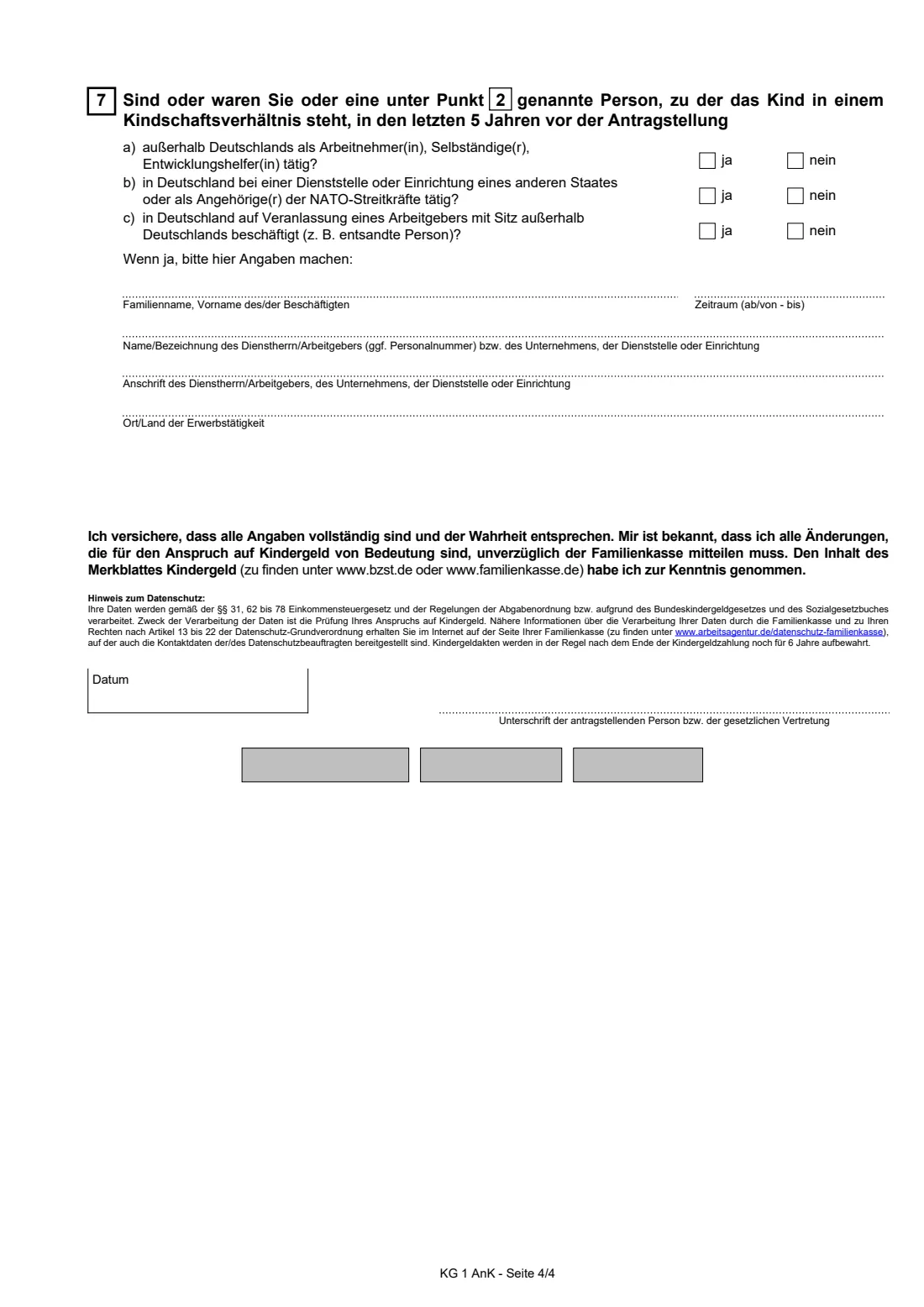
10 7 Work abroad or for a foreign employer in the last 5 years
Three yes/no questions about you and anyone in part 2 to whom the child is related: a) working outside Germany as an employee, self-employed person or development worker; b) working in Germany for another state's office or institution, or as a member of the NATO forces; c) being posted to Germany by an employer based abroad. Diplomatic or consular service also counts as yes under a) or b). If any answer is yes, give the person, period, employer, address and place or country of work — Anlage Ausland may also be needed.
11 Declaration and signature (Unterschrift)
You confirm that the details are complete and true, that you will report relevant changes to the Familienkasse without delay, and that you have read the Merkblatt Kindergeld. Sign and date by hand; a legal representative signs for an applicant under 18.
Common mistakes to avoid
- Using one Anlage Kind for several children — each child needs their own, numbered in the Lfd. Nr. box.
- Leaving the "other person" in part 2 blank. The form says these details are always required; write "verstorben", "unbekannt" or "Vaterschaft nicht festgestellt" where that applies.
- Omitting the child's tax identification number when one has been issued.
- Ticking a part 3 situation without its dates or without attaching the proof, or forgetting KG 11a for job-seeking or a missing training place.
- Skipping 3.2 after ticking a situation in 3.1 — the employment questions must then be answered.
- Answering no to question 7 when a parent works for an embassy, consulate or the NATO forces.
- Sending the Anlage without the main application KG 1.
After you fill it out
Print each Anlage Kind and sign and date it by hand. Check that the date in the header matches the date of the KG 1 it belongs to and that the serial numbers run 1, 2, 3 across your children.
Post all the Anlagen together with the signed KG 1 and the supporting documents — proof of training for an adult child, KG 11a where needed, an adoption order or foreign birth certificate — to your Familienkasse. FileIt does not submit anything for you. You do not need to send a German birth certificate for a child born in Germany unless the Familienkasse asks for it.
Save a copy in the child's folder in your FileIt vault. For an older child, revisit the Anlage whenever their situation changes — starting or finishing training, a new job, a gap between courses — because changes that affect child benefit must be reported to the Familienkasse straight away.
Fill out Anlage Kind (KG 1) online with FileIt
- Pick the person. Choose someone from People and FileIt fills in their name, date of birth, address and other details it already knows.
- Answer plain-language questions. One part of the form at a time, with the official help text beside each question — 96 fields in all. Your answers save as you go.
- Check the live preview. Watch your answers land on the real Bundesagentur für Arbeit — Familienkasse form, and let FileIt do any worksheet arithmetic.
- Generate the official PDF. FileIt prints your answers into the agency’s own PDF and files it in that person’s folder in your vault.
FileIt fills the form — it never files or submits anything for you. Deliver the finished form to whoever asked for it, the way the form’s instructions say.
Start Anlage Kind (KG 1) now — it’s freeAnlage Kind (KG 1): frequently asked questions
What is the Anlage Kind?
It is the child supplement to the German child benefit application KG 1. KG 1 is filled in once for the household, and one Anlage Kind is added for each child you claim Kindergeld for.
Can I fill out the Anlage Kind online in English?
FileIt lets you fill it online with English explanations and the German terms alongside, then prints your answers onto the official German PDF. The form you send is still the German original, which you sign by hand.
Where do I send the Anlage Kind?
Post it to your Familienkasse together with the main application KG 1 and any proof it asks for. FileIt does not submit it for you.
Do I have to name the child's other parent if we are not together?
Yes. Part 2 asks for the other person to whom the child is related, typically the other biological parent who does not live with you. If the parent has died or paternity has not been established, you write that instead.
Can I get Kindergeld for a child over 18?
Only in the situations the form lists from § 32 (4) EStG: under 21 and registered as a job-seeker without a job; under 25 and in training or study, in a transition of up to four months, without a training place, or in a recognised voluntary service; or, with no age limit, unable to support themselves due to a disability that began before 25. Fill in part 3 and attach proof.
What is form KG 11a?
It is the certificate for an adult child without a training place or job (Bescheinigung für ein volljähriges Kind ohne Ausbildungs- oder Arbeitsplatz). The Anlage Kind asks you to send it, completed and signed, if the child cannot find a training place or is registered as a job-seeker.
Do I need to send a birth certificate?
For a child born in Germany, the notes say the birth certificate is only needed if the Familienkasse asks. For a child born abroad, you prove the parent-child relationship with official documents such as the foreign birth certificate.
Can my adult child work and still get Kindergeld?
During a first training or degree, yes. After a first completed training or degree, the child can generally work up to 20 hours a week, and minijobs do not count towards that. Section 3.2 collects the details the Familienkasse needs to check this.
Official sources
- Blank form (PDF), published by Bundesagentur für Arbeit — Familienkasse: https://www.arbeitsagentur.de/datei/kg1-anlagekind_ba033765.pdf
- Official instructions and guidance: https://www.arbeitsagentur.de/familie-und-kinder/downloads-familie-und-kinder/formulare-kindergeld
- Edition shown on this page: KG 1 Anlage Kind - 01.25 - Stand September 2025 (checked 2026-09-25).
FileIt is not affiliated with or endorsed by Bundesagentur für Arbeit — Familienkasse or any government. This page explains the form in general terms and is not legal, tax or immigration advice. Always read the official instructions, and check that you are using the edition the recipient accepts. Page last reviewed 2026-09-25.