What is Commonwealth statutory declaration?
A statutory declaration is a written statement of facts that you declare to be true. The Commonwealth form, made under section 9 of the Statutory Declarations Act 1959, is the one Australian Government agencies ask for. Examples include supporting a Centrelink or Services Australia claim, a visa matter, or explaining a missing document. A knowingly false statement is an offence punishable by up to 4 years' imprisonment, as the form itself warns.
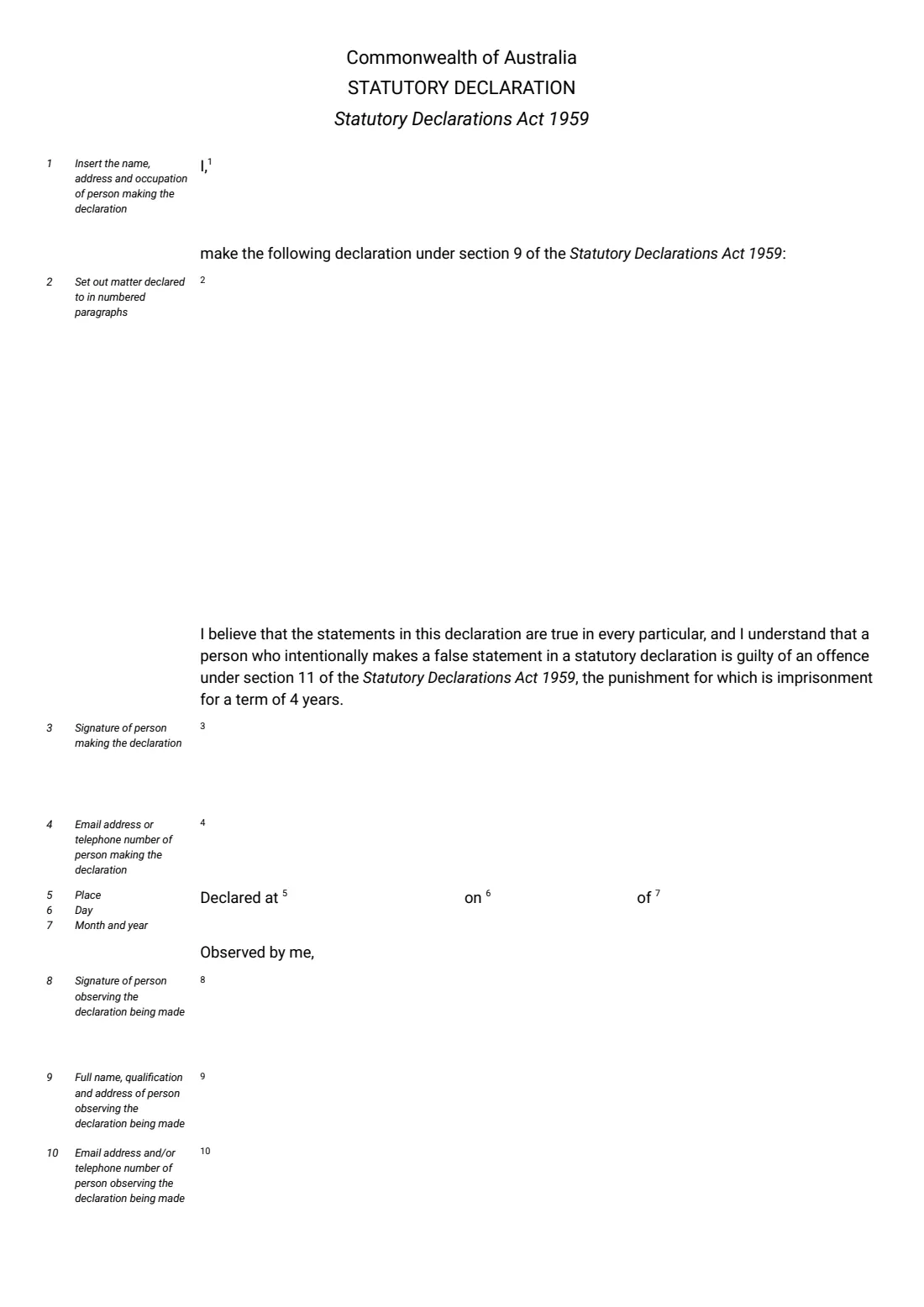
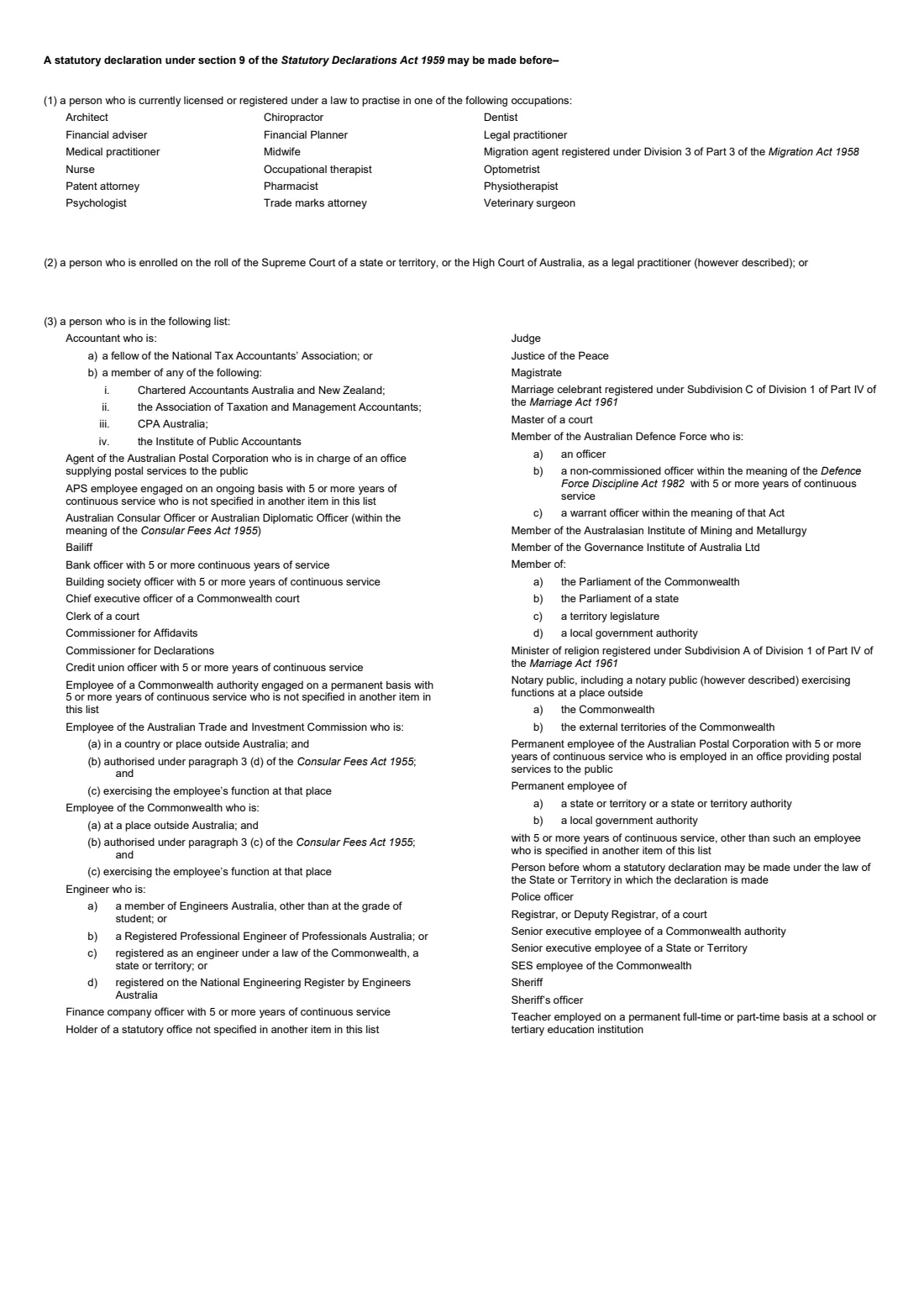
The form is a single page. It has your name, address and occupation, your statement in numbered paragraphs, your signature and contact details, and where and when you declare it. It closes with the signature, name, qualification, address and contact details of the person who watched you sign. Page 2 lists who can be a witness.
FileIt fills in the Attorney-General's own PDF. It prints your details as one sentence and keeps your paragraph breaks. It warns you if the statement won't fit the box, and it can pre-fill the witness details if you already know who they'll be. You still sign in front of your witness, and FileIt never lodges the declaration anywhere.
- Made under
- Section 9 of the Statutory Declarations Act 1959 (Cth)
- Who fills it
- The person making the declaration. The witness adds their own details
- Given to
- Whichever Commonwealth agency or organisation asked for it
- Signatures
- You and an authorised witness from the list on page 2
- Statement space
- About 20 lines. Use the AG's Word version for more
- Penalty for a false statement
- Up to 4 years' imprisonment (section 11)
Who needs to fill out Commonwealth statutory declaration?
- Anyone an Australian Government agency asks for a Commonwealth statutory declaration, for example Services Australia, the ATO or the Department of Home Affairs.
- People confirming facts they can't prove with a document, such as living arrangements, a relationship, a lost document or a change of name in everyday use.
- Parents and carers confirming care arrangements or a child's circumstances for a Commonwealth payment.
- People asked by a bank, insurer, employer or university to give a Commonwealth statutory declaration.
When to use Commonwealth statutory declaration
- When the organisation asking for it wants a Commonwealth statutory declaration. For a state or territory matter, such as some court or land title matters, that state's own form is usually needed instead.
- Once you know exactly what you need to declare. Keep it to facts you know first-hand.
- Before you meet your witness, in person or remotely. You sign and date it while they watch, so bring the form unsigned.
What you need before you start
- Your full legal name, an address you can be contacted at (home or work) and your occupation.
- Your email address or phone number (question 4).
- The facts you're declaring, written as numbered paragraphs.
- Any documents you want to attach as annexures. Each one should be identified in the statement and signed by the witness too.
- An authorised witness from the page 2 list. Examples include a Justice of the Peace, a registered pharmacist, nurse, medical practitioner or legal practitioner, a police officer, a bank or credit union officer with 5 or more years of continuous service, or a permanent teacher.
- The witness's full name, qualification, address, and email and/or phone number (questions 9 and 10).
What’s on Commonwealth statutory declaration
The 2024 edition has 2 pages. FileIt asks for it in 4 parts, and it is signed by Person making the declaration and Authorised witness:
- Your detailsPerson making the declaration
- What you declare (question 2)Person making the declaration
- Where and when you signPerson making the declaration
- Your witnessAuthorised witness
How to fill out Commonwealth statutory declaration, step by step
1 Question 1: who is making the declaration
The form opens 'I, [name, address and occupation], make the following declaration under section 9 of the Statutory Declarations Act 1959'. Enter your full legal name, an address you can be contacted at (home or work) and what you do, for example 'teacher', or 'student' or 'unemployed' if that applies. FileIt joins them into one sentence and checks it fits the box.
2 Question 2: your statement
Set out what you're declaring in numbered paragraphs, one fact per paragraph. Say where something is your belief rather than your own knowledge, and refer to any annexures by name.
The box holds about 20 lines of typed text. If yours is longer, FileIt tells you before the PDF is made. Shorten it, or use the Word version of the form on the Attorney-General's website.
3 Questions 3 and 4: your signature and contact details
Leave question 3 for your signature, which you add in front of your witness. Question 4 asks for your email address or phone number.
4 Questions 5 to 7: where and when
'Declared at [place] on [day] of [month and year]'. This must be where and when you actually sign in front of the witness. If you don't know yet, leave these blank and write them in at the signing. FileIt prints a date you give as, for example, '5th' and 'March 2026'.
5 Questions 8 to 10: the witness
The witness watches you sign, then signs at question 8 and adds their full name, qualification and address (question 9) and their email and/or phone number (question 10). Their qualification is the item on the page 2 list that lets them witness, such as 'Justice of the Peace' or 'Pharmacist'. You can fill these in ahead of time in FileIt, or leave them for the witness to write.
Common mistakes to avoid
- Signing before you meet the witness. The declaration must be signed while they watch.
- Using a witness who isn't on the page 2 list, or who isn't currently licensed or registered in the occupation that qualifies them.
- Using the Commonwealth form for a state or territory matter that needs the state's own declaration.
- Writing opinions or hearsay as fact. Say 'I believe' where you don't know something first-hand.
- Running out of room and writing outside the box. Use the Word version, or annexures identified in the statement.
- Forgetting the contact details at questions 4 and 10.
After you fill it out
Download the PDF from FileIt and take it, unsigned, to your witness. Sign it in front of them, complete the place and date if you left them blank, and have them sign and complete their details. If you have annexures, the witness signs those too.
Give the signed declaration to the agency or organisation that asked for it, in the way they asked. The Attorney-General's Department says you can sign in front of your witness either in person or remotely. See its page on making a Commonwealth statutory declaration with a witness for how. FileIt doesn't send the declaration anywhere.
Keep a copy in your FileIt vault with the documents it supports, so you can show what you declared and when.
Fill out Commonwealth statutory declaration online with FileIt
- Pick the person. Choose someone from People and FileIt fills in their name, date of birth, address and other details it already knows.
- Answer plain-language questions. One part of the form at a time, with the official help text beside each question — 13 fields in all. Your answers save as you go.
- Check the live preview. Watch your answers land on the real Attorney-General's Department form, and let FileIt do any worksheet arithmetic.
- Generate the official PDF. FileIt prints your answers into the agency’s own PDF and files it in that person’s folder in your vault. Sign it, or send it for e-signature.
FileIt fills the form — it never files or submits anything for you. Deliver the finished form to whoever asked for it, the way the form’s instructions say.
Start Commonwealth statutory declaration now — it’s freeCommonwealth statutory declaration: frequently asked questions
What is a Commonwealth statutory declaration?
It's a written statement of facts that you declare to be true under the Statutory Declarations Act 1959, signed in front of an authorised witness. Australian Government agencies accept it as evidence where a document isn't available.
Who can witness a Commonwealth statutory declaration?
Only the people listed on page 2 of the form. Examples include a Justice of the Peace, a currently registered pharmacist, nurse, medical practitioner, dentist or legal practitioner, a police officer, a bank, building society or credit union officer with 5 or more years of continuous service, a permanent teacher, or an Australian consular officer overseas.
What happens if I make a false statement?
The form states that a person who intentionally makes a false statement in a statutory declaration is guilty of an offence under section 11 of the Act, punishable by imprisonment for 4 years.
Can I fill in a statutory declaration online?
Yes. FileIt lets you type your details and statement and prints them into the Attorney-General's official PDF, with line breaks kept. You still sign it in front of an authorised witness.
What if my statement doesn't fit?
The box holds about 20 typed lines, and FileIt warns you before it would cut anything off. For a longer statement, use the Word version of the form from the Attorney-General's website, or put detail in annexures that the witness also signs.
Is this the right form for a state matter?
Not always. This form is for Commonwealth matters. Some state and territory matters need that state's own statutory declaration, so check with the organisation that asked for it.
Official sources
- Blank form (PDF), published by Attorney-General's Department: https://www.ag.gov.au/sites/default/files/2024-02/statutory-declaration-form.PDF
- Official instructions and guidance: https://www.ag.gov.au/legal-system/statutory-declarations
- Edition shown on this page: Statutory Declarations Act 1959 form (January 2024 revision, published 2024-02) (checked 2026-09-28).
FileIt is not affiliated with or endorsed by Attorney-General's Department or any government. This page explains the form in general terms and is not legal, tax or immigration advice. Always read the official instructions, and check that you are using the edition the recipient accepts. Page last reviewed 2026-09-28.