What is Beih 100 — Antrag auf Familienbeihilfe (family allowance)?
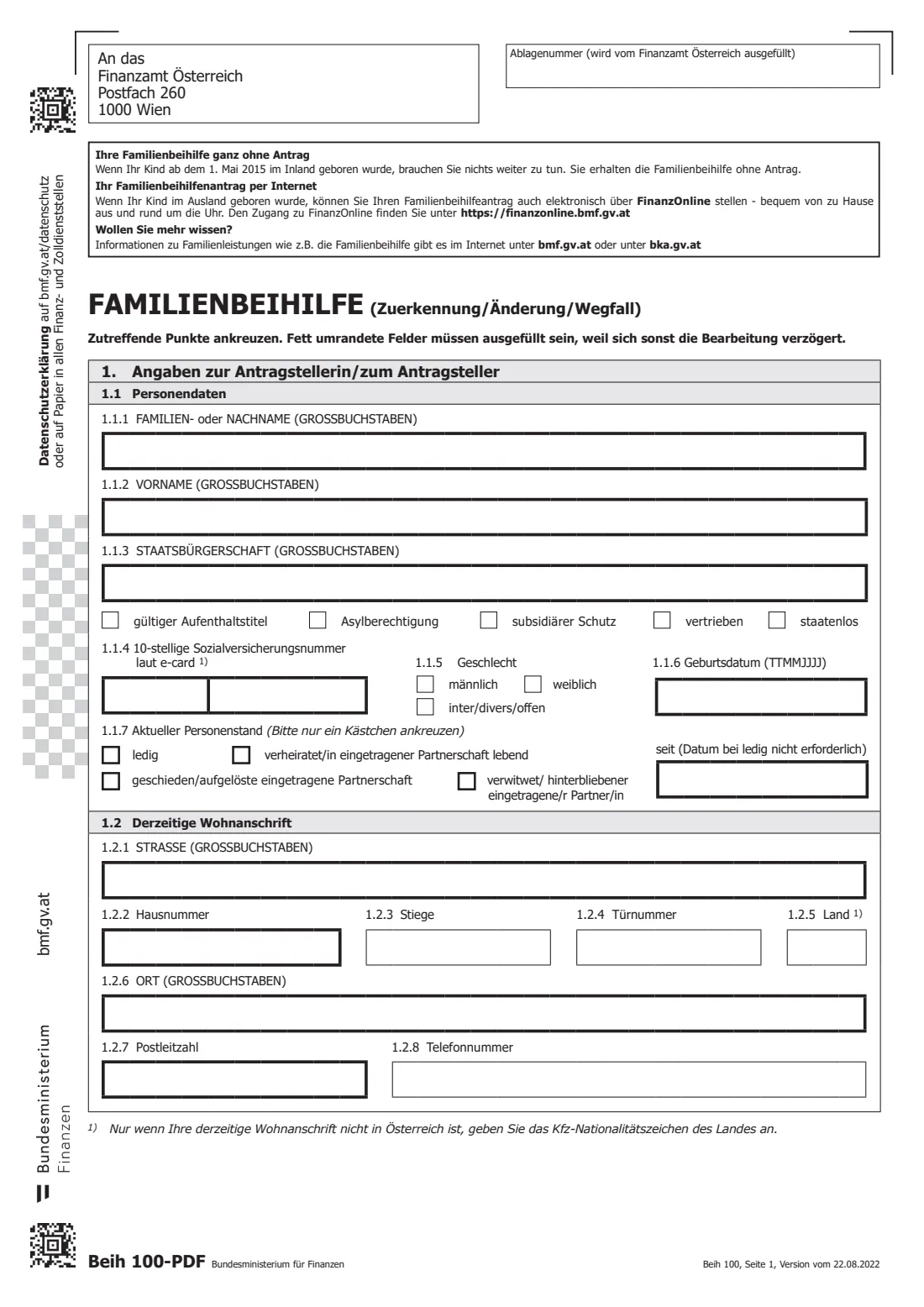
Beih 100 is the official form of the Austrian Federal Ministry of Finance (BMF) for family allowance (Familienbeihilfe). Its title, "Familienbeihilfe (Zuerkennung/Änderung/Wegfall)", shows what it does: apply for the allowance to be granted, report a change, or report that it should stop — each time for one named child. It goes to the Finanzamt Österreich, the national tax office that handles family allowance. The current edition is dated 22.08.2022.
Many families never need it. As the form itself explains, a child born in Austria on or after 1 May 2015 normally receives family allowance without any application. For a child born abroad, the application can also be made electronically through FinanzOnline. The paper Beih 100 remains the route for everyone else — for example families moving to Austria, parents whose situation has changed, or people who prefer paper.
FileIt takes you through the four pages of Beih 100 in English, with the German term for each box, and prints your answers onto the official PDF in the capital letters the form asks for — one character per box. Names and dates of birth can be pre-filled from the People records in your FileIt vault, the child's address can be copied from yours, and insurance numbers and IBANs are checked before you print. The finished PDF is stored in your vault. FileIt does not submit anything: you sign the form by hand and post it yourself.
- Who fills it
- The parent or other person claiming family allowance for the child
- Given to
- Finanzamt Österreich, Postfach 260, 1000 Wien (as printed on the form)
- When
- To start, change or stop family allowance for a child — one form per child
- Signatures
- The applicant or legal representative by hand; the partner signs point 2.2 if they waive their priority claim
- Edition
- Beih 100, Version vom 22.08.2022
Who needs to fill out Beih 100 — Antrag auf Familienbeihilfe (family allowance)?
- Families who have moved to Austria with children and want to claim family allowance.
- Parents of a child born abroad who prefer a paper application to FinanzOnline.
- Parents reporting a change for a child already receiving family allowance, for example the start of an apprenticeship or university.
- Parents reporting that family allowance for a child should stop.
- A father applying where the mother waives her priority entitlement, or other carers such as grandparents, step-parents, adoptive or foster parents.
- Young people who are full orphans (or treated as such) claiming family allowance for themselves.
When to use Beih 100 — Antrag auf Familienbeihilfe (family allowance)
- When a child's family allowance needs to be granted and it is not paid automatically — the form notes that children born in Austria since 1 May 2015 normally get it without an application.
- When something changes that affects the allowance, such as a new education or training, or a change of address or household.
- When family allowance for a child should end.
- Whenever details change: the declaration says every change to the information on the form must be reported to the Finanzamt Österreich within one month.
What you need before you start
- Your, your partner's and the child's 10-digit social insurance numbers from the e-cards (for a child without one, the European health insurance card number).
- Dates of birth, citizenships and — for non-EU/EEA citizens — the residence title or protection status of each person.
- Your current address, and your family home address if it is different.
- Your IBAN, if the tax office doesn't have your bank details yet or they have changed (and the child's, for direct payment).
- Details of any employer abroad, for you or your partner.
- The child's education or training and its expected end date; proof if it is "other" training.
- Details of the child's other biological parent if they are not your current partner.
What’s on Beih 100 — Antrag auf Familienbeihilfe (family allowance)
The 2022 edition has 4 pages. FileIt asks for it in 13 parts:
- 1.1 About you, the applicant (Angaben zur Antragstellerin/zum Antragsteller — Personendaten)Applicant (antragsteller/in)
- 1.2 Your current address (Derzeitige Wohnanschrift)Applicant (antragsteller/in)
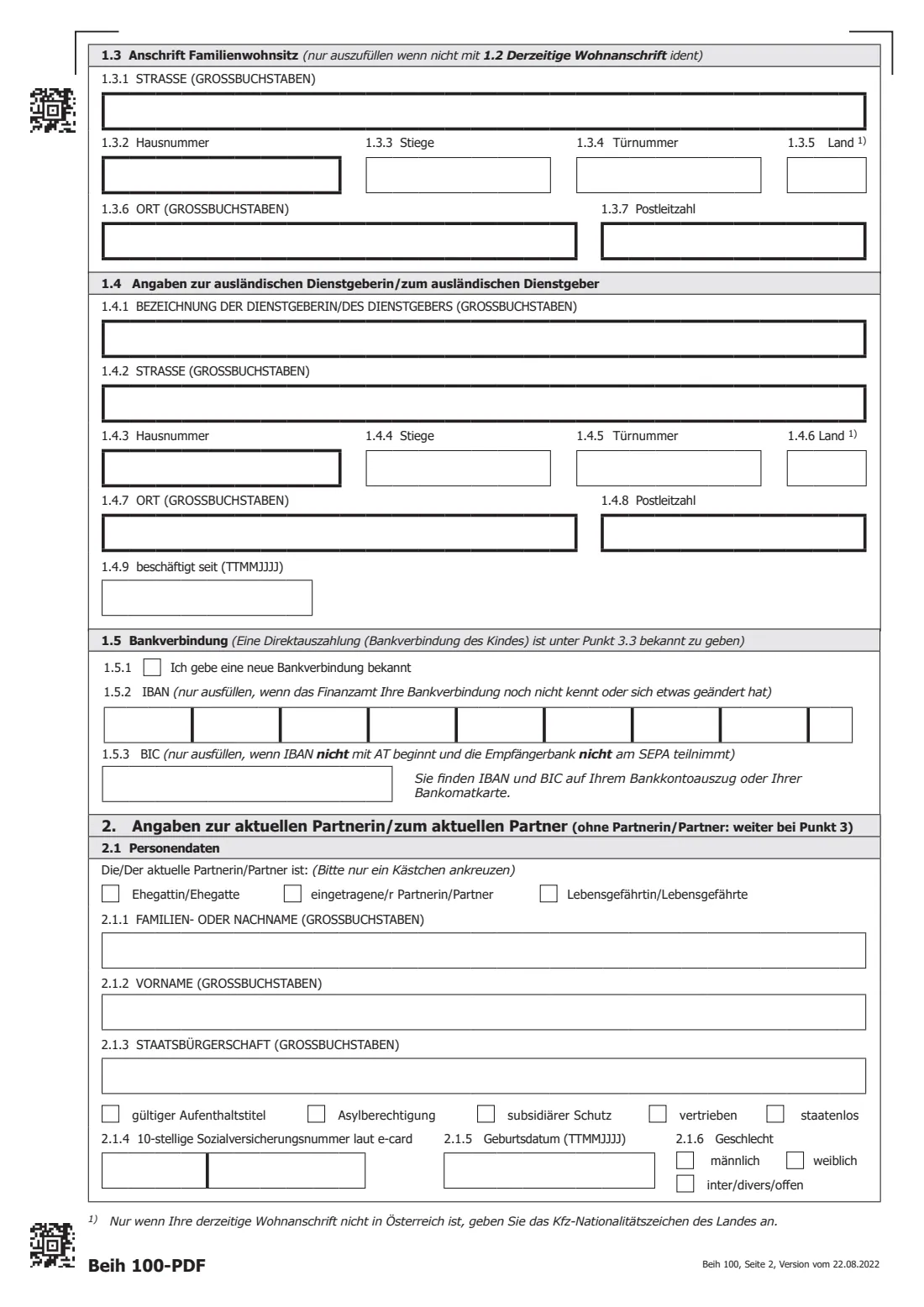
- 1.3 Family home address, if different (Anschrift Familienwohnsitz)Applicant (antragsteller/in)
- 1.4 Your employer abroad (Angaben zur ausländischen Dienstgeberin/zum ausländischen Dienstgeber)Applicant (antragsteller/in)
- 1.5 Bank account (Bankverbindung)Applicant (antragsteller/in)
- 2.1 Your current partner (Angaben zur aktuellen Partnerin/zum aktuellen Partner)Applicant (antragsteller/in)
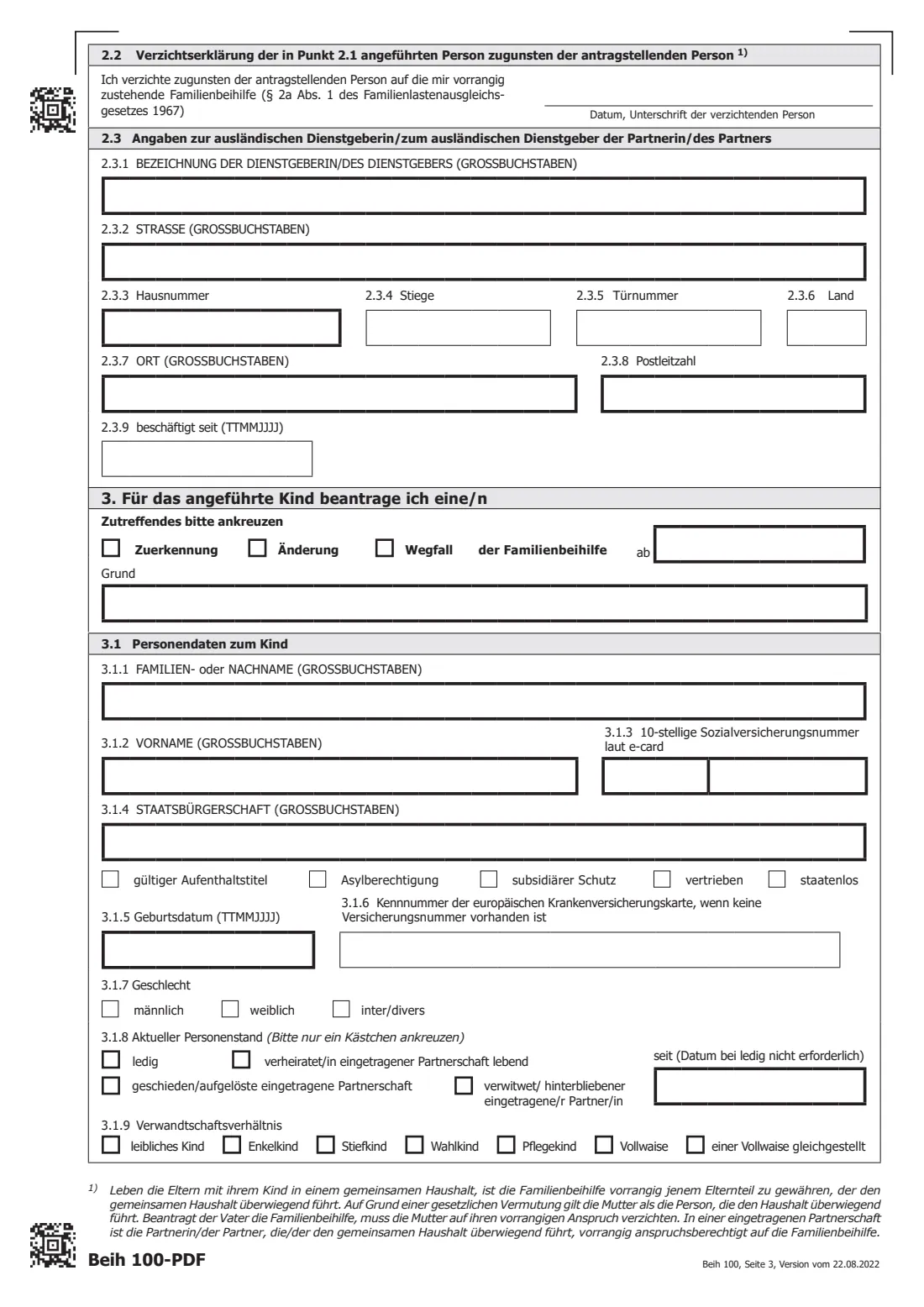
- 2.3 Your partner's employer abroad (ausländische Dienstgeberin/ausländischer Dienstgeber der Partnerin/des Partners)Applicant (antragsteller/in)
- 3 / 3.1 The child and what you apply for (Für das angeführte Kind beantrage ich … / Personendaten zum Kind)Applicant (antragsteller/in)
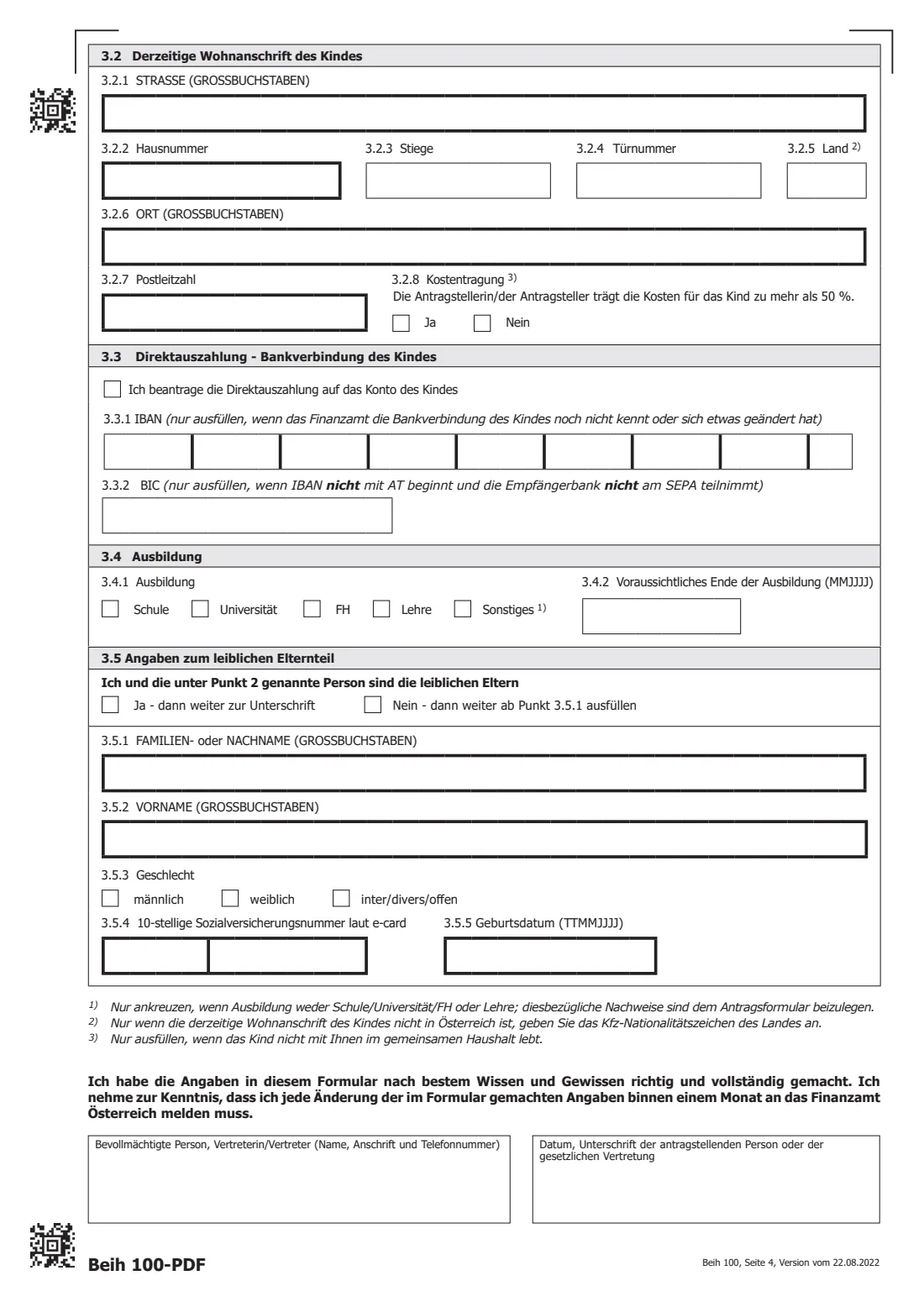
- 3.2 The child's current address (Derzeitige Wohnanschrift des Kindes)Applicant (antragsteller/in)
- 3.3 Payment straight to the child's account (Direktauszahlung — Bankverbindung des Kindes)Applicant (antragsteller/in)
- 3.4 Education or training (Ausbildung)Applicant (antragsteller/in)
- 3.5 The child's biological parents (Angaben zum leiblichen Elternteil)Applicant (antragsteller/in)
- Declaration and signature (Datum, Unterschrift)Applicant (antragsteller/in)
How to fill out Beih 100 — Antrag auf Familienbeihilfe (family allowance), step by step
1 1.1 Personendaten — about you
Enter your surname, first name and citizenship in capital letters, and — only if you are not an Austrian or EU/EEA citizen — tick your residence status: valid residence title, asylum status, subsidiary protection, displaced person or stateless. Then your 10-digit insurance number, sex, date of birth and current marital status with the date since when (not needed if single).
The form says that boxes with a bold border must be filled, otherwise processing is delayed.
2 1.2 and 1.3 — current address and family home
Give your current address with street, house number, staircase, door number, town and postcode, plus a phone number if you like. The small "Land" box is only for an address outside Austria: enter the international vehicle registration code of the country (for example D or HR). Part 1.3 is only for a family home that is different from your current address.
3 1.4 and 1.5 — employer abroad and bank account
If you work for an employer outside Austria, give its name, address and the date you started. Under 1.5, tick that you are giving new bank details and enter your IBAN — but only if the tax office doesn't know your account yet or it has changed. The BIC is needed only if the IBAN doesn't start with AT and the bank isn't part of SEPA.
4 2.1 — your current partner
If you have a spouse, registered partner or partner you live with, tick which, and give their name, citizenship, residence status (if relevant), insurance number, date of birth and sex. Without a partner, skip to point 3.
5 2.2 Verzichtserklärung — the partner's waiver
When the parents live with the child in one household, family allowance goes first to the parent who mainly runs the household — by legal presumption the mother, the form's footnote explains. If the father applies, the mother must waive her priority claim by signing and dating point 2.2. In a registered partnership, the partner who mainly runs the household has priority. This part is signed by hand; there is nothing to type.
6 2.3 — partner's employer abroad
If your partner works for an employer outside Austria, give its name, address and your partner's start date.
7 3 and 3.1 — what you apply for and the child's details
Tick whether you apply for the grant (Zuerkennung), a change (Änderung) or the end (Wegfall) of family allowance, the date from when, and the reason. Then the child: surname and first name in capitals, insurance number (or European health insurance card number if there is none), citizenship and residence status, date of birth, sex and marital status.
Under 3.1.9 tick the relationship: own child, grandchild, stepchild, adopted child, foster child, full orphan, or treated as a full orphan.
8 3.2 — the child's address and share of costs
Give the child's current address. If the child does not live in your household, also say whether you bear more than 50 % of the child's costs (Kostentragung).
9 3.3 and 3.4 — direct payment and education
Under 3.3 you can ask for the allowance to be paid directly into the child's own account, giving the child's IBAN if the tax office doesn't have it. Under 3.4 tick the child's education — school, university, university of applied sciences (FH), apprenticeship or other — and the expected end as month and year. For "other" training, the form asks you to attach proof.
10 3.5 — the biological parents, and signature
Say whether you and the person in point 2 are the child's biological parents. If not, give the biological parent's name, sex, insurance number and date of birth. Finally, an authorised person or representative can be named with address and phone number, and you date and sign the declaration — confirming the details are correct and complete, and that you will report any change within a month.
Common mistakes to avoid
- Applying unnecessarily: for a child born in Austria since 1 May 2015, the form says family allowance is normally granted without an application.
- Putting two children on one form. Beih 100 covers one child — use a separate form for each.
- Leaving bold-bordered boxes empty, which the form warns delays processing.
- Forgetting the mother's waiver in 2.2 when the father applies while both live with the child.
- Entering bank details that haven't changed. The IBAN is only needed if the tax office doesn't know the account or it has changed.
- Writing the country name instead of the vehicle registration code in the small "Land" boxes.
- Not attaching proof for "other" education, or not reporting later changes within one month.
After you fill it out
Print the completed PDF and sign it by hand in the box at the bottom of page 4 (or have your legal representative sign). If your partner waives their priority claim, they sign and date point 2.2 on page 3. FileIt keeps a copy in your vault.
Post the form, with any proof it asks for, to the address printed on page 1: Finanzamt Österreich, Postfach 260, 1000 Wien. Alternatively, as the form notes, an application for a child born abroad can be made electronically through FinanzOnline.
Keep the decision you receive with the child's documents in your vault. If anything on the form changes later — address, education, household — report it to the Finanzamt Österreich within one month, as the declaration requires.
Fill out Beih 100 — Antrag auf Familienbeihilfe (family allowance) online with FileIt
- Pick the person. Choose someone from People and FileIt fills in their name, date of birth, address and other details it already knows.
- Answer plain-language questions. One part of the form at a time, with the official help text beside each question — 91 fields in all. Your answers save as you go.
- Check the live preview. Watch your answers land on the real Bundesministerium für Finanzen (BMF) — Finanzamt Österreich form, and let FileIt do any worksheet arithmetic.
- Generate the official PDF. FileIt prints your answers into the agency’s own PDF and files it in that person’s folder in your vault.
FileIt fills the form — it never files or submits anything for you. Deliver the finished form to whoever asked for it, the way the form’s instructions say.
Start Beih 100 — Antrag auf Familienbeihilfe (family allowance) now — it’s freeBeih 100 — Antrag auf Familienbeihilfe (family allowance): frequently asked questions
What is the Beih 100 form?
Beih 100 is the Austrian BMF application for family allowance (Familienbeihilfe). It is used to apply for the allowance for a child, report a change or report that it should end, and it goes to the Finanzamt Österreich.
Do I need to apply for family allowance for a newborn?
According to the form, if your child was born in Austria on or after 1 May 2015 you normally don't need to do anything — family allowance is granted without an application.
Where do I send Beih 100?
By post to the address printed on the form: Finanzamt Österreich, Postfach 260, 1000 Wien. For a child born abroad you can also apply through FinanzOnline instead.
Can I fill out Beih 100 online?
Yes — FileIt guides you through the form in English and prints your answers onto the official BMF PDF, one character per box, and saves it in your vault. You then sign it by hand and post it yourself; FileIt doesn't send it.
Can the father apply for family allowance?
Yes, but where both parents live with the child, the mother has priority by legal presumption. If the father applies, the mother must waive her priority claim by signing point 2.2 on the form.
Do I need one form per child?
Yes. Beih 100 is for the one child named in point 3, so fill in a separate form for each child.
What if my child has no Austrian insurance number?
The form asks for the identification number of the European health insurance card instead, in box 3.1.6.
Is family allowance the same as the Familienbonus Plus?
No. Family allowance is a payment from the Finanzamt Österreich; the Familienbonus Plus is a tax credit. Receiving family allowance is a condition for the Familienbonus Plus, which employees can have applied through payroll with form E 30.
Is there a German equivalent?
Germany's counterpart is Kindergeld, claimed from the Familienkasse with form KG 1. The Austrian and German systems are separate.
Official sources
- Blank form (PDF), published by Bundesministerium für Finanzen (BMF) — Finanzamt Österreich: https://formulare.bmf.gv.at/service/formulare/inter-Steuern/pdfs/9999/Beih100.pdf?open=download
- Official instructions and guidance: https://formulare.bmf.gv.at/service/formulare/inter-Steuern/
- Edition shown on this page: Beih 100, Version vom 22.08.2022 (checked 2026-09-26).
FileIt is not affiliated with or endorsed by Bundesministerium für Finanzen (BMF) — Finanzamt Österreich or any government. This page explains the form in general terms and is not legal, tax or immigration advice. Always read the official instructions, and check that you are using the edition the recipient accepts. Page last reviewed 2026-09-26.