What is E 30 — Familienbonus Plus declaration to the employer?
Form E 30 is published by the Austrian Federal Ministry of Finance (Bundesministerium für Finanzen, BMF). Its full German title is "Erklärung zur Berücksichtigung beim Arbeitgeber" — a declaration asking your employer, or the body that pays your pension, to take certain tax reliefs into account every month instead of waiting for your annual tax assessment. It covers five things: the sole earner's tax credit (Alleinverdienerabsetzbetrag), the single parent's tax credit (Alleinerzieherabsetzbetrag), the Familienbonus Plus for children, disability-related allowances for a partner, and the increased pensioner's tax credit. The current edition is dated 12.11.2025.
Unlike most tax forms, E 30 does not go to the tax office. You give it to your employer's payroll department, and the form states that the employer must apply the details, if correct, in the next month's payroll at the latest. That means more net pay during the year rather than a refund later — but it also means a compulsory tax assessment (Pflichtveranlagung) if something was applied that you were not entitled to.
FileIt walks you through every part of E 30 in English, with the German term alongside, and prints your answers onto the official BMF PDF. Names and dates can be pre-filled from the People records in your FileIt vault, insurance numbers are split into the form's two boxes automatically, and the check digit of each Austrian social insurance number is verified before you print. The finished PDF is saved in your vault, and you can send it for e-signature if your employer accepts that. FileIt does not send anything to your employer or the tax office: you hand the signed form over yourself.
- Who fills it
- An employee or pensioner living (or usually staying) in Austria
- Given to
- Your employer or pension payer (payroll) — not the tax office
- When
- When you become entitled, e.g. after a birth, on starting a new job or when your family situation changes
- Signatures
- Your own signature and date on page 4
- Edition
- E 30, Version vom 12.11.2025
Who needs to fill out E 30 — Familienbonus Plus declaration to the employer?
- Parents who receive Austrian family allowance (Familienbeihilfe) and want the Familienbonus Plus applied through their monthly pay.
- The spouse or partner of the person who receives family allowance, when they want to take all or half of the Familienbonus Plus through their own employer.
- Parents who pay maintenance (Alimente) for a child who does not live with them and want their share of the Familienbonus Plus through payroll.
- Employees who live in a partnership with a low-earning partner and claim the sole earner's tax credit.
- Single parents who receive family allowance and claim the single parent's tax credit.
- Pensioners claiming the increased pensioner's tax credit or disability-related allowances for their spouse or registered partner.
When to use E 30 — Familienbonus Plus declaration to the employer
- After a child is born or joins your family and family allowance has been granted, so the Familienbonus Plus starts in your pay.
- When you start a new job — your new employer does not know about your children or credits until you give them an E 30.
- When you and your partner decide to split the Familienbonus Plus differently, for example half each instead of the whole amount for one of you.
- When you start or stop living in a partnership, which decides between the sole earner's and single parent's credit.
- If the conditions stop applying or change, the form says you must tell your employer or pension payer within one month using form E 31 — not a new E 30.
What you need before you start
- Your employer's or pension payer's name.
- Your 10-digit social insurance number from your e-card (Versicherungsnummer), and those of your partner and children.
- Your postcode and home address.
- Your children's names and insurance numbers (or dates of birth if they have none).
- Proof of your family allowance entitlement for the Familienbonus Plus in 3.1 — the form notes you can get the confirmation through FinanzOnline or from your tax office.
- For 3.2, proof that you pay maintenance, such as records of payments made so far.
- Your partner's approximate annual income, to check it against the limits printed on the form.
- For point 4, the certificate of your partner's disability for the pension payer.
What’s on E 30 — Familienbonus Plus declaration to the employer
The 2025 edition has 4 pages. FileIt asks for it in 7 parts, and it is signed by Employee:
- Employer and your details (An … / Angaben zur Antragstellerin/zum Antragsteller)Employee
- 1. Sole earner's tax credit (Alleinverdienerabsetzbetrag) or 2. single parent's tax credit (Alleinerzieherabsetzbetrag)Employee
- 3.1 Familienbonus Plus — you or your partner receive the family allowance (beim Familienbeihilfenbezieher oder (Ehe)Partner)Employee
- 3.2 Familienbonus Plus — you pay maintenance for the child (beim Unterhaltszahler)Employee
- 4. Disability-related allowances for your partner (Behinderungsbedingte Freibeträge für außergewöhnliche Belastungen)Employee
- 5. Increased pensioner's tax credit (Erhöhter Pensionistenabsetzbetrag)Employee
- Declaration and signature (Datum, Unterschrift)Employee
How to fill out E 30 — Familienbonus Plus declaration to the employer, step by step
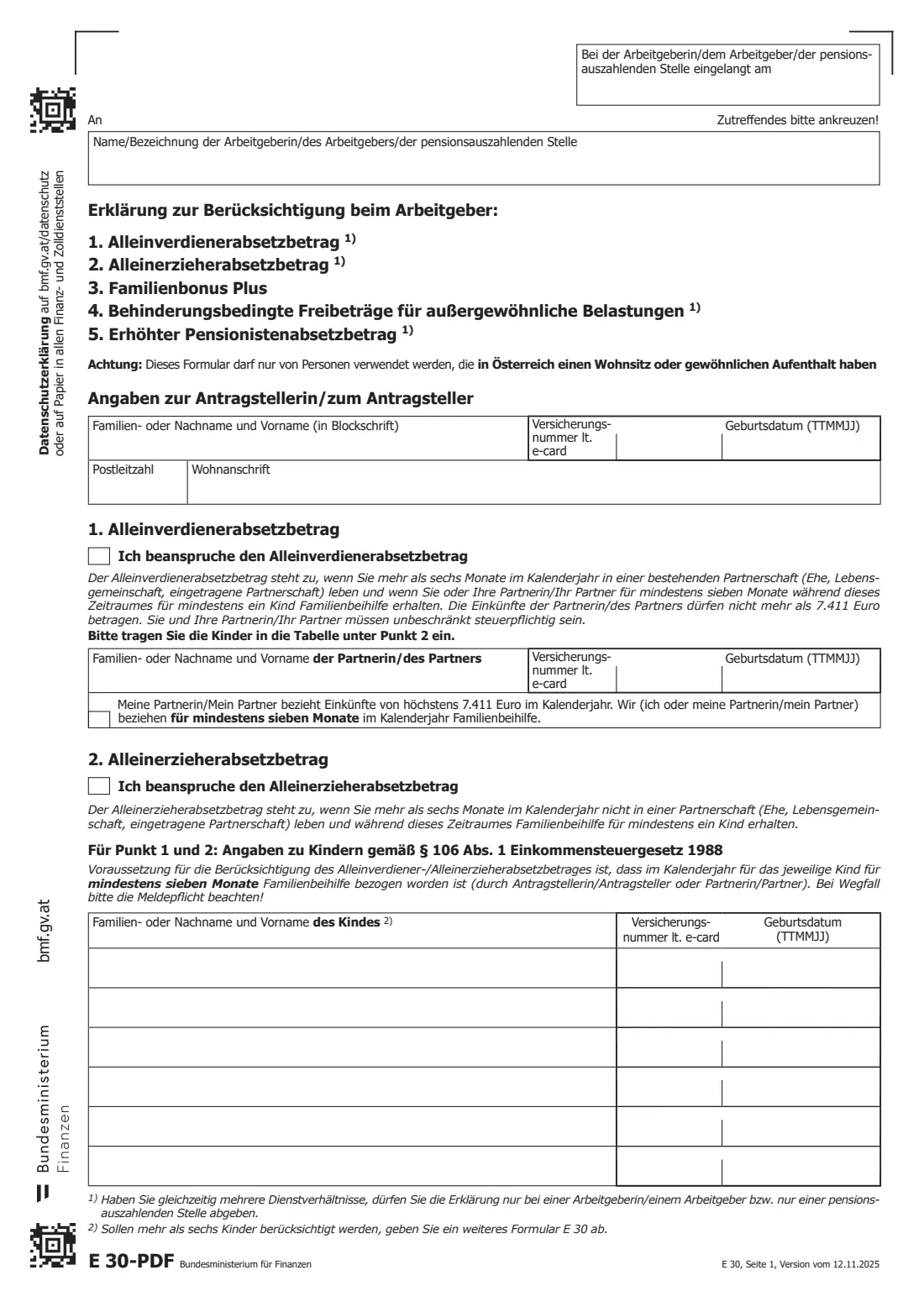
1 An … — employer or pension payer (Name/Bezeichnung der Arbeitgeberin/des Arbeitgebers)
Start with the name of the employer or pension-paying body you are handing the form to. The small box beside it, "eingelangt am", is for the employer to note the date they received it — leave that empty.
If you have more than one job at the same time, the form's first footnote matters: the sole earner's and single parent's credits, the disability allowances and the increased pensioner's credit may be claimed with only one employer or pension payer.
2 Angaben zur Antragstellerin/zum Antragsteller — your details
Give your surname and first name in block capitals, your social insurance number and your postcode and home address. The insurance number is printed in two boxes: the four-digit number and the birth-date part (TTMMJJ). FileIt splits it for you.
The form carries a warning at the top: only people who have their residence or usual abode in Austria may use it.
3 1. Alleinverdienerabsetzbetrag — sole earner's tax credit
Tick this if, for more than six months of the calendar year, you live in a marriage, registered partnership or cohabitation and you or your partner receive family allowance for at least one child for at least seven months in that period. Both of you must be fully liable to tax in Austria, and your partner's income must not exceed the limit printed on the form — 7,411 euros a year on the 12.11.2025 edition.
Enter your partner's name and insurance number, and tick the confirmation box about their income and the seven months of family allowance. Then list the children in the table under point 2.
4 2. Alleinerzieherabsetzbetrag — single parent's tax credit
Tick this instead if you do not live in a partnership for more than six months of the year and receive family allowance for at least one child during that time. You can claim either point 1 or point 2, never both.
For either credit, the table "Für Punkt 1 und 2" lists each child for whom family allowance is received for at least seven months of the year: name, insurance number and birth-date part. There is room for six children; for more, the form says to hand in a further E 30.
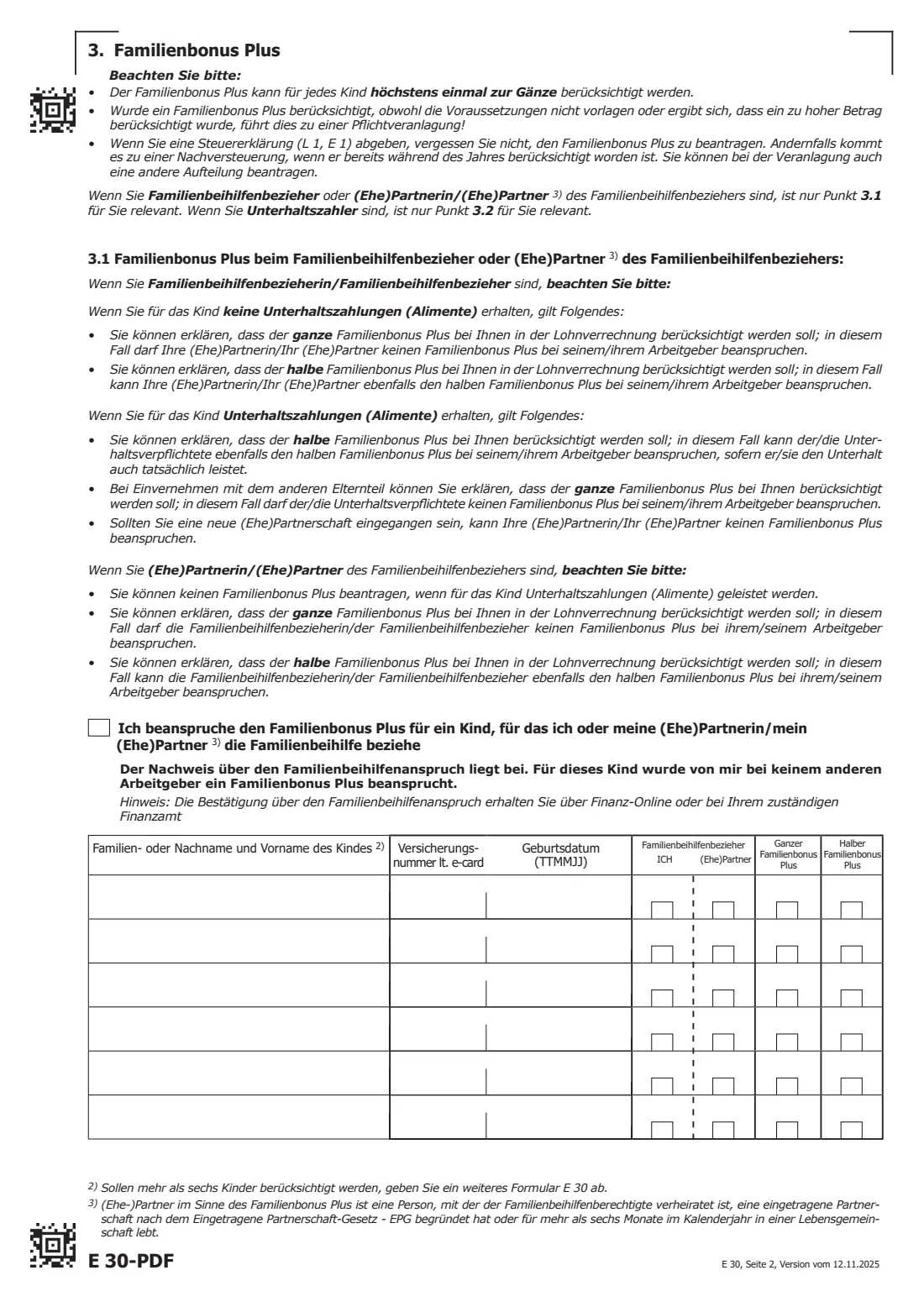
5 3.1 Familienbonus Plus — family allowance recipient or their partner
This part is for the parent who receives family allowance for the child, or that person's spouse or partner. Tick the claim box — by doing so you confirm that proof of the family allowance entitlement is attached and that you have not claimed the bonus for this child with any other employer.
For each child, give the name and insurance number, tick who receives the family allowance (ICH for you, or your partner) and whether you want the whole or half Familienbonus Plus. The rules printed above the table explain the split: without maintenance payments, you can take the whole bonus (your partner then takes none) or half each; with maintenance payments, half, or the whole bonus if the other parent agrees. A partner of the recipient cannot claim it at all if maintenance is paid for the child.
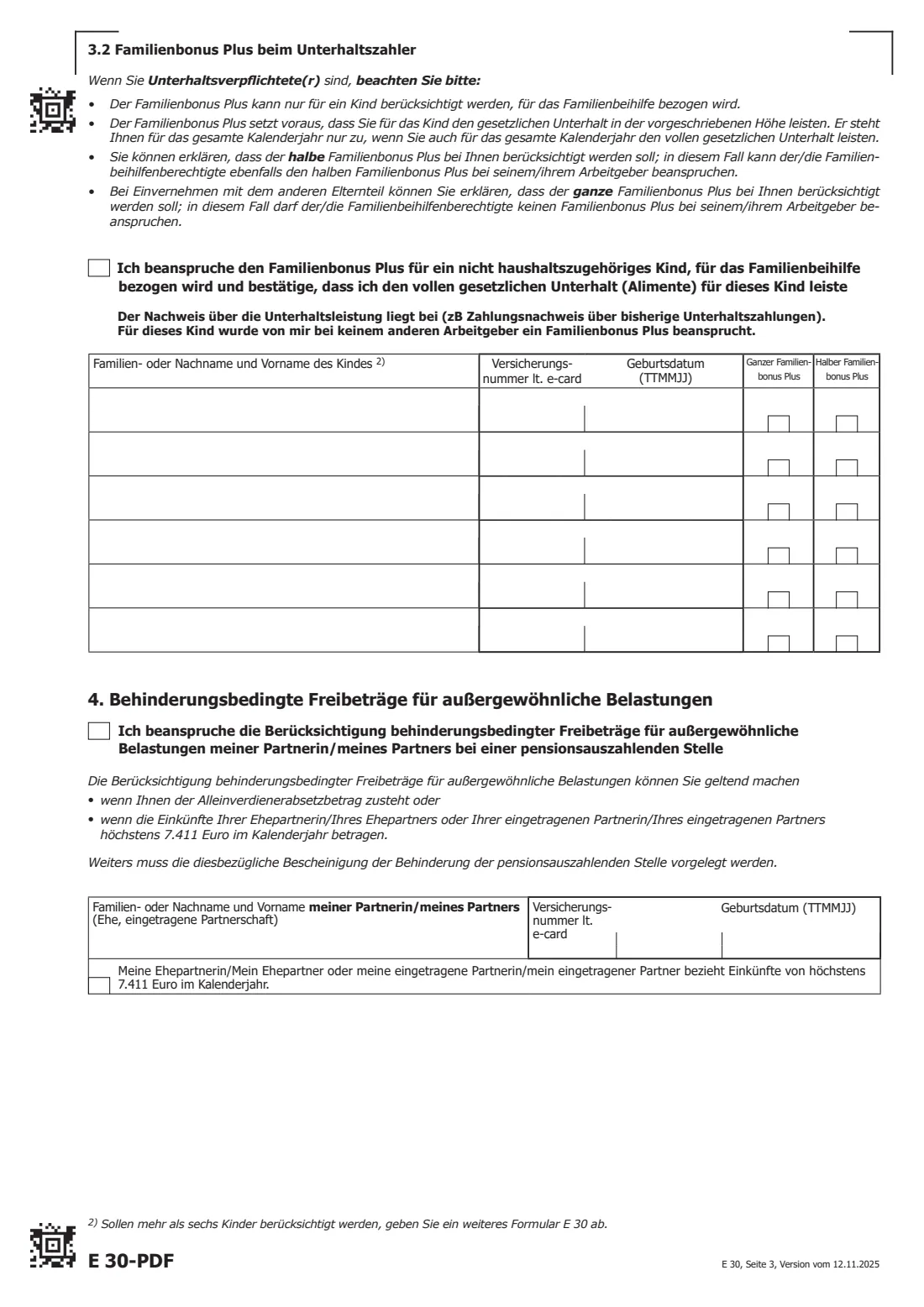
6 3.2 Familienbonus Plus — maintenance payer (Unterhaltszahler)
Parents paying maintenance for a child who does not live with them use this part instead of 3.1. You confirm that family allowance is paid for the child, that you pay the full legal maintenance, and that proof of the payments is attached.
For each child choose the whole or half bonus. Half leaves the other half to the parent entitled to family allowance; the whole bonus is only possible by agreement with the other parent. The bonus for the whole year depends on paying full maintenance for the whole year.
7 4. Behinderungsbedingte Freibeträge — disability-related allowances
This point applies only with a pension payer (pensionsauszahlende Stelle). You can claim the disability-related allowances for extraordinary burdens of your spouse or registered partner if you are entitled to the sole earner's credit, or if your partner's income is no more than 7,411 euros a year (as printed on this edition). Give your partner's details, tick the income box if it applies, and show the pension payer the certificate of the disability.
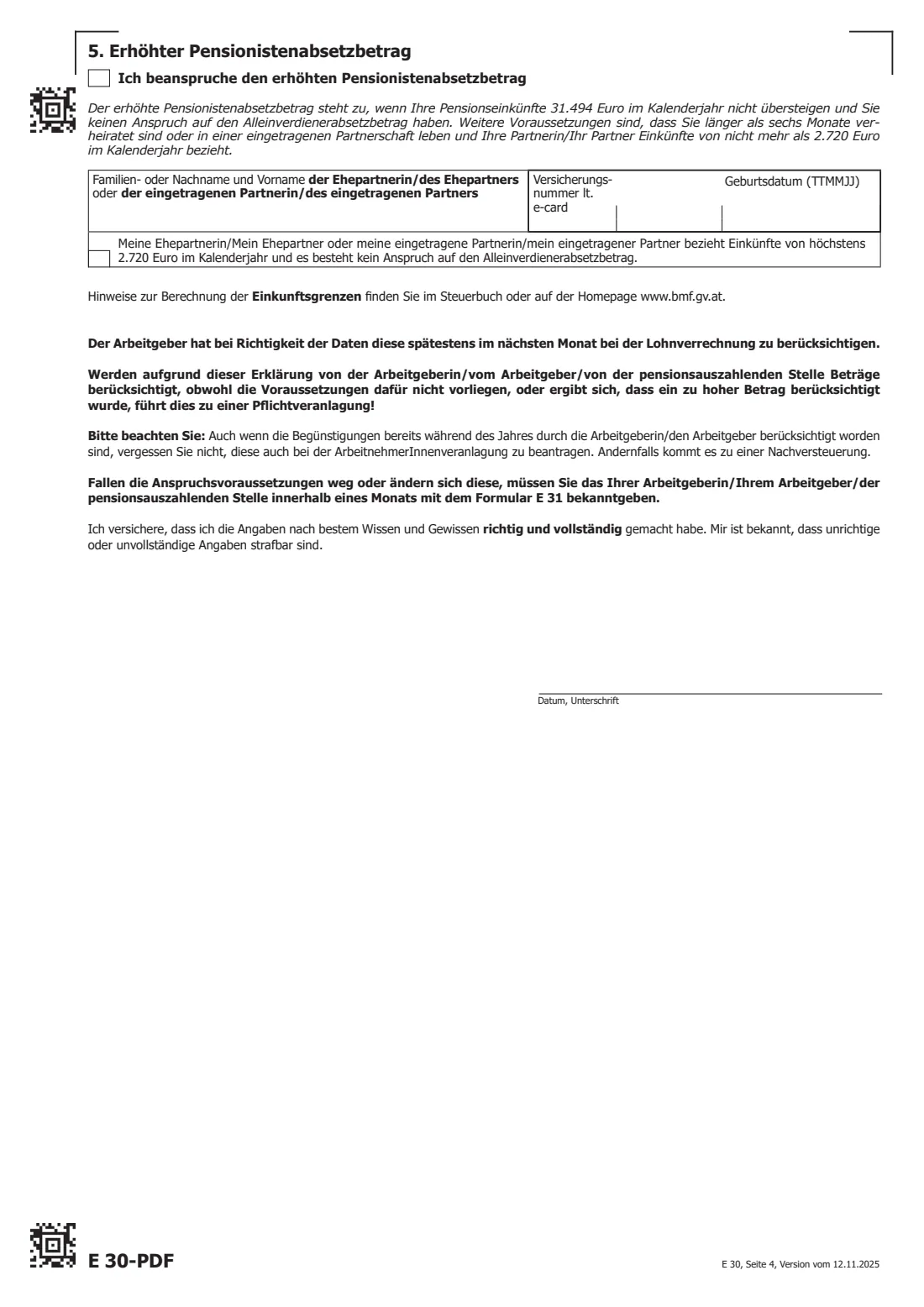
8 5. Erhöhter Pensionistenabsetzbetrag — increased pensioner's credit
For pensioners whose pension income does not exceed 31,494 euros a year and who are not entitled to the sole earner's credit, who have been married or in a registered partnership for more than six months, and whose partner earns no more than 2,720 euros a year — the figures printed on the 12.11.2025 edition. Enter your spouse's or partner's name and insurance number and tick the income confirmation.
9 Datum, Unterschrift — date and signature
Page 4 repeats the key warnings: the employer applies correct details by the next month's payroll; amounts applied without the conditions, or too high, lead to a compulsory assessment; and you must still claim the reliefs in your annual employee tax assessment (ArbeitnehmerInnenveranlagung), or they are taxed back. You then confirm that your details are correct and complete, and date and sign.
Common mistakes to avoid
- Handing E 30 to the tax office. It belongs with your employer or pension payer; the tax office never sees it unless there is an assessment.
- Claiming the sole earner's or single parent's credit with two employers at once. With several jobs, only one employer or pension payer may apply it.
- Both parents claiming the whole Familienbonus Plus for the same child. The bonus can be applied in full only once per child — agree on whole or half first.
- Forgetting the proof. Point 3.1 needs proof of the family allowance entitlement and point 3.2 proof of maintenance payments.
- Mistyping an insurance number. FileIt checks the check digit, but compare the numbers with the e-cards anyway.
- Not claiming the reliefs again in the annual tax assessment (L 1 or E 1), which the form warns leads to the amounts being taxed back.
- Using E 30 to report a change. When the conditions stop or change, the form says to tell your employer within a month on form E 31.
After you fill it out
Print the completed PDF, check it, and sign and date page 4 — or use FileIt's optional e-signature if your employer accepts electronically signed forms. Attach the proof the form asks for (family allowance confirmation or maintenance records) and hand everything to your payroll department or pension payer. FileIt keeps a copy of the PDF in your vault.
According to the form, the employer must take the correct details into account in the next month's payroll at the latest. Check your payslips to make sure the credits appear.
Keep the form in mind for your annual tax assessment: the reliefs applied through payroll must be claimed again there. And if your situation changes — a separation, a child's family allowance ending, a new partner — tell your employer within one month on form E 31.
Fill out E 30 — Familienbonus Plus declaration to the employer online with FileIt
- Pick the person. Choose someone from People and FileIt fills in their name, date of birth, address and other details it already knows.
- Answer plain-language questions. One part of the form at a time, with the official help text beside each question — 78 fields in all. Your answers save as you go.
- Check the live preview. Watch your answers land on the real Bundesministerium für Finanzen (BMF) form, and let FileIt do any worksheet arithmetic.
- Generate the official PDF. FileIt prints your answers into the agency’s own PDF and files it in that person’s folder in your vault. Sign it, or send it for e-signature.
FileIt fills the form — it never files or submits anything for you. Deliver the finished form to whoever asked for it, the way the form’s instructions say.
Start E 30 — Familienbonus Plus declaration to the employer now — it’s freeE 30 — Familienbonus Plus declaration to the employer: frequently asked questions
What is form E 30 in Austria?
E 30 is the BMF declaration you give your employer or pension payer so that the Familienbonus Plus, the sole earner's or single parent's tax credit, disability-related allowances for a partner or the increased pensioner's credit are applied in your monthly payroll.
Where do I send the E 30?
To your employer or the body that pays your pension — not to the tax office. The form is addressed "An" your employer at the top of page 1.
Can I fill out E 30 online?
Yes. FileIt lets you fill in E 30 in a guided form with English explanations and prints your answers onto the official BMF PDF, which is saved in your vault. You then sign it and give it to your employer yourself; FileIt doesn't send it anywhere.
Should I take the whole or half Familienbonus Plus?
The form explains the options: without maintenance payments, one parent can take the whole bonus or both can take half; with maintenance payments, half each, or the whole bonus for one parent by agreement. What suits you depends on your incomes, so this is a decision for you and your partner.
What is the income limit for the sole earner's tax credit?
On the 12.11.2025 edition of E 30, your partner's income may be at most 7,411 euros in the calendar year. Limits can change from year to year, so always check the edition you are using.
I have two jobs — can I give E 30 to both employers?
Not for everything. The form says the sole earner's and single parent's credits, the disability allowances and the increased pensioner's credit may be claimed with only one employer or pension payer. For the Familienbonus Plus you confirm that you haven't claimed it for the same child with another employer.
What happens if my circumstances change?
You must tell your employer or pension payer within one month, using form E 31. If reliefs were applied although the conditions were not met, a compulsory tax assessment follows.
Do I still need to claim the Familienbonus Plus in my tax return?
Yes. The form reminds you to claim it in your employee tax assessment (L 1, or E 1 for a full return) even when payroll has already applied it; otherwise it is taxed back. The children's details for the L 1 go on the L 1k supplement.
Can I e-sign the E 30?
FileIt offers an optional e-signature on the PDF. Whether an electronically signed E 30 is enough is up to your employer, so ask payroll first; otherwise print it and sign by hand.
Official sources
- Blank form (PDF), published by Bundesministerium für Finanzen (BMF): https://formulare.bmf.gv.at/service/formulare/inter-Steuern/pdfs/9999/E30.pdf?open=download
- Official instructions and guidance: https://formulare.bmf.gv.at/service/formulare/inter-Steuern/
- Edition shown on this page: E 30, Version vom 12.11.2025 (checked 2026-09-26).
FileIt is not affiliated with or endorsed by Bundesministerium für Finanzen (BMF) or any government. This page explains the form in general terms and is not legal, tax or immigration advice. Always read the official instructions, and check that you are using the edition the recipient accepts. Page last reviewed 2026-09-26.