
What is the startup cost worksheet form template?
Most new business owners know roughly what they want to start. Far fewer have written down what it will cost before the first sale, what it costs to stay open each month, and how many months their money will cover. Business advisers, small business centres and accountants spend a lot of first meetings drawing that out on a notepad.
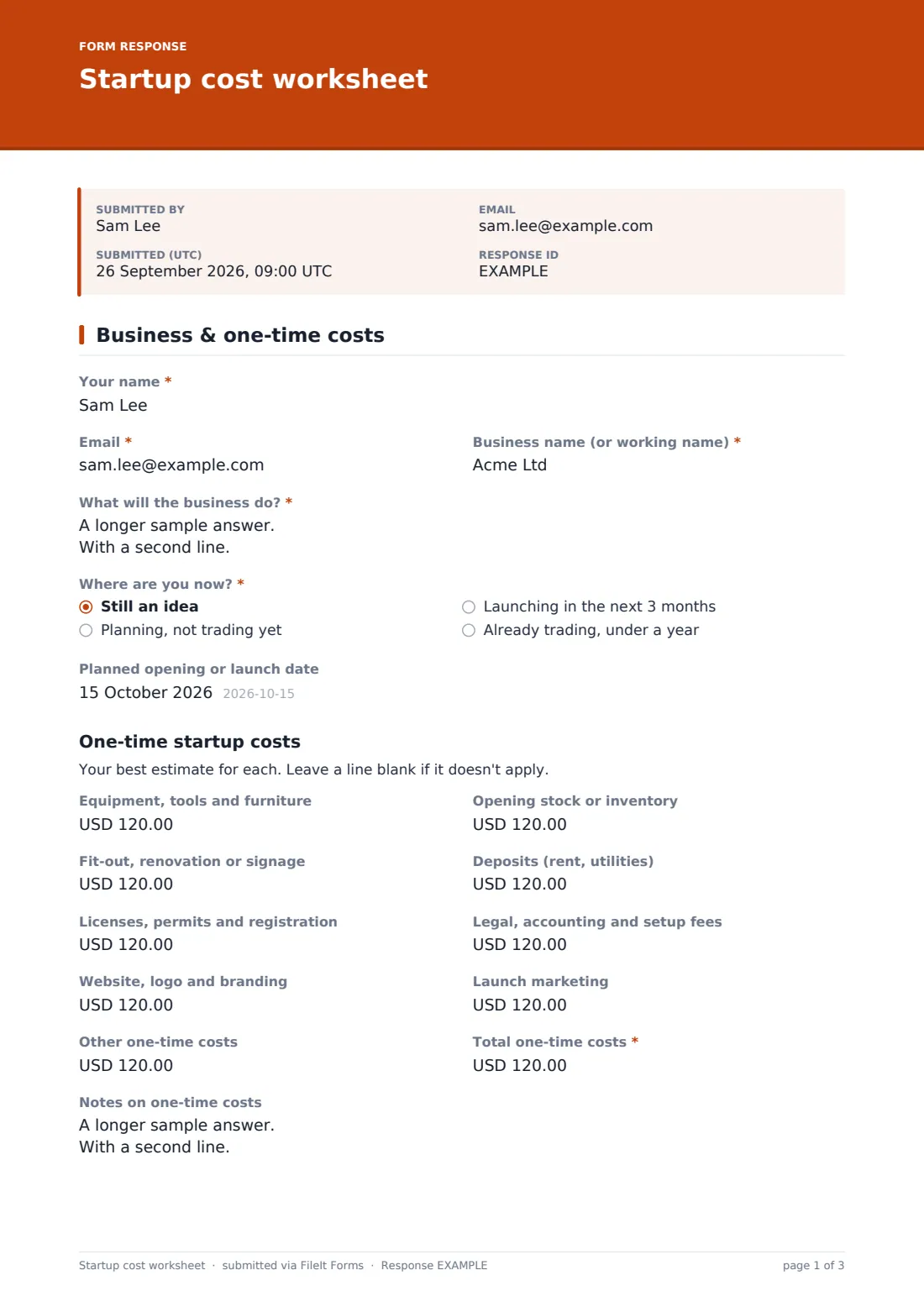
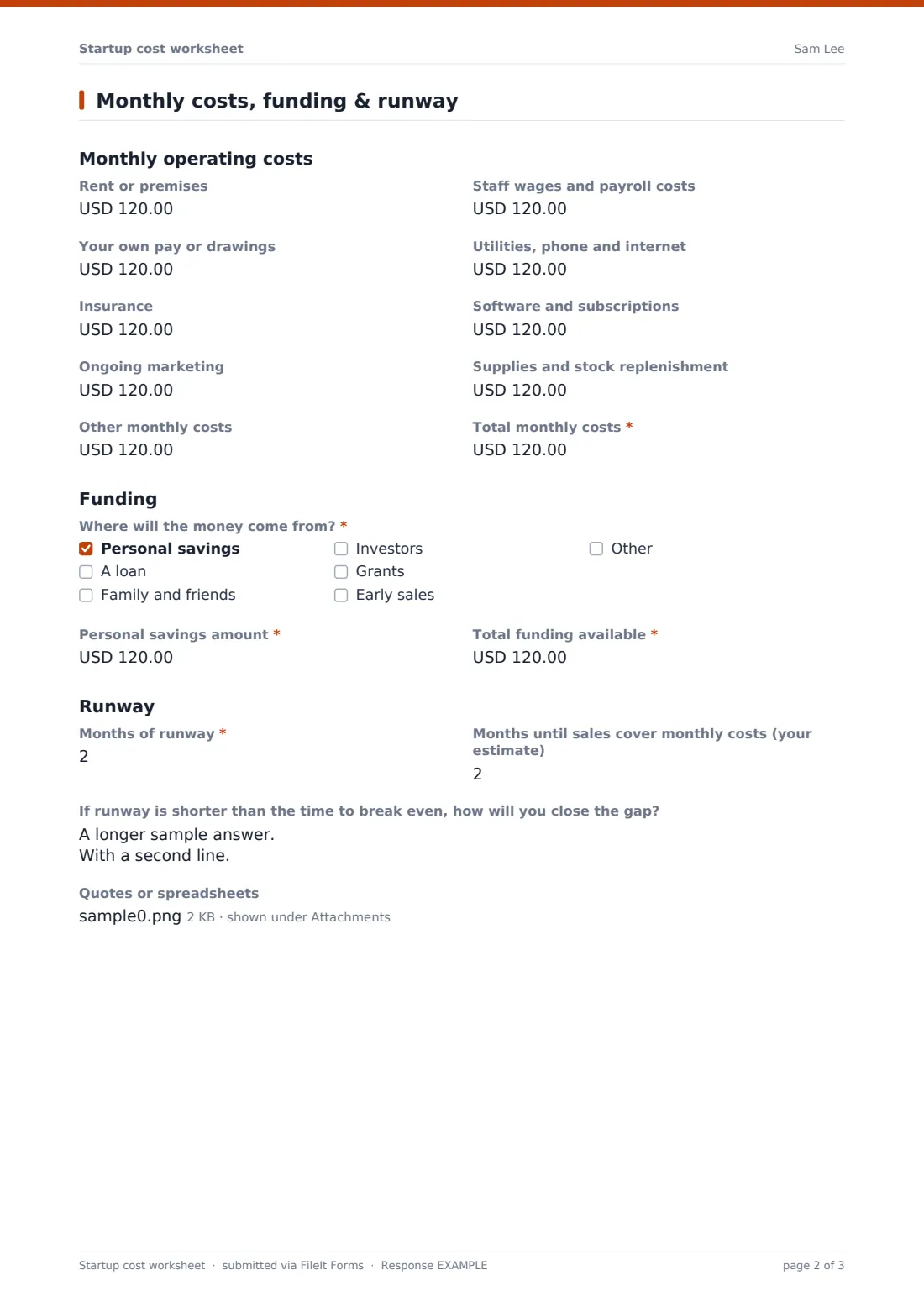
This two-page worksheet gets it done before the meeting. The first page covers the business and its one-time costs: equipment, opening stock, fit-out, deposits, licenses, professional fees, branding and launch marketing, each a separate line, with a total. The second page lists monthly operating costs, from rent and wages to software and insurance, and asks where the money will come from. Every funding source ticked asks for its amount. Choosing A loan also asks for the interest rate, the term in months and the lender.
The worksheet closes with Months of runway, an estimate of how long until sales cover costs, and space to explain how any gap will be bridged. Each completed worksheet is filed as a PDF in your FileIt vault, so adviser and founder are looking at the same numbers.
- Best for
- Small business advisers, accelerators, accountants and first-time founders
- Filled in by
- The founder or owner planning the business
- Time to complete
- About 10-15 minutes with rough figures to hand
- Pages
- 2: one-time costs, then monthly costs, funding and runway
Who uses a startup cost worksheet form?
- A small business centre sending clients the worksheet before a first advice session
- A founder preparing figures before approaching a bank for a startup loan
- An accelerator comparing the cash needs of each new cohort
- An accountant onboarding a client who is about to open a shop or café
- A side business owner deciding whether they can afford to go full time
- A family member being asked to invest who wants to see the numbers first
Questions on this startup cost worksheet form
41 questions over 2 pages · includes file upload, conditional questions, multiple pages.
1 Business & one-time costs
- Your name*
- Email*
- Business name (or working name)*
- What will the business do?*
- Where are you now?* Still an idea · Planning, not trading yet · Launching in the next 3 months · Already trading, under a year
- Planned opening or launch date
- Equipment, tools and furniture
- Opening stock or inventory
- Fit-out, renovation or signage
- Deposits (rent, utilities)
- Licenses, permits and registration
- Legal, accounting and setup fees
- Website, logo and branding
- Launch marketing
- Other one-time costs
- Total one-time costs*
- Notes on one-time costs
2 Monthly costs, funding & runway
- Rent or premises
- Staff wages and payroll costs
- Your own pay or drawings
- Utilities, phone and internet
- Insurance
- Software and subscriptions
- Ongoing marketing
- Supplies and stock replenishment
- Other monthly costs
- Total monthly costs*
- Where will the money come from?* Personal savings · A loan · Family and friends · Investors · Grants · Early sales
- Personal savings amount* asked only when it applies
- Family and friends amount* asked only when it applies
- Loan amount* asked only when it applies
- Interest rate (% per year)* asked only when it applies
- Loan term (months)* asked only when it applies
- Lender asked only when it applies
- Investor amount* asked only when it applies
- Grant amount* asked only when it applies
- Total funding available*
- Months of runway*
- Months until sales cover monthly costs (your estimate)
- If runway is shorter than the time to break even, how will you close the gap?
- Quotes or spreadsheets
The startup cost worksheet form, page by page
1 Business & one-time costs
The founder gives their name, email, Business name (or working name) and What will the business do? Where are you now? runs from still an idea to already trading for under a year, with an optional launch date.
One-time startup costs has nine lines: Equipment, tools and furniture; Opening stock or inventory; Fit-out, renovation or signage; Deposits (rent, utilities); Licenses, permits and registration; Legal, accounting and setup fees; Website, logo and branding; Launch marketing; and Other one-time costs. Total one-time costs is required, and a notes box takes quotes and assumptions.
2 Monthly costs, funding & runway
Monthly operating costs lists rent, staff wages, Your own pay or drawings, utilities, insurance, software, marketing, supplies and other costs, with a required total.
Where will the money come from? offers personal savings, a loan, family and friends, investors, grants and early sales, plus Other. Each ticked source asks for its amount, and A loan adds Interest rate (% per year), Loan term (months) and the lender. Total funding available follows.
Under Runway, Months of runway comes with a reminder of how to work it out, then Months until sales cover monthly costs and a question about closing any gap between the two. Quotes or spreadsheets can be uploaded.
Make the template yours
- Rename cost lines to suit the trades you work with, such as kitchen equipment for food businesses
- Change the currency on every amount for your country
- Add a third page for a simple sales forecast
- Remove the investor option if you only advise sole traders
- Add your advice centre's booking link to the confirmation message
- Send it as a personal request before each first appointment
Tips for a better startup cost worksheet form
- Get real quotes for the biggest one-time costs rather than guessing
- Include your own pay; a business that only works if you earn nothing isn't really working
- Add a contingency line of 10-20% to one-time costs if you're unsure
- Expect sales to take longer to build than you hope, and plan runway accordingly
- Revisit the worksheet after three months of trading and compare it with what actually happened
Every response becomes a PDF in your vault
Each worksheet is filed as a PDF in the vault folder you choose, titled with the founder's name and the date, with any quotes attached. You're notified by email, and the founder gets a copy to keep working from.
Advisers can open the PDF ahead of the meeting, and the CSV export from the Responses table lets you compare costs and runway across a cohort or client list.
- Start from this template. It opens in the FileIt Forms designer — change any question, add pages, set the rules for when questions appear.
- Share it. Turn on a public link, or send it to people by email, each with their own link. They don’t need a FileIt account.
- Get the answers as PDFs. Each response is saved as a PDF in the vault folder you choose, with uploaded files attached — and listed in a Responses table you can export to CSV.
Startup cost worksheet form: frequently asked questions
Is this startup cost worksheet free?
Yes. It's a starter template in FileIt's Forms app on every account, and you can change any line.
Does the form add up the totals?
No. Each total is entered by the founder, with a reminder to add up the lines above. That keeps the form simple and lets the founder check their own sums.
How is months of runway worked out?
The help text suggests taking the funding left after one-time costs and dividing it by monthly costs, rounding down.
Is this a business plan or financial advice?
No. It's a structured estimate the founder fills in. It's a good starting point for a conversation with an adviser or lender.
What does choosing a loan ask for?
The loan amount, the interest rate per year, the term in months and, optionally, the lender.
Do founders need a FileIt account?
No. Send them the link and they can complete it without signing up.