What is the pricing survey form template?
Setting a price is guesswork for many new products. The Van Westendorp price sensitivity method is a popular way to take some of the guessing out: instead of asking people what they'd pay, it asks four questions about where price starts to feel wrong in each direction, then plots the answers to show an acceptable range.
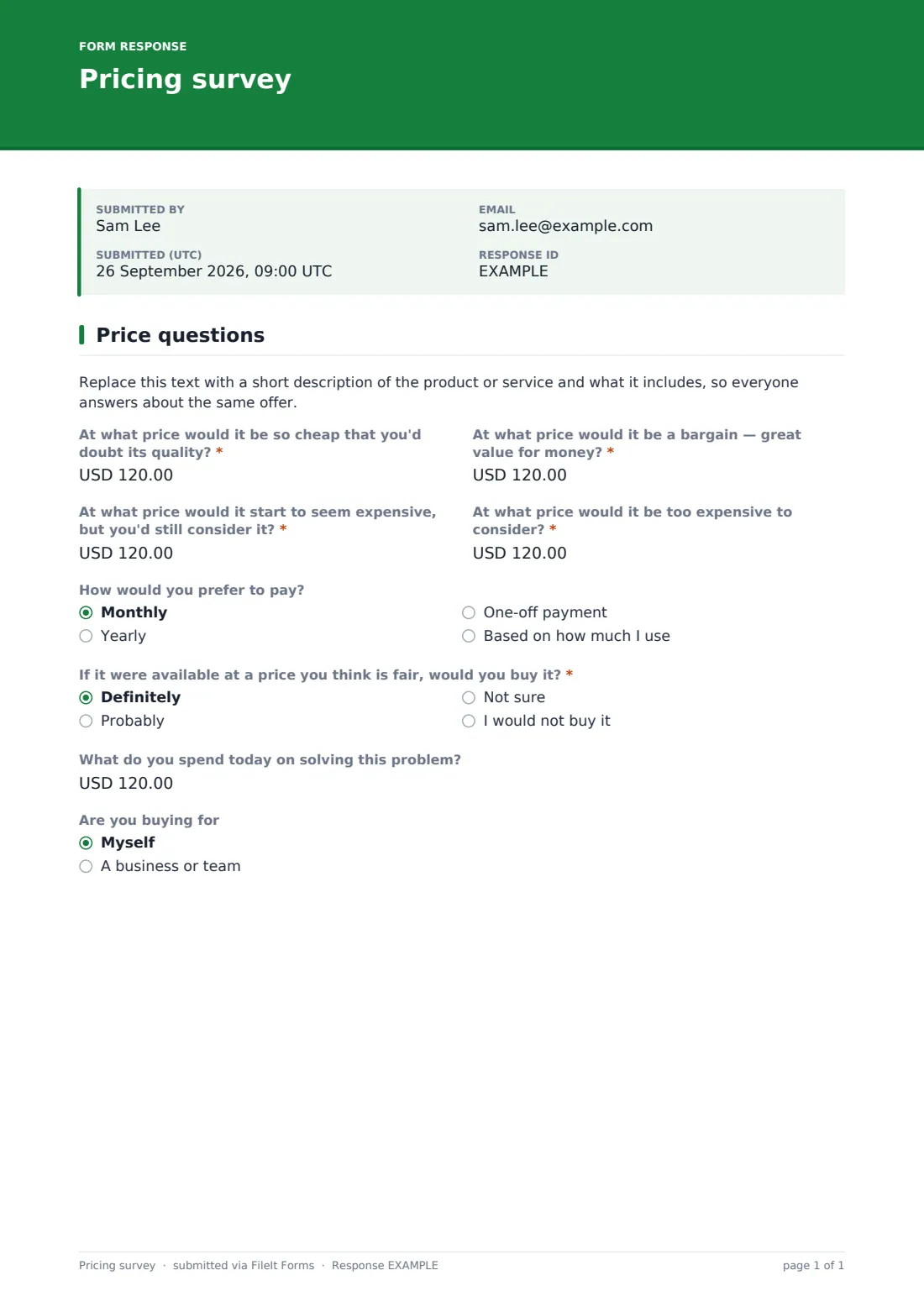
This template puts those four questions on one page as currency answers. Respondents read a short description of the offer, then say at what price it would be so cheap they'd doubt its quality, a bargain, starting to seem expensive but still worth considering, and too expensive to consider. They also choose how they'd prefer to pay.
A purchase intent question follows: if it were available at a price you think is fair, would you buy it? Anyone who picks I would not buy it is asked why, with options such as I don't need it, I already use something similar or it isn't my decision, plus room to explain. The survey ends with current spending on the problem and whether they're buying for themselves or a business. Each response is filed as a PDF in FileIt.
- Best for
- Founders, product marketers, pricing teams and market researchers
- Filled in by
- Prospects, trial users or a research panel
- Time to complete
- About 2 minutes
- Includes
- An offer description, four Van Westendorp price questions, billing preference, purchase intent, reasons for not buying, current spend and buyer type
Who uses a pricing survey form?
- Testing a price range before launching a new product
- Checking whether a planned price rise is still acceptable
- Comparing price expectations of individuals and businesses
- Pricing a new course, membership or subscription tier
- Asking trial users what they'd pay before the trial ends
- Learning why some prospects would not buy at any price
Questions on this pricing survey form
11 questions · includes conditional questions.
1 Price questions
- At what price would it be so cheap that you'd doubt its quality?*
- At what price would it be a bargain — great value for money?*
- At what price would it start to seem expensive, but you'd still consider it?*
- At what price would it be too expensive to consider?*
- How would you prefer to pay? Monthly · Yearly · One-off payment · Based on how much I use
- If it were available at a price you think is fair, would you buy it?* Definitely · Probably · Not sure · I would not buy it
- Why not?* asked only when it applies I don't need it · I already use something similar · Too expensive at any price · I'd want to know more first · It isn't my decision
- Tell us more asked only when it applies
- What do you spend today on solving this problem?
- Are you buying for Myself · A business or team
- Team or company size asked only when it applies 1–10 · 11–50 · 51–250 · More than 250
The pricing survey form, page by page
1 Price questions
A paragraph at the top is a placeholder for your product description, so every respondent answers about the same offer. The four price questions sit side by side in pairs and are all required: At what price would it be so cheap that you'd doubt its quality?, At what price would it be a bargain — great value for money?, At what price would it start to seem expensive, but you'd still consider it? and At what price would it be too expensive to consider?
How would you prefer to pay? offers monthly, yearly, a one-off payment or usage-based pricing. The required purchase intent question has four answers from definitely to I would not buy it; the last one reveals Why not? (at least one reason required) and Tell us more. What do you spend today on solving this problem? is optional, and choosing a business or team as the buyer reveals team or company size.
Make the template yours
- Replace the placeholder paragraph with a clear description of what's included
- Change the currency on the four price questions to match your market
- Add 'per month' or 'per user' to the question labels if that's how you'll charge
- Edit the reasons for not buying to reflect objections you hear in sales calls
- Duplicate the form to test two different packages with separate groups
- Add a question on which features matter most at each price
Tips for a better pricing survey form
- Describe the offer precisely; vague descriptions give scattered prices
- Keep the four questions in the standard order so answers are comparable with the method
- Check for answers that contradict each other, such as a bargain price above 'too expensive'
- Look at business and individual buyers separately
- Treat the results as a range to test, not a final price
- Read the 'would not buy' reasons alongside the numbers
Every response becomes a PDF in your vault
Each response is saved as a PDF in the vault folder you choose, and the account owner is notified.
Export the Responses table to CSV and plot the cumulative share of each price answer in a spreadsheet to find where the curves cross, which is the usual Van Westendorp analysis.
- Start from this template. It opens in the FileIt Forms designer — change any question, add pages, set the rules for when questions appear.
- Share it. Turn on a public link, or send it to people by email, each with their own link. They don’t need a FileIt account.
- Get the answers as PDFs. Each response is saved as a PDF in the vault folder you choose, with uploaded files attached — and listed in a Responses table you can export to CSV.
Pricing survey form: frequently asked questions
Is this pricing survey template free?
Yes. It's part of the Forms app, which is included with every FileIt account, including the free plan.
Does FileIt draw the Van Westendorp chart?
No. Export the answers to CSV and build the chart in a spreadsheet. Each price answer is its own column.
Can I change the currency?
Yes. Each price question has a currency setting in the designer; set all four to the same currency.
Why ask four price questions instead of one?
People find it easier to say when a price feels wrong than to name the right price. The four answers together show a range.
Who should answer it?
People who understand what you're offering, such as prospects, trial users or a panel that matches your target market.
Is the survey anonymous?
Yes. It doesn't ask for a name or email unless you add those questions or send personal emailed requests.