
What is the landlord-tenant dispute intake form template?
Housing disputes are often urgent and nearly always paper-heavy. A notice with a short deadline, a deposit that may not have been protected, months of emails about a leak — the adviser needs all of it, in order, to know what options exist.
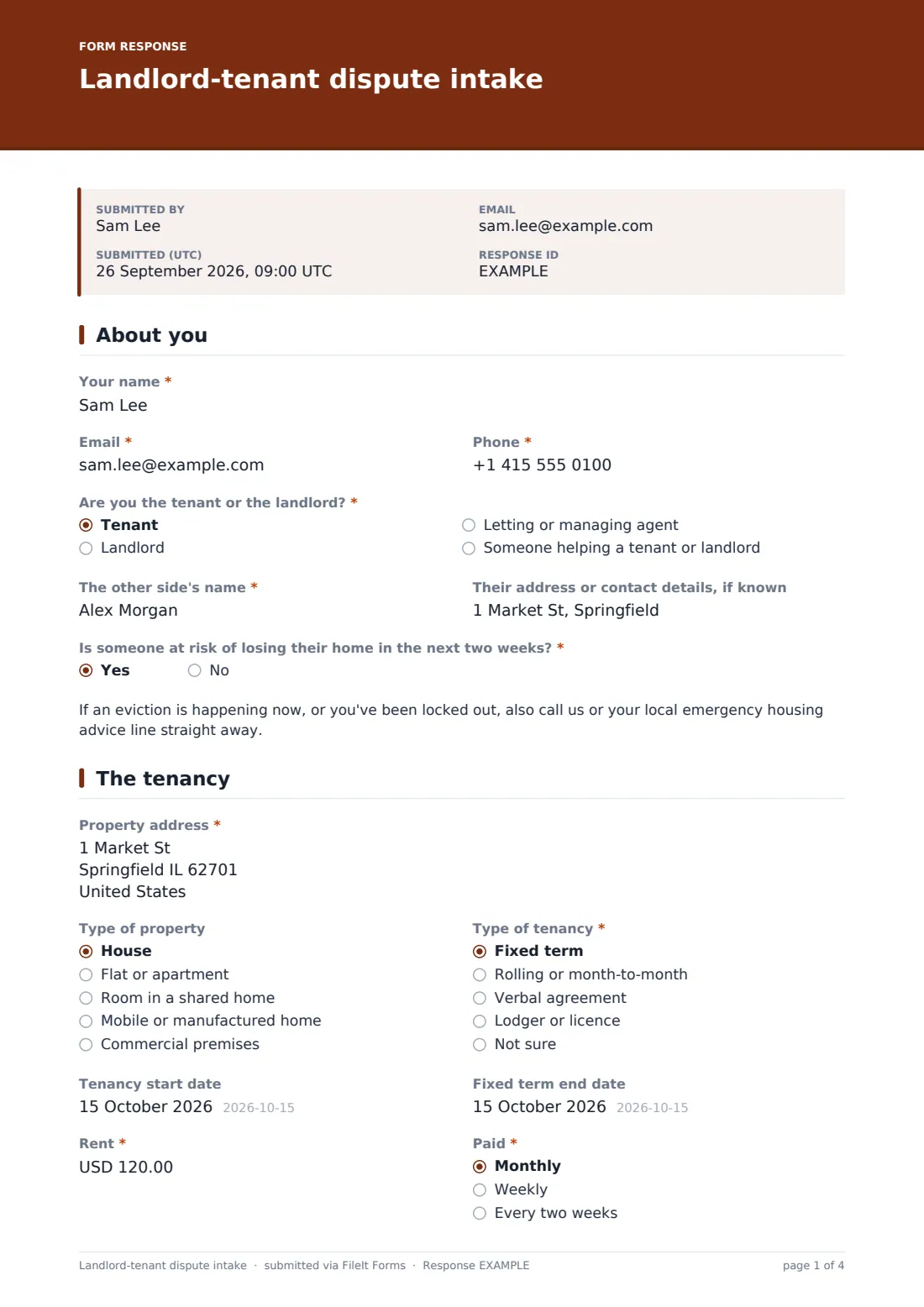
This four-page intake works for tenants and landlords alike. The first page records who the client is, the other side, and whether anyone is at risk of losing their home soon, with an urgent-help note. The tenancy page covers the property, type of tenancy, dates, rent, deposit and whether it was protected.
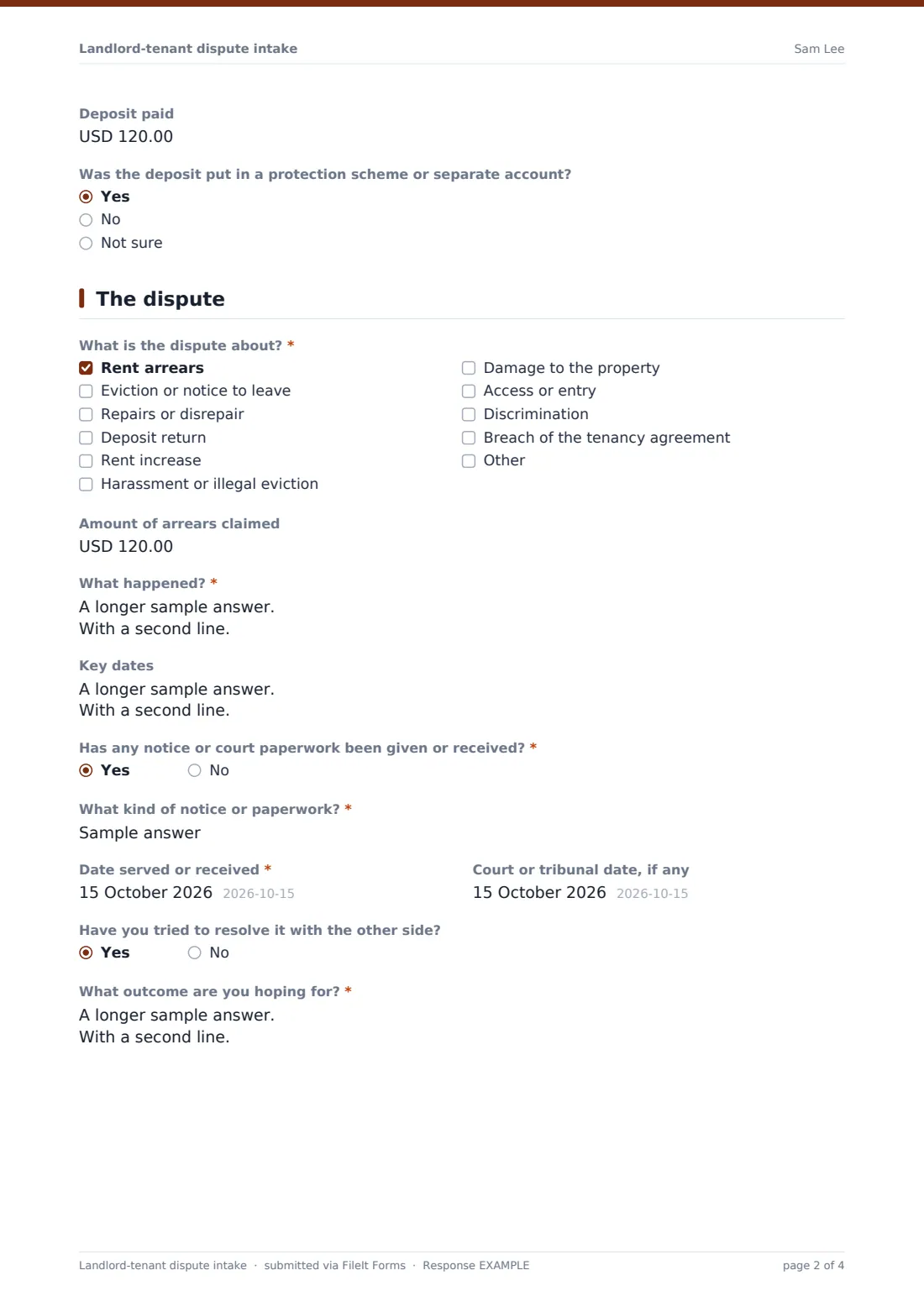
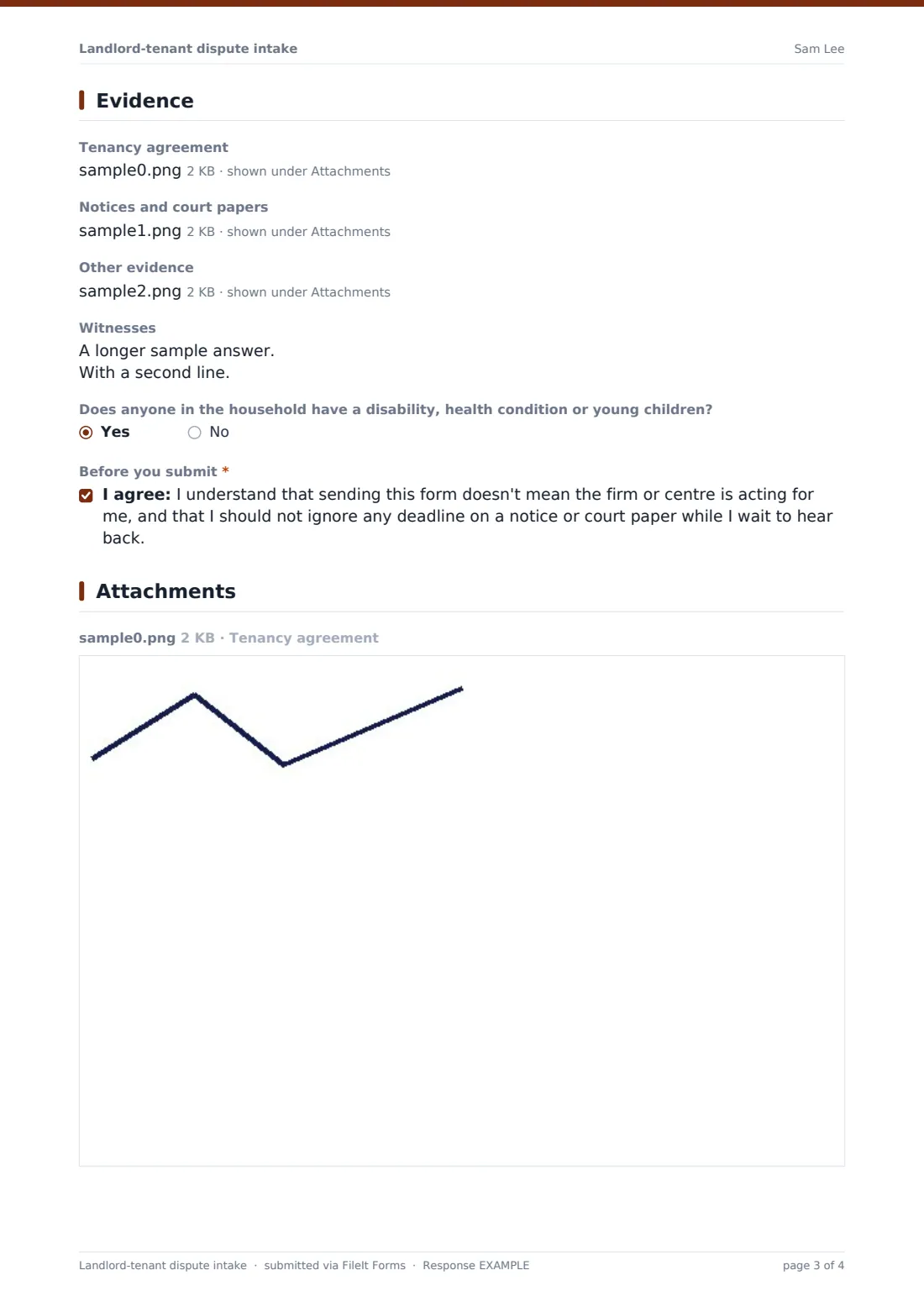
The dispute page lists common issues — arrears, eviction, repairs, deposit, rent increases, harassment, damage, access, discrimination, breach — with follow-ups for arrears and repairs, a summary, key dates, any notice or court paperwork and its dates, and the outcome wanted. The last page takes the tenancy agreement, notices and other evidence. Each intake is saved as a PDF in your FileIt vault.
- Best for
- Housing lawyers, tenant advice centres, legal clinics and landlord associations
- Filled in by
- Tenants, landlords or someone helping them
- Time to complete
- About 10-15 minutes
- Includes
- Urgency check, tenancy terms, ten issue types, notices and dates, evidence uploads
Who uses a landlord-tenant dispute intake form?
- A tenant who has received an eviction notice and needs advice quickly
- A tenant with unresolved disrepair who wants to know their options
- A landlord dealing with rent arrears and considering next steps
- A dispute over how much of a deposit should be returned
- A legal clinic triaging housing enquiries from its website
- An advice worker filling it in with a client during an appointment
Questions on this landlord-tenant dispute intake form
33 questions over 4 pages · includes file upload, conditional questions, multiple pages, consent checkbox.
1 About you
- Your name*
- Email*
- Phone*
- Are you the tenant or the landlord?* Tenant · Landlord · Letting or managing agent · Someone helping a tenant or landlord
- The other side's name*
- Their address or contact details, if known
- Is someone at risk of losing their home in the next two weeks?*
2 The tenancy
- Property address*
- Type of property House · Flat or apartment · Room in a shared home · Mobile or manufactured home · Commercial premises
- Type of tenancy* Fixed term · Rolling or month-to-month · Verbal agreement · Lodger or licence · Not sure
- Tenancy start date
- Fixed term end date asked only when it applies
- Rent*
- Paid* Monthly · Weekly · Every two weeks
- Deposit paid
- Was the deposit put in a protection scheme or separate account? Yes · No · Not sure
3 The dispute
- What is the dispute about?* Rent arrears · Eviction or notice to leave · Repairs or disrepair · Deposit return · Rent increase · Harassment or illegal eviction · Damage to the property · Access or entry · Discrimination · Breach of the tenancy agreement
- Amount of arrears claimed asked only when it applies
- What needs repairing, and when was it reported? asked only when it applies
- What happened?*
- Key dates
- Has any notice or court paperwork been given or received?*
- What kind of notice or paperwork?* asked only when it applies
- Date served or received* asked only when it applies
- Court or tribunal date, if any asked only when it applies
- Have you tried to resolve it with the other side?
- What outcome are you hoping for?*
4 Evidence
- Tenancy agreement
- Notices and court papers asked only when it applies
- Other evidence
- Witnesses
- Does anyone in the household have a disability, health condition or young children?
- Before you submit*
The landlord-tenant dispute intake form, page by page
1 About you
The client gives Your name, Email and Phone and says whether they're the tenant, the landlord, an agent, or helping one of them. They give the other side's name and contact details. Is someone at risk of losing their home in the next two weeks? shows an urgent-help note when the answer is yes.
2 The tenancy
Property address and Type of property come first, then Type of tenancy — fixed term, rolling, verbal, lodger or not sure — with a fixed-term end date when relevant. Tenancy start date, Rent and how often it's paid, Deposit paid and whether the deposit was protected complete the page.
3 The dispute
What is the dispute about? lists ten issues plus Other. Arrears asks the amount claimed; repairs asks what needs fixing and when it was reported. What happened? is required, and Key dates gives space for a timeline. If notice or court paperwork has been given or received, the form asks what kind, when, and any hearing date. The client says whether they've tried to resolve it and what outcome they want.
4 Evidence
Uploads cover the tenancy agreement, notices and court papers, and other evidence such as photos, letters, messages and rent records. Witnesses and a question about disability, health conditions or young children in the household follow, then an acknowledgement that the firm isn't yet acting and deadlines still apply.
Make the template yours
- Rename tenancy types and notices to the terms used in your jurisdiction
- Add a means or eligibility question if you provide free or legal aid advice
- Split it into tenant and landlord versions if you only act for one side
- Add your emergency contact number to the urgent-help note
- Route urgent submissions to a separate inbox with a notification email
- Add a language preference question if you offer interpreters
Tips for a better landlord-tenant dispute intake form
- Check notice dates and deadlines first — they drive what you can do
- Ask for the tenancy agreement and every notice, not a description of them
- Photos with dates are strong evidence in disrepair and deposit disputes
- A clear timeline saves time in the first appointment
- Run a conflict check on the other party before giving advice
Every response becomes a PDF in your vault
Each intake is saved as a PDF in the vault folder you choose, with the tenancy agreement, notices and evidence attached. Your team is emailed straight away, and the client can get a copy.
Use the Responses table to triage by urgency and hearing date. The CSV export helps with case reporting for funders.
- Start from this template. It opens in the FileIt Forms designer — change any question, add pages, set the rules for when questions appear.
- Share it. Turn on a public link, or send it to people by email, each with their own link. They don’t need a FileIt account.
- Get the answers as PDFs. Each response is saved as a PDF in the vault folder you choose, with uploaded files attached — and listed in a Responses table you can export to CSV.
Landlord-tenant dispute intake form: frequently asked questions
Is this landlord-tenant dispute intake free?
Yes. It's a starter template in the FileIt Forms app on every account.
Can landlords use it as well as tenants?
Yes. The first question asks which side the client is on, and the rest of the form works for both.
Does the form give legal advice?
No. It collects facts and documents for an adviser to review. The acknowledgement makes clear the firm isn't acting yet.
Is the information kept private?
Responses are visible only to people with access to the form in your FileIt account, and files go to the vault folder you choose.
Can it be used outside the US or UK?
Yes. The wording is general. Rename tenancy and notice types to match local law.
Do clients need a FileIt account?
No. They use the link from your website or one you send them.