What is the legal aid eligibility screening form template?
Legal aid programs turn away more people than they help, and phone queues are long. A short online screening lets people apply when they can — after a shift, once the children are in bed — and lets intake staff see at a glance who is likely to qualify and whose court date is next week.
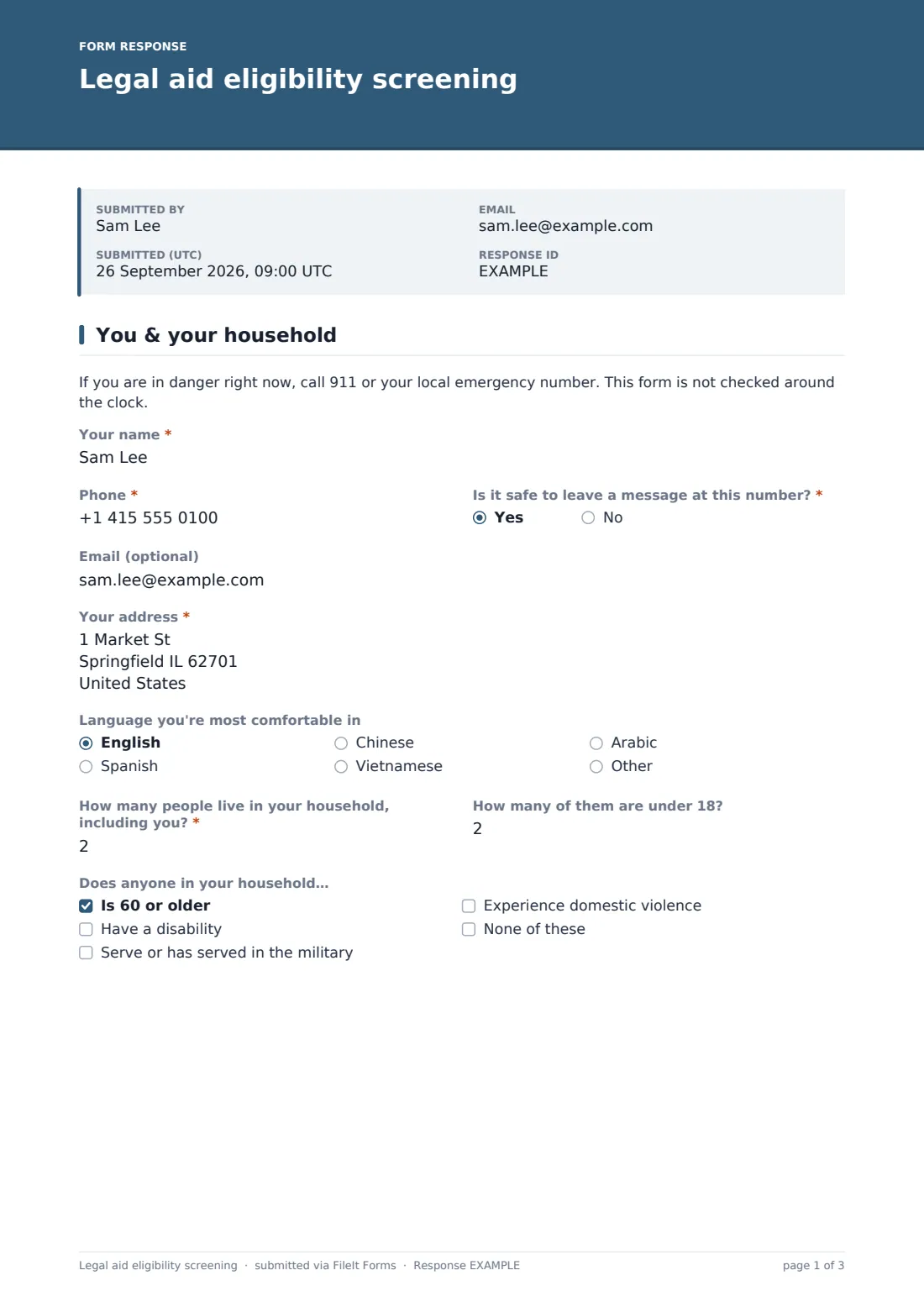
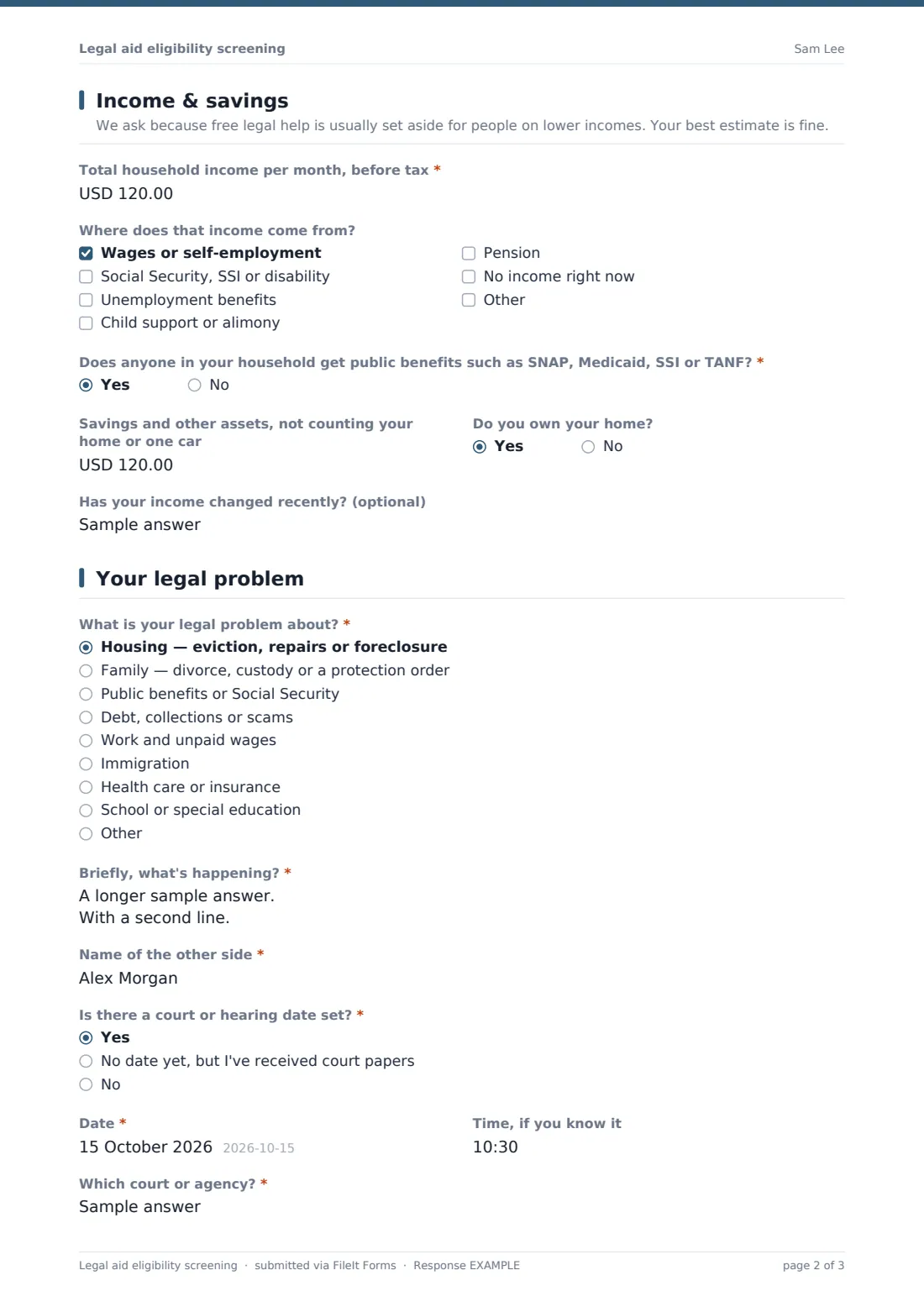
This template keeps the questions few and plain. It asks for household size and how many are children, total household income per month before tax, where that income comes from, whether anyone gets public benefits, savings beyond a home and car, and whether the applicant owns their home. A checklist notes seniors, disabilities, veterans and domestic violence, since many programs have specific help for those groups.
Then the problem itself: the kind of issue, a few sentences on what's happening, and the other side's name for a conflict check. Answering that a court date is set reveals the date, time and court. Each screening is filed as a PDF in your FileIt vault, ready for an intake worker to review.
- Best for
- Legal aid organisations, law school clinics, pro bono programs and court self-help centres
- Filled in by
- A person looking for free legal help
- Time to complete
- About 7 minutes
- Includes
- Safe-message question, household size, income and benefits, savings, issue type, other side, court date and court, urgency, uploads
Who uses a legal aid eligibility screening form?
- An "apply for help" page on a legal aid website
- Pro bono clinics deciding who to book into a limited number of slots
- Tenant hotlines catching eviction cases with a hearing this week
- Partner agencies helping clients apply on a shared tablet
- Law school clinics screening cases for students
- Reporting how many people asked for help, by issue type, from the CSV export
Questions on this legal aid eligibility screening form
27 questions over 3 pages · includes file upload, conditional questions, multiple pages, consent checkbox.
1 You & your household
- Your name*
- Phone*
- Is it safe to leave a message at this number?*
- Email (optional)
- Your address*
- Language you're most comfortable in English · Spanish · Chinese · Vietnamese · Arabic
- How many people live in your household, including you?*
- How many of them are under 18?
- Does anyone in your household… Is 60 or older · Have a disability · Serve or has served in the military · Experience domestic violence · None of these
2 Income & savings
- Total household income per month, before tax*
- Where does that income come from? Wages or self-employment · Social Security, SSI or disability · Unemployment benefits · Child support or alimony · Pension · No income right now
- Does anyone in your household get public benefits such as SNAP, Medicaid, SSI or TANF?*
- Savings and other assets, not counting your home or one car
- Do you own your home?
- Has your income changed recently? (optional)
3 Your legal problem
- What is your legal problem about?* Housing — eviction, repairs or foreclosure · Family — divorce, custody or a protection order · Public benefits or Social Security · Debt, collections or scams · Work and unpaid wages · Immigration · Health care or insurance · School or special education
- Briefly, what's happening?*
- Name of the other side*
- Is there a court or hearing date set?* Yes · No date yet, but I've received court papers · No
- Date* asked only when it applies
- Time, if you know it asked only when it applies
- Which court or agency?* asked only when it applies
- Any deadline written on the papers asked only when it applies
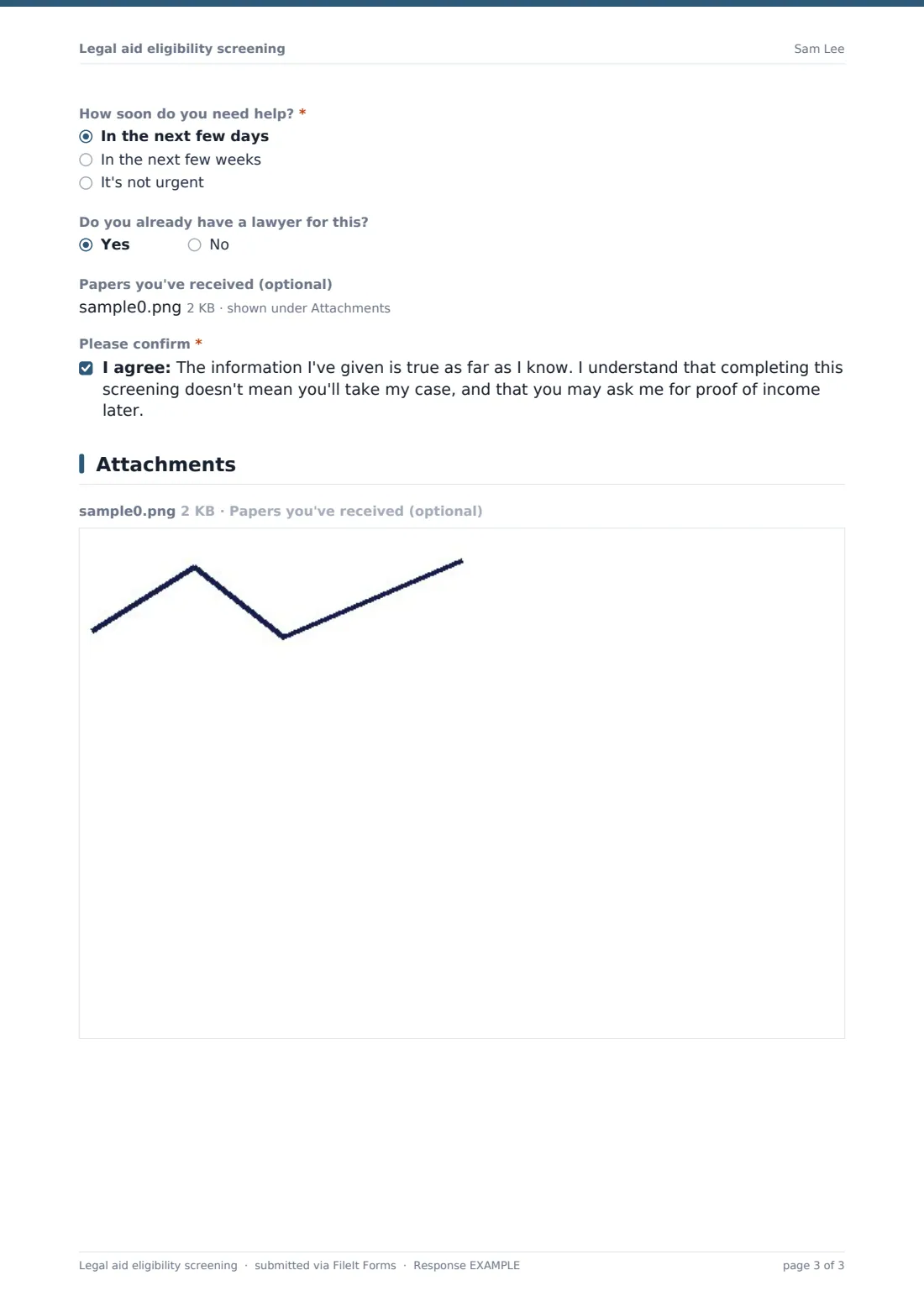
- How soon do you need help?* In the next few days · In the next few weeks · It's not urgent
- Do you already have a lawyer for this?
- Papers you've received (optional)
- Please confirm*
The legal aid eligibility screening form, page by page
1 You & your household
An emergency note, name and phone, and "Is it safe to leave a message at this number?" Email is optional, since not everyone has one. Address, preferred language, household size, how many are under 18, and a checklist for seniors, disability, military service and domestic violence.
2 Income & savings
"Total household income per month, before tax" with help on what to count, where it comes from, whether anyone gets SNAP, Medicaid, SSI or TANF, savings excluding a home and one car, home ownership and any recent change in income.
3 Your legal problem
The type of issue — housing, family, benefits, debt, work, immigration, health or school — "Briefly, what's happening?" and the other side's name, which the help text explains is for a conflict check. "Is there a court or hearing date set?" Yes requires the date and court and asks for the time. Court papers with no date asks for any deadline. Urgency, an existing lawyer, a photo of papers and a confirmation finish it.
Make the template yours
- Add your income guideline table or a link to it in the page description
- Replace the issue types with the case types you actually take
- Change the language options to the ones your community speaks
- Add a county question if you serve a defined area
- Notify the intake supervisor and route screenings to a restricted folder
- Add a "Who is filling this in?" question for referrals from partner agencies
Tips for a better legal aid eligibility screening form
- Sort by court date and urgency every morning so the most urgent cases are called first
- Honour the safe-message answer every time
- Tell people who don't qualify where else they might get help
- Keep the form short — every extra question loses applicants who are already stretched
Every response becomes a PDF in your vault
Each screening is filed as a PDF in the vault folder you choose, with any uploaded papers attached, and intake staff are notified by email. The applicant's emailed copy is off by default, since some applicants share devices or inboxes; you can switch it on.
The Responses table lists every applicant with their issue, income and court date, and exports to CSV for your case management or reporting. FileIt doesn't decide eligibility — your staff do.
- Start from this template. It opens in the FileIt Forms designer — change any question, add pages, set the rules for when questions appear.
- Share it. Turn on a public link, or send it to people by email, each with their own link. They don’t need a FileIt account.
- Get the answers as PDFs. Each response is saved as a PDF in the vault folder you choose, with uploaded files attached — and listed in a Responses table you can export to CSV.
Legal aid eligibility screening form: frequently asked questions
Is this legal aid screening template free?
Yes. It's one of the templates in FileIt's Forms app, available on every plan, including free.
Does the form calculate whether someone qualifies?
No. It collects household size, income and assets so your staff can apply your program's guidelines.
Do applicants need an email address?
No. Email is optional and phone is required, since many applicants prefer calls.
Why does it ask for the other side's name?
Legal aid programs usually check for conflicts of interest before they help someone. The help text explains this to the applicant.
Can someone apply on another person's behalf?
The form is written for the applicant. A caseworker can fill it in with them, or you can add a question about who is completing it.
Can I offer it in other languages?
Yes. You can translate every label in the designer, or create separate forms per language.