What is a virtual office services agreement?
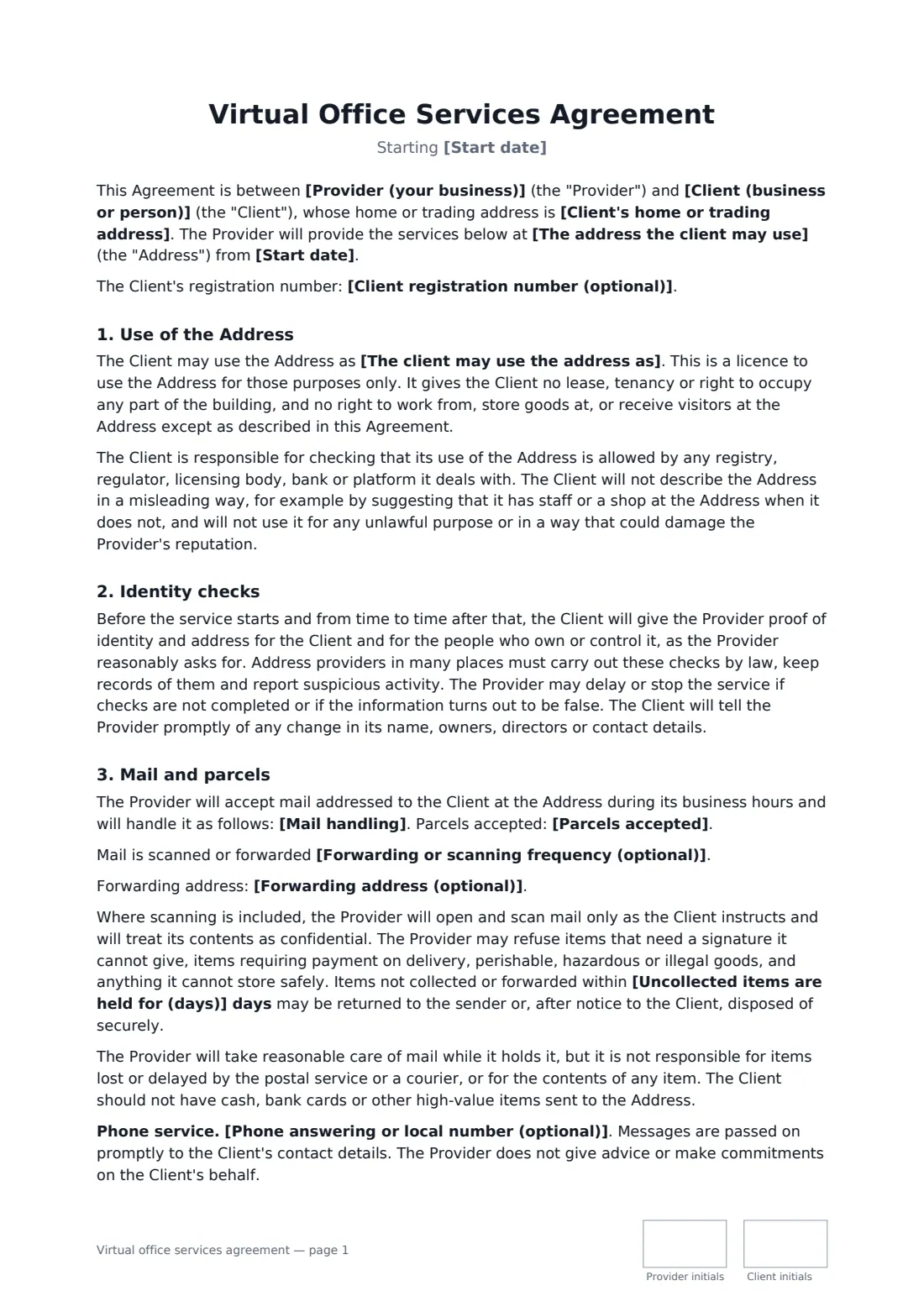
A virtual office lets a business use a real street address for its mail, website and stationery without renting space. For the provider the risks are clear: a client that never passes identity checks, an address used to look bigger or more local than the business really is, unpaid fees, and mail that keeps arriving long after the client has gone. A virtual office services agreement deals with each of them.
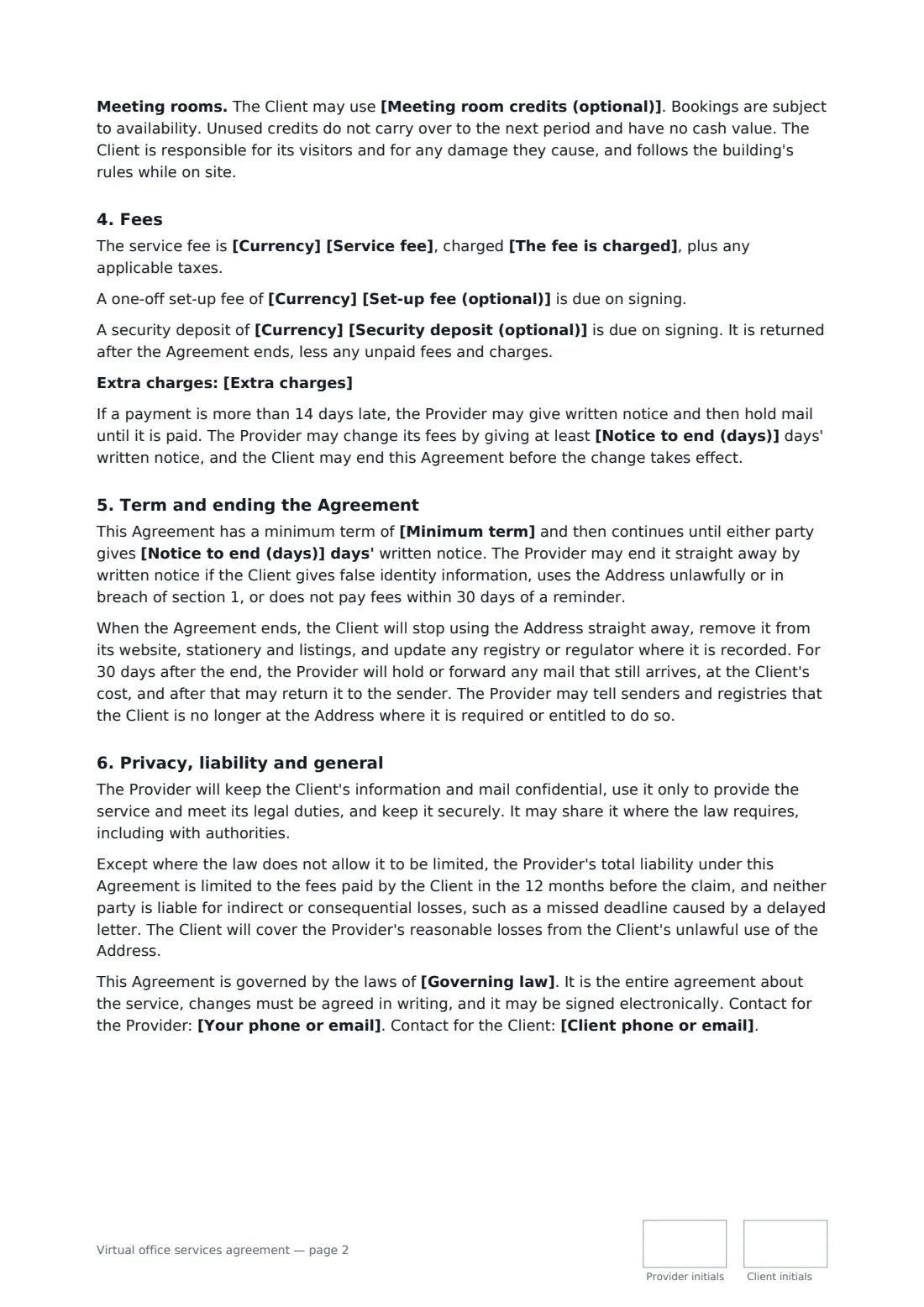
This template records the address and exactly how the client may use it, from a mailing address only to a registered office where the law allows it, and says plainly that it is a licence, not a lease. It covers identity and address checks, mail held for collection, scanned or forwarded on a set frequency, which parcels are accepted, how long uncollected items are held, optional phone answering and optional meeting room credits. It sets the fee, set-up fee, deposit and extra charges, a minimum term and notice period, the client's duty to remove the address everywhere when it leaves, 30 days of mail handling after closure, confidentiality and a limit on liability.
- Best for
- Business centres, coworking spaces and mail-handling services
- Signed by
- The provider and the client business
- Mail options
- Hold for collection, scan, forward, or scan then forward
- Length
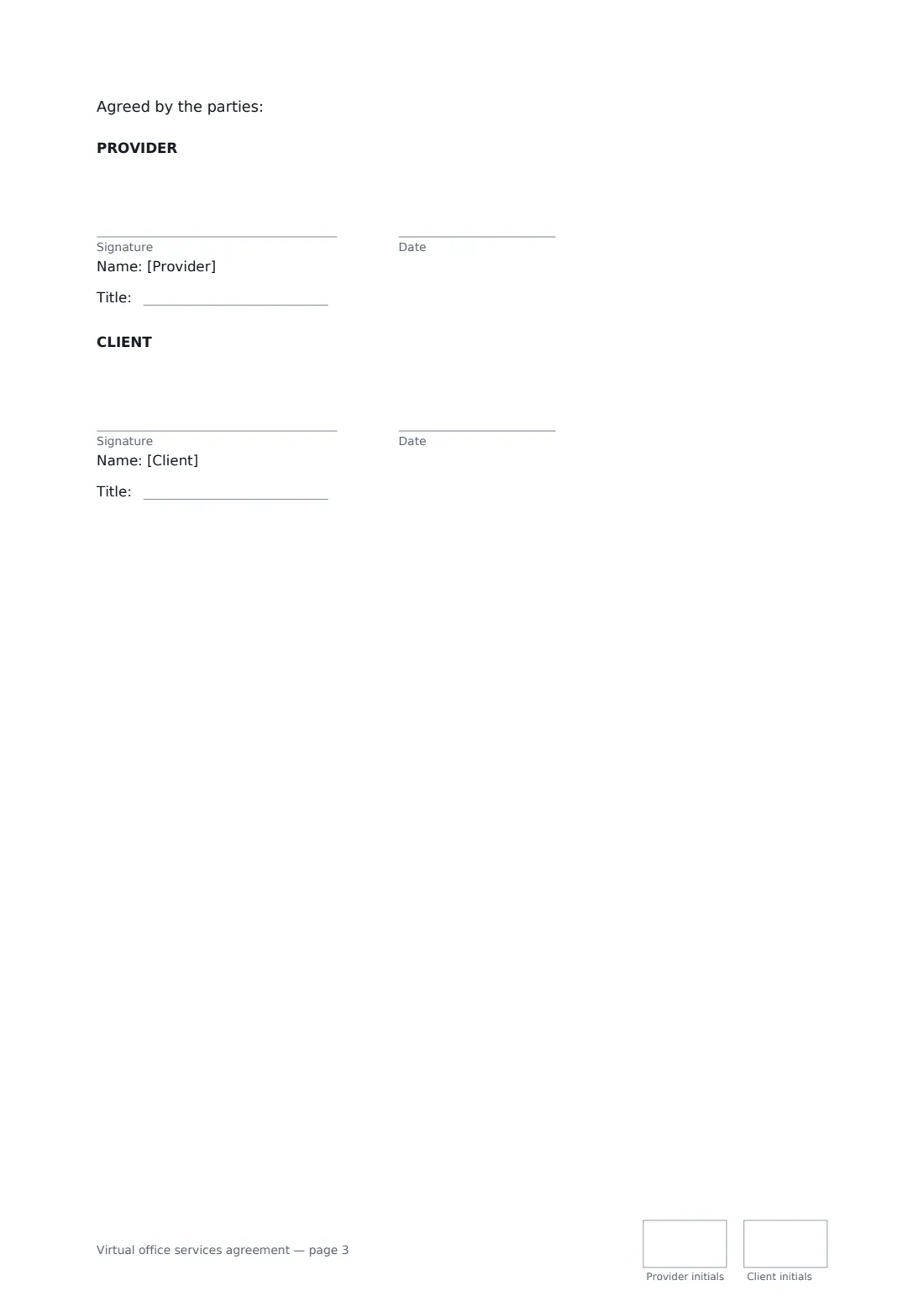
- 3 pages, initialled on every page, signatures on the last page
When to use a virtual office services agreement
- A consultant who works from home but wants a city-centre business address
- An overseas company that needs a local address for correspondence
- A start-up using a coworking space's address with a few meeting room hours each month
- A sole trader who wants mail scanned and emailed while travelling
- A business centre formalising its address and mail terms for all clients
What you fill in
25 blanks, then the name and email of each person who signs: provider, client.
1 The parties
- Start date*
- Provider (your business)*
- Your phone or email*
- Client (business or person)*
- Client registration number (optional)
- Client phone or email*
- Client's home or trading address*
2 The service
- The address the client may use*
- The client may use the address as* a mailing and correspondence address · a mailing address and its business address on its website and stationery · a mailing address, business address and registered office address where the law allows it
- Mail handling* held for collection · scanned and emailed, originals held for collection · forwarded to the client's chosen address · scanned and emailed, then forwarded
- Forwarding or scanning frequency (optional)
- Forwarding address (optional)
- Parcels accepted* letters only, no parcels · small parcels up to a size and weight the Provider can store safely · parcels of any reasonable size, subject to storage charges
- Uncollected items are held for (days)*
- Phone answering or local number (optional)
- Meeting room credits (optional)
3 Fees
- Currency*
- Service fee*
- The fee is charged* monthly in advance · quarterly in advance · yearly in advance
- Set-up fee (optional)
- Security deposit (optional)
- Extra charges
4 Term and notice
- Minimum term* 1 month · 3 months · 6 months · 12 months
- Notice to end (days)*
- Governing law*
5 Who signs
- Provider signature and date, job title, initials on every page · The business centre or virtual office company providing the address.
- Client signature and date, job title, initials on every page · The business or person using the address — someone authorised to sign for it.
What the virtual office services agreement covers
- Use of the Address
- Identity checks
- Mail and parcels
- Fees
- Term and ending the Agreement
- Privacy, liability and general
Using the virtual office services agreement, step by step
1 Name the client and its real address
Enter the client business, its registration number if it has one, and where it actually lives or trades. That address is used for identity checks.
2 Set how the address may be used
Choose mailing only, mailing plus business address, or registered office where allowed. The client confirms it checks the rules of any registry or regulator.
3 Describe the mail service
Choose how mail is handled, how often it is scanned or forwarded, which parcels are accepted and how long unclaimed items are held. Add phone answering or meeting room credits if included.
4 Fees, term and send
Enter the fee and how often it is charged, any set-up fee, deposit and extra charges, then the minimum term, notice period and governing law, and send it to the client.
Tips before you send it
- Complete the identity checks before the client starts giving out the address. In many places address providers are required to verify their clients and keep records.
- Rules on which addresses may be used as a registered office or for licences vary. The agreement puts the duty to check on the client, but don't advertise uses your address can't support.
- List postage and handling charges in Extra charges so forwarding costs are not a surprise.
- When a client leaves, the agreement gives 30 days of mail handling. Diarise it, then return later mail to the sender.
Sign it online in minutes
- Fill in the blanks. Names, dates and amounts go straight into the agreement — the preview shows exactly where.
- Name who signs. Tick “This is me” for your own part. FileIt builds the PDF with every signature, date and initials box on the right line, and you can check or move anything before sending.
- Send it. Each signer gets a secure link and signs from any device — no account needed. The signed PDF, with an audit trail and a Certificate of Completion, is filed in your vault and emailed to everyone.
Virtual office services agreement: frequently asked questions
Does the client get a lease of office space?
No. The agreement says it is a licence to use the address for the agreed purposes only, with no tenancy or right to occupy any part of the building.
Can the address be used as a registered office?
Only if you choose that option and the law where the client registers allows it. The client is responsible for checking registry and regulator rules.
What happens to mail after the client leaves?
For 30 days the provider holds or forwards it at the client's cost. After that it may be returned to the sender. The client must remove the address from its website, stationery and registries straight away.
Is the provider responsible for lost post?
The provider takes reasonable care while it holds mail but is not responsible for losses by the postal service or couriers. Liability is capped at 12 months of fees, except where the law does not allow it.
Can it be signed electronically?
Yes. E-signatures are generally valid for business service agreements like this in the US, UK, EU and Canada. FileIt keeps an audit trail with the signed PDF.