What is a timber sale agreement?
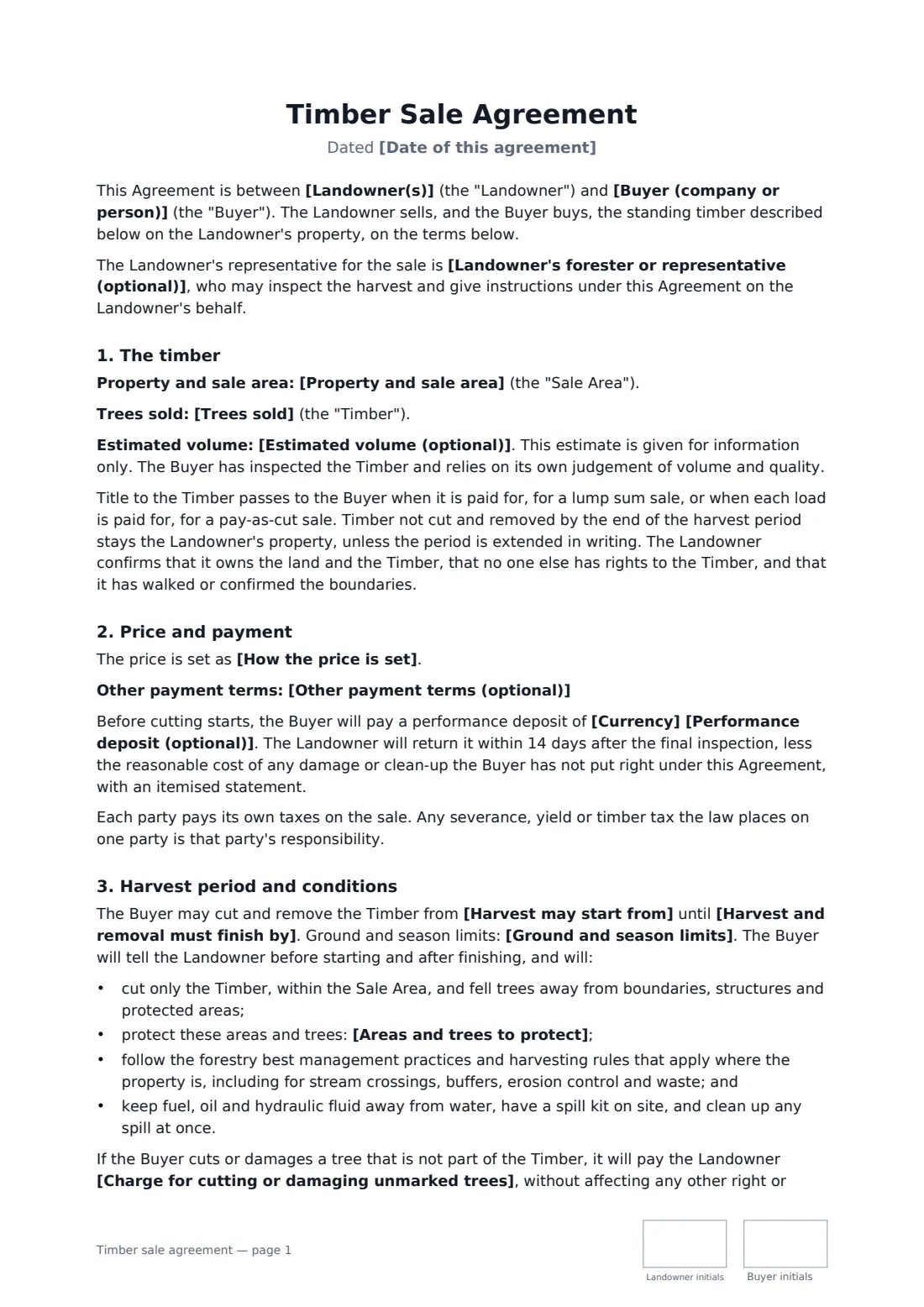
Selling timber is often a once-in-a-generation event for a landowner. A handshake deal can leave rutted tracks, broken fences, damaged streams and unmarked trees cut by mistake. A timber sale agreement sets out exactly which trees are sold and how they are marked, how the price is calculated, when the work can happen and what the land must look like afterwards.
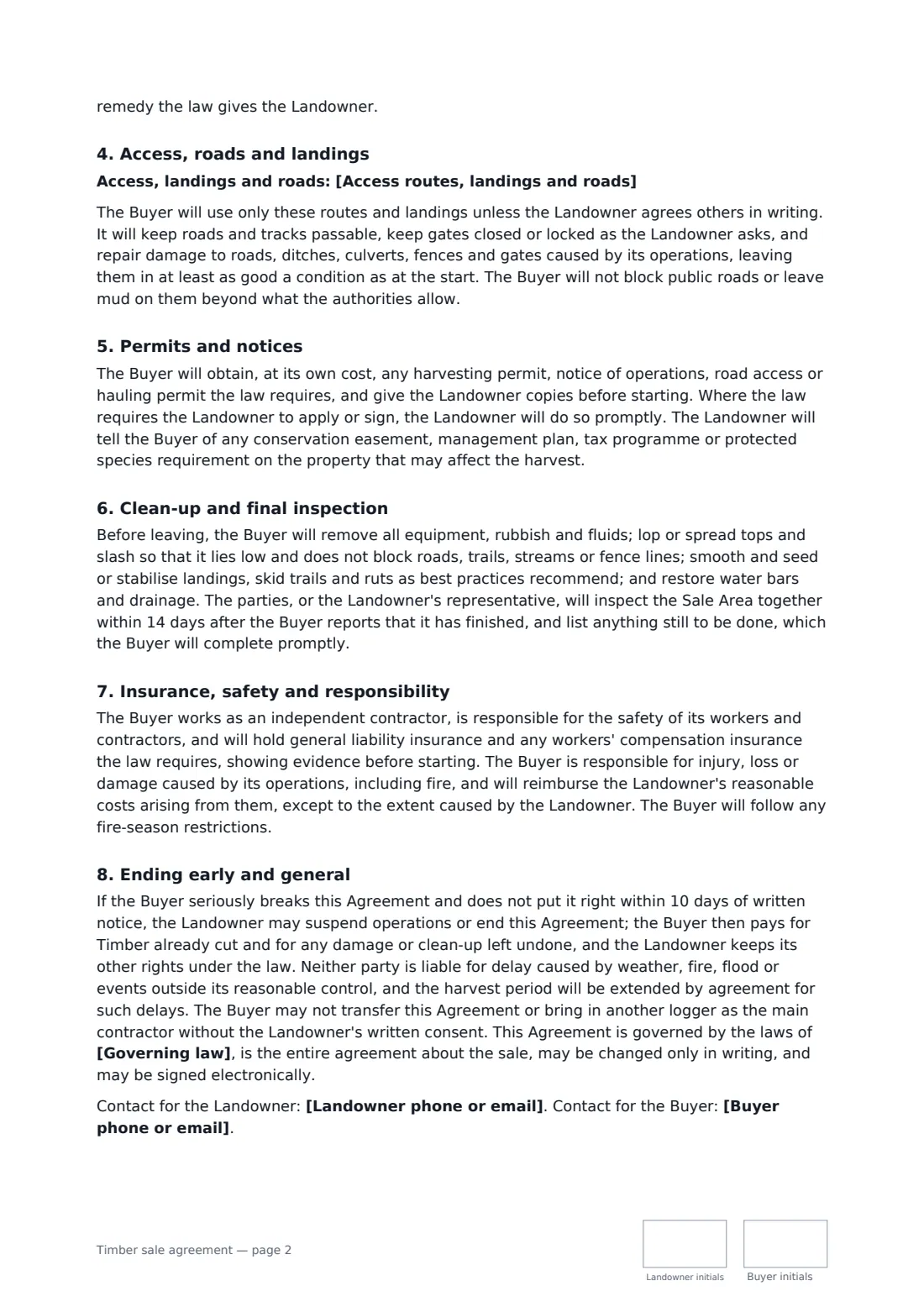
Describe the sale area and the marked trees, with an optional volume estimate. Choose a lump sum paid before cutting, or pay-as-cut unit prices settled weekly against scale tickets, and add an optional performance deposit. You set the harvest window, ground and season limits, access routes and landings, the areas to protect and a charge for damaging unmarked trees. The buyer gets the permits, follows forestry best practices, repairs roads and fences, cleans up slash and landings, and joins a final inspection. A forester can be named to act for you.
- Best for
- Woodlot owners selling marked standing timber to a logger or mill
- Signed by
- The landowner and the buyer, with co-owners added as signers
- Price options
- Lump sum, or pay-as-cut unit prices with scale tickets
- Length
- About 3 pages, initialled on every page
When to use a timber sale agreement
- A family woodlot selling a marked thinning
- A farm harvesting mature hardwood after a forester's cruise
- A pulpwood sale paid per ton by mill tickets
- Clearing storm-damaged timber with a local logger
- A landowner putting a long-standing logger arrangement in writing
What you fill in
22 blanks, then the name and email of each person who signs: landowner, buyer.
1 The parties
- Date of this agreement*
- Landowner(s)*
- Landowner phone or email*
- Buyer (company or person)*
- Buyer phone or email*
- Landowner's forester or representative (optional)
2 The timber
- Property and sale area*
- Trees sold*
- Estimated volume (optional)
3 Price
- How the price is set* a lump sum for all the trees sold · a price per unit of timber cut and removed
- Currency*
- Lump sum price (for a lump sum sale)
- Unit prices (for a pay-as-cut sale)
- Other payment terms (optional)
- Performance deposit (optional)
4 Harvest
- Harvest may start from*
- Harvest and removal must finish by*
- Ground and season limits*
- Access routes, landings and roads*
- Areas and trees to protect*
- Charge for cutting or damaging unmarked trees*
- Governing law*
5 Who signs
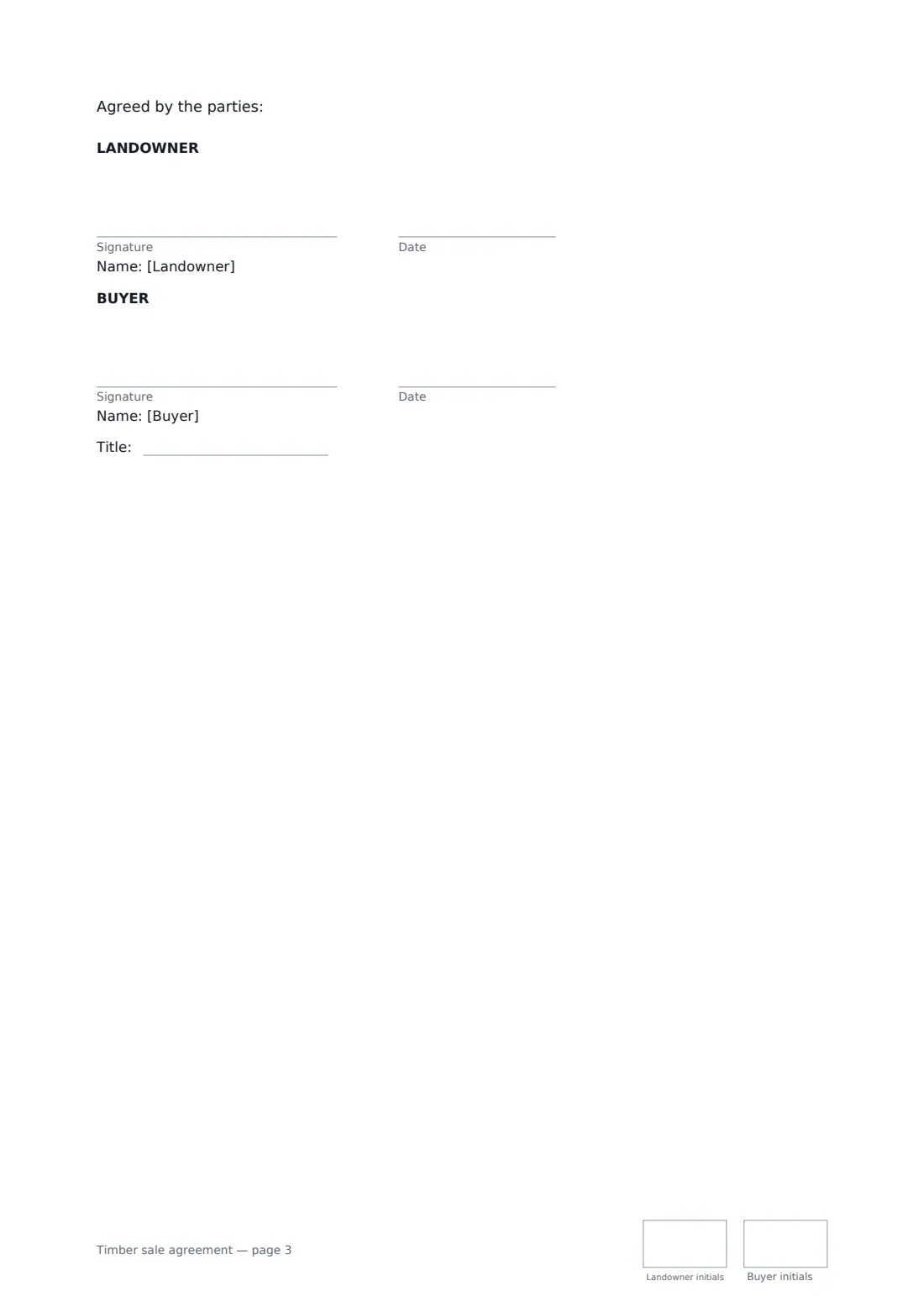
- Landowner signature and date, initials on every page · The owner of the land and the timber. If the land has co-owners, name them all above and add each one as a signer in the editor.
- Buyer signature and date, job title, initials on every page · The timber buyer, logger or sawmill buying the trees.
What the timber sale agreement covers
- The timber
- Price and payment
- Harvest period and conditions
- Access, roads and landings
- Permits and notices
- Clean-up and final inspection
- Insurance, safety and responsibility
- Ending early and general
Using the timber sale agreement, step by step
1 Describe the timber
Enter the property and sale area, how trees and boundaries are marked, and any volume estimate from a cruise.
2 Set the price
Choose lump sum or pay-as-cut, enter the amount or the unit prices, add any other payment terms and an optional performance deposit.
3 Set the harvest rules
Enter the harvest window, ground limits, access routes and landings, protected areas and the charge for unmarked trees.
4 Sign
Add contacts and the governing law. If the land has co-owners, add each one as a signer. The parties initial each page and sign on the last.
Tips before you send it
- Consider a consulting forester to mark the trees and estimate the volume, so you know what the timber is worth before you negotiate.
- Mark the boundary clearly before signing and walk it with the buyer.
- Ask for the buyer's insurance certificate and any required harvest permit before cutting starts.
- Keep scale tickets, the map and photos of roads and fences before work starts in your vault.
Sign it online in minutes
- Fill in the blanks. Names, dates and amounts go straight into the agreement — the preview shows exactly where.
- Name who signs. Tick “This is me” for your own part. FileIt builds the PDF with every signature, date and initials box on the right line, and you can check or move anything before sending.
- Send it. Each signer gets a secure link and signs from any device — no account needed. The signed PDF, with an audit trail and a Certificate of Completion, is filed in your vault and emailed to everyone.
Timber sale agreement: frequently asked questions
Lump sum or pay-as-cut?
With a lump sum, the buyer pays a fixed price up front and takes the risk on volume. With pay-as-cut, you're paid per unit removed, backed by scale or mill tickets, so you share the risk and need to check the tickets.
What if the logger cuts trees that weren't sold?
The buyer pays the charge you set, by default twice the tree's value. Your other legal remedies stay in place, and some places set their own penalties for cutting trees without permission.
Who gets the harvesting permit?
The buyer, at its own cost, unless the law requires the landowner to apply or sign, in which case the landowner does so promptly.
Is this the same as selling the land?
No. Only the marked trees are sold. Uncut timber at the end of the harvest period stays with the landowner. Some places treat standing timber sales as property interests that can be recorded, so check local rules.