What is a stage performance license?
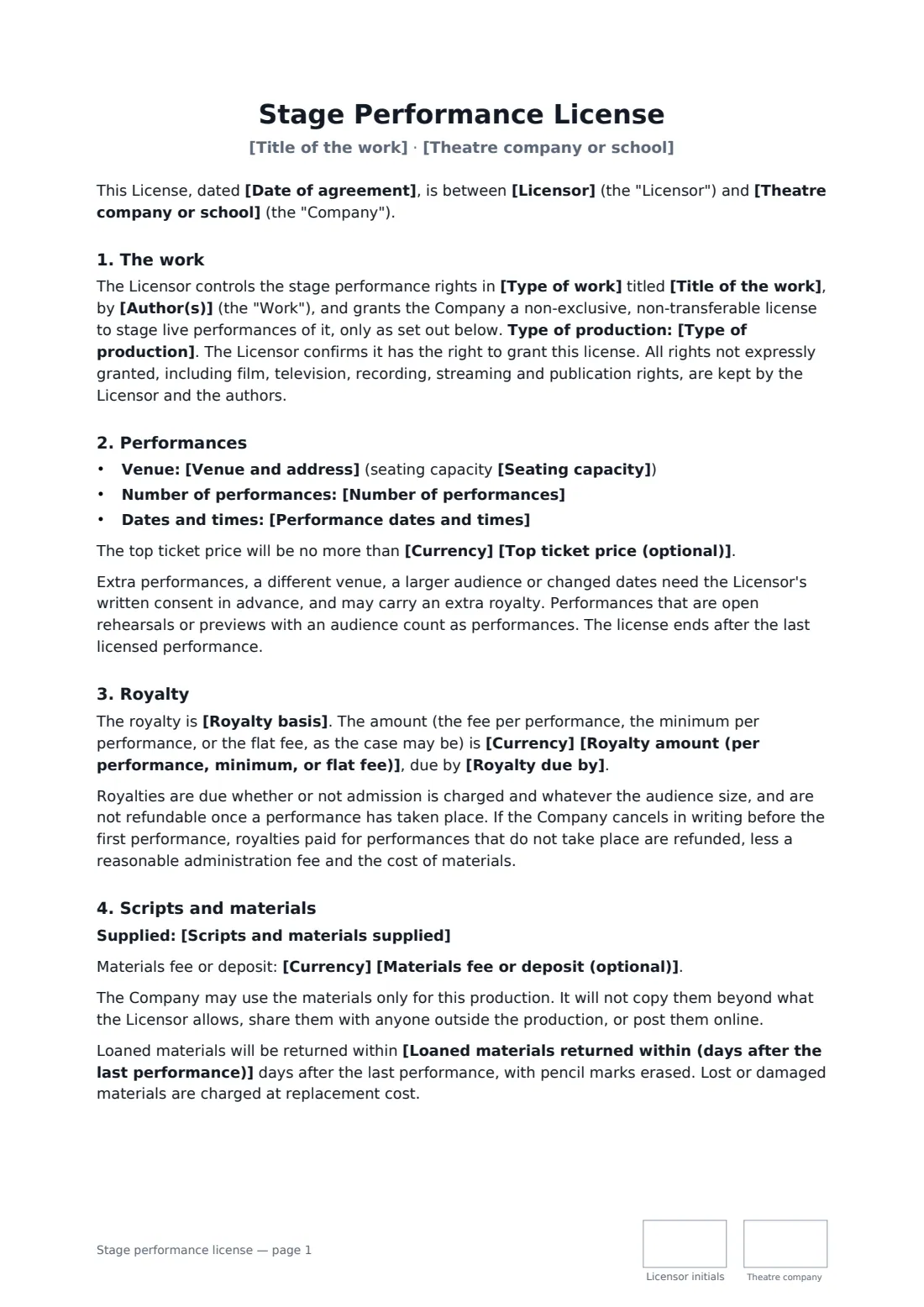
Playwrights, composers and their estates usually license stage productions through an agency, but many works, especially new plays, local musicals and self-published scripts, are licensed directly. A clear performance license tells the company exactly what it can stage, where, how many times and for how much, and protects the text from unapproved rewrites.
This template sets out the work and its authors, the type of production, the venue and seating capacity, the number of performances and their dates, and an optional ticket price cap. It covers the royalty, whether a fixed fee per performance, a box office percentage with a minimum, or a single flat fee, with a box office statement where a percentage applies, and the refund position if the company cancels. It covers scripts and materials, copying limits and return of loaned scores, the rule against changes to the text, the billing credit, a choice of recording rules from none at all to a private archival video, and publicity photos.
- Best for
- Playwrights, composers and estates licensing directly to companies and schools
- Signed by
- The licensor and the theatre company or school
- Royalty
- Per performance, box office percentage with a minimum, or flat fee
- Length
- About 2 pages, initialled on every page
When to use a stage performance license
- A community theatre staging a local writer's new comedy
- A high school licensing a musical directly from its composer
- A university drama society putting on a one-act festival
- A small professional company producing a new play for a short run
- An estate licensing an out-of-print play for a revival
What you fill in
25 blanks, then the name and email of each person who signs: licensor, theatre company.
1 The parties
- Date of agreement*
- Licensor*
- Licensor contact (email or phone)*
- Theatre company or school*
- Company contact (name and email)*
2 The work
- Title of the work*
- Author(s)*
- Type of work* a play · a musical · a one-act play · an opera or operetta · a revue or sketch show
- Type of production* amateur / community · school or youth · college or university · professional
3 Performances
- Venue and address*
- Seating capacity*
- Number of performances*
- Performance dates and times*
- Top ticket price (optional)
4 Royalty and materials
- Currency*
- Royalty basis* a fixed fee per performance · a percentage of box office receipts, with a minimum per performance · a single flat fee for all performances
- Royalty amount (per performance, minimum, or flat fee)*
- Box office percentage (if used)
- Royalty due by*
- Scripts and materials supplied*
- Materials fee or deposit (optional)
- Loaned materials returned within (days after the last performance)
5 Credit and recording
- Required billing credit*
- Recording* no audio or video recording or streaming of any kind · one archival video for the Company's private records only, not shared or streamed · a recording for cast and families only, for private, non-commercial viewing, if the Licensor approves in writing
- Governing law*
6 Who signs
- Licensor signature and date, job title, initials on every page · The playwright, composer, estate or agent who controls the stage rights.
- Theatre company signature and date, job title, initials on every page · The theatre group, school or producer staging the show, signed by someone authorised to commit it.
What the stage performance license covers
- The work
- Performances
- Royalty
- Scripts and materials
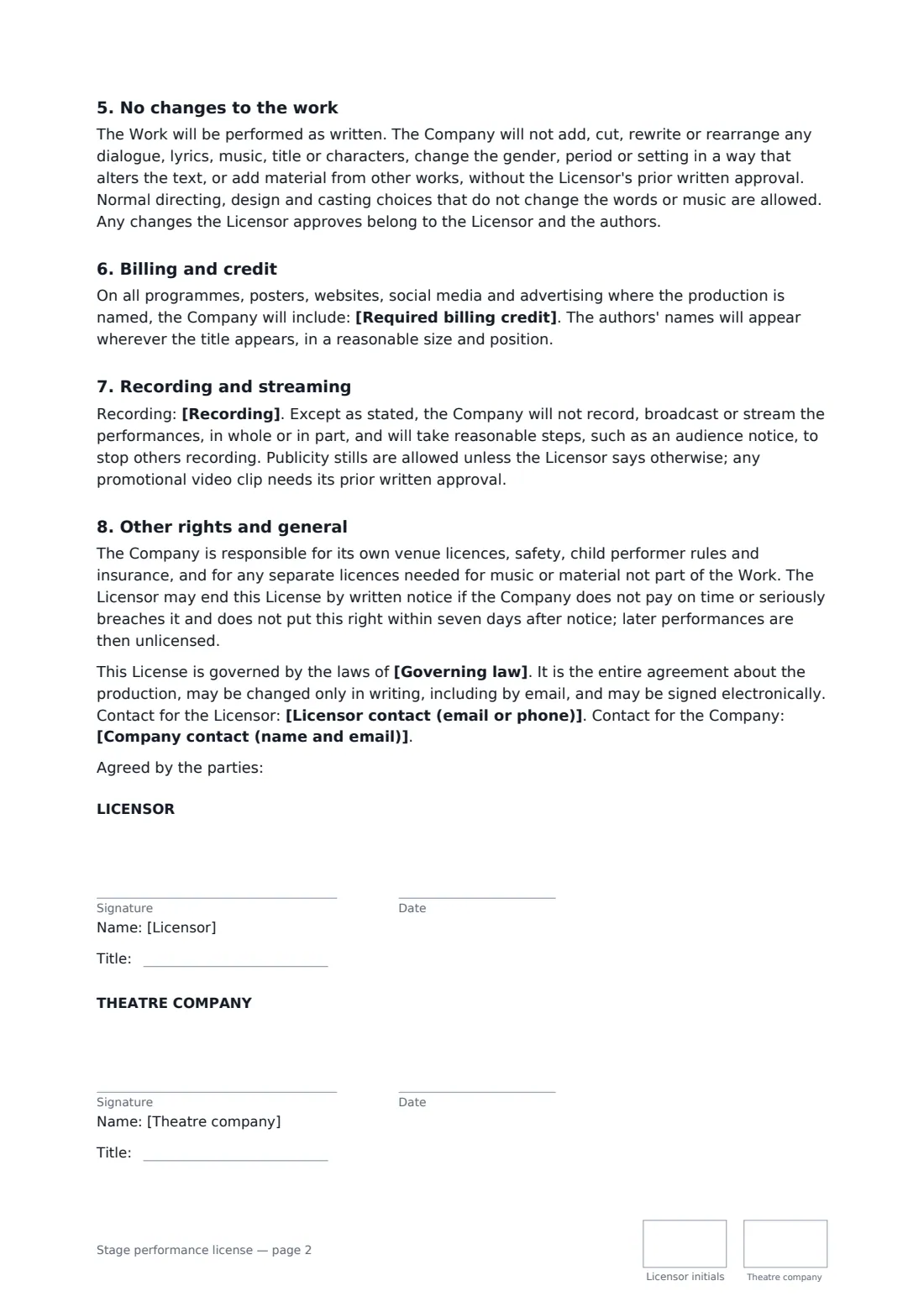
- No changes to the work
- Billing and credit
- Recording and streaming
- Other rights and general
Using the stage performance license, step by step
1 Describe the work and production
Enter the title and authors, choose the type of work and production, and give the venue, seating capacity, number of performances and dates.
2 Set the royalty
Choose the royalty basis, enter the amount and, for a percentage, the rate, and set the date it's due.
3 List the materials
Describe the scripts and scores supplied, any materials fee or deposit, and when loaned materials must be returned.
4 Set credit and recording, then send
Write the billing credit line, choose the recording rule, add the governing law and send to the company.
Tips before you send it
- Royalties are due even for free performances. The license says so plainly, which avoids awkward conversations later.
- Count previews and open dress rehearsals with an audience as performances, as the license does.
- If you allow any recording, check the music and any third-party material first. Your permission may not cover them.
- Ask for a programme and poster proof so you can check the credit before it's printed.
Sign it online in minutes
- Fill in the blanks. Names, dates and amounts go straight into the agreement — the preview shows exactly where.
- Name who signs. Tick “This is me” for your own part. FileIt builds the PDF with every signature, date and initials box on the right line, and you can check or move anything before sending.
- Send it. Each signer gets a secure link and signs from any device — no account needed. The signed PDF, with an audit trail and a Certificate of Completion, is filed in your vault and emailed to everyone.
Stage performance license: frequently asked questions
Can the company change the script?
No, not without the licensor's prior written approval. That includes cutting or adding dialogue, lyrics or music, changing the title or characters, or changing the setting in a way that alters the text. Normal directing, design and casting choices are fine.
Can the company film the show?
Only as the recording option you choose allows: no recording at all, a private archival video, or a cast-and-families recording if you approve in writing. Publicity stills are allowed unless you say otherwise, and any promotional video clip needs your written approval.
What if the company wants extra performances?
Extra performances, a different venue, a larger audience or changed dates need the licensor's written consent in advance and may carry an extra royalty.
Is this suitable for a show licensed through an agency?
If an agency or publisher controls the rights, it will use its own license. This template is for rights holders licensing directly.