What is a copyright permission letter?
Authors, publishers, teachers, designers and marketers regularly need to reuse someone else's work: an epigraph from a novel, a photograph in a textbook, a chart in a report, an illustration on a website. Unless an exception such as fair use or fair dealing clearly applies, the safe course is to ask the rights holder. A clear request gets a faster yes, and a signed reply is the record publishers, printers and platforms ask for.
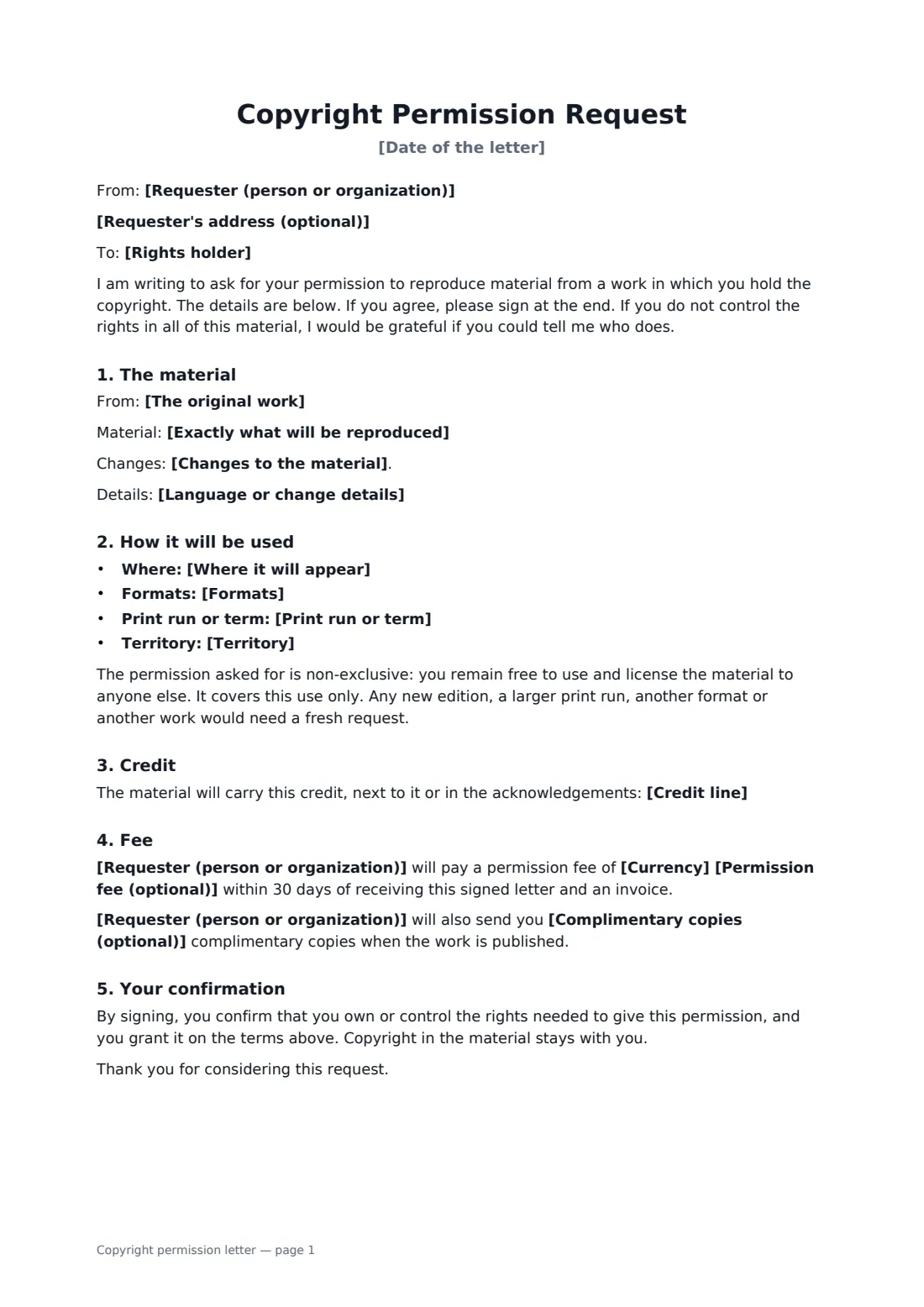
This letter identifies the original work and exactly what you want to reproduce, says whether it will be changed, cropped or translated, and describes where it will appear, in which formats, for what print run or term and in which territory. The permission is non-exclusive and limited to that use, so the rights holder keeps full control of their work. You set the credit line, and either confirm that permission is free or state a fee and any complimentary copies. The rights holder signs to confirm they control the rights and grant permission.
- Best for
- Books and anthologies, textbooks and course packs, websites, reports, presentations, film and video
- Signed by
- The rights holder and the requester
- You set
- Work and material, changes, use, formats, print run or term, territory, credit, fee
- Length
- About 2 pages
When to use a copyright permission letter
- An author quoting song lyrics, a poem or a long passage in their book
- A publisher clearing photographs and illustrations for a textbook
- A teacher reproducing articles in a course pack
- A company using a third-party chart or image in a report or website
- A filmmaker showing a photograph or artwork on screen
What you fill in
16 blanks, then the name and email of each person who signs: rights holder, requester.
1 The parties
- Requester (person or organization)*
- Requester's address (optional)
- Rights holder*
- Date of the letter*
2 The material
- The original work*
- Exactly what will be reproduced*
- Changes to the material* none — it will be reproduced as it is · resizing or cropping only · translation into the language below · as described below
- Language or change details
3 The use
- Where it will appear*
- Formats* print only · print and ebook · website or online only · print, ebook and online · presentation, course pack or teaching materials · film, video or broadcast
- Print run or term*
- Territory*
4 Credit and fee
- Credit line*
- Currency
- Permission fee (optional)
- Complimentary copies (optional)
5 Who signs
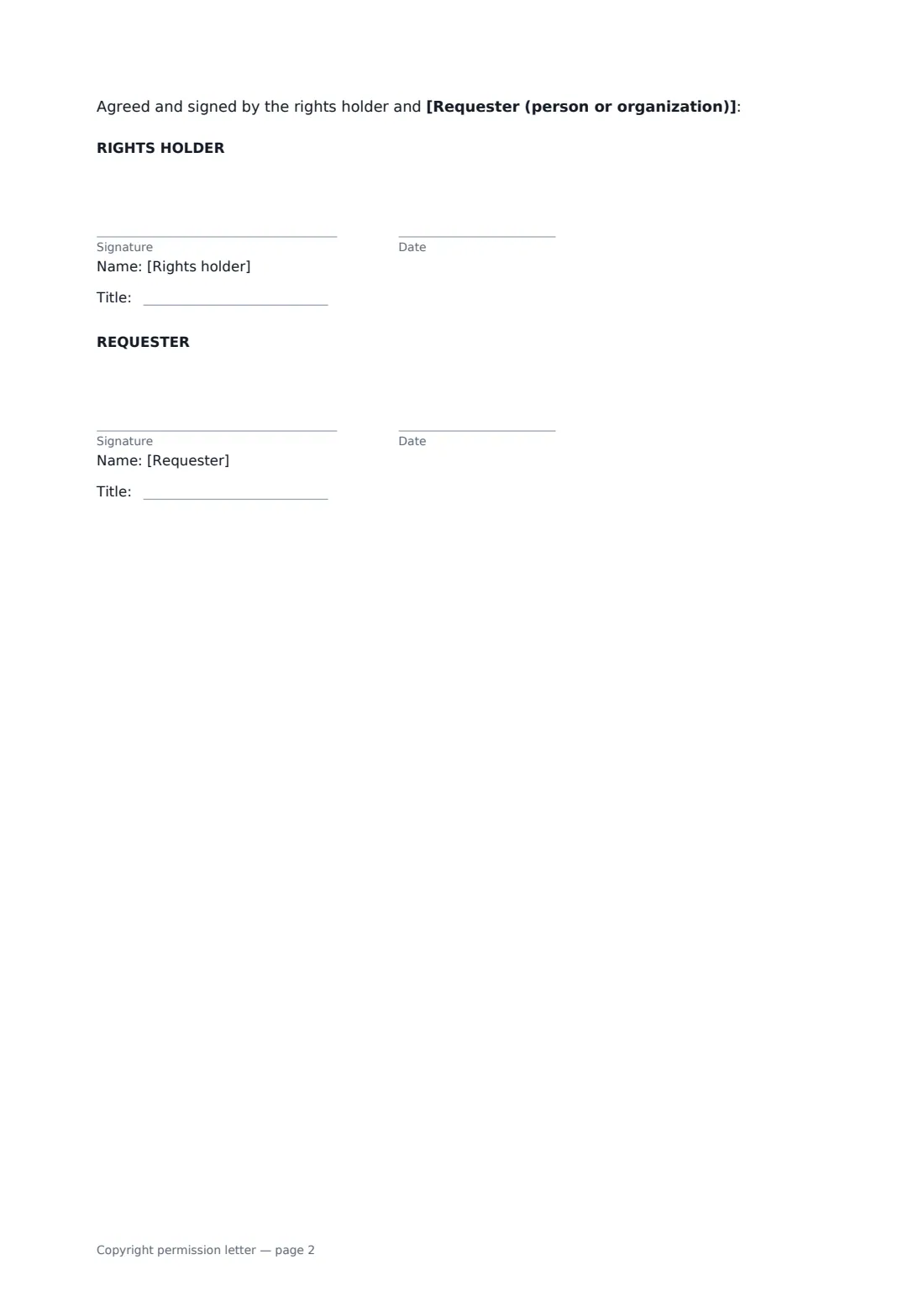
- Rights holder signature and date, job title · The author, artist, photographer or publisher who owns or controls the rights.
- Requester signature and date, job title
What the copyright permission letter covers
- The material
- How it will be used
- Credit
- Fee
- Your confirmation
Using the copyright permission letter, step by step
1 Identify the material precisely
Name the original work — title, author or artist, publisher and year — then list exactly what you want: page numbers, line counts, image numbers. Vague requests get slow answers.
2 Describe the use
Say where it will appear and choose the formats. Give a print run for printed works and a term for online use, plus the territory and language.
3 Agree credit and fee
Write the credit line you plan to use, or ask the rights holder for theirs. Leave the fee empty if you're asking for free permission; add complimentary copies if you're offering them.
4 Send to the rights holder
Add the rights holder as a signer. They sign on their phone or computer without a FileIt account, and the signed letter is filed in your vault with its audit trail.
Tips before you send it
- Make sure you're asking the right person. For published works, the publisher's permissions department often controls reprint rights, not the author.
- Photos, illustrations and lyrics inside a book may belong to someone other than the book's publisher.
- Ask for every format you're likely to need — print, ebook and audio, say — now. Going back later costs time and often money.
- Keep the signed letter with your manuscript or project files; publishers and broadcasters often ask to see permissions before release.
- If the rights holder can't be found, take advice; this letter needs someone to sign it.
Sign it online in minutes
- Fill in the blanks. Names, dates and amounts go straight into the agreement — the preview shows exactly where.
- Name who signs. Tick “This is me” for your own part. FileIt builds the PDF with every signature, date box on the right line, and you can check or move anything before sending.
- Send it. Each signer gets a secure link and signs from any device — no account needed. The signed PDF, with an audit trail and a Certificate of Completion, is filed in your vault and emailed to everyone.
Copyright permission letter: frequently asked questions
When do I need copyright permission?
Whenever you reproduce a substantial part of someone else's protected work and no exception, such as fair use in the US or fair dealing in the UK, Canada and elsewhere, clearly applies. Those exceptions are narrow and fact-specific, so many publishers ask for permission anyway.
Is the permission exclusive?
No. The letter asks for non-exclusive permission for the stated use only. The rights holder can license the same material to anyone else.
What if the rights holder wants a fee?
Enter it in the fee field and it becomes part of the letter, payable within 30 days of the signed letter and an invoice. Leave it empty for free permission.
Does this transfer copyright?
No. The letter says copyright stays with the rights holder. You get permission to use the material in one specific way.
Is an e-signed permission letter accepted by publishers?
Electronic signatures are generally valid for permission letters like this, and FileIt adds an audit trail and Certificate of Completion to the signed PDF as evidence of who signed and when.