What is a literary option agreement?
Producers rarely buy film or TV rights outright at the start. Instead they pay the author a smaller option fee for the exclusive right to buy later, then use the option period to develop scripts, attach talent and raise money. If the project gets the green light, they exercise the option and pay the full purchase price; if not, the rights go back to the author, who keeps the fees.
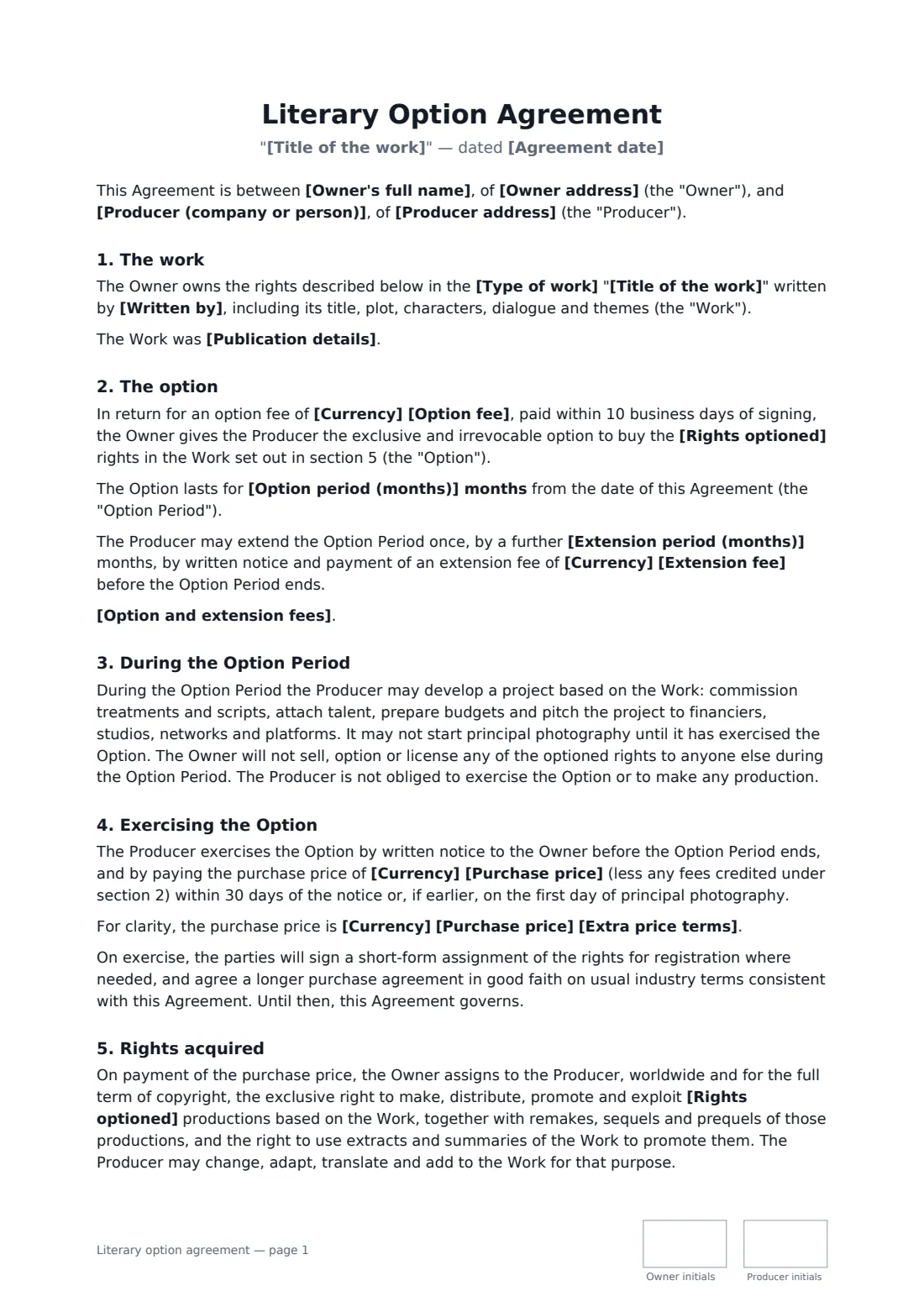
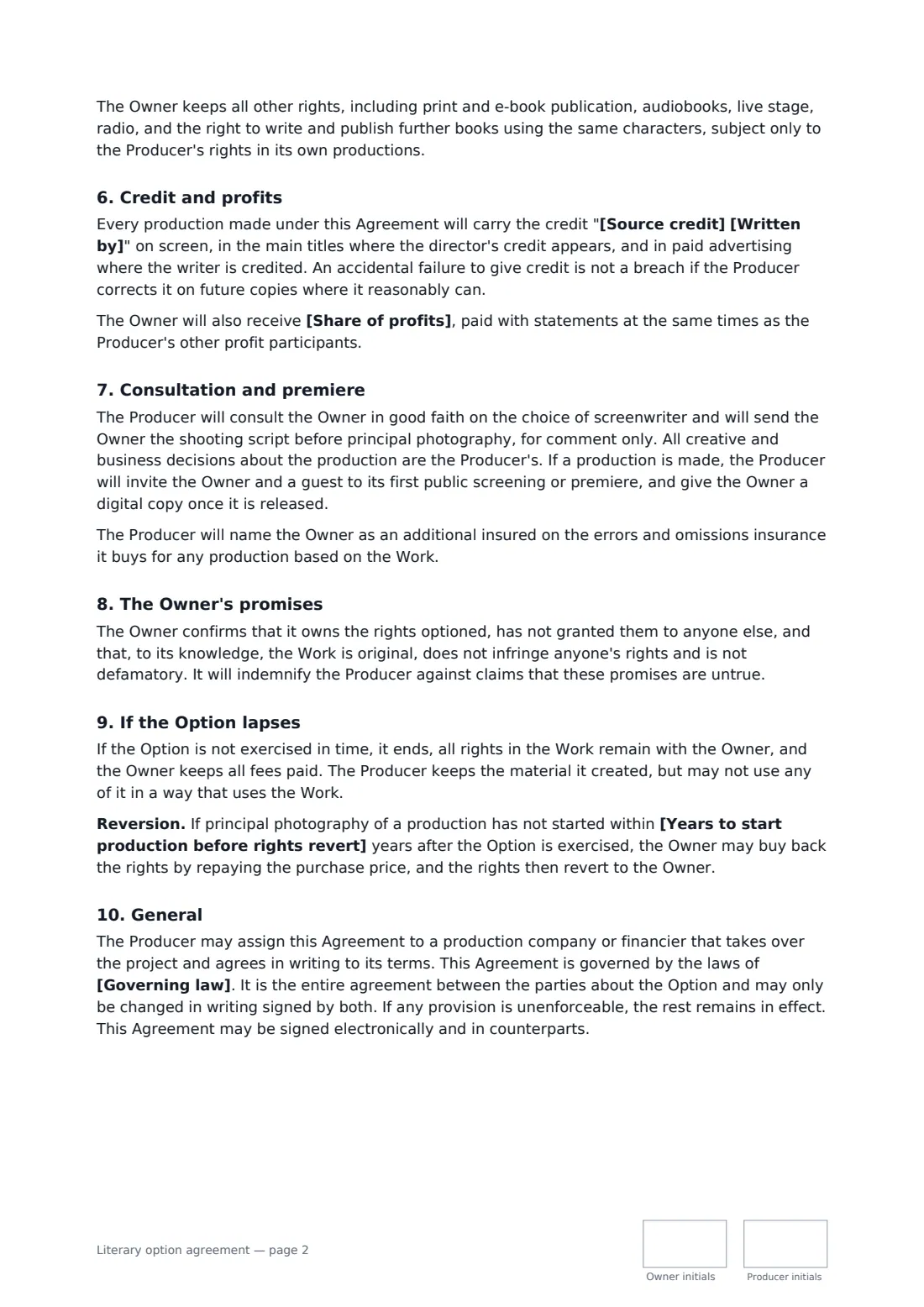
This template sets out the work and its publication, the media optioned (film and TV, film only or series only), the option fee, the option period and one paid extension, and which fees count towards the price. It covers what the producer may do during development, exercise by notice and payment, the rights acquired and those the author keeps, the source credit and an optional share of profits, the owner's promises about the work, what happens if the option lapses, and an optional reversion if production never starts.
- Best for
- Independent producers optioning a novel, memoir, short story, play or screenplay
- Signed by
- The rights owner and the producer
- Money
- Option fee, optional extension fee, purchase price and optional profit share
- Length
- 2–3 pages, initialled by both on every page
When to use a literary option agreement
- An independent producer optioning a self-published thriller for a feature film
- A small production company optioning a memoir for a limited TV series
- A director optioning a short story to develop as a festival short and later a feature
- A playwright granting screen rights in a stage play while keeping live-stage rights
- Renewing an expiring option on fresh terms with a new extension
What you fill in
22 blanks, then the name and email of each person who signs: owner, producer.
1 The parties
- Agreement date*
- Owner's full name*
- Owner address
- Producer (company or person)*
- Producer address
2 The work
- Title of the work*
- Type of work* novel · non-fiction book · short story · screenplay · stage play · graphic novel
- Written by*
- Publication details
- Rights optioned* film and television · feature film only · television series only
3 Option
- Currency*
- Option fee*
- Option period (months)*
- Extension period (months)
- Extension fee
- Option and extension fees* The first option fee is credited against the purchase price; extension fees are not · All option and extension fees are credited against the purchase price · No fees are credited against the purchase price
4 Purchase
- Purchase price*
- Extra price terms
- Share of profits
- Source credit*
- Years to start production before rights revert
- Governing law*
5 Who signs
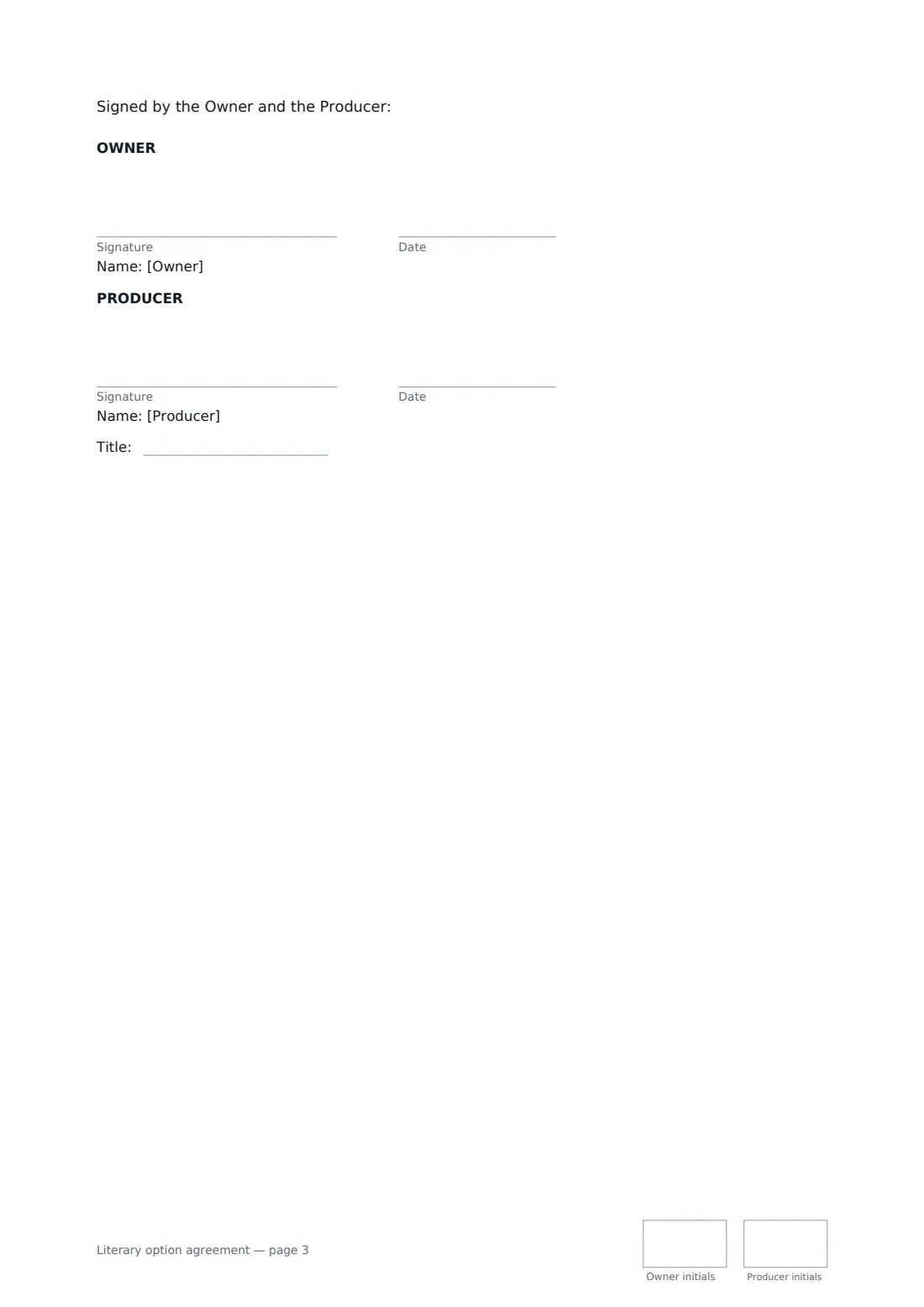
- Owner signature and date, initials on every page · The author or other person who owns the screen rights in the work.
- Producer signature and date, job title, initials on every page · The producer or production company taking the option.
What the literary option agreement covers
- The work
- The option
- During the Option Period
- Exercising the Option
- Rights acquired
- Credit and profits
- Consultation and premiere
- The Owner's promises
- If the Option lapses
- General
Using the literary option agreement, step by step
1 Identify the work and the rights
Enter the title, the type of work and the author, with publication details if any. Choose whether you're optioning film and TV, film only or a series only.
2 Set the option money and time
Add the option fee and period — 12 to 18 months is common — and, if wanted, one extension with its own fee. Choose which fees are credited against the purchase price.
3 Agree the purchase terms
Enter the purchase price and any budget-linked formula, a profit share if there is one, the wording of the source credit, and how long production can take before the owner may buy the rights back.
4 Send to the owner
Sign for the production company and send it to the author or their representative. They sign online without an account, and the signed agreement is filed in your FileIt vault, so the option expiry date is easy to find.
Tips before you send it
- Put the option expiry date in your calendar the day you sign — a missed deadline usually means the rights are gone.
- Check that the author really owns the screen rights; some publishing contracts give the publisher a share or control.
- Use the long-form purchase agreement on exercise to cover details such as approval rights, errors and omissions insurance and sequel payments.
- Industry practice and union rules differ by country; an entertainment lawyer can tell you what's usual for your project.
Sign it online in minutes
- Fill in the blanks. Names, dates and amounts go straight into the agreement — the preview shows exactly where.
- Name who signs. Tick “This is me” for your own part. FileIt builds the PDF with every signature, date and initials box on the right line, and you can check or move anything before sending.
- Send it. Each signer gets a secure link and signs from any device — no account needed. The signed PDF, with an audit trail and a Certificate of Completion, is filed in your vault and emailed to everyone.
Literary option agreement: frequently asked questions
What does an option actually give the producer?
An exclusive right, for a limited time, to buy the screen rights at an agreed price. During that time the owner can't sell or option them to anyone else. The producer doesn't have to buy, and doesn't own the rights until it exercises the option and pays.
Does the author keep the book rights?
Yes. The template leaves print, e-book, audiobook, stage and radio rights with the owner, along with the right to write further books with the same characters.
What happens if the producer never makes the film?
If the option is never exercised, it simply lapses and the owner keeps the fees. If the rights were bought but production doesn't start within the reversion period you set, the owner can buy them back by repaying the purchase price.
Can it be signed electronically?
In most countries, including the US (ESIGN Act and UETA), the UK, the EU (eIDAS) and Canada, an electronic signature is generally valid for an agreement like this one. Copyright assignments may need a signed writing, which an e-signature usually satisfies, and some registries have their own forms. FileIt keeps an audit trail and a Certificate of Completion with the signed PDF.
Is this template free?
Yes. The template is free to use with the eSignature app in FileIt, and the people you send it to don't need a FileIt account to sign.