What is a self-employment income statement?
Employees can hand over a payslip or an employer's letter. Freelancers, sole traders, contractors and gig workers usually can't, so landlords, lenders, housing offices and schools often ask for a signed statement of self-employed income, backed by bank statements or tax returns.
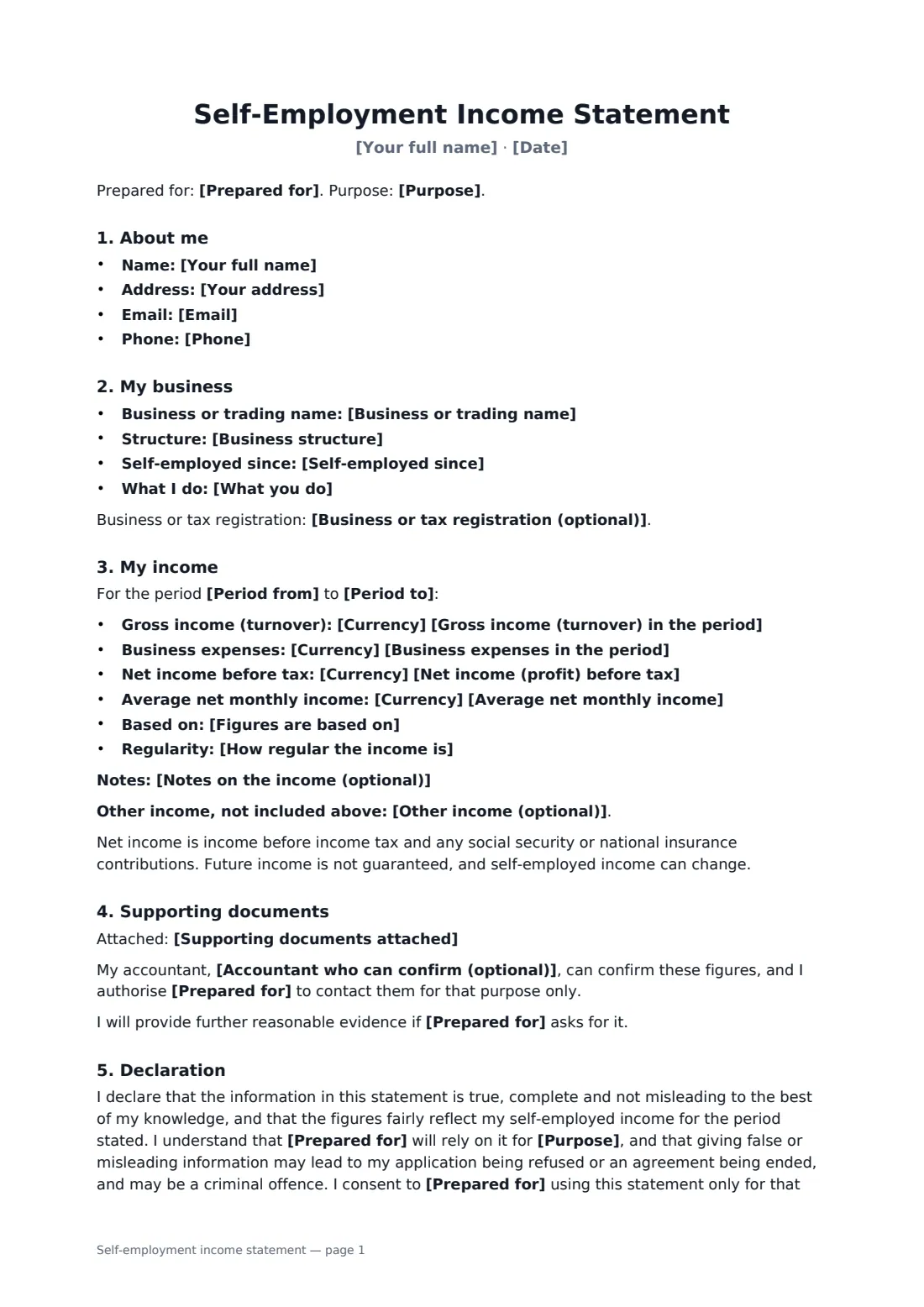
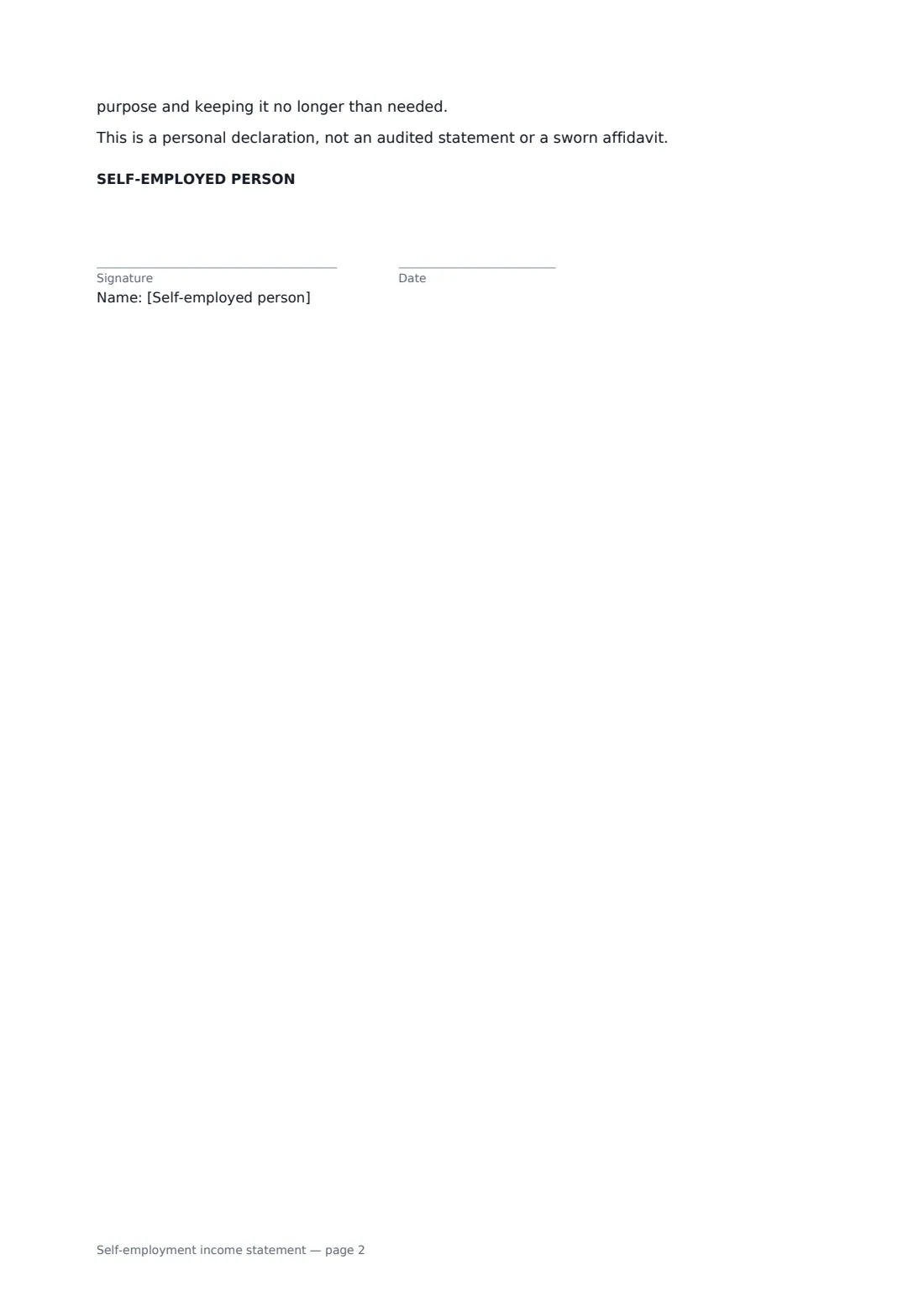
This statement says who it's for and why, then describes your business: trading name, structure, what you do and how long you've been self-employed. For a period you choose, it sets out gross income, business expenses, net income before tax and average net monthly income, what the figures are based on, how regular the income is, and any other income. You list the supporting documents attached and can name an accountant who can confirm the figures. The declaration says the information is true and that the recipient may use it only for the stated purpose, and makes clear it's a personal declaration, not an audited statement or affidavit.
- Best for
- Freelancers, sole traders, contractors, gig workers and small business owners
- Signed by
- The self-employed person
- You set
- Recipient, purpose, business, period, gross and net income, documents attached
- Length
- About 2 pages
When to use a self-employment income statement
- Applying to rent a flat or house
- A car loan or personal loan application
- Housing, benefits or school fee assistance applications
- A mortgage broker's request for an income summary
- Childcare or tuition fee arrangements based on income
What you fill in
25 blanks, then the name and email of each person who signs: self-employed person.
1 You
- Your full name*
- Your address*
- Email*
- Phone
2 Purpose
- Prepared for*
- Purpose*
- Date*
3 The business
- Business or trading name*
- Business structure* sole trader / sole proprietor · freelancer or independent contractor · partner in a partnership · owner of a limited company or LLC
- What you do*
- Self-employed since*
- Business or tax registration (optional)
4 Income
- Currency*
- Period from*
- Period to*
- Gross income (turnover) in the period*
- Business expenses in the period*
- Net income (profit) before tax*
- Average net monthly income*
- Figures are based on* my business records and bank statements · my filed tax return · accounts prepared by my accountant · my own estimate (records attached)
- How regular the income is* steady month to month · varies month to month · seasonal · mainly from one or two regular clients
- Notes on the income (optional)
- Other income (optional)
5 Supporting documents
- Supporting documents attached*
- Accountant who can confirm (optional)
6 Who signs
- Self-employed person signature and date
What the self-employment income statement covers
- About me
- My business
- My income
- Supporting documents
- Declaration
Using the self-employment income statement, step by step
1 Who it's for
Your name and email fill in. Add who the statement is for and the purpose, such as a tenancy application.
2 Your business
Enter your trading name, choose your structure, and describe what you do and since when.
3 Your income
Choose the period and enter gross income, expenses, net income and the monthly average, plus what the figures are based on and how regular they are.
4 Attach and sign
List the documents you're attaching and, if you like, your accountant. Sign it and send it with the attachments.
Tips before you send it
- Use a period that matches your evidence, such as your last tax year or the last 12 months of bank statements.
- Make sure gross minus expenses equals net — recipients check.
- Explain seasonal or uneven income in the notes so it doesn't look like a red flag.
- Share only part of a tax or business registration number unless the recipient genuinely needs it all.
- Never overstate income. False statements to a lender or landlord can have serious consequences.
Sign it online in minutes
- Fill in the blanks. Names, dates and amounts go straight into the agreement — the preview shows exactly where.
- Name who signs. Tick “This is me” for your own part. FileIt builds the PDF with every signature, date box on the right line, and you can check or move anything before sending.
- Send it. Each signer gets a secure link and signs from any device — no account needed. The signed PDF, with an audit trail and a Certificate of Completion, is filed in your vault and emailed to everyone.
Self-employment income statement: frequently asked questions
Is this a legal proof of income?
It's a signed personal declaration. Most recipients will also want evidence, such as bank statements, tax returns or an accountant's letter, which you list as attachments.
Is it the same as an affidavit?
No. It isn't sworn before an official. The statement says so. If a recipient needs a sworn statement, ask them what form they require.
Should I give gross or net income?
Both. Gross is your total turnover; net is after business expenses but before income tax. Many landlords and lenders look mainly at net income, so ask the recipient which they use.
What if my income varies?
Choose "varies month to month" or "seasonal" and explain in the notes. An average over 12 months usually gives the fairest picture.
Can I include income from a part-time job?
Yes, as other income, kept separate from your self-employed figures.