What is a letter of explanation to a lender?
During a mortgage or loan application, underwriters often ask the borrower for a letter of explanation, usually called an LOE. Something on a bank statement, credit report or application doesn't explain itself: a large deposit, a few months without a job, a new credit enquiry, a late payment, several addresses in two years, or a name that differs between documents. A clear letter, with evidence attached, is usually all the lender needs to move on.
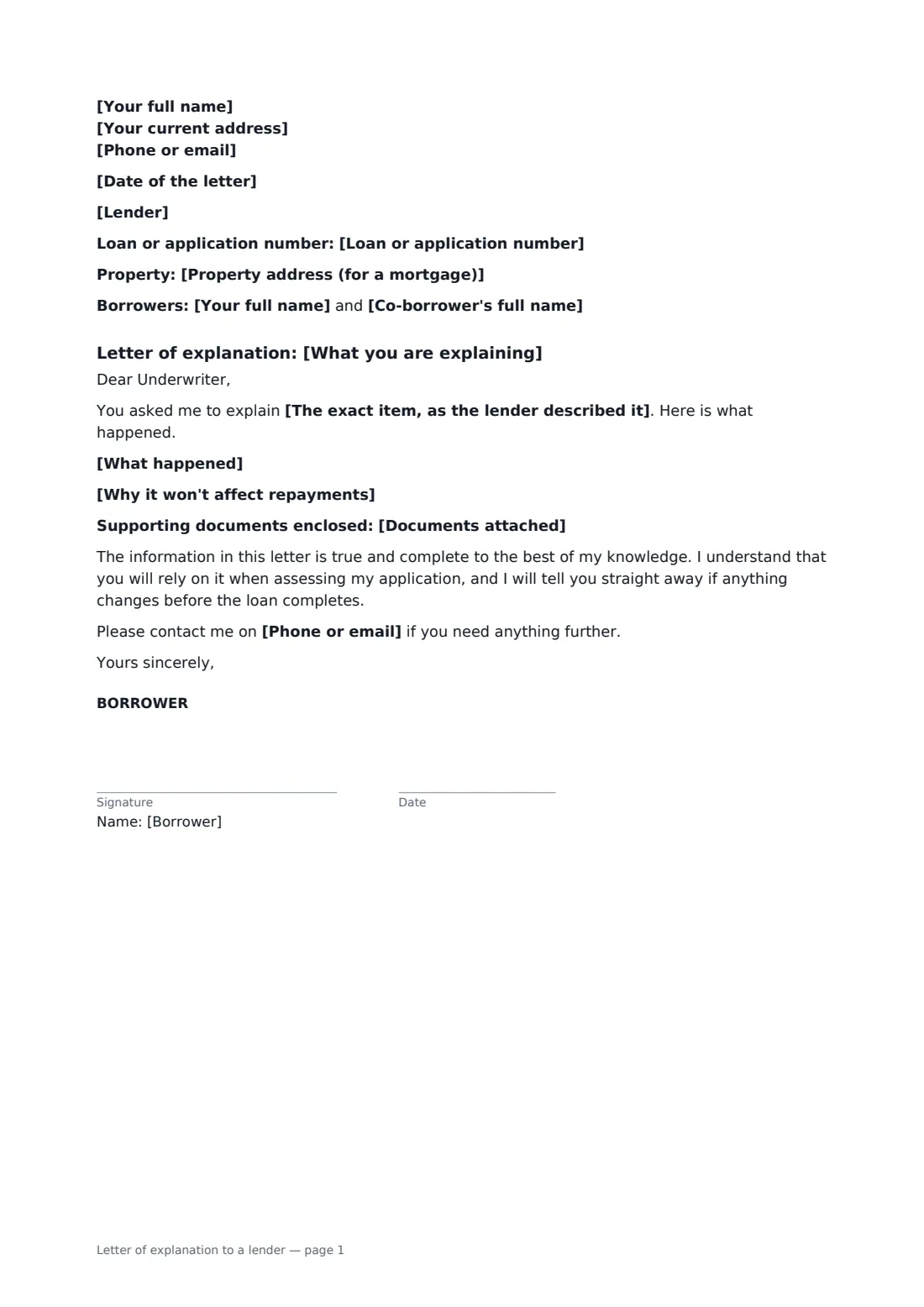
This template follows the format underwriters expect. It gives your name, address and contact details, the lender and loan number, the property and any co-borrower, a heading that names the item, the item described in the lender's own words, what happened, why it won't affect your repayments, and the supporting documents you're enclosing. It closes with a statement that the information is true and complete, and a promise to tell the lender if anything changes before completion. Co-borrowers can be added as extra signers.
- Best for
- Mortgage, remortgage, car loan and personal loan applications
- Signed by
- The borrower, plus any co-borrower
- Common topics
- Large deposits, employment gaps, credit enquiries, late payments, addresses
- Length
- 1 page
When to use a letter of explanation to a lender
- Explaining a large deposit from the sale of a car or a family gift
- Accounting for a gap between jobs, a career break or parental leave
- Explaining a recent credit enquiry that didn't lead to new debt
- Giving the reason for a one-off late payment and showing it was put right
- Explaining several addresses in a short time, or a name change after marriage
What you fill in
13 blanks, then the name and email of each person who signs: borrower.
1 You
- Date of the letter*
- Your full name*
- Co-borrower's full name
- Your current address*
- Phone or email*
2 The application
- Lender*
- Loan or application number*
- Property address (for a mortgage)
3 The explanation
- What you are explaining* a large deposit into my account · a gap in my employment · a recent credit enquiry · a late or missed payment · my address history · a change in my income · a difference in my name on documents · another item the lender asked about
- The exact item, as the lender described it*
- What happened*
- Why it won't affect repayments
- Documents attached
4 Who signs
- Borrower signature and date · The person applying for the loan. If there is a co-borrower, add them as an extra signer in the editor so you both sign.
Using the letter of explanation to a lender, step by step
1 Copy the lender's request
Choose the topic and paste the exact item the lender asked about, with its date and amount, for example "the deposit of $8,500 into checking account ending 4471 on 3 September 2026". The underwriter can then tick it off quickly.
2 Explain what happened
Keep it short and factual: who, what, when and why. Underwriters want a clear answer, not a story. If it's about income or a missed payment, add a line on why it won't affect your repayments.
3 List your evidence
Name every document you're attaching, such as a bill of sale, a gift letter, a bank statement or an employer letter. The letter tells the lender what to look for.
4 Sign and send
Enter the loan number and lender, add a co-borrower as an extra signer if there is one, and sign. Download the signed PDF to upload to your lender's portal or send it to your loan officer. A copy stays in your FileIt vault.
Tips before you send it
- Answer only what was asked. Extra detail can trigger new questions.
- Make dates and amounts match the statement exactly.
- For a gift towards a deposit, most lenders want a separate gift letter from the giver as well.
- Never guess. If you're not sure where a deposit came from, check your records before you write.
- Keep the signed letter with your other application documents in case the lender asks again at completion.
Sign it online in minutes
- Fill in the blanks. Names, dates and amounts go straight into the agreement — the preview shows exactly where.
- Name who signs. Tick “This is me” for your own part. FileIt builds the PDF with every signature, date box on the right line, and you can check or move anything before sending.
- Send it. Each signer gets a secure link and signs from any device — no account needed. The signed PDF, with an audit trail and a Certificate of Completion, is filed in your vault and emailed to everyone.
Letter of explanation to a lender: frequently asked questions
What is a letter of explanation?
A short, signed letter from a borrower that answers a specific question from an underwriter about something in their application, credit report or bank statements.
Does my lender have its own form?
Some do. If your lender gives you a form or specific wording, use it. Otherwise this template covers what underwriters usually look for.
Do both borrowers need to sign?
Often yes, on a joint application. Add the co-borrower as an extra signer in the editor and each of you signs from your own email.
Can I explain more than one item in a letter?
It's usually clearer to send one letter per item, so each one can be matched to the underwriter's list. Sending another takes a minute once the first is set up.
Is this template free?
Yes. It is free to use with the eSignature app in FileIt.