What is a music sync license agreement?
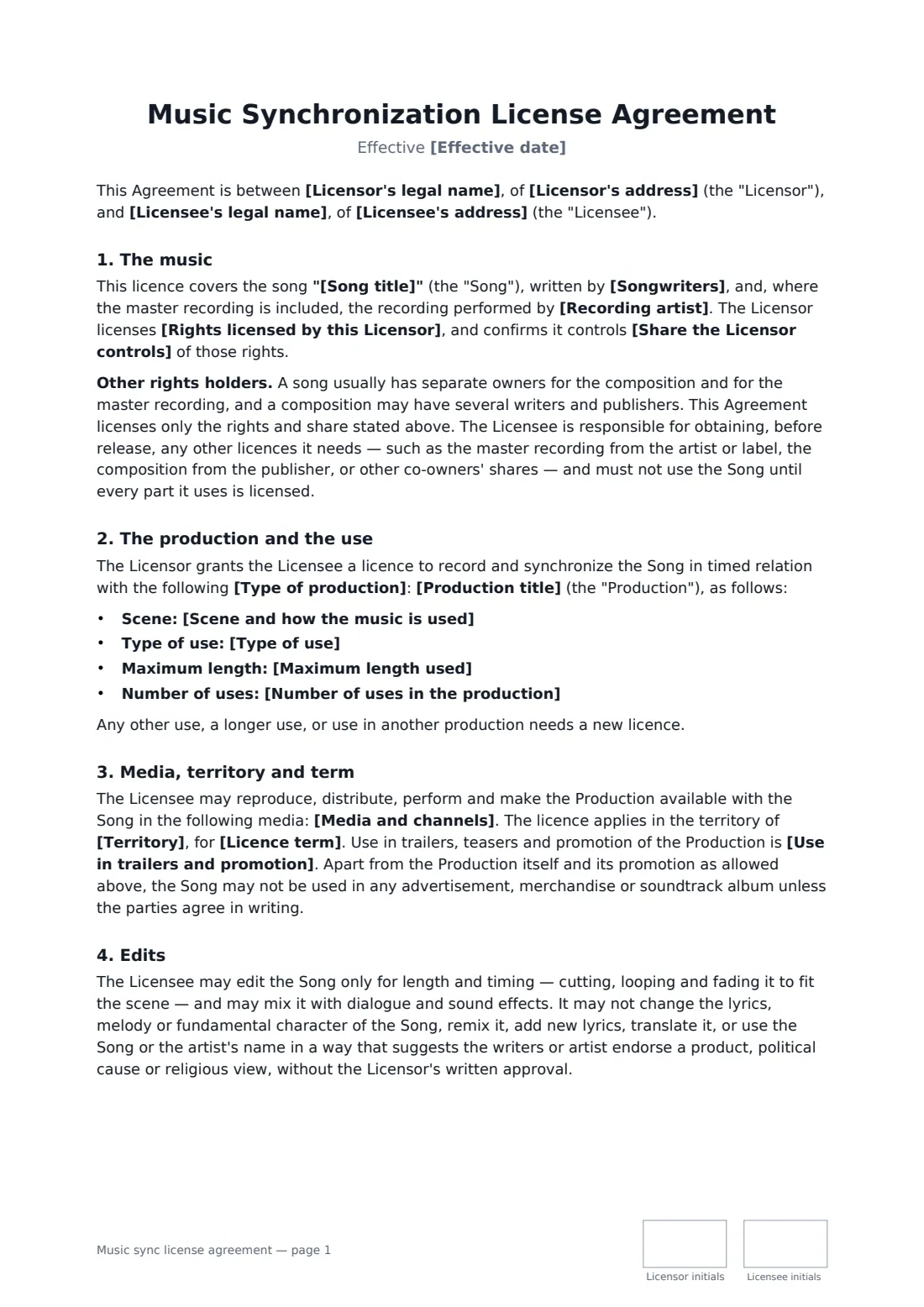
A synchronization (sync) licence is permission to put a piece of music in timed relation with pictures or other media — under a scene in a film, behind an advertisement, in a game level or in a podcast intro. Most songs have two separate copyrights: the composition, controlled by the writers and their publishers, and the master recording, controlled by the artist or label. A producer usually needs a licence for each part it uses, from whoever controls it.
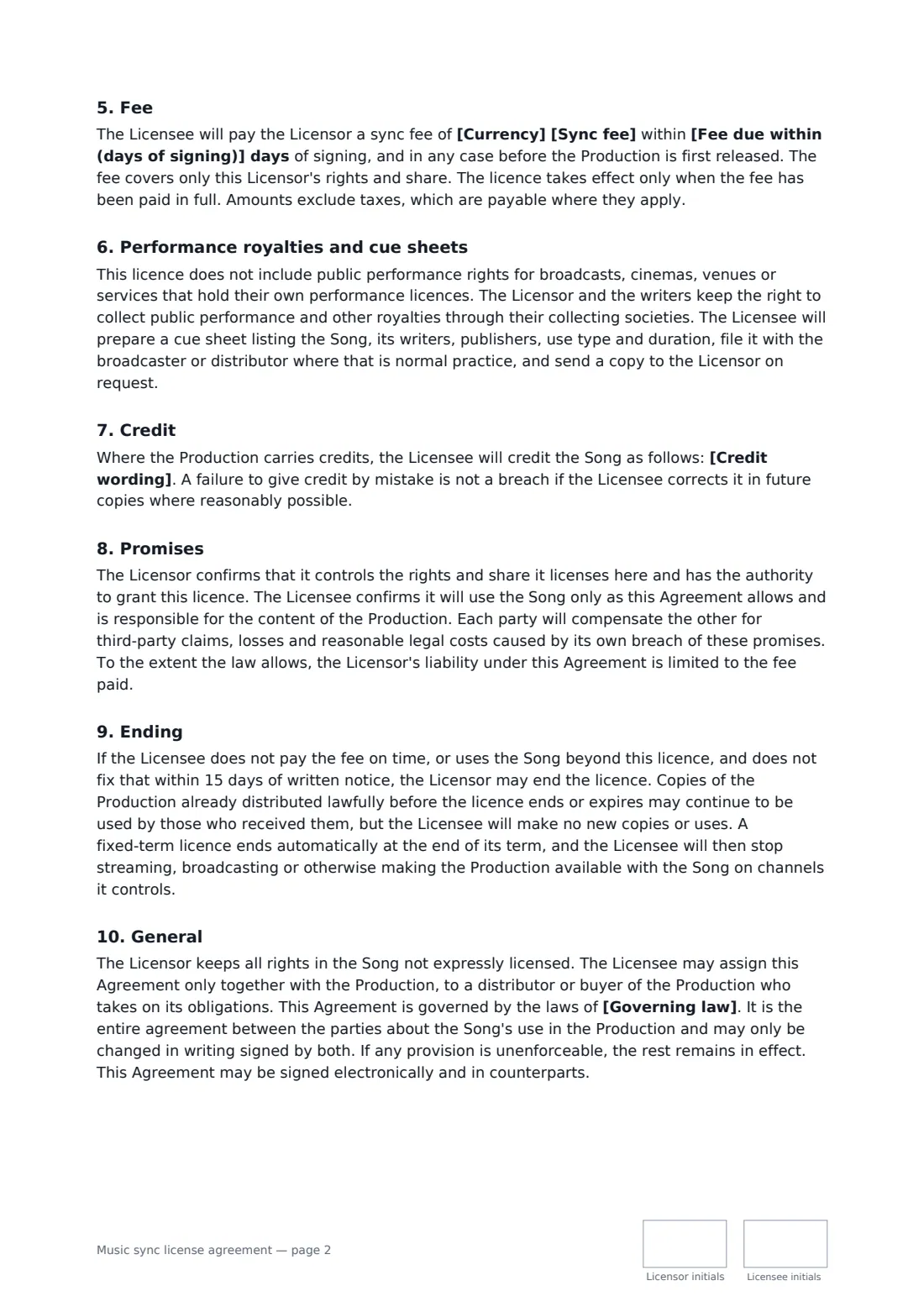
This template is signed by one rights holder for the rights and share it controls — the composition, the master, or both — and says plainly that other owners must license their parts separately. It covers the production and its type, the scene, the type of use, maximum length and number of uses, media and channels, territory and term, trailers and promotion, non-exclusive or category-exclusive use, edits allowed (timing only, no lyric changes or remixes), the sync fee and when it is due, performance royalties and cue sheets, credit, promises, and ending the licence for non-payment or misuse.
- Best for
- Independent artists, publishers and labels licensing songs to filmmakers, brands, game studios and creators
- Signed by
- The licensor (rights holder) and the licensee (production company or brand)
- Rights
- Composition, master recording or both — for the share the licensor controls
- Length
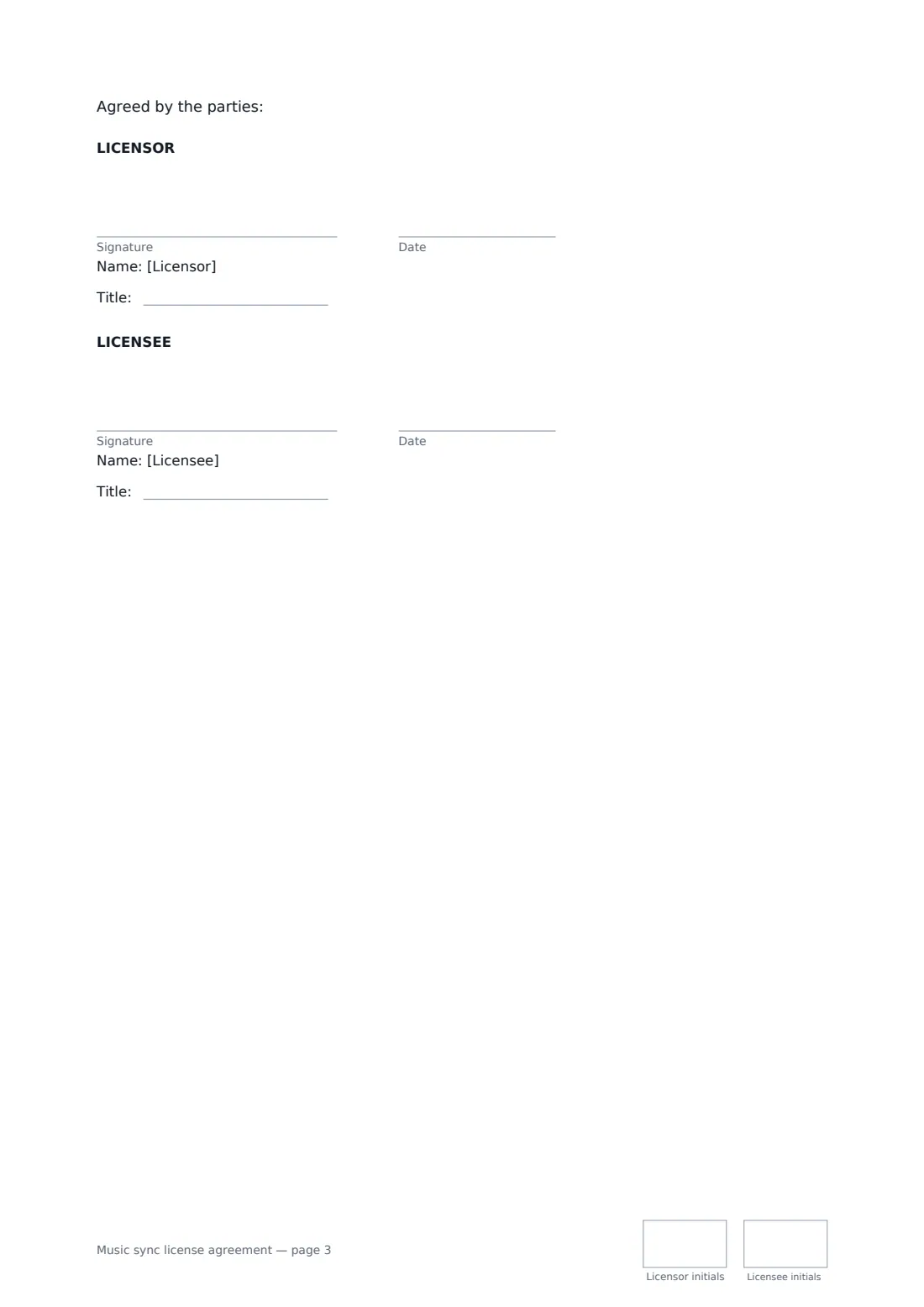
- 3 pages, initialled on every page
When to use a music sync license agreement
- An independent artist licensing their own song (writing and recording) to a documentary
- A publisher licensing its share of a composition to an advertising agency
- A label licensing a master recording to a video game studio
- A YouTube creator or podcaster clearing a track for an episode
- A brand licensing a song for a fixed-term social media campaign
What you fill in
27 blanks, then the name and email of each person who signs: licensor, licensee.
1 The parties
- Effective date*
- Licensor's legal name*
- Licensor's address
- Licensee's legal name*
- Licensee's address
2 The music
- Song title*
- Recording artist
- Songwriters
- Rights licensed by this Licensor* both the composition and the master recording · the composition (publishing) only · the master recording only
- Share the Licensor controls*
3 The use
- Production title*
- Type of production* feature film · television programme or series · online video · advertisement · video game · podcast · corporate or event video · trailer or promo
- Scene and how the music is used*
- Type of use* background instrumental · background vocal · featured (foreground, on-screen or a key moment) · opening or theme · end credits
- Maximum length used*
- Number of uses in the production*
4 Scope
- Media and channels*
- Territory*
- Licence term*
- Use in trailers and promotion* allowed in context only (the same scene used to promote the production) · allowed in and out of context · not allowed without a separate licence
- Exclusivity* Non-exclusive · Exclusive in the Licensee's product category for the term
- Product category (for exclusivity)
5 Fee and credit
- Currency*
- Sync fee*
- Fee due within (days of signing)*
- Credit wording
6 Other terms
- Governing law*
7 Who signs
- Licensor signature and date, job title, initials on every page · The songwriter, publisher, artist or label granting the licence, or an authorised person at it.
- Licensee signature and date, job title, initials on every page · The production company, brand, studio or creator using the music.
What the music sync license agreement covers
- The music
- The production and the use
- Media, territory and term
- Edits
- Fee
- Performance royalties and cue sheets
- Credit
- Promises
- Ending
- General
Using the music sync license agreement, step by step
1 Identify the song and the rights
Enter the song title, writers and recording artist, then choose whether you are licensing the composition, the master recording or both, and what share you control (for example 100% or 50%).
2 Describe the use
Name the production and its type, describe the scene, and choose the type of use — background, featured, theme or end credits — with a maximum length and number of uses.
3 Set media, territory and term
List the media and channels, the territory and the term (a fixed period or in perpetuity), and choose whether trailers and promotion may use the song and whether the licence is exclusive in a product category.
4 Fee and credit
Enter the sync fee and how many days after signing it is due — the licence takes effect only once it is paid — and the credit wording, or leave it empty if no credit is given.
5 Send for signature
Send it to the person signing for the production. Once signed, both parties get the PDF and it is filed in your vault.
Tips before you send it
- Check who controls every part of the song before quoting. If co-writers or a label control other shares, the licensee needs their licences too — the template says so.
- Ads are often licensed for a fixed term and territory; films and documentaries usually in perpetuity. Price the term accordingly.
- Ask for the cue sheet. It is how broadcasters and collecting societies know to pay performance royalties to the writers.
- Keep the edit clause tight. Remixing, new lyrics or using the song to endorse a product or cause needs separate approval under the template.
Sign it online in minutes
- Fill in the blanks. Names, dates and amounts go straight into the agreement — the preview shows exactly where.
- Name who signs. Tick “This is me” for your own part. FileIt builds the PDF with every signature, date and initials box on the right line, and you can check or move anything before sending.
- Send it. Each signer gets a secure link and signs from any device — no account needed. The signed PDF, with an audit trail and a Certificate of Completion, is filed in your vault and emailed to everyone.
Music sync license agreement: frequently asked questions
What is the difference between a sync licence and a master use licence?
Strictly, a sync licence covers the composition and a master use licence covers the recording. This template can cover either or both, depending on what the licensor controls, so one rights holder who owns both can grant them together.
Does the licence cover performance royalties?
No. This licence does not include public performance rights for broadcasters, cinemas or services that hold their own performance licences. The writers keep collecting performance royalties through their collecting societies, using the cue sheet the licensee prepares.
Can the music be used in the trailer?
Only as you choose: in context (the same scene, used to promote the production), in and out of context, or not without a separate licence. Apart from the production itself and its promotion, use in any advertisement, merchandise or a soundtrack album needs a separate written agreement.
Can a sync licence be signed electronically?
In most countries, including the US (ESIGN Act and UETA), the UK, the EU (eIDAS) and Canada, an electronic signature is generally valid for an ordinary commercial contract like this one. FileIt keeps an audit trail and a Certificate of Completion with the signed PDF as evidence of who signed and when.
Is this template free?
Yes. The template is free to use with the eSignature app in FileIt, and the people you send it to don't need a FileIt account to sign.