What is a composer agreement?
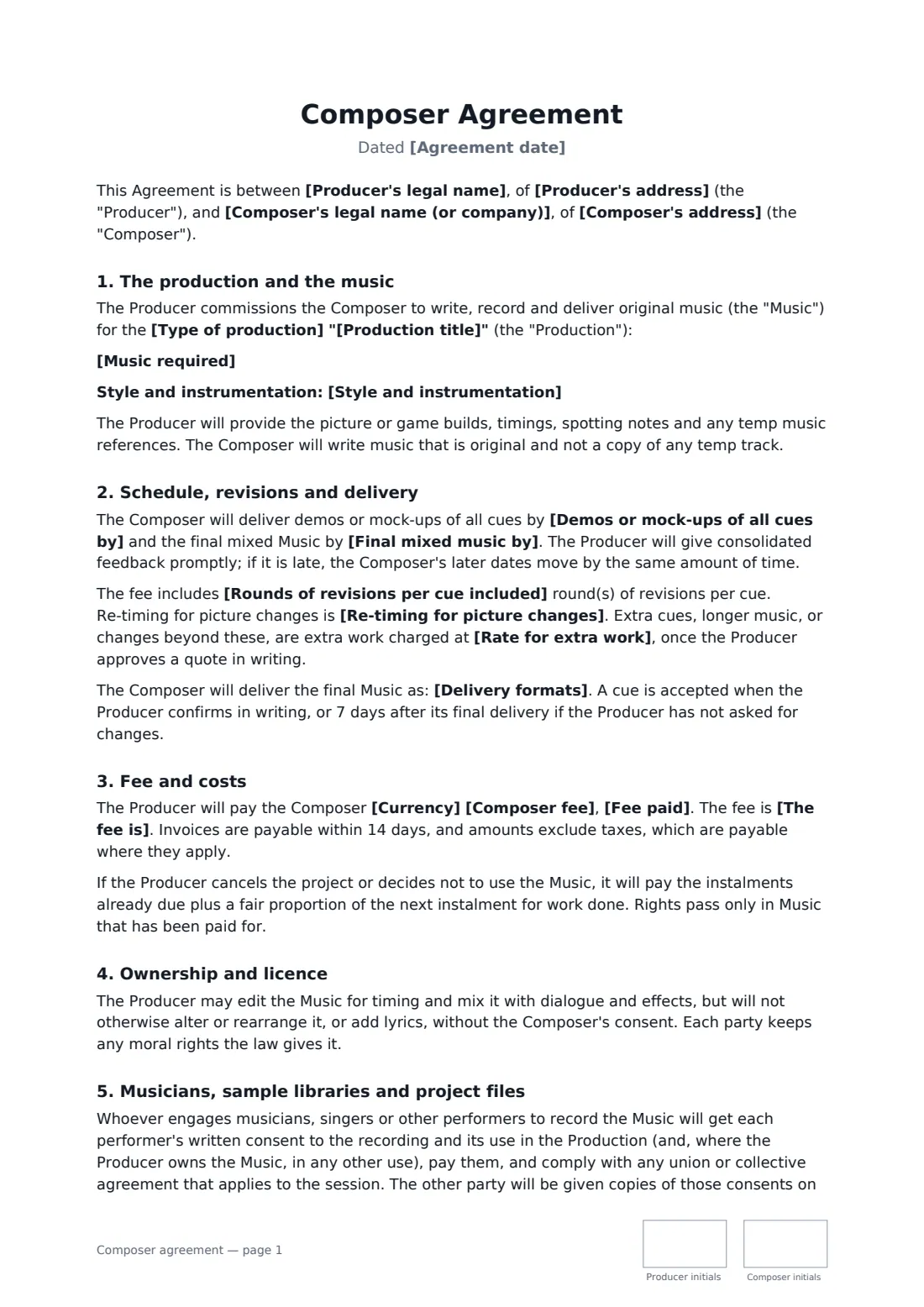
A composer agreement is the contract a producer signs with a composer to write and deliver original music for a production — a film or series score, game music, an advertising track or a podcast theme. It sets the creative brief and schedule, how the music is delivered, what it costs and who pays the musicians, and who ends up owning the music.
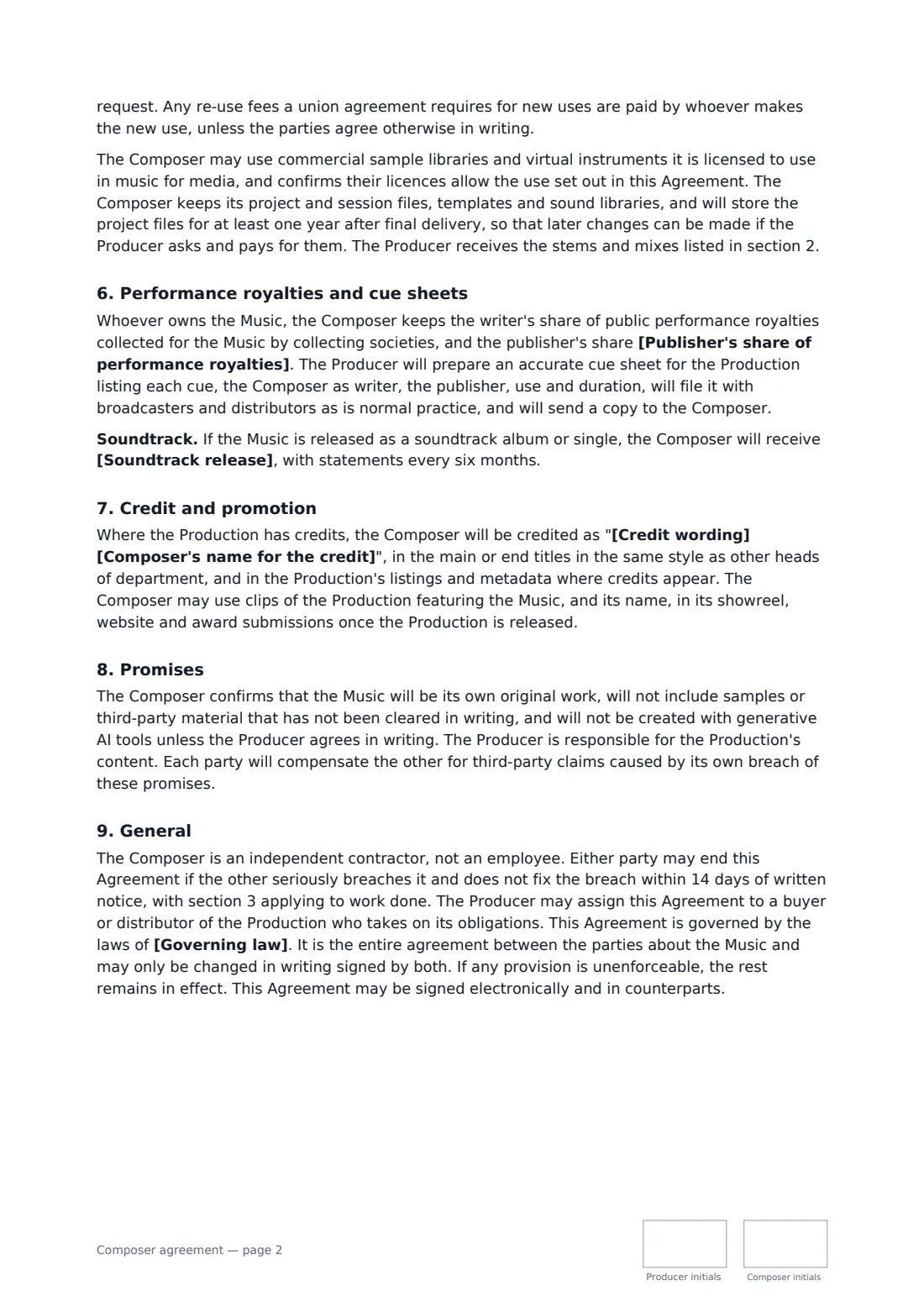
This template covers the music required and its style, demo and final delivery dates, revisions per cue and re-timing for picture changes, delivery formats and stems, an all-in package or creative fee with an approved recording budget, payment stages and cancellation, either the producer owning the music or the composer keeping copyright and licensing it, edits allowed, performer consents and union re-use fees, sample libraries and project files, the composer's writer's share of performance royalties and who gets the publisher's share, cue sheets, an optional soundtrack royalty, credit and showreel use, and originality and no-generative-AI promises.
- Best for
- Independent film, TV, game, advertising and podcast producers commissioning original music
- Signed by
- The producer (with a job title) and the composer
- Ownership
- The producer owns the music, or the composer keeps it and grants a licence
- Length
- 3 pages, initialled on every page
When to use a composer agreement
- Scoring a short film or feature documentary
- Commissioning a soundtrack for an indie video game
- An agency commissioning an original track for an advertisement
- A podcast commissioning a theme and transition stings
- A theatre company commissioning incidental music
What you fill in
26 blanks, then the name and email of each person who signs: producer, composer.
1 The parties
- Agreement date*
- Producer's legal name*
- Producer's address
- Composer's legal name (or company)*
- Composer's name for the credit*
- Composer's address
2 The production
- Production title*
- Type of production* feature film · short film · documentary · television series · video game · advertisement · podcast · online series
3 The music
- Music required*
- Style and instrumentation
4 Schedule and delivery
- Demos or mock-ups of all cues by*
- Final mixed music by*
- Rounds of revisions per cue included*
- Re-timing for picture changes* included for minor edits; major re-cuts charged as extra work · included without limit until picture lock · charged as extra work
- Delivery formats*
5 Fee
- Currency*
- Composer fee*
- The fee is* an all-in package (the Composer pays musicians, studio and mixing) · a creative fee only (the Producer pays recording costs it approves)
- Fee paid* half on signing and half on delivery of the final music · one third on signing, one third on approval of demos and one third on delivery · in full on delivery of the final music
- Rate for extra work
6 Rights and royalties
- Who owns the music* The Producer owns the music · The Composer owns the music and licenses it to the Producer
- Licence covers (if the Composer owns the music)
- Publisher's share of performance royalties* goes to the Composer · goes to the Producer (or its music publisher) · is split equally
- Soundtrack release
- Credit wording*
- Governing law*
7 Who signs
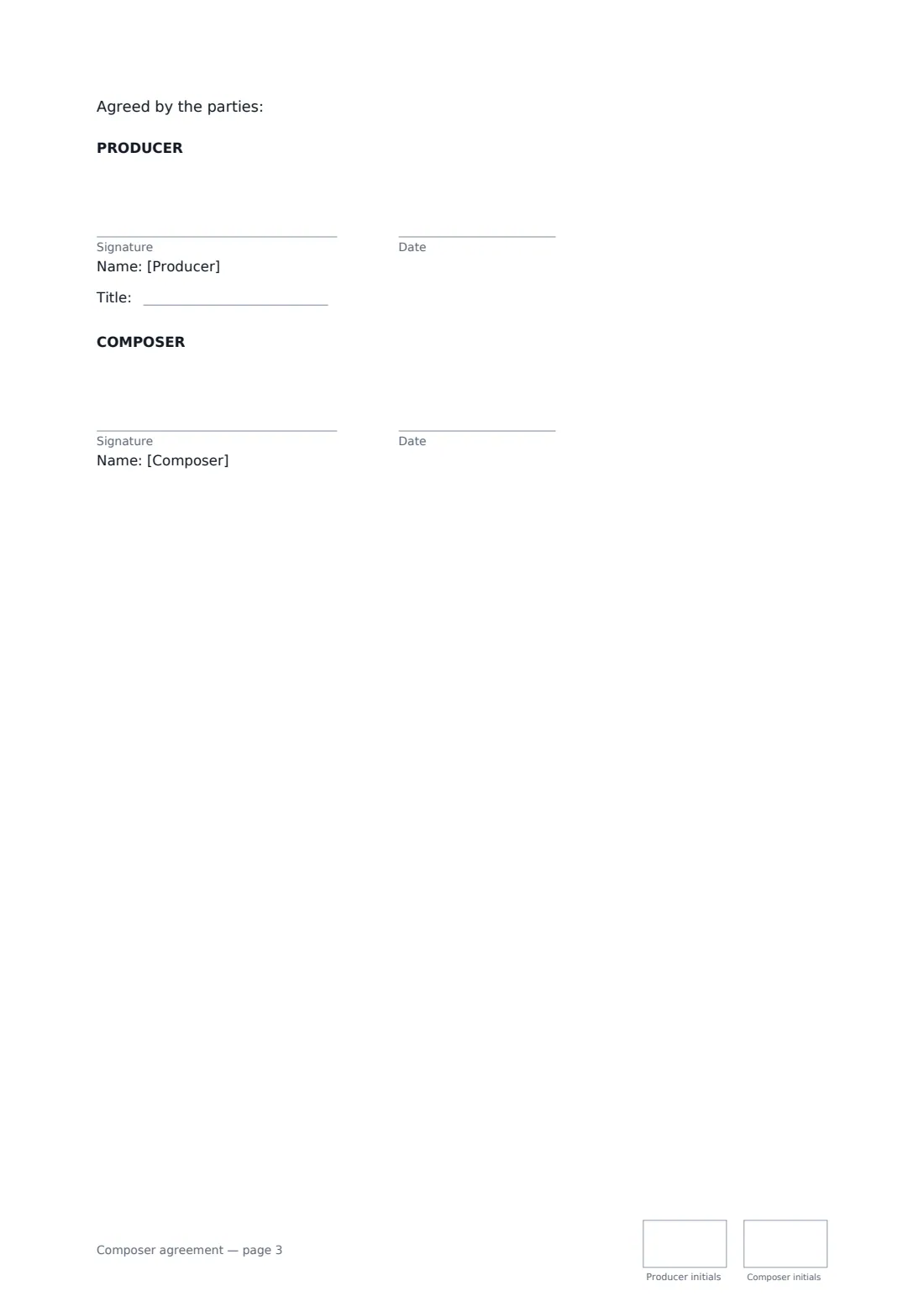
- Producer signature and date, job title, initials on every page · An authorised person at the production company, studio or agency commissioning the music.
- Composer signature and date, initials on every page · The composer, or the composer's company.
What the composer agreement covers
- The production and the music
- Schedule, revisions and delivery
- Fee and costs
- Ownership and licence
- Musicians, sample libraries and project files
- Performance royalties and cue sheets
- Credit and promotion
- Promises
- General
Using the composer agreement, step by step
1 Describe the production and the music
Name the production and its type, describe the music required — cues, themes and approximate running time — and add style and instrumentation notes if you have them.
2 Set the schedule and delivery
Choose dates for demos and final mixes, revisions per cue, how picture changes are handled, and the delivery formats and stems you need.
3 Agree the fee
Enter the fee, whether it is an all-in package or a creative fee with recording costs on the producer, how it is paid in stages, and a rate for extra work.
4 Decide ownership and royalties
Choose whether the producer owns the music or the composer licenses it (describe the licence), who gets the publisher's share of performance royalties, any soundtrack royalty, and the credit wording.
5 Send for signature
Send it to the composer. Once signed, the agreement is filed in your vault with the production's other contracts.
Tips before you send it
- Owning the music usually costs more than licensing it. A licence lets the composer keep the copyright and reuse unused material.
- Whoever owns the music, the composer keeps the writer's share of performance royalties under the template — file accurate cue sheets so they are paid.
- With a package deal, the composer pays musicians and studios out of the fee. Make sure the fee covers the recording you want.
- Union agreements may require re-use fees for new uses of recorded music. The template puts them on whoever makes the new use unless you agree otherwise.
Sign it online in minutes
- Fill in the blanks. Names, dates and amounts go straight into the agreement — the preview shows exactly where.
- Name who signs. Tick “This is me” for your own part. FileIt builds the PDF with every signature, date and initials box on the right line, and you can check or move anything before sending.
- Send it. Each signer gets a secure link and signs from any device — no account needed. The signed PDF, with an audit trail and a Certificate of Completion, is filed in your vault and emailed to everyone.
Composer agreement: frequently asked questions
What is a package deal?
In a package (all-in) deal, the composer's fee covers writing and producing the music, including paying musicians, studio and mixing. In a creative-fee deal, the composer is paid for writing and the producer pays recording costs under a budget it approves.
Who gets the performance royalties?
The composer always keeps the writer's share of public performance royalties collected for the music. You choose whether the publisher's share goes to the composer, to the producer or its music publisher, or is split equally.
What if the producer decides not to use the music?
The producer pays the instalments already due plus a fair proportion of the next instalment for work done. Rights pass only in music that has been paid for.
Can a composer agreement be signed electronically?
In most countries, including the US (ESIGN Act and UETA), the UK, the EU (eIDAS) and Canada, an electronic signature is generally valid for an ordinary commercial contract like this one. FileIt keeps an audit trail and a Certificate of Completion with the signed PDF as evidence of who signed and when.
Is this template free?
Yes. The template is free to use with the eSignature app in FileIt, and the people you send it to don't need a FileIt account to sign.