What is a invention disclosure form?
An invention disclosure is the first step towards protecting a new idea at a company, lab or university. It tells the organisation that something potentially valuable exists, before anyone presents it at a conference or ships it in a product. Dates, contributors and any earlier public disclosure matter a great deal later, and they are easiest to record accurately at the start.
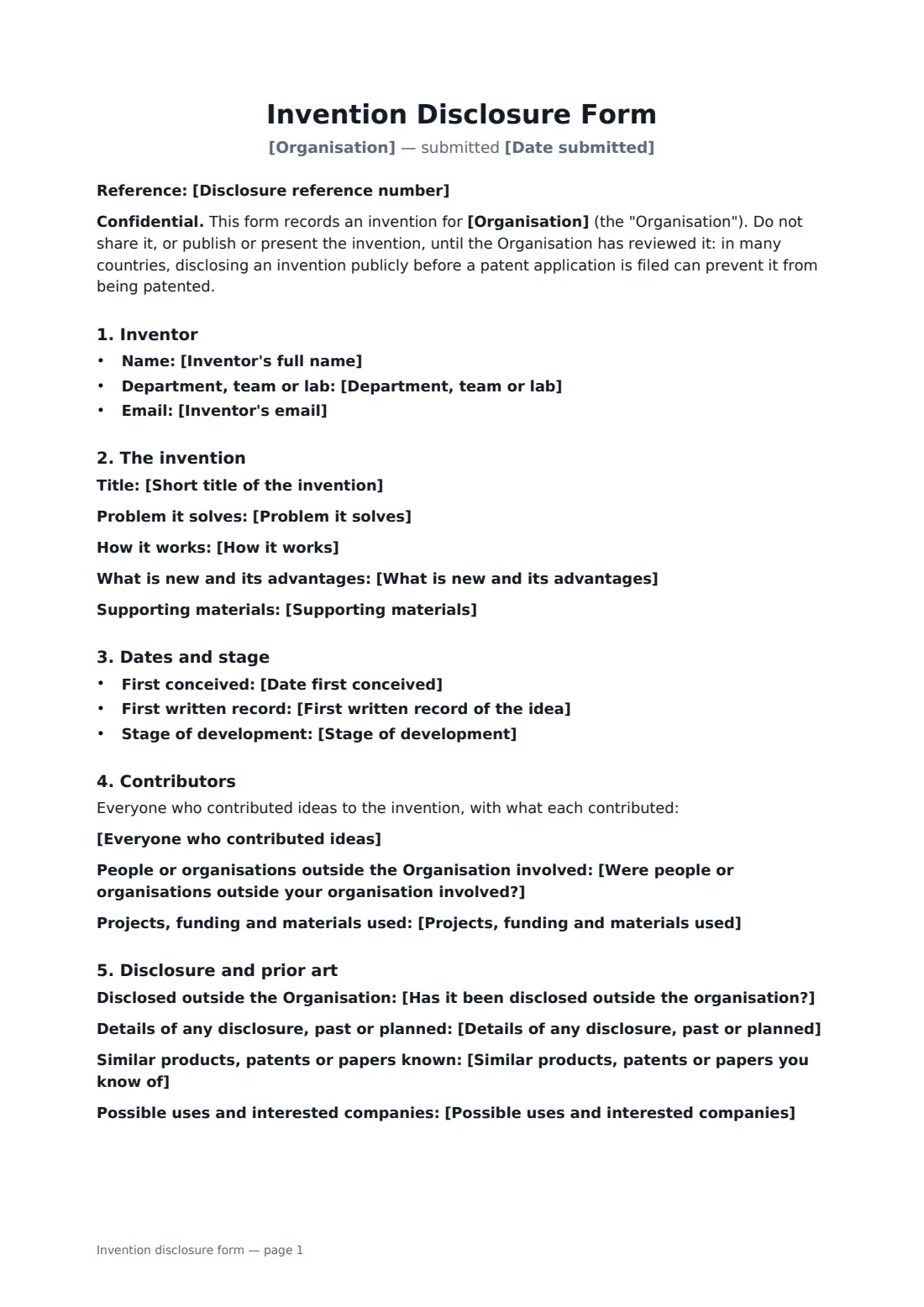
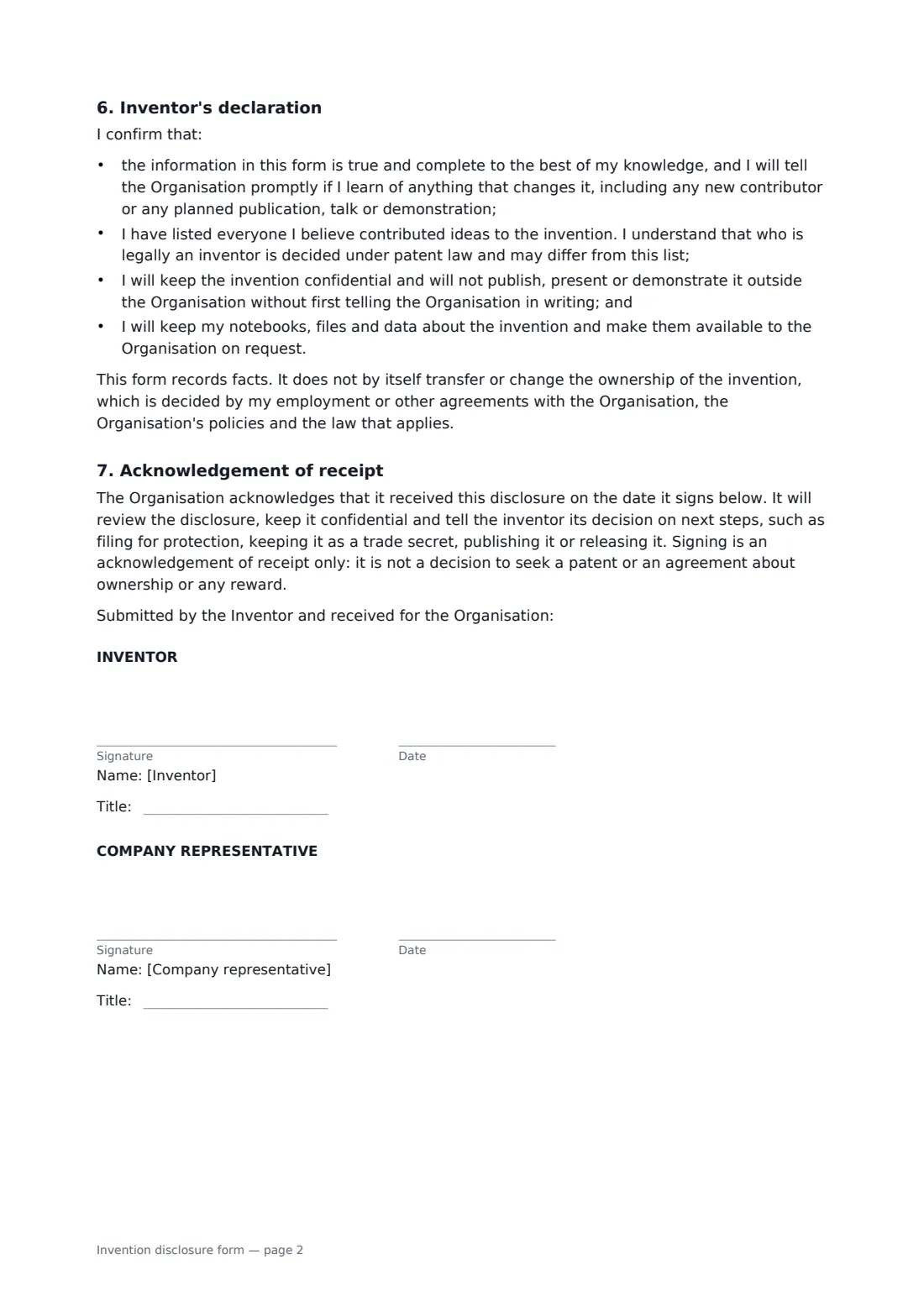
This form records the inventor and their team, a title, the problem solved, how it works, what is new and where the supporting evidence lives. It records the date of conception and its first written record, the stage of development, every contributor and what each did, outside involvement and agreements, projects, funding and third-party materials, any past or planned public disclosure, known prior art and possible uses. The inventor confirms accuracy and confidentiality; a company representative signs to acknowledge receipt. Neither signature transfers ownership or commits to filing a patent.
- Best for
- Employees, researchers and students reporting a new invention to their organisation
- Signed by
- The inventor and a manager or IP officer acknowledging receipt
- Records
- Description, conception date, contributors, funding, disclosures, prior art
- Length
- 2 pages
When to use a invention disclosure form
- An engineer reporting a new sensor design to the company's IP team
- A university researcher notifying the technology transfer office
- A software team recording a novel algorithm before a conference talk
- A start-up keeping a dated record of each new invention for its investors
- A contractor disclosing an invention made on a client project
What you fill in
22 blanks, then the name and email of each person who signs: inventor, company representative.
1 Reference
- Organisation*
- Disclosure reference number
- Date submitted*
2 Inventor
- Inventor's full name*
- Department, team or lab*
- Inventor's email
3 The invention
- Short title of the invention*
- Problem it solves*
- How it works*
- What is new and its advantages*
- Supporting materials
4 Dates and stage
- Date first conceived*
- First written record of the idea
- Stage of development* Concept only · Tested in the lab or as a prototype · Working prototype or pilot in use · In or close to a product
5 Contributors
- Everyone who contributed ideas*
- Were people or organisations outside your organisation involved?* No · Yes
- Outside involvement and any agreements
- Projects, funding and materials used
6 Disclosure and prior art
- Has it been disclosed outside the organisation?* No · Yes · Not yet, but planned
- Details of any disclosure, past or planned
- Similar products, patents or papers you know of
- Possible uses and interested companies
7 Who signs
- Inventor signature and date, job title · The person submitting the disclosure. Co-inventors are listed in the form; each can sign their own copy.
- Company representative signature and date, job title · The manager, IP or technology transfer officer who receives the disclosure.
What the invention disclosure form covers
- Inventor
- The invention
- Dates and stage
- Contributors
- Disclosure and prior art
- Inventor's declaration
- Acknowledgement of receipt
Using the invention disclosure form, step by step
1 Fill in the reference details
Enter your organisation, an optional reference number and the submission date, then your name, team and email.
2 Describe the invention
Give a title, the problem it solves, how it works and what is new, and list where drawings, code and data are kept.
3 Record dates and people
Enter the conception date and first written record, the stage of development, every contributor, outside involvement and funding.
4 Record disclosures and send
Say whether it has been or will be disclosed outside, list known prior art, then sign it and send it to your manager or IP officer to acknowledge receipt.
Tips before you send it
- Submit the form before any talk, paper, poster, demo or sale. In many countries, public disclosure before filing can prevent a patent.
- List everyone who contributed ideas, even if you're unsure they count as inventors; legal inventorship is decided later under patent law.
- Mention grants, customer projects and material transfer agreements — they can affect who owns the invention or who must be told.
- Keep the signed form in FileIt with the lab notebooks and drawings it refers to.
Sign it online in minutes
- Fill in the blanks. Names, dates and amounts go straight into the agreement — the preview shows exactly where.
- Name who signs. Tick “This is me” for your own part. FileIt builds the PDF with every signature, date box on the right line, and you can check or move anything before sending.
- Send it. Each signer gets a secure link and signs from any device — no account needed. The signed PDF, with an audit trail and a Certificate of Completion, is filed in your vault and emailed to everyone.
Invention disclosure form: frequently asked questions
Does signing this form give the company my invention?
No. The form records facts. Ownership is decided by your employment or other agreements, the organisation's policies and the law. The company's signature only acknowledges receipt.
Is an invention disclosure the same as a patent application?
No. It's an internal record. The organisation reviews it and decides whether to file for protection, keep it as a trade secret, publish it or release it.
Why does the date of conception matter?
It can help show when an idea was first complete, and helps the organisation work out what came before. Give your best estimate and point to the first written record you have.
Can it be signed electronically?
In most countries, including the US (ESIGN Act and UETA), the UK, the EU (eIDAS) and Canada, an electronic signature is generally valid for an agreement like this one. FileIt keeps an audit trail and a Certificate of Completion with the signed PDF as evidence of who signed and when.
Is this template free?
Yes. The template is free to use with the eSignature app in FileIt, and the people you send it to don't need a FileIt account to sign.