What is a research collaboration agreement?
Joint research between a university and a company, or between two companies or labs, works best when the hard questions are settled before anyone starts the experiments. Who owns a discovery made by one side's researcher using the other side's materials? Can the academic team publish, and how long can the company hold that back to file a patent? What happens to the money if the project is cut short?
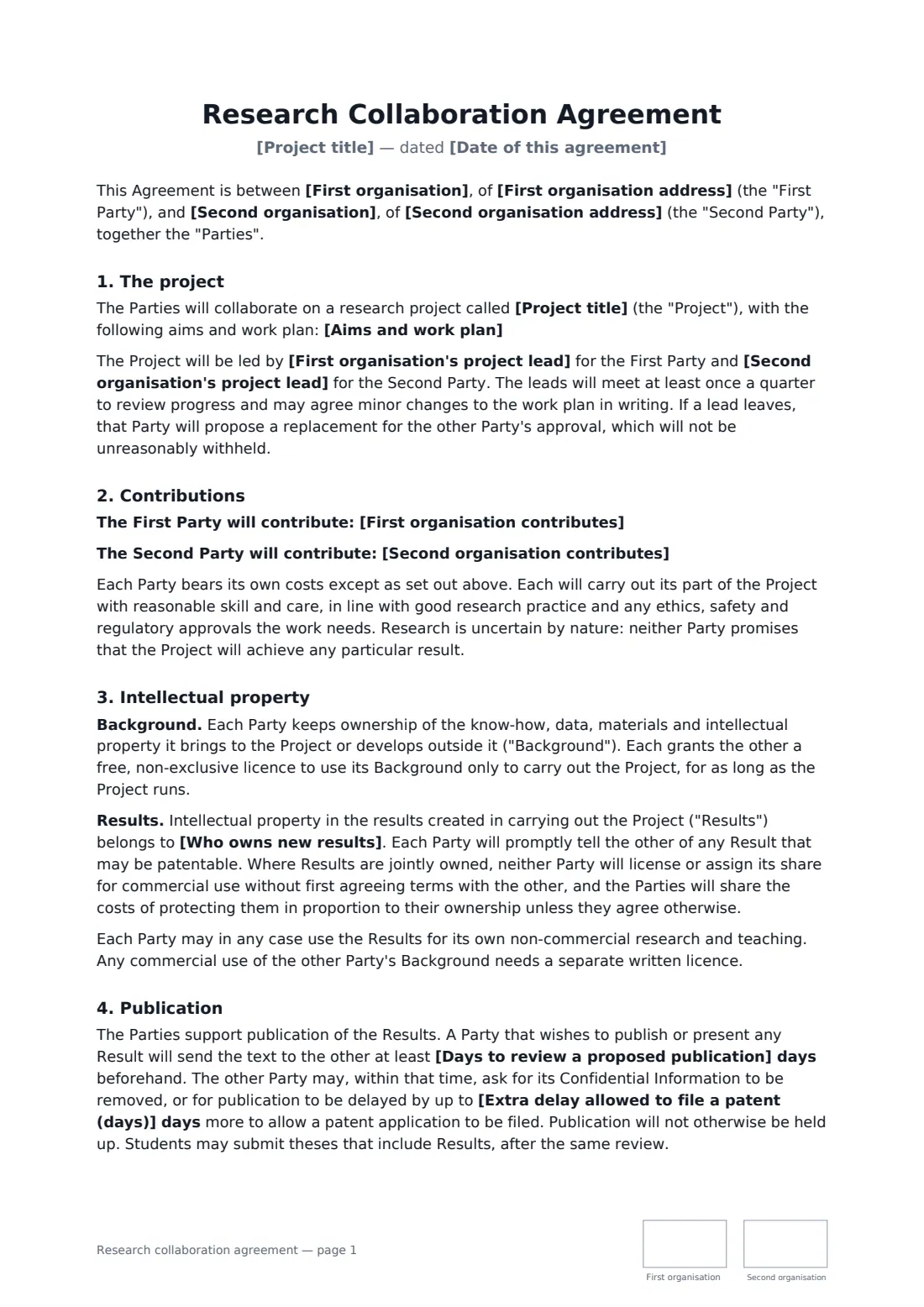
This template defines the project, its aims and the two project leads, and records what each organisation contributes, from equipment and staff time to funding. Each side keeps its background IP and licenses it for the project. You choose who owns the results, and there is a publication review period with an optional delay for patent filing. Confidentiality, a fixed term and notice to end are included.
- Best for
- University and industry projects, or two companies doing joint R&D
- Signed by
- An authorised signatory for each organisation
- IP options
- The creator owns, or one party owns with a licence to the other
- Length
- About 3 pages, initialled on every page
When to use a research collaboration agreement
- A materials company funding a university lab to test new formulations
- Two start-ups pooling data and engineering time on a shared technical problem
- A hospital research unit working with a medical device maker on a study design
- A research institute and a small business applying jointly for grant funding
- Formalising a collaboration that began with informal discussions between scientists
What you fill in
17 blanks, then the name and email of each person who signs: first organisation, second organisation.
1 The parties
- Date of this agreement*
- First organisation*
- First organisation address
- Second organisation*
- Second organisation address
2 The project
- Project title*
- Aims and work plan*
- First organisation's project lead*
- Second organisation's project lead*
3 Contributions
- First organisation contributes*
- Second organisation contributes*
4 Results and publication
- Who owns new results* the party whose staff created them, or jointly if created jointly · the Second Party, with a licence back to the First Party for research and teaching · the First Party, with a licence to the Second Party to use them in its own business
- Days to review a proposed publication*
- Extra delay allowed to file a patent (days)*
5 Term
- Project start date*
- Project end date*
- Governing law*
6 Who signs
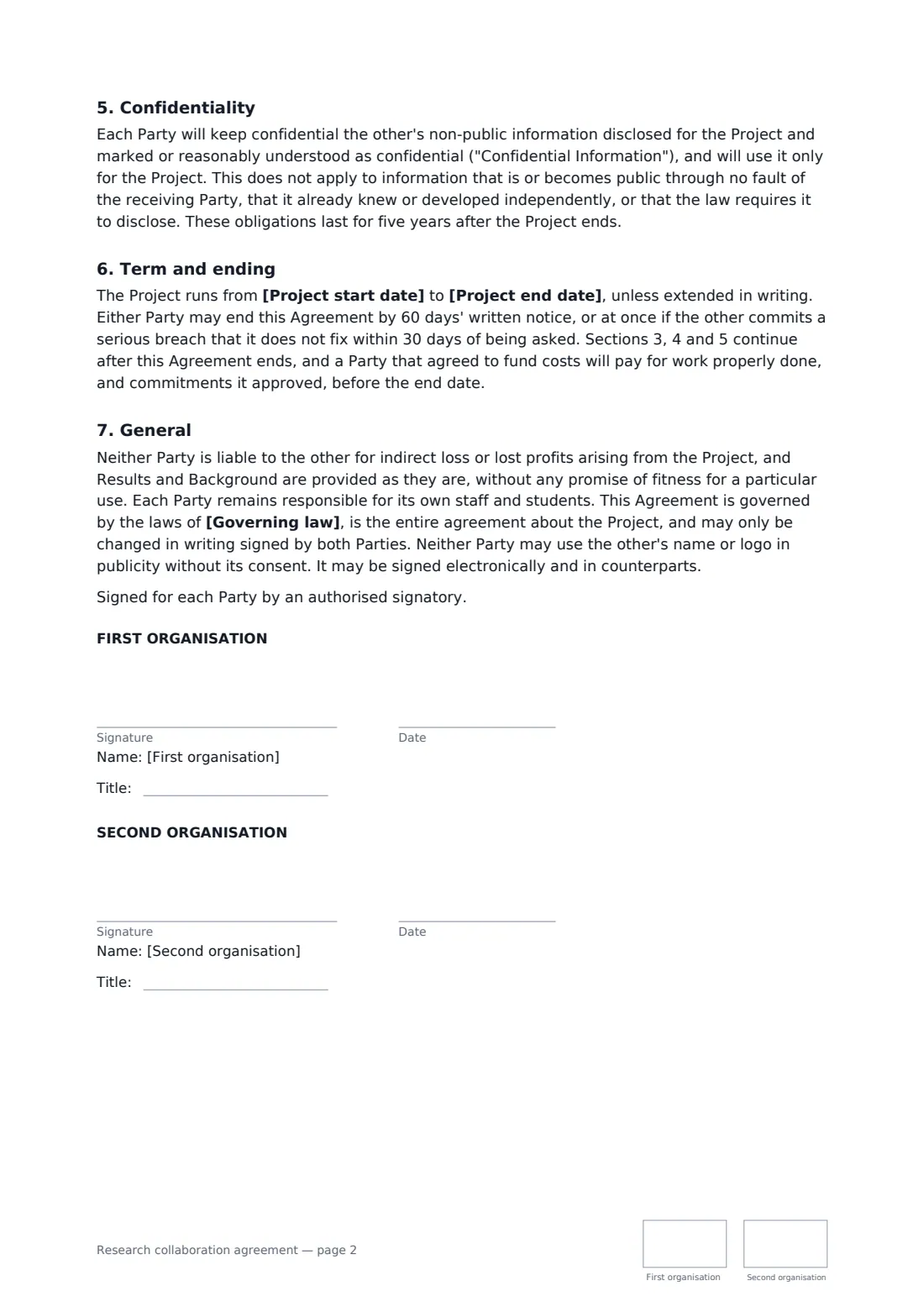
- First organisation signature and date, job title, initials on every page · Signed by someone with authority to commit the organisation, not necessarily the project lead.
- Second organisation signature and date, job title, initials on every page
What the research collaboration agreement covers
- The project
- Contributions
- Intellectual property
- Publication
- Confidentiality
- Term and ending
- General
Using the research collaboration agreement, step by step
1 Describe the project
Give the project a title and summarise its aims and work plan. Name the lead on each side who will run it day to day.
2 Record each side's contribution
List what each organisation provides: staff, equipment, materials, data or money, and when any payments are due.
3 Choose how IP and publication work
Pick who owns new results, then set how many days each side has to review a publication and how much extra time is allowed to file a patent.
4 Set the dates and sign
Enter the start and end dates and the governing law. Send it to authorised signatories on both sides. Each initials every page.
Tips before you send it
- Universities usually have a research contracts or technology transfer office that must approve these agreements. Involve them early.
- If there is grant funding, check its terms first. Funders often set their own rules on IP and publication.
- List any important background IP in a schedule so there is no later argument over what each side brought.
- Keep dated lab records. They are the best evidence of who created which result.
Sign it online in minutes
- Fill in the blanks. Names, dates and amounts go straight into the agreement — the preview shows exactly where.
- Name who signs. Tick “This is me” for your own part. FileIt builds the PDF with every signature, date and initials box on the right line, and you can check or move anything before sending.
- Send it. Each signer gets a secure link and signs from any device — no account needed. The signed PDF, with an audit trail and a Certificate of Completion, is filed in your vault and emailed to everyone.
Research collaboration agreement: frequently asked questions
What is the difference between background IP and results?
Background is what each side already owns or develops outside the project. Results are what the project itself produces. Each side keeps its background, and the agreement decides who owns the results.
Can the company stop the university publishing?
No. It can review a draft, ask for its confidential information to be removed, and delay publication for a limited extra period to file a patent. After that, publication goes ahead.
Is this the same as a material transfer agreement?
No. A material transfer agreement covers handing over specific research materials for the recipient's own work. A collaboration agreement covers working on a shared project together.
Who should sign it?
Someone with authority to bind each organisation, often a contracts officer or director rather than the scientist leading the work. The leads are named in the agreement itself.