What is a material transfer agreement?
Labs share materials all the time: a cell line, a plasmid, tissue samples, a novel compound, a prototype device. Once the vial leaves your freezer, a material transfer agreement is what keeps it from ending up in a commercial product, in another lab you have never heard of, or in a publication that gives away your next patent. Most universities will not ship or accept materials without one.
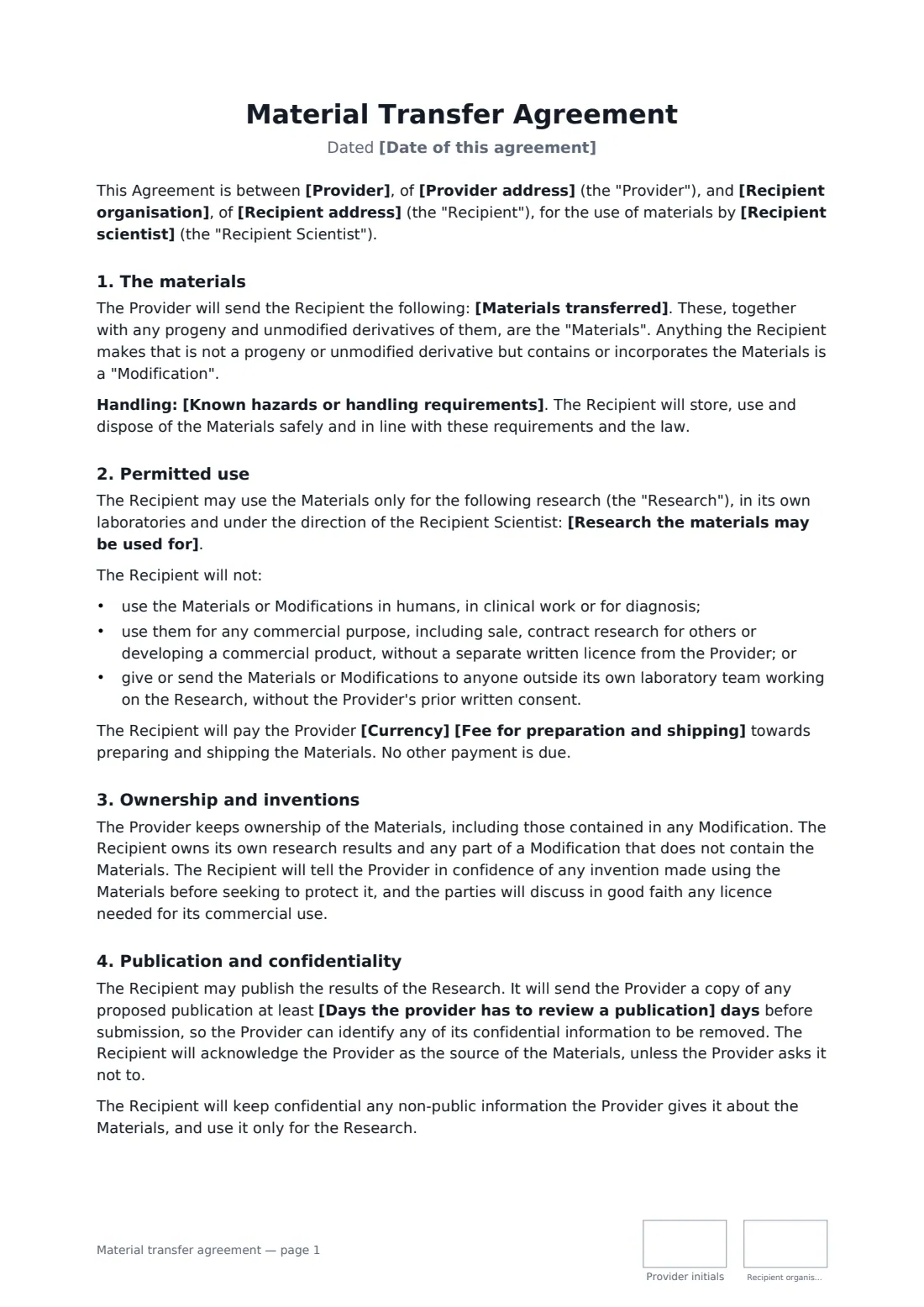
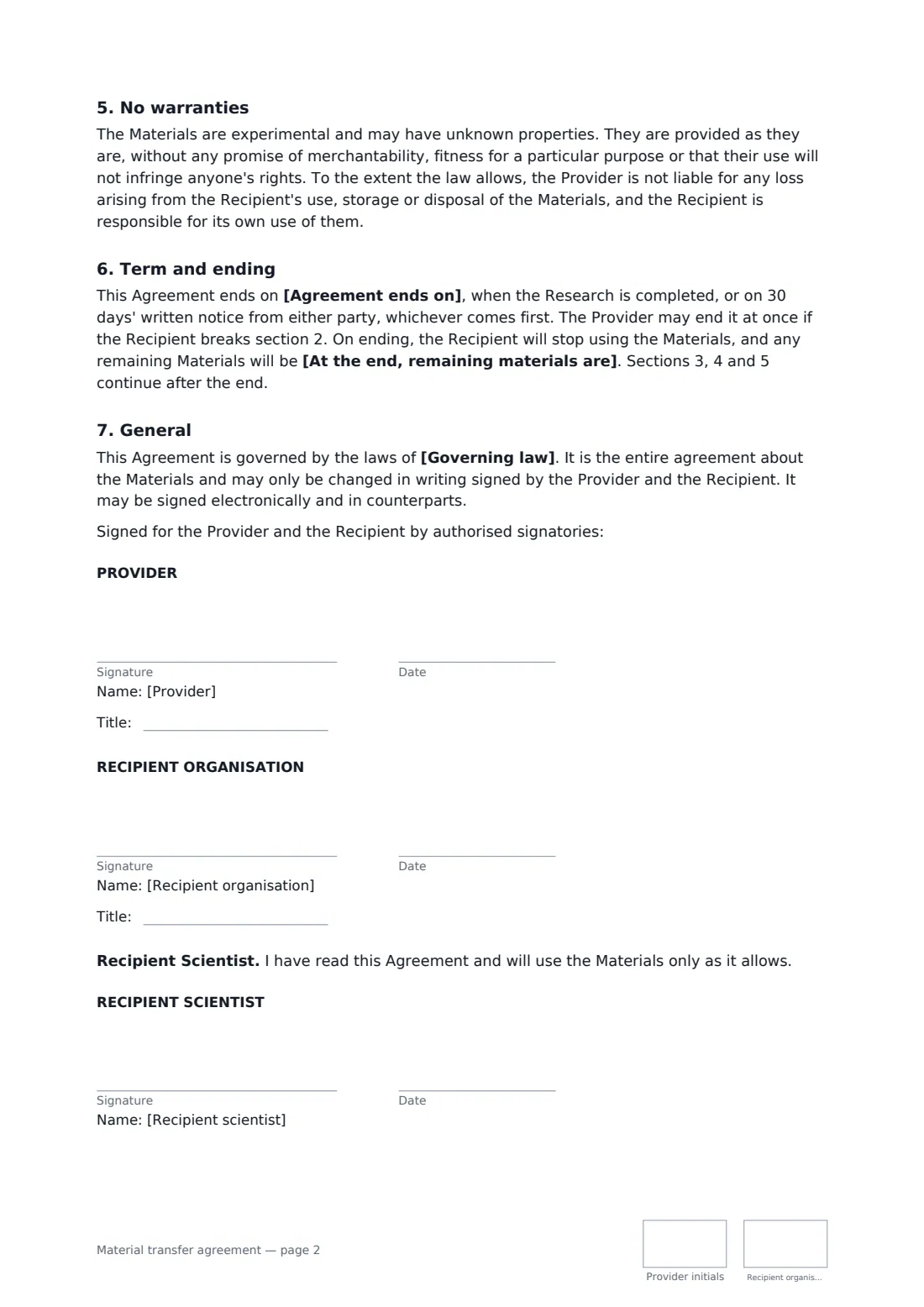
This template describes the materials, with handling requirements and a paragraph for human-derived samples. It limits use to the research you name, in the recipient's own lab, with no human use, no commercial use and no passing them on. The provider keeps ownership of the materials, while the recipient owns its own results and tells the provider of any invention. There is publication review with acknowledgement, a no-warranty clause and return or destruction at the end. The recipient scientist signs as well.
- Best for
- Academic and industry labs sharing biological or chemical materials
- Signed by
- The provider, the recipient organisation and the recipient scientist
- Use
- Named research only, no commercial use or onward transfer
- Length
- About 2 to 3 pages
When to use a material transfer agreement
- A university lab sending a cell line to a collaborator at another institution
- A biotech company supplying a test compound to an academic group for an independent study
- A hospital biobank releasing anonymised samples to an approved research team
- A start-up lending prototype sensors to a research group for evaluation
- A researcher who has moved institutions asking for their former lab's materials
What you fill in
16 blanks, then the name and email of each person who signs: provider, recipient organisation, recipient scientist.
1 The parties
- Date of this agreement*
- Provider*
- Provider address
- Recipient organisation*
- Recipient address
- Recipient scientist*
2 The materials
- Materials transferred*
- Known hazards or handling requirements
- Are the materials of human origin?* No · Yes
3 Use
- Research the materials may be used for*
- Fee for preparation and shipping
- Currency
- Days the provider has to review a publication*
4 Term
- Agreement ends on*
- At the end, remaining materials are* destroyed, and the destruction confirmed in writing · returned to the Provider at the Provider's cost · returned or destroyed, as the Provider chooses
- Governing law*
5 Who signs
- Provider signature and date, job title, initials on every page · The organisation that owns and sends the materials.
- Recipient organisation signature and date, job title, initials on every page · Signed by someone authorised to bind the receiving organisation.
- Recipient scientist signature and date, initials on every page · The researcher who will use the materials. Signs to confirm they have read and will follow the agreement.
What the material transfer agreement covers
- The materials
- Permitted use
- Ownership and inventions
- Publication and confidentiality
- No warranties
- Term and ending
- General
Using the material transfer agreement, step by step
1 Name the organisations and scientist
Enter the provider, the recipient organisation and the scientist who will use the materials. The scientist signs as well as their institution.
2 Describe the materials
Give the quantity, form and identifiers. Add storage or biosafety requirements, and say whether the materials are of human origin.
3 Define the permitted research
Describe the study the materials may be used for. Add a fee only if you charge for preparation and shipping, and set the publication review period.
4 Set the end and send
Choose the end date and whether leftovers are destroyed or returned. Send it for signature before the materials ship, and keep the signed MTA in your vault.
Tips before you send it
- Do not ship anything until every party has signed. Customs and couriers may also ask for permits for biological or hazardous materials.
- Check whether the materials themselves came to you under an earlier MTA that restricts passing them on.
- For human samples, confirm the donor consent covers the recipient's planned research before you send them.
- Many institutions use standard forms such as the UBMTA for routine academic transfers. Check whether your partner prefers one.
Sign it online in minutes
- Fill in the blanks. Names, dates and amounts go straight into the agreement — the preview shows exactly where.
- Name who signs. Tick “This is me” for your own part. FileIt builds the PDF with every signature, date and initials box on the right line, and you can check or move anything before sending.
- Send it. Each signer gets a secure link and signs from any device — no account needed. The signed PDF, with an audit trail and a Certificate of Completion, is filed in your vault and emailed to everyone.
Material transfer agreement: frequently asked questions
What is a modification?
Something the recipient makes that contains or incorporates the materials but is not simply progeny or an unmodified derivative. The provider keeps ownership of the materials inside a modification, and the recipient owns the rest.
Can the recipient publish results?
Yes. They send the provider a draft first so it can ask for its confidential information to be removed, and they acknowledge the provider as the source of the materials.
Why does the scientist sign as well as the institution?
The scientist is the person who handles the materials day to day. Their signature confirms they have read the restrictions and will follow them.
What happens if the recipient wants to use the materials commercially?
They need a separate written licence from the provider. The MTA covers research use only.