What is a group therapy confidentiality agreement?
Group therapy and support groups depend on trust. Unlike one-to-one therapy, confidentiality isn't only the facilitator's duty: every member has to keep what others share private. Facilitators also need members to understand that the facilitator cannot guarantee others will keep their word, and that there are times the facilitator must share information.
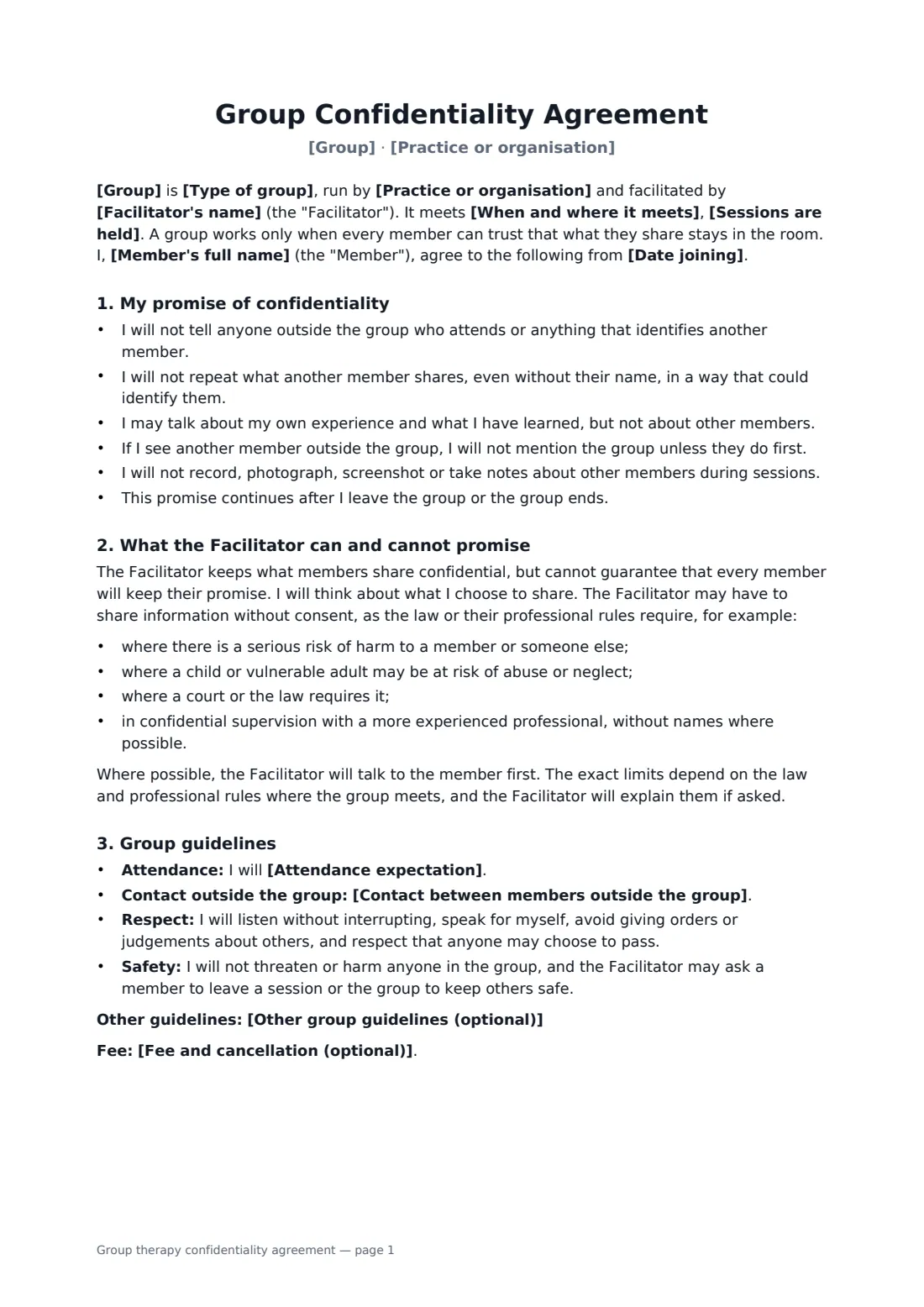
This agreement names the group, its type, when it meets and whether sessions are in person, online or both. Each member promises not to identify other members or repeat what they share, not to record or screenshot, and to keep this promise after the group ends. For online sessions, they agree to join from a private place. It explains the usual limits of confidentiality — serious risk of harm, safeguarding, legal requirements and supervision — and sets group guidelines on attendance, contact between members outside the group, respect and safety. It covers fees, leaving the group, raising concerns and where to go in a crisis.
- Best for
- Therapists, counsellors, support group facilitators and peer support groups
- Signed by
- Each member and the facilitator
- You set
- Group type, schedule, online or in person, outside contact rule, fees, crisis support
- Length
- About 2 pages
When to use a group therapy confidentiality agreement
- A therapist-led anxiety or depression skills group
- A bereavement or grief support circle
- An addiction recovery or peer support group
- An online support group for carers or new parents
- A DBT, CBT or mindfulness skills group
What you fill in
14 blanks, then the name and email of each person who signs: member, facilitator.
1 The group
- Practice or organisation*
- Group*
- Type of group* a therapy group led by a qualified therapist · a support group led by a trained facilitator · a peer support group
- When and where it meets*
- Sessions are held* in person · online by video · both in person and online
- Facilitator's name*
2 The member
- Member's full name*
- Date joining*
3 Guidelines
- Attendance expectation*
- Contact between members outside the group* allowed, but members will tell the group about any significant relationship that develops · discouraged while the group runs · not part of this group — please avoid it
- Other group guidelines (optional)
- Fee and cancellation (optional)
- Facilitator contact between sessions*
- Crisis support*
4 Who signs
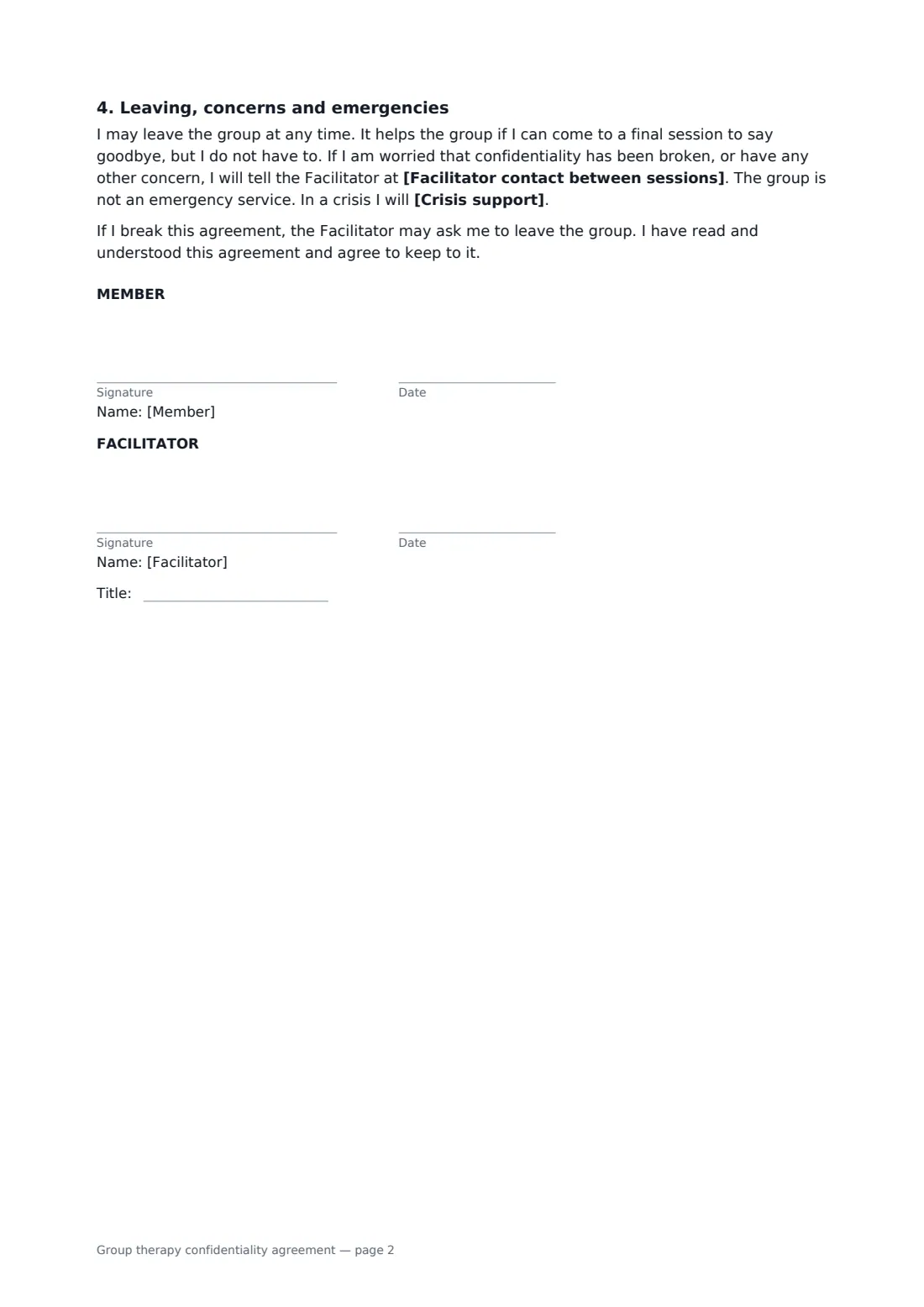
- Member signature and date · Each group member signs their own copy.
- Facilitator signature and date, job title
What the group therapy confidentiality agreement covers
- My promise of confidentiality
- What the Facilitator can and cannot promise
- Group guidelines
- Leaving, concerns and emergencies
Using the group therapy confidentiality agreement, step by step
1 Describe the group
Name the group, choose its type, and add when and where it meets and whether sessions are online.
2 Set the guidelines
Write the attendance expectation, choose the rule on contact between members outside the group, and add any other guidelines and fees.
3 Add contacts
Give your contact between sessions and where members should go in a crisis.
4 Every member signs
Send a copy to each member before the first session. They sign, you countersign, and each signed copy is kept with your records.
Tips before you send it
- Go through the agreement out loud at the first session, especially the limits of confidentiality.
- Remind members that you can't guarantee others will keep their promise, so they can choose what to share.
- Online groups need extra care: private space, headphones, no one else watching.
- Give a local crisis line as well as the emergency number.
- Your professional body may have its own requirements for group work — follow them.
Sign it online in minutes
- Fill in the blanks. Names, dates and amounts go straight into the agreement — the preview shows exactly where.
- Name who signs. Tick “This is me” for your own part. FileIt builds the PDF with every signature, date box on the right line, and you can check or move anything before sending.
- Send it. Each signer gets a secure link and signs from any device — no account needed. The signed PDF, with an audit trail and a Certificate of Completion, is filed in your vault and emailed to everyone.
Group therapy confidentiality agreement: frequently asked questions
Can the facilitator guarantee confidentiality?
The facilitator keeps what members share confidential, subject to the limits explained, but cannot guarantee every member will. The agreement says so clearly.
When might the facilitator share information?
Typically where there is a serious risk of harm, a child or vulnerable adult may be at risk, the law or a court requires it, and in confidential supervision. The exact limits depend on local law and professional rules.
Can members talk about the group to friends and family?
They may talk about their own experience and what they learned, but not identify other members or repeat what others share.
Can members meet outside the group?
You choose: allowed with openness about significant relationships, discouraged while the group runs, or to be avoided.
Does it work for peer support groups without a therapist?
Yes. Choose the peer support group type. The limits-of-confidentiality section still helps set expectations.