What is a counselling informed consent?
Clients come to counselling carrying a lot, and the practical details are easy to rush. A clear contract up front means the first session can be about the client, not about fees or whether you'd ever have to tell anyone what they said.
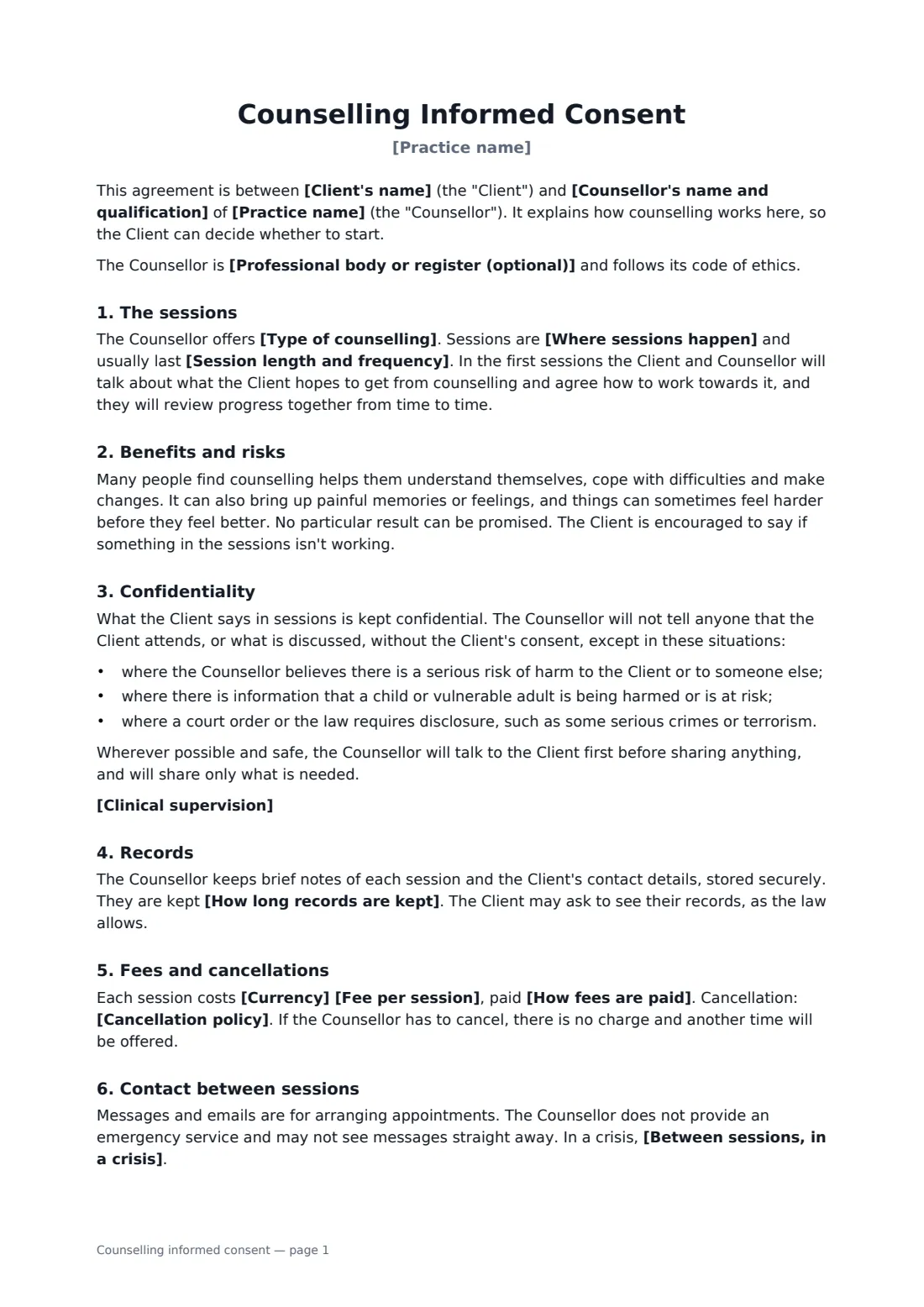
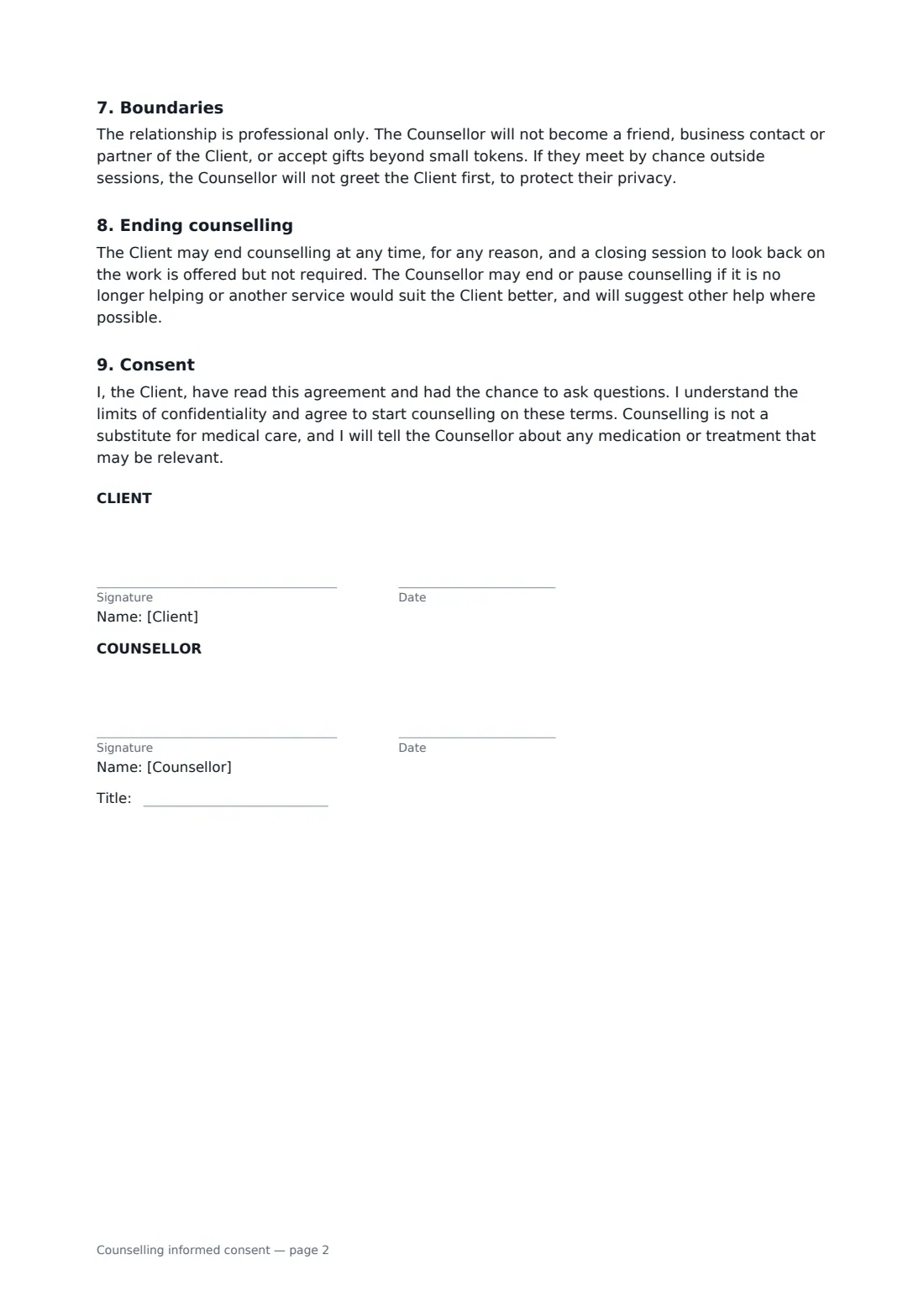
This agreement names the practice, counsellor, qualification and professional body, the type of counselling, and whether sessions are in person, by video or by phone. It explains how the work is reviewed, the possible benefits and risks, confidentiality and its three main limits, supervision, notes and how long they're kept, fees and cancellations, contact between sessions with a crisis line, professional boundaries, and how either side can end the work. For children and teenagers there is a separate parental consent form.
- Best for
- Private counsellors, psychotherapists, couples and online therapists
- Signed by
- The adult client and the counsellor
- Session formats
- In person, video, phone or a mix
- Length
- 2 pages
When to use a counselling informed consent
- Starting with a new private client
- Online therapy with clients in another town
- Short-term bereavement or stress counselling
- Employee assistance referrals to an independent counsellor
- Updating terms for existing clients when fees change
What you fill in
14 blanks, then the name and email of each person who signs: client, counsellor.
1 The counsellor
- Practice name*
- Counsellor's name and qualification*
- Professional body or register (optional)
2 Sessions
- Type of counselling*
- Client's name*
- Where sessions happen* in person at the practice · by secure video call · by phone · a mix of in person and video
- Session length and frequency*
3 Fees
- Currency*
- Fee per session*
- How fees are paid*
- Cancellation policy*
4 Confidentiality
- Clinical supervision* The Counsellor discusses their work with a clinical supervisor, without giving the client's name or identifying details. · The Counsellor does not use clinical supervision.
- How long records are kept*
- Between sessions, in a crisis*
5 Who signs
- Client signature and date · An adult client. For a child or teenager, use the parental consent for a minor's counselling.
- Counsellor signature and date, job title
What the counselling informed consent covers
- The sessions
- Benefits and risks
- Confidentiality
- Records
- Fees and cancellations
- Contact between sessions
- Boundaries
- Ending counselling
- Consent
Using the counselling informed consent, step by step
1 You and your practice
Your practice name fills in from your account. Add your name, qualification and membership of any professional body.
2 The sessions
Describe your approach, choose the format, and set session length and frequency.
3 Fees and confidentiality
Enter your fee, payment and cancellation terms. Choose your supervision wording, how long you keep notes, and the crisis contacts you want clients to use.
4 Send before the first session
The client signs online before you meet, you countersign, and the agreement is filed in your FileIt vault. Go over confidentiality again in person at the first session.
Tips before you send it
- Check your professional body's code for anything it expects in a client contract.
- Explain the limits of confidentiality out loud as well as in writing.
- For video sessions, agree what happens if the connection drops.
- Ask clients to sign a fresh copy when your fees or policies change.
Sign it online in minutes
- Fill in the blanks. Names, dates and amounts go straight into the agreement — the preview shows exactly where.
- Name who signs. Tick “This is me” for your own part. FileIt builds the PDF with every signature, date box on the right line, and you can check or move anything before sending.
- Send it. Each signer gets a secure link and signs from any device — no account needed. The signed PDF, with an audit trail and a Certificate of Completion, is filed in your vault and emailed to everyone.
Counselling informed consent: frequently asked questions
When can a counsellor break confidentiality?
The form lists serious risk of harm to the client or others, a child or vulnerable adult at risk, and disclosure required by a court or the law. It says the counsellor will talk to the client first wherever possible.
Is this suitable for a teenager?
No. It's for adult clients. Use the parental consent for a minor's counselling for children and young people.
Can the client stop counselling?
Yes, at any time and for any reason. A closing session is offered but not required.
Does it work for online therapy?
Yes. Choose video or phone as the format. The client signs online, with no account needed, and FileIt adds an audit trail to the PDF.