What is a fundraiser funds agreement?
Online fundraisers for medical bills, funerals, a house fire or a family in crisis often start in a rush, run by a friend or relative rather than the person who needs the help. That is when things can go wrong. The money lands in the organiser's account, nobody is quite sure what it can be spent on, and when the fundraiser closes there is money left and no plan for it. A short written agreement between the organiser and the beneficiary protects both of them, and the trust of the donors.
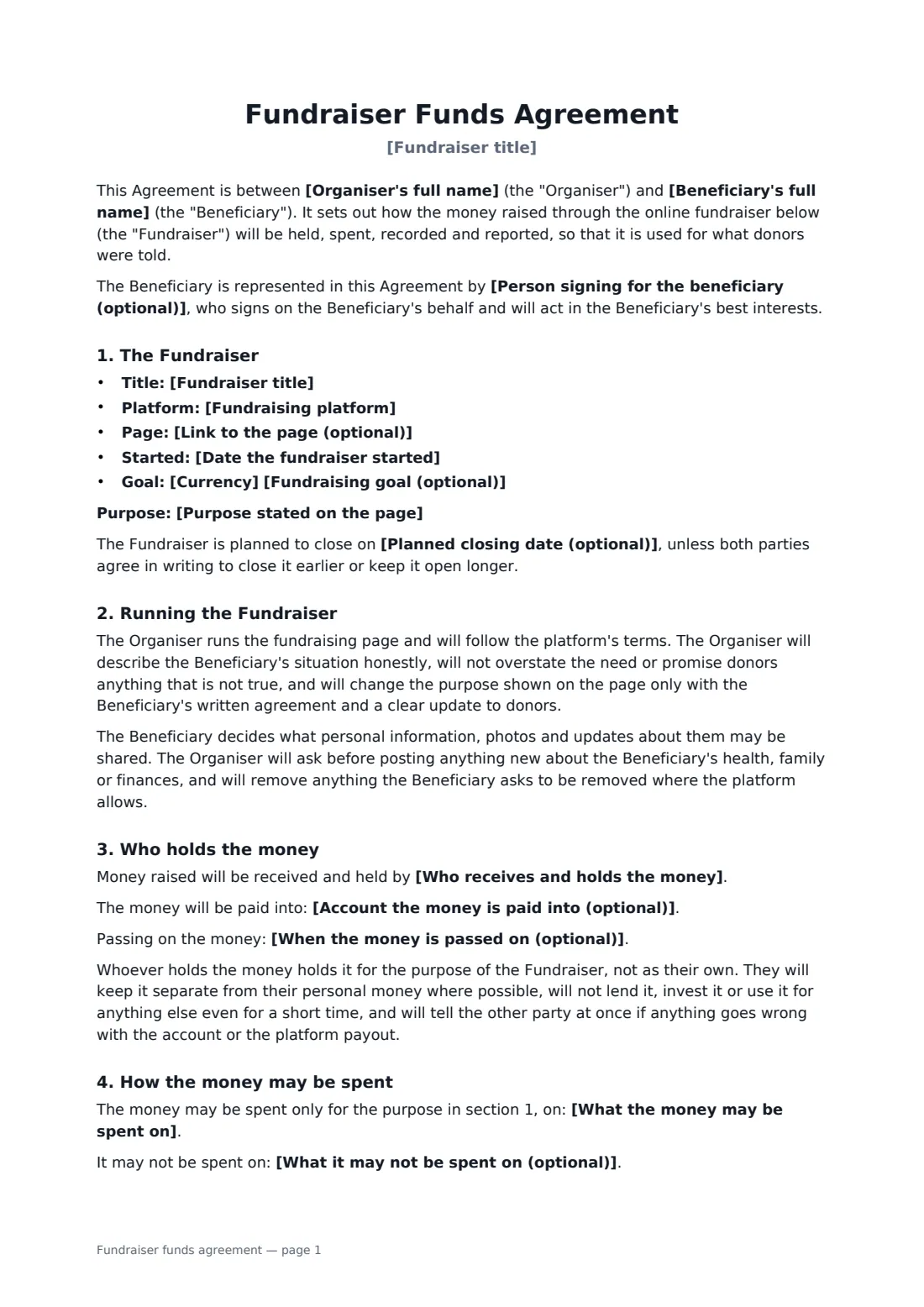
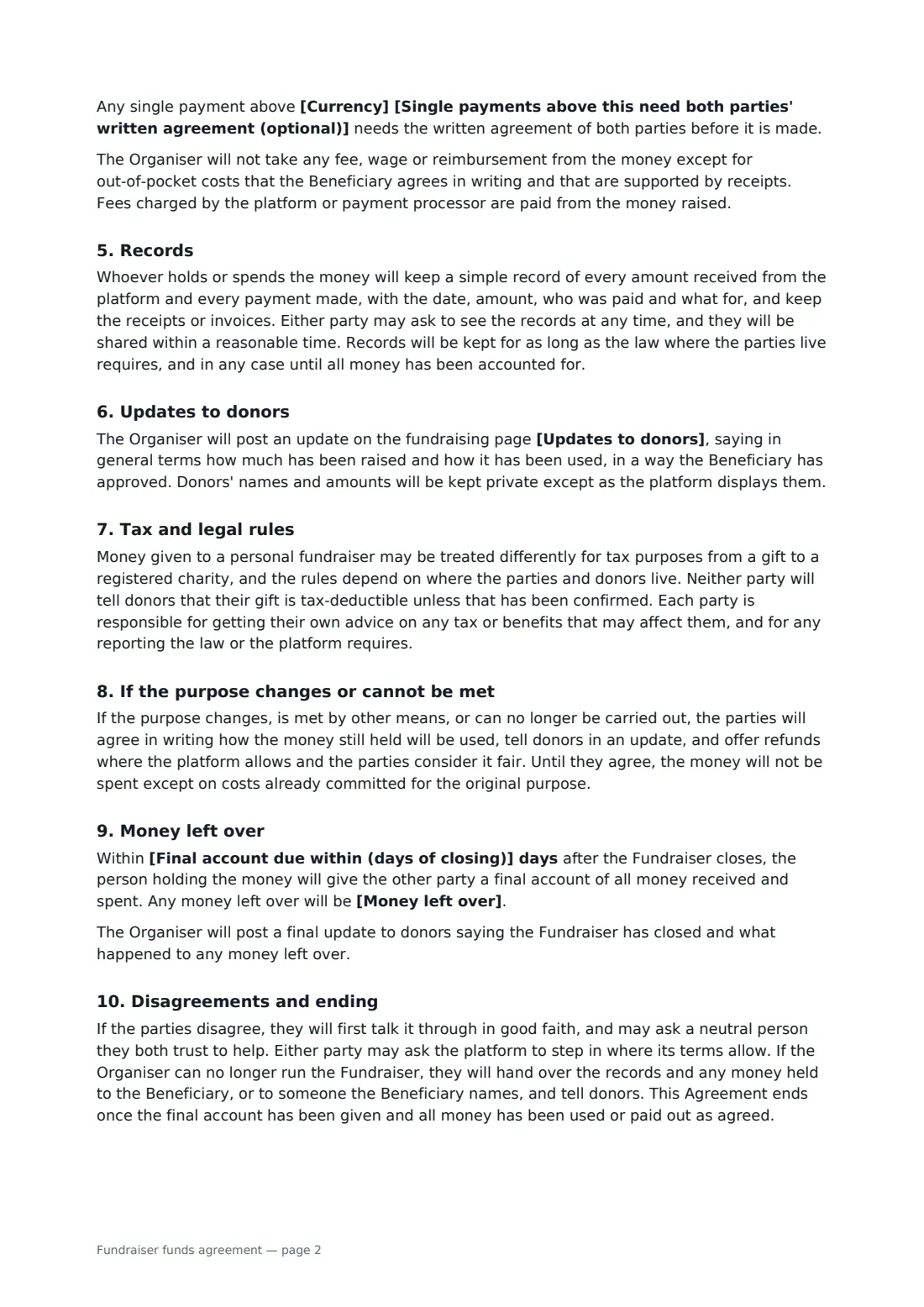
This template records the fundraiser's title, platform, link, start date, goal and stated purpose, in the same words donors saw. You choose who receives and holds the money, and when and how it is passed on, and you list what it may and may not be spent on. You can set an amount above which a payment needs both parties' written agreement. It requires a record of every amount in and out, regular updates to donors on a schedule you choose, the beneficiary's control over what is shared about them, and no payment to the organiser beyond agreed out-of-pocket costs. It also covers tax caution, what happens if the purpose changes, a final account after closing, and where any leftover money goes.
- Best for
- Personal online fundraisers run by one person for another
- Signed by
- Organiser and beneficiary (or a family member for them)
- Covers
- Who holds the money, allowed spending, records, donor updates, tax, leftover funds
- Length
- About 3 pages
When to use a fundraiser funds agreement
- A friend raising money for a family after a fire or flood
- A relative running a medical or treatment fundraiser
- A memorial or funeral fundraiser for a grieving family
- A parent signing for a child who is the beneficiary
- A community raising money for a neighbour's accessibility needs
What you fill in
25 blanks, then the name and email of each person who signs: organiser, beneficiary.
1 The people
- Organiser's full name*
- Organiser's email or phone*
- Beneficiary's full name*
- Person signing for the beneficiary (optional)
- Beneficiary's email or phone*
2 The fundraiser
- Fundraiser title*
- Fundraising platform*
- Link to the page (optional)
- Date the fundraiser started*
- Planned closing date (optional)
- Currency*
- Fundraising goal (optional)
- Purpose stated on the page*
3 Holding the money
- Who receives and holds the money* the Organiser, who will pass it to the Beneficiary as set out below · the Organiser, who will pay approved costs directly on the Beneficiary's behalf · the Beneficiary, as the platform's named recipient of the funds
- Account the money is paid into (optional)
- When the money is passed on (optional)
4 Spending
- What the money may be spent on*
- What it may not be spent on (optional)
- Single payments above this need both parties' written agreement (optional)
5 Records and updates
- Updates to donors* at least every two weeks while the fundraiser is open, and when it closes · at least once a month while the fundraiser is open, and when it closes · at each major milestone, and when it closes
6 Leftover funds
- Money left over* paid to the Beneficiary for their general needs · donated to the charity named below · used for the further purpose described below · refunded to donors where the platform allows it, with the rest donated to the charity named below
- Charity for leftover money (if chosen)
- Further purpose for leftover money (if chosen)
- Final account due within (days of closing)*
- Governing law (optional)
7 Who signs
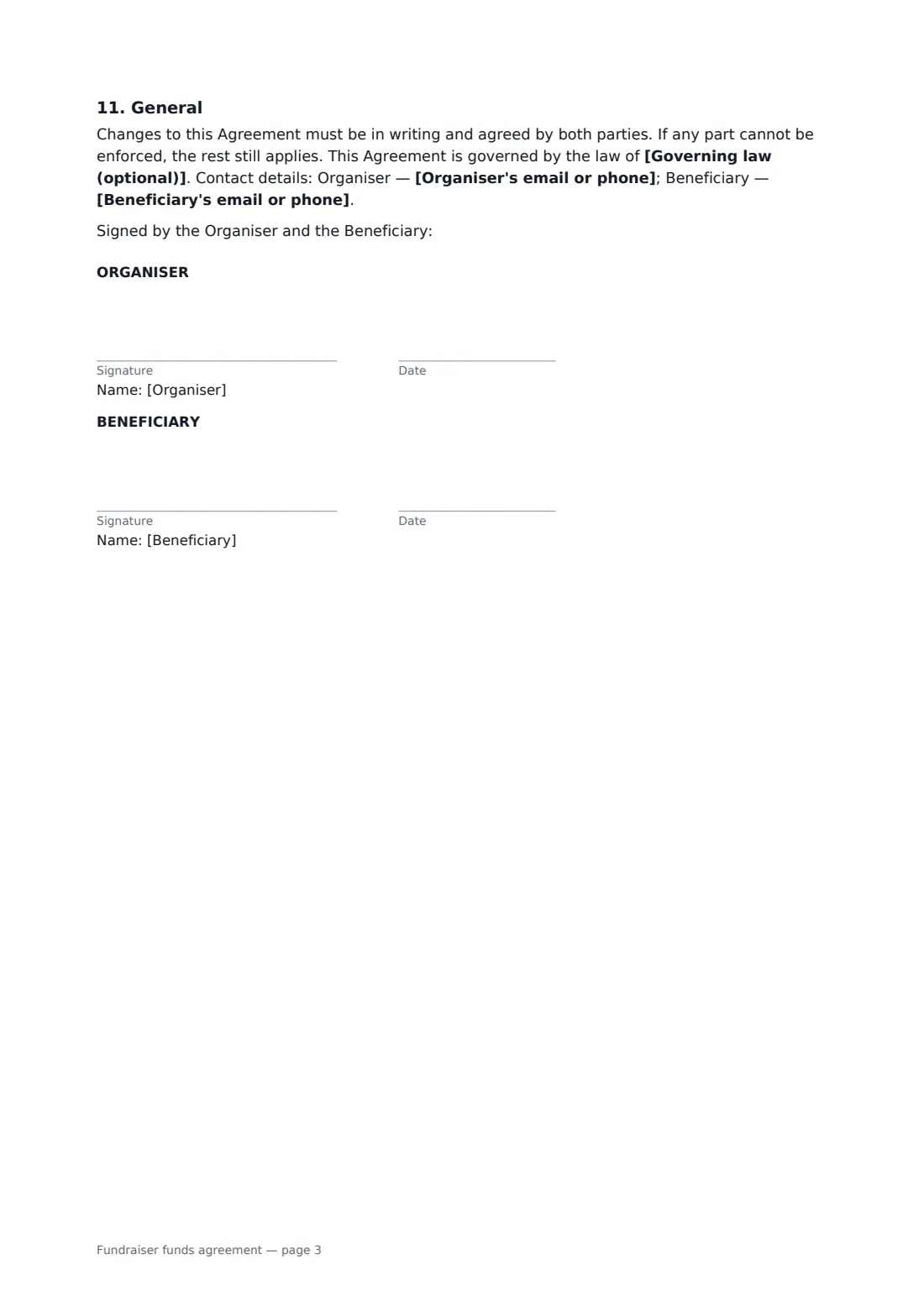
- Organiser signature and date · The person who set up and runs the fundraising page.
- Beneficiary signature and date · The person the money is raised for, or a family member signing for them. A parent or guardian signs for a child.
What the fundraiser funds agreement covers
- The Fundraiser
- Running the Fundraiser
- Who holds the money
- How the money may be spent
- Records
- Updates to donors
- Tax and legal rules
- If the purpose changes or cannot be met
- Money left over
- Disagreements and ending
- General
Using the fundraiser funds agreement, step by step
1 Describe the fundraiser
Enter the title, platform, link, start date and goal, and copy the purpose from the fundraising page. Spending is limited to that purpose, so the words matter.
2 Choose who holds the money
Pick whether the organiser passes the money on, pays approved costs directly, or the beneficiary receives it from the platform. Add the account (last digits only) and when transfers happen.
3 Set spending, updates and leftovers
List what the money may be spent on and anything ruled out, and an optional limit above which both of you must agree. Choose how often donors get updates and what happens to money left over.
4 Sign together
Send it to the beneficiary, or the family member signing for them. You both sign online, and the signed copy is filed in your FileIt vault, ready to share if donors ask questions.
Tips before you send it
- Sign this as early as you can, ideally before the money starts coming in.
- Keep receipts for everything paid from the fund. A simple spreadsheet is enough.
- Don't tell donors their gift is tax-deductible unless it really is. Gifts to a personal fundraiser are often treated differently from gifts to a registered charity.
- Large sums can affect the beneficiary's tax or benefits. It's worth getting local advice.
- Check the platform's own rules on who can withdraw funds and on refunds. They apply alongside this agreement.
Sign it online in minutes
- Fill in the blanks. Names, dates and amounts go straight into the agreement — the preview shows exactly where.
- Name who signs. Tick “This is me” for your own part. FileIt builds the PDF with every signature, date box on the right line, and you can check or move anything before sending.
- Send it. Each signer gets a secure link and signs from any device — no account needed. The signed PDF, with an audit trail and a Certificate of Completion, is filed in your vault and emailed to everyone.
Fundraiser funds agreement: frequently asked questions
Who owns the money raised?
The agreement says whoever holds the money holds it for the fundraiser's purpose, not as their own, and may spend it only as agreed. The platform's terms and local law may also say who is treated as receiving it.
Can the organiser be paid for running the fundraiser?
Under this agreement, no. The organiser can be reimbursed only for out-of-pocket costs the beneficiary agrees in writing, with receipts. Platform and payment fees come out of the money raised.
What happens to money left over?
You choose at the start: paid to the beneficiary for general needs, donated to a named charity, used for a further purpose you describe, or refunded to donors where the platform allows with the rest donated. A final account is due within the number of days you set after closing.
What if the beneficiary is a child?
A parent or guardian signs on the child's behalf. Enter their name in the signing-for field, and the agreement says they act in the child's best interests.