What is a household budget agreement?
Money is one of the most common sources of friction in a shared home, and the problem is rarely the amount. It's not knowing what was agreed. One person thought groceries were shared, the other thought takeaways weren't, and nobody remembers deciding about the new sofa. A household budget agreement fixes the basics on paper.
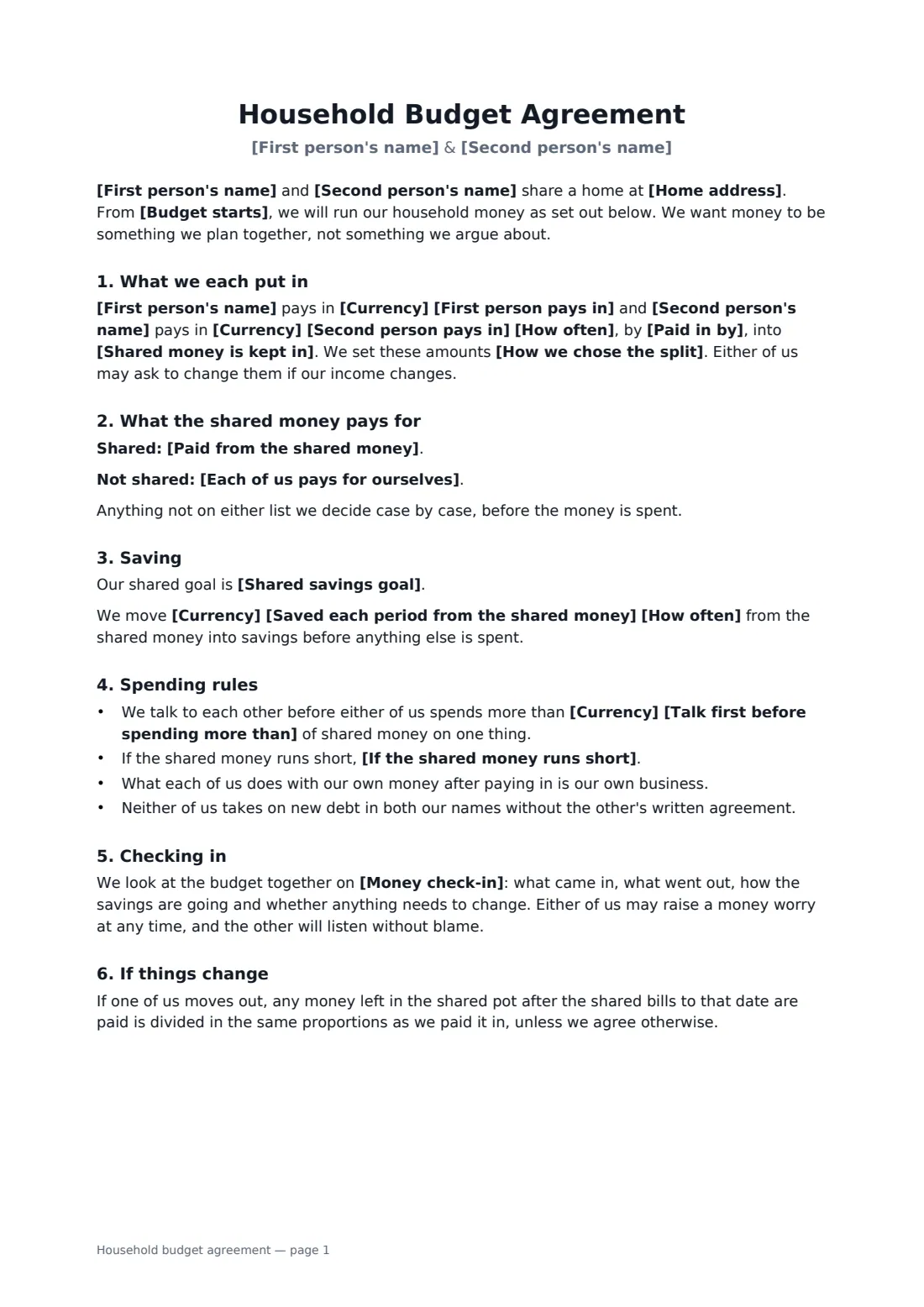
This template records what each person pays in, how often and by when, and whether the split is equal or in proportion to take-home pay. It lists what the shared money pays for and what each person covers alone. You can set a shared savings goal and an amount to put aside first, a limit above which you talk before spending, what to do if the pot runs short, and a regular money check-in. It also says what happens to the pot if one of you moves out, and that it isn't a cohabitation or marital agreement and doesn't decide who owns the home.
- Best for
- Couples, partners and housemates who share bills
- Signed by
- Both household members
- Covers
- Pay-ins, shared and personal costs, savings, big purchases, shortfalls, check-ins, moving out
- Not
- A cohabitation, prenuptial or property agreement
- Length
- 2 pages
When to use a household budget agreement
- A couple moving in together and opening a joint account
- Partners with different incomes splitting bills fairly
- Housemates running a shared bills account
- Resetting the budget after a new baby or a job change
- Saving together for a house deposit
What you fill in
18 blanks, then the name and email of each person who signs: first household member, second household member.
1 Our household
- First person's name*
- Second person's name*
- Home address*
- Budget starts*
2 Money in
- Currency*
- First person pays in*
- Second person pays in*
- How often* each month · every two weeks · each week
- How we chose the split* in proportion to our take-home pay · equally · by agreement, taking into account other costs each of us carries
- Paid in by*
- Shared money is kept in*
3 What it pays for
- Paid from the shared money*
- Each of us pays for ourselves*
4 Savings
- Shared savings goal
- Saved each period from the shared money
5 Spending rules
- Talk first before spending more than*
- If the shared money runs short* we top it up in the same proportions as our contributions · we top it up equally · we cut back on non-essential shared spending until the next pay-in
- Money check-in*
6 Who signs
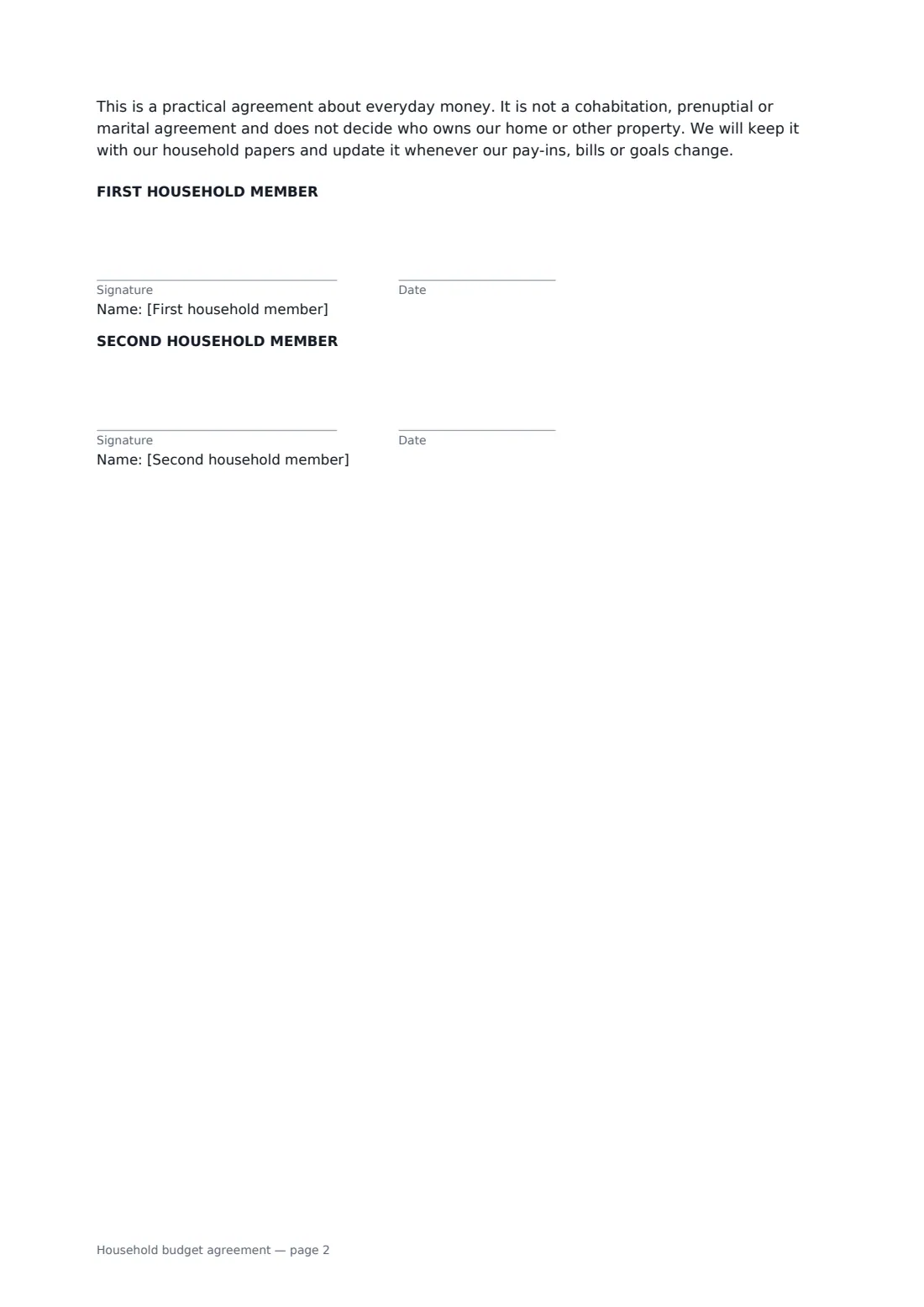
- First household member signature and date
- Second household member signature and date
What the household budget agreement covers
- What we each put in
- What the shared money pays for
- Saving
- Spending rules
- Checking in
- If things change
Using the household budget agreement, step by step
1 Set up the household
Enter both names, your home and the date the budget starts.
2 Agree the pay-ins
Enter what each of you pays in, how often and by when, where the shared money is kept, and how you chose the split.
3 Divide the costs
Edit the lists of shared and personal costs. Add a savings goal and an amount to put aside first if you have one.
4 Set the ground rules and sign
Pick a big-purchase limit, what happens when money runs short and when you'll check in. Both of you sign online.
Tips before you send it
- A proportional split often feels fairer when incomes are very different. Try the numbers both ways before deciding.
- Save first, spend second. Moving savings out on pay day works better than saving what's left.
- Keep the check-in short and regular. Ten minutes a month beats one big row a year.
- Leave each person some money that's entirely theirs, no questions asked.
- If you're buying property together or want rules for a breakup, look at a cohabitation agreement as well.
Sign it online in minutes
- Fill in the blanks. Names, dates and amounts go straight into the agreement — the preview shows exactly where.
- Name who signs. Tick “This is me” for your own part. FileIt builds the PDF with every signature, date box on the right line, and you can check or move anything before sending.
- Send it. Each signer gets a secure link and signs from any device — no account needed. The signed PDF, with an audit trail and a Certificate of Completion, is filed in your vault and emailed to everyone.
Household budget agreement: frequently asked questions
Is this a cohabitation agreement?
No. It deals with everyday money: pay-ins, bills, savings and spending. It says plainly that it doesn't decide who owns the home or other property. For that, see the cohabitation agreement.
What if one of us earns much more?
Choose "in proportion to our take-home pay" and set the pay-ins to match. You can change them whenever either income changes.
What happens to the shared money if one of us moves out?
Once the shared bills to that date are paid, whatever is left is divided in the same proportions as you paid it in, unless you agree otherwise.
Can housemates use it?
Yes. The wording works for any two people sharing a home. For more than two, add extra signers in the editor.