What is a excavation and grading contract?
Most excavation disputes start underground. A boulder the size of a car, a water line nobody marked, or twenty more truck loads of spoil than anyone expected can double the cost of a dig. An excavation and grading contract sets the scope and gives both sides a fair process for what the ground turns up.
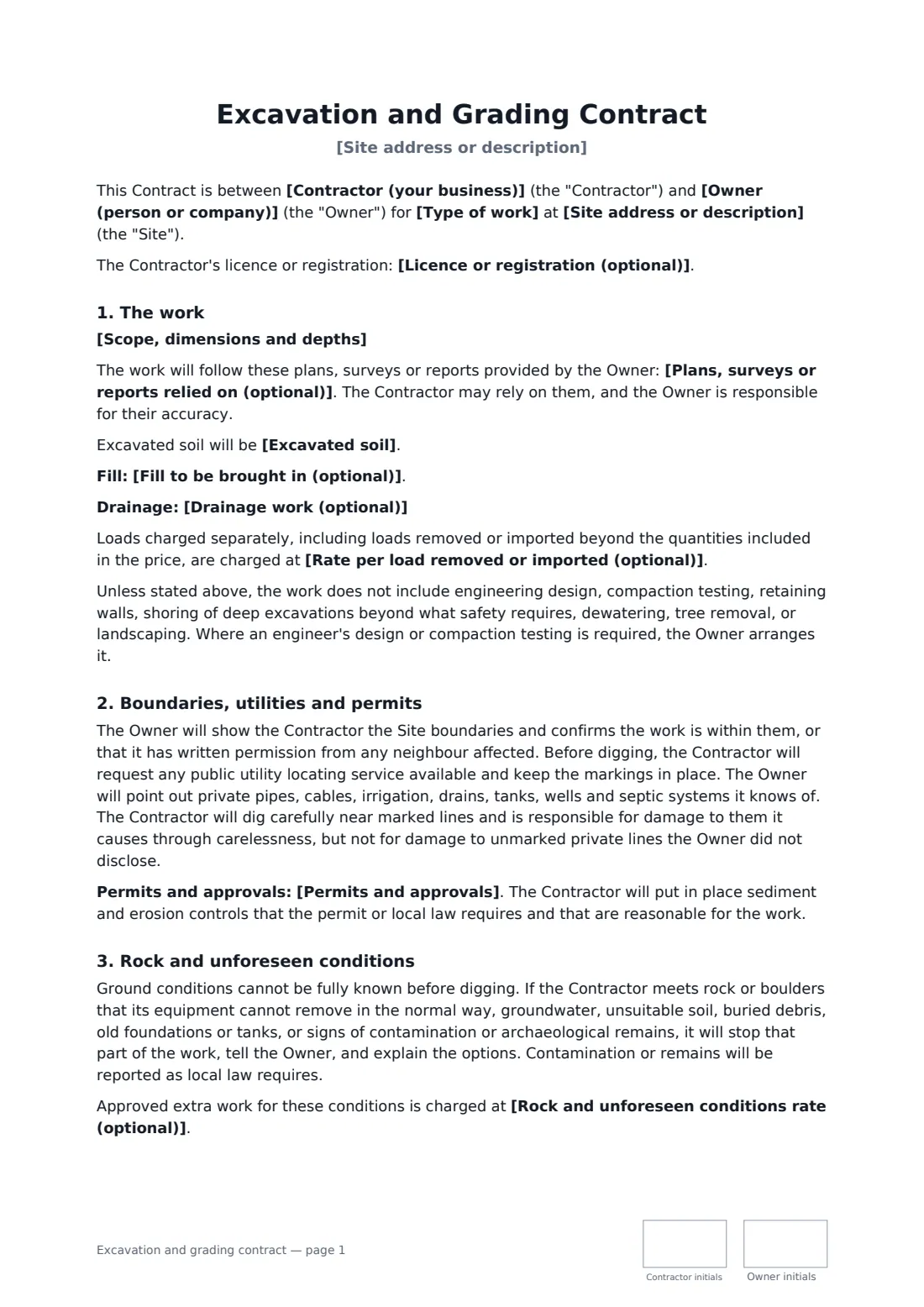
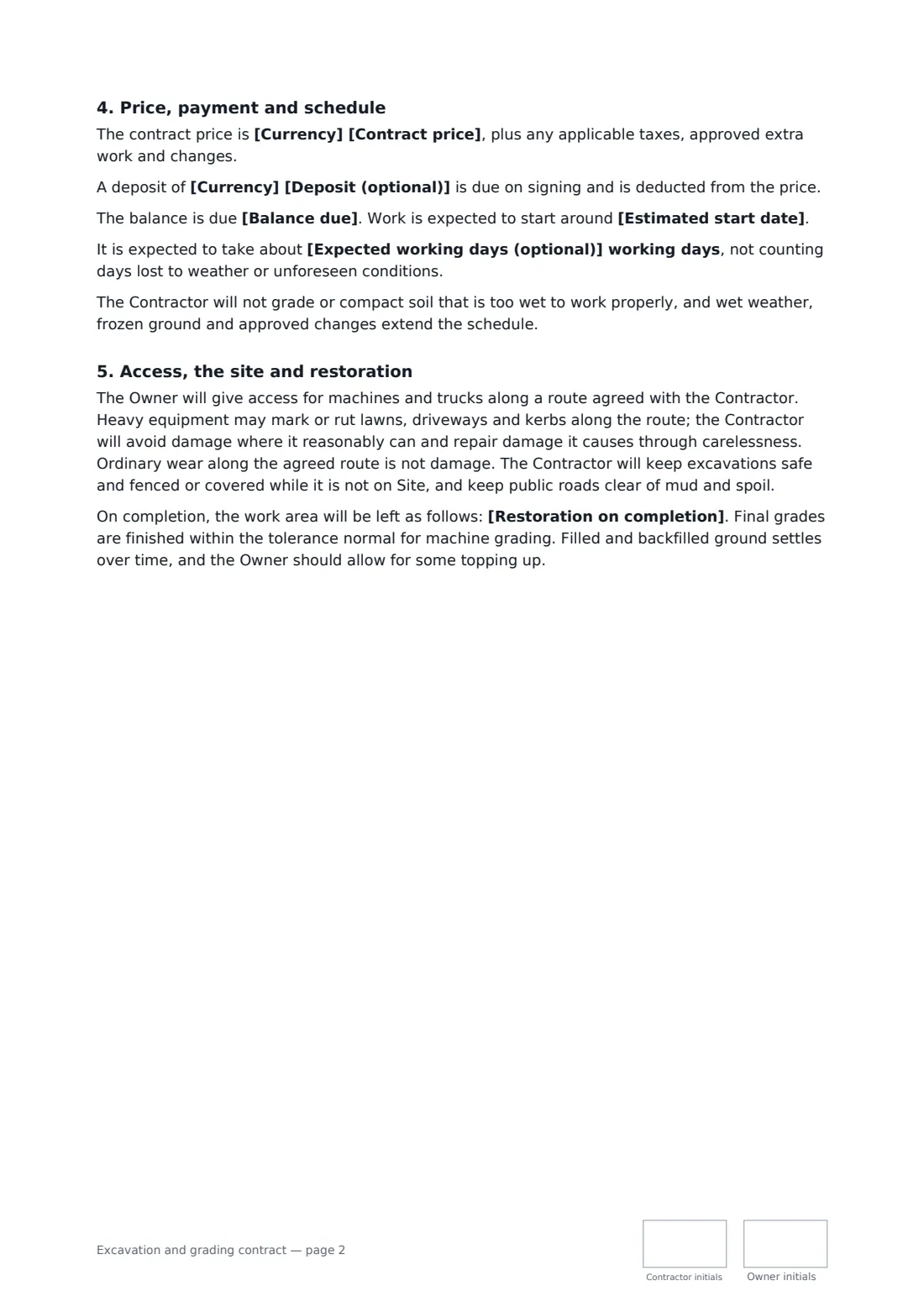
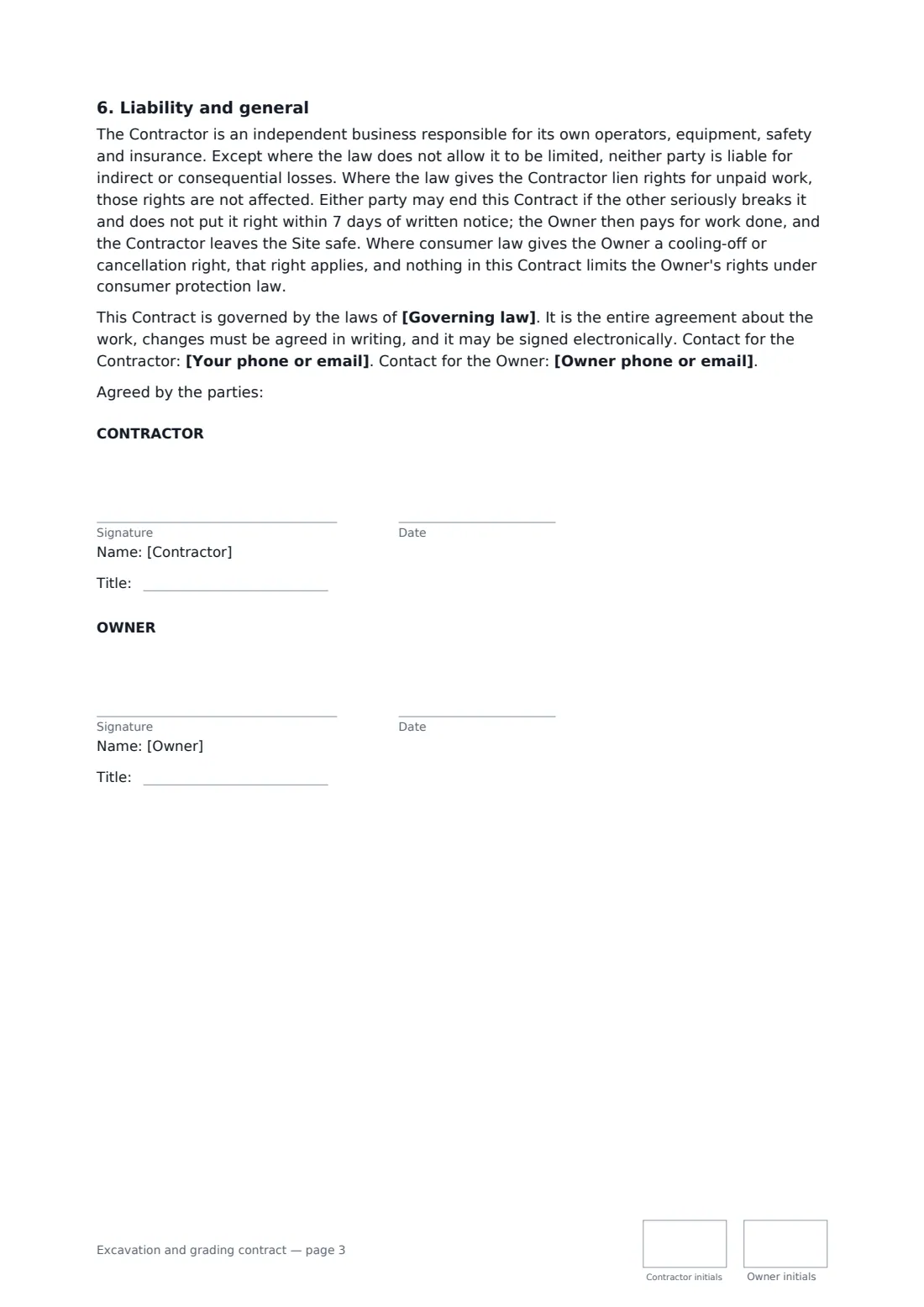
This template covers foundation and basement digs, site grading and levelling, trenching, pool and pond excavation, lot clearing and regrading for drainage. It records the scope, dimensions and depths, any plans relied on, what happens to excavated soil, imported fill, drainage work and an optional per-load rate. Boundaries and utility locates are handled up front, with the owner disclosing private lines. A rock and unforeseen conditions clause stops the work and explains options before extra charges, with an optional hourly rate. It sets the price, deposit and balance, schedule and wet weather, access and wear along the route, safe excavations, restoration from rough grade to seeded topsoil, and settlement.
- Best for
- Excavation contractors, earthworks firms and machine operators
- Signed by
- The contractor and the land owner
- Covers
- Depths, locates, soil and fill, drainage, rock, restoration
- Length
- About 3 pages, initialled on every page
When to use a excavation and grading contract
- Digging out a house foundation on a new build plot
- Regrading a back yard so water drains away from the house
- Trenching for a new water line or drainage pipe
- Excavating for an in-ground pool
- Clearing and levelling a lot for a barn or shed
What you fill in
23 blanks, then the name and email of each person who signs: contractor, owner.
1 The parties
- Contractor (your business)*
- Your phone or email*
- Licence or registration (optional)
- Owner (person or company)*
- Owner phone or email*
2 The work
- Site address or description*
- Type of work* excavation for foundations or a basement · site grading and levelling · trenching for utilities or drainage · excavation for a pool or pond · clearing and grading a lot · regrading around a building for drainage · other earthworks described below
- Scope, dimensions and depths*
- Plans, surveys or reports relied on (optional)
- Excavated soil* removed from the site by the Contractor, included in the price · removed from the site by the Contractor, charged per load · kept and spread on the site as directed by the Owner · stockpiled on the site for the Owner
- Rate per load removed or imported (optional)
- Fill to be brought in (optional)
- Drainage work (optional)
3 Price and schedule
- Rock and unforeseen conditions rate (optional)
- Currency*
- Contract price*
- Deposit (optional)
- Balance due* on completion · within 14 days of completion · within 30 days of completion · in stages, invoiced as each part of the work is completed
- Estimated start date*
- Expected working days (optional)
- Permits and approvals* obtained by the Owner · obtained by the Contractor, included in the price · obtained by the Contractor and charged at cost · none are needed for this work
- Restoration on completion* rough grade only, ready for the Owner's landscaping · rough grade, with topsoil spread · topsoil spread and seeded · none — the site is left for the next trade
- Governing law*
4 Who signs
- Contractor signature and date, job title, initials on every page · The excavation or earthworks business doing the work.
- Owner signature and date, job title, initials on every page · The owner of the land, or someone authorised to sign for the owner.
What the excavation and grading contract covers
- The work
- Boundaries, utilities and permits
- Rock and unforeseen conditions
- Price, payment and schedule
- Access, the site and restoration
- Liability and general
Using the excavation and grading contract, step by step
1 Describe the dig
Choose the type of work and enter the scope, dimensions and depths. Reference any site plan or survey you're working from.
2 Soil, fill and drainage
Choose what happens to excavated soil, add any fill and drainage work, and a per-load rate for extra loads.
3 Price the unknowns
Enter an optional rate for rock and unforeseen conditions, the price, deposit and balance terms, the start date and expected days.
4 Permits and restoration
Choose who obtains permits and how the site is left on completion, enter the governing law and send it to sign.
Tips before you send it
- Always request the public utility locate before digging, and ask the owner about private lines such as irrigation, septic and outbuilding power.
- Agree the truck route in advance. The contract treats ordinary wear on the agreed route as not damage.
- Grading and land disturbance often need permits and erosion controls, especially near waterways. Check local rules before you start.
- Photograph rock or groundwater when you hit it. It supports the extra-work charge the contract describes.
Sign it online in minutes
- Fill in the blanks. Names, dates and amounts go straight into the agreement — the preview shows exactly where.
- Name who signs. Tick “This is me” for your own part. FileIt builds the PDF with every signature, date and initials box on the right line, and you can check or move anything before sending.
- Send it. Each signer gets a secure link and signs from any device — no account needed. The signed PDF, with an audit trail and a Certificate of Completion, is filed in your vault and emailed to everyone.
Excavation and grading contract: frequently asked questions
What happens if we hit rock?
If the equipment can't remove it in the normal way, the contractor stops that part of the work, tells the owner and explains the options. Extra work is charged at the optional rate or priced and approved first.
Who is responsible if a buried line is damaged?
The contractor requests the public locate and digs carefully near marked lines, and is responsible for damage it causes through carelessness. It's not responsible for unmarked private lines the owner didn't disclose.
What does 'rough grade' mean?
The ground is shaped to the agreed levels within the tolerance normal for machine grading, ready for landscaping. You can choose instead to spread topsoil, or topsoil and seed.
Does it cover engineering or compaction testing?
Not unless it's in the scope. Where an engineer's design or compaction testing is required, the owner arranges it.
Can I sign it electronically?
Yes. E-signatures are generally valid for construction contracts in the US, UK, EU and Canada. FileIt keeps an audit trail with the signed PDF.